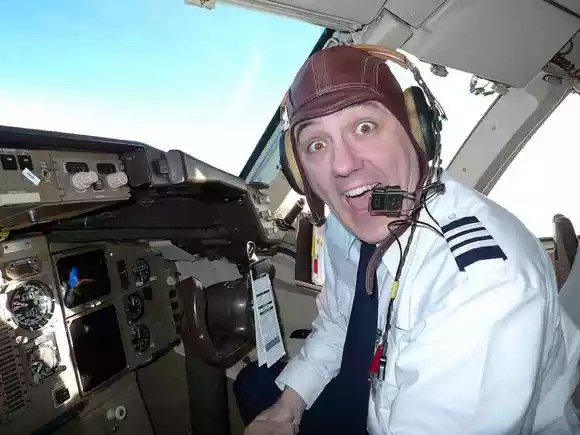
Great: one more thing I wish I didn’t have to worry about…
The New York Times has an article up [Gift link!] titled “Why Airline Pilots Feel Pushed to Hide Their Mental Illness.” Wait—there are mentally ill people flying planes? Yikes. But of course there are…depending on what is called a “mental illness” at any given time.
In the Denzel Washington film “Flight,” the actor plays an excellent pilot who is an alcoholic and cocaine abuser. He saves a plane full of passengers from doom by executing a brilliant but risky mid-air maneuver, then has to cover up the fact that he was drunk when he did it. I haven’t checked lately to see if alcoholism is current classified as a mental problem, but having had extensive experience in the area, I have concluded that it is a physical problem with profound effects on mental and emotional stability, so I really don’t care if it’s technically a mental illness or not. Alcoholics and recovering alcoholics should not be piloting aircraft.
Isn’t that an easy call? The same call should apply to bi-polar individuals, chronic depressives, OCD sufferers…but how far down the list do we go? It’s been estimated that as much as 20% of successful individuals, high-performers, are sociopaths. I don’t think I want to know how many airline pilots are narcissists. Once upon a time, homosexuality was considered a mental illness. Next up: transsexual pilots.
The article describes a gay pilot prone to deep depression and crying jags. “[W]hen Merritt was at work, flying planes, he was much better, focused on the tasks in front of him. It was when he reached his destination city and tried to settle into a strange hotel room that loneliness and sadness crept over him again. Co-workers didn’t seem to notice because he was often flying with different crews,” the Times tells us. “Merritt, like all pilots, knew that if he was formally diagnosed with a mental-health condition, he might never fly a plane again. Pilots and air traffic controllers must be deemed medically fit by the Federal Aviation Administration through a certification process — one that is particularly arduous when it involves mental-health diagnoses.”
Well, that’s good to hear, anyway. The Times, being the Times, subtly and not so subtly paints pilots and aspiring pilots with mental and emotional issues as victims. Then we get this: “Last month, the administration fired close to 400 F.A.A. workers. And the aviation industry is already facing serious shortages: More than 90 percent of air traffic control facilities today are understaffed, and according to some estimates, the United States could be short as many as 30,000 pilots in the next five years.”
What is the relevance of that statistic in an article about how the industry screens out mentally or emotionally ill pilots? Are we supposed to loosen the mental health standards to deal with a pilot shortage? We are also told that air safety has been exemplary until lately: is this supposed to be an argument that we’ve had mentally ill pilots flying planes all along, and it’s worked out just fine?
I don’t know where it is responsible to draw the line regarding acceptable mental health standards for pilots. My reflex attitude would be a no tolerance policy: any mental or emotional problems, large or small, means that you have to pick a profession where your job performance and responses under stress and pressure don’t risk the lives of plane-loads of human beings. That, however, is clearly unfair and irresponsible. A persuasive argument can be made, I think, that everyone has some emotional or mental abnormalities.
This is obviously a complex problem that involves resolving ethical duties, practical realities, and societal priorities.
I was happier before I started thinking about it.
ooo
 Ethics Alarms
“What is the relevance of that statistic in an article about how the industry screens out mentally or emotionally ill pilots? Are we supposed to loosen the mental health standards to deal with a pilot shortage? We are also told that air safety has been exemplary until lately: is this supposed to be an argument that we’ve had mentally ill pilots flying planes all along, and it’s worked out just fine?”
Probably, but they also have to get a dig in at Bad Orange Man. It reminds me of the “Don’t Ask, Don’t Tell” days post-9/11 in which we saw articles with headlines editorializing about how many gays had been kicked out of the military recently and what percentage of them spoke Arabic.
The idea is, of course, to make sure that people know there’s a shortage, that DOGE just made that shortage more acute and that mentally ill people – broad definition that it is – are perfectly capable of safely flying planes because they keep their melancholies in the hotel rooms.
A childhood friend and his younger brother both became commercial airline pilots with major carriers. The younger brother was depressive and lost his license. He subsequently committed suicide. Very sad.
A childhood friend and his younger brother both became commercial airline pilots with major carriers. The younger brother was depressive and lost his license. He subsequently committed suicide. Very sad.
At least he committed suicide without flying a plane into a mountain…
Or fly it into the Atlantic shouting “Aleah Akbar!”
At March 24, 2015, flight Germanwings 9525 flew into a mountain, killing all 150 passengers on board. The cause was suicide by co-pilot. The co-pilot was treated by his doctor for suicidal tendencies by his doctor, who deemed him medically unfit to work. However, his employer was neither notified by the pilot nor by the doctor.
This is not the only flight that crashed due to suicide. Malaysia Airlines flight 370 went missing at March 8 2014, never to be seen again. The suspected cause is suicide by pilot.
So the mental health by pilots is a serious flight safety concern.
If you’re referring to the Germanwings flight in which the first officer was left alone in the cockpit, mid-flight, only to program the autopilot to crash, that created a new international rule in which the cockpit never has fewer than two people on deck: a flight attendant had to enter and occupy the cockpit before a member vacates (for a trip to the lav, etcetera).
If someone is trying to crash the plane, the other could still unlock the door & invite others to restrain & disable the suicide pilot.
This is the kind of thing that doesn’t concern me. At least not from a safety standpoint, mental health is a massive and growing problem generally, but every day as I drove to work in Winnipeg, I saw probably… I don’t know. 50… 100…. Some relatively large number of people travelling at highway speeds. Any of them could have made the decision to suicide and ruin my day. It never happened. Were some of the people I saw mentally unwell? Depressed? It’s probably a statistical certainty. Was I ever injured? No.
Our system functions on a certain amount of trust that the people we interact with are well-enough adjusted individuals that they won’t do something deadly stupid. We do unwitting trust exercises thousands of times every day, and we are rewarded for our trust by people not doing something deadly stupid.
I think the argument could be made here is that a pilot could do more damage than a highway driver. Maybe? I suppose. But again… The likelihood is that some amount of pilots are mentally unwell, and that can’t possibly be new, but I can’t think of a crash happening where the reporting was that the pilot did something intentionally since September of 2001.
No commercial airline pilots did anything with deadly intention in September 2001. Referring to hijackers as “pilots” while literally true, is an interesting way of referring to them.
But suicidal piloting does happen:
https://en.wikipedia.org/wiki/Suicide_by_pilot
The majority of which are typically pilot only.
A majority of what’s left impacted minimal crew (horrible of course).
With fleetingly few instances of a pilot bringing down the craft with passengers as well.
Nonetheless, including crew and passengers, suicide by pilot does bring down a decent number of innocents.
Whether or not that is an “reasonable” trade off in the market compared to our current efforts to screen genuinely dangerous or harmful mental illness is up for discussion. I would tend to think it virtually impossible to screen out everyone who might share the same demeanor as an actual suicidal person who would otherwise get by a screening and still have an appropriately sized pool of pilots.
My tongue was firmly in my cheek.
But I think my point stands…. That article you had didn’t list a single case of successful pilot (or terrorist) suicide since 9/11. Even if you could find a case or two, I just don’t think that it happens often enough to be concerned by.
From that list?
2015 for sure.
2014 and 2022 are distinct possibilities.
And yes, it’s about trade offs.
No efforts can be guarantee flawless executions in life.
My bad, Sorry! I didn’t see the separate tables for hijackers and legit pilots.
I stopped flying a few years ago and I’ll not likely start again unless I’m forced to do so for some reason, like an ocean between me and my destination or serious time constraints.
As much as I’ve always enjoyed flying in the past, I’m done with it because of the combination of problems with the airline industry, seemingly routine incidents in the air and on the ground, airplane maintenance issues on lots of older planes, costs going up and services going down, problems with wacko passengers, more seat congestion on planes, ground crews stealing things out of luggage, luggage getting lost, long lines, flights getting changed, flights being late, flights getting diverted to airports that are far from your destination. It seems to me that the airline industry as a whole is no longer trying to inspire confidence in flying anymore. Plus, if I fly, I still have to rent a car at my destination and that’s been turning into a crap shoot to get a good, clean, reliable, non-smoking, decent size car at a reasonable price. I just don’t want to partake in all the BS anymore, I’d rather jump in my car and drive over 6,000 miles for three weeks across the USA for vacation, like I did last summer, than jump on a plane and rent a car to reduce the vacation duration by a few days. I plan to drive for my vacation this year too, that’ll probably be around 5,000 miles.
Until the airline industry, as a whole, can show me that they’ve greatly improved, I’m not flying.
Same here!
PWS
“…and according to some estimates, the United States could be short as many as 30,000 pilots in the next five years.”
And according to some others, supply and demand will mean that the cost of flying will increase in proportion to higher standards for pilots and thus decrease the demand based on price until a balance point is reached.
According to me, there will not be enough pilots and planes until the cost of flying roundtrip to Canada every summer for my family of 7 costs about $1000 USD, but at that point the quality will be so shoddy that I am smart enough to still drive.
“Last month, the administration fired close to 400 F.A.A. workers. And the aviation industry is already facing serious shortages: More than 90 percent of air traffic control facilities today are understaffed, and according to some estimates, the United States could be short as many as 30,000 pilots in the next five years.”
A bit of slight-of-hand and misdirection by NYT there (Yeah, big surprise). 400 fired F.A.A. workers are not necessarily air traffic controllers, and certainly not part of some nebulous prophesied shortage of commercially employed airline pilots.