I apologize for seeming to force a topic on participants here, as the Open Forum is for you to write about ethics issues that intrigue you, and not necessarily me. However, I can’t think of anywhere else to use the remnants of a post I did a lot of work on before giving up in disgust.
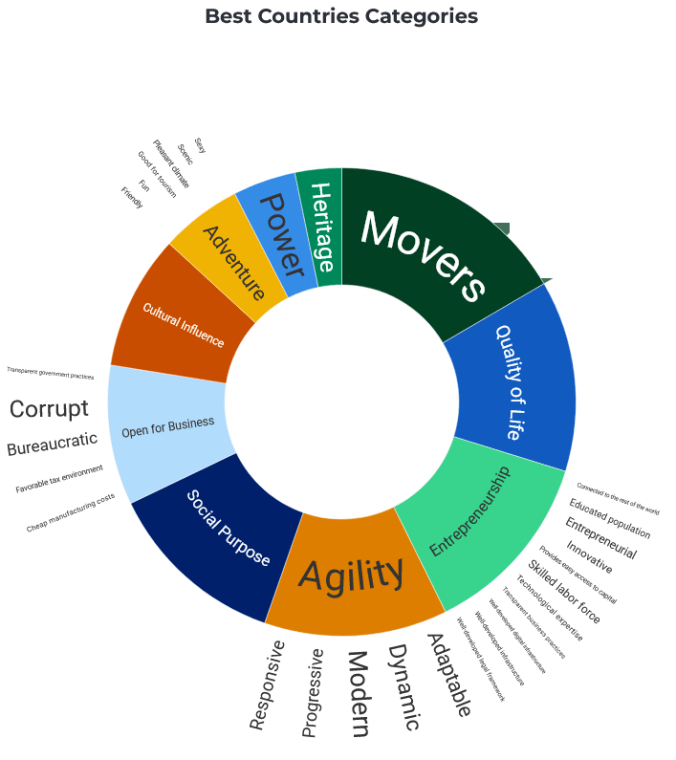
The impetus for this aborted project was reading more of the increasingly unhinged rants of the formerly rational lawyers, artists, scholars and baseball fans on my Facebook feed, whose Trump Derangement is something to behold. One of them posted a chart purporting to list the nations in order of their “quality of life”; this one showed the U.S. 19th, after, among others, Slovenia, Oman, and Estonia. #1 was Switzerland. “I wonder how much lower we will be after Trump and Musk are through with us?” the poster queried to a flurry of likes. angry faces and the “care imogi. The moronic post moved me to look at the most recent such surveys, most of which seem to conclude that Spain is the best country to live in. Spain is a country where you can be imprisoned for criticizing the king, and where the average household income is around $40,000. On the one that was posted by my friend who is leaking IQ points, Spain finished 15th. Huh! First in one quality of life survey, 15th in another. This is, of course, why none of these “scientific” surveys are worth the paper they are printed on: the rankings will always reflect the biases of the researchers. The reason the U.S. always finishes absurdly low in these things is because our learned class believes fervently in socialism, and any nation that isn’t a nanny state is, by definition, inferior. The U.S. allows its citizens to own guns. It allows “dangerous” speech. It isn’t committed to fighting “climate change.” It hasn’t solved its racial tensions, while Switzerland has done such a bang-up job dealing with the descendants of its African slaves.
Yeah well, the U.S. is still guided by the most aspirational mission of any nation on Earth, and it has Major League baseball too, so bite me. (One of the rankings rated the U.S. low for “climate.” Which climate? Hawaii? Fairbanks? )
Spain is, I’m sure, a great country for someone like Richard Gere to live in (he moved there with his Spanish citizen wife and kids after Trump won the election: he was a big Harris supporter) who had lots of money and has already made his mark in life. For the most part, however, the immediate retort that comes to mind when I read someone on Facebook arguing seriously that Spain is a “better” nation than the United States of America, is “Wow, you really are an idiot, aren’t you? I’m so sorry.”
Anyway…Open Forum!
 Ethics Alarms
Need a ruling:
State Representative is arrested for solicitation of a minor and resigns.
https://www.mprnews.org/story/2025/03/21/eichorn-resigns-from-senate-but-has-legal-hurdles-ahead
Ethics Hero?
(Of course this is tongue in cheek, but considering how many politicians refuse to resign in such circumstances, this may be noteworthy. And, as Jack would probably note, that is the corrosive effect of ethics corrupters: values get so degraded by people who refuse to do what should be a no-brainer (resign), when someone does it, the act seems laudable.)
-Jut
I had my wallet stolen by an organized gang of gypsies on the subway in Madrid. One stood in front of the door without pushing the button to open the door when we arrived at the stop, so I had to take my hand out of my coat pocket, reach around him, and push the button. Which allowed the guy’s teammate to pilfer my wallet from my hands-free pocket. I didn’t even realize the wallet had been stolen until we got to the theater box office when I put my hand in to get my wallet to pay for tickets. By the time we got back to our hotel, and I called the bank, they’d hit the card for 4,500 bucks, presumably at a restaurant that was in on the job. The next day, the police who took our report were shocked, shocked I tell you that such a thing was happening in their city.
Overall, I found Spain pretty dreary.
Here is an issue worth writing about.
https://www.courthousenews.com/wp-content/uploads/2025/03/reyes-blocks-trans-military-ban-opinion.pdf
“Spain is a country where you can be imprisoned for criticizing the king, and where the average household income is around $40,000. On the one that was posted by my friend who is leaking IQ points, Spain finished 15th. Huh! First in one quality of life survey, 15th in another. This is, of course, why none of these “scientific” surveys are worth the paper they are printed on: the rankings will always reflect the biases of the researchers. The reason the U.S. always finishes absurdly low in these things is because our learned class believes fervently in socialism, and any nation that isn’t a nanny state is, by definition, inferior. The U.S. allows its citizens to own guns. It allows “dangerous” speech. It isn’t committed to fighting “climate change.” It hasn’t solved its racial tensions, while Switzerland has done such a bang-up job dealing with the descendants of its African slaves.”
I mean… I take your point about how these surveys are inherently unscientific, and how a lot of this should be taken with a grain of salt… But America’s citizens are in a rough patch, and have been for a very long time.
Take your point about Spain’s average earnings… It doesn’t matter if you make more on average if you spend more on average. What’s the buying power of that 40k? What does their quality of life look like? And not for everyone, for the average person, but for the poor. America’s wealth statistics are deceptive. The difference between the average earnings of a black family and that of a white family is almost $50,000. But is the average black family actually that much worse off than the average white family, or are the white statistics inflated by the presence of America’s billionaires, who are very disproportionately white? Can the average person buy their home? Is the average person driving a new car? Do they have meaningful work? Did they get a good education? Can they read? Are they healthy? Are they hungry?
I have no idea what the situation looks like in Spain, not my wheelhouse, but it wouldn’t surprise me if they beat you in some of these metrics. Americans are proud, but America is a land of complex hypocrisy… You have freedoms, yes. And some very rough outcomes. You have a whole lot of guns, and a whole lot of gun deaths. You value the rebel spirit, and have to incarcerate a whole lot of people. You earn a lot, and pay low taxes, and play hard… But you’re some of the most unhealthy, indebted people in the first world. What is America first in, anymore, that doesn’t have a massive asterisk?
Of course this is subjective, but where do you think you should rank?
The surveys are absurd because, to reduce it to its simplest form, no other nation’s culture is compatible with Americans. “Quality of life” depends on what each individual thinks is important. I know people who moved to Hawaii because of the climate, the beaches, the easy-going lifestyle, the pace—and went nuts after about 6 months. In “1776” Ben Franklin says, “We’ve spawned a new race here, Mr. Dikinson. Rougher, simpler; more violent, more enterprising; less refined. We’re a new nationality.” BINGO! And other people from other nations and cultures may well not fit in and be comfortable with that nation’s values and priorities. Americans are inherently dissatisfied: that’s the tradition and the culture. They want more, better, different. It means that there is always drama, conflict, and aggravation. I can understand anyone saying “Who needs that?”, and for them it might mean that a less stressful, more sedate and secure culture is “better.” As I’ve related before, the US pavilion at Expo ’67 was the star attraction because it presented the US as a source of imagination, innovation, trivia and pop culture. That’s what its strength and appeal has been: if that’s what you’re excited by, you accept that you have to pay for your own healthcare and life-style choices.
Stipulated: American culture as a whole seeks challenge where other cultures may not.
However, there’s a difference between challenge and desperation: Are you becoming stronger, or are you being worn down to nothing? Are your options getting better, or are you being exploited by other people? What’s your next best option if you walk away from a bad deal?
Is the journey fulfilling and meaningful, or is it merely draining and futile? Are you being rewarded for your hard work, tangibly or intangibly? Are you making the situation better for yourself, your community, or society? How much bad luck or how big of a mistake would it take for you to lose everything?
These are the sorts of questions by which we must judge our society’s quality of life.
I don’t know Jack… I feel like these conversations happen because Americans have some delusions about themselves that they can’t square with the rest of the world, and actually talking about it forces an uncomfortable reconciliation. Think about this… You aren’t saying that the surveys are objectively wrong. You aren’t saying that I don’t have a point when it comes to outcomes. You’re saying that American values are different, and so any comparison between America and other nations is inherently flawed.
But since when has that kept patriotic Americans from saying America is the Greatest nation on Earth™?
American Pride seems very fragile. It’s not the enduring pride of the truly strong, that can weather the slings and arrows of their inferiors. There’s a very raw-nerve aspect to this. People spend years of their lives bragging their country up and mocking their neighbors, unprovoked by anything, and the moment they see pushback there’s this level of offended outrage that someone would dare believe otherwise.
What are we supposed to do with that?
I would rank the US ahead of all the countries that rely on it for defense and whose lifestyle is possible only because of the military umbrella that the US has put over them so that they can spend money on public works other than defending themselves from the depredations of the Soviet Union, Russia, China, and other bad actors.
Braver Angels has a series of discussions about the Trump administration, if you’re interested in sharing your perspectives and hearing about other people points of view. The next one is Tuesday, March 25th. Here’s the link to the series: https://www.eventbrite.com/e/national-debate-series-trumps-first-100-days-registration-1254673304629?discount=BRAVER.
Below is the schedule but the issues described could be argued under any administration if done as a true debate. Tying Trump’s presidency to any one of these issues I suspect will create the kind of Cognitive Dissonance described so often here.
If you label the program “Trump’s firs 100 days can we expect that we will have group of rational debaters or will it be populated by partisans? I suspect the latter. The May 1st debate is non sensical because “greatness” is in large measure defined like surveying people on which countries are the best in which to live or who are the happiest.
If each of those debates were moderated and named advocates for each side were tasked to put forth cogent arguments for their point of view then it might be worth listening to.
I would love to hear a non-emotional fact based debate on these issues but this is structured like a panel discussion that includes audience input based on this statement:
Come join us for this free national debate, in which all participants from across the ideological spectrum will have an opportunity to speak and ask their questions. Tell us what you have experienced and what you think.
Using debate terms like “Resolved” does not make a discussion a debate. As for the last item regarding making “America Great” has problems from the perspective of short run versus long run and again define “Great”. Would anyone evaluate Jeff Bezos and Amazon in its first 100 days? I would be ludicrous to do so because we cannot predict the future. Moreover, how can you measure efficacy of a policy if it is routinely enjoined by an judge who may be engaging in judicial activism and political pundits distorting issues like saying Trump is going to end Social Security and Medicare.
Additionally, is this program limited to US citizens only or can anyone weigh in on this subject? You know the term “Ugly American” predates the Trump administration so if the audience is global the end result might be a bit skewed to the left.
Thursday March 13th – Resolved: End birthright citizenship.
Tuesday March 25 – Resolved: The U.S. should prioritize domestic interests over international leadership.
Tuesday April 8th (**National Panel Debate**) – Resolved: Governance by executive order has got to go.
Tuesday April 22nd – Resolved: Defend DEI.
Thursday May 1st – Resolved: President Trump is Making America Great Again.
To address your concerns in order:
What do you think?
EC
On your point one. Are they more stressed because of what the Trump administration is doing or are they stressed because media outlets frame issues in a way to cause stress. This is not to say that Trump’s blunt way of talking does not alienate some, especially those whose higher than average standard of living that is directly tied to massive government spending, but to say that his policies are causing stress across the broader population is unfair.
Do the continual structural deficits and national debt pose an existential threat to our way of life in the future? Yes. Is it ethical to indenture future taxpayers to either pay high taxes or suffer a much lower standard of living so that taxpayers today can shift the burden of spending on to them. Would you think it ethical if banks could hold children of debtors liable for debts incurred by the parents?
So why are people complaining about attempts to reduce the size and impact of current government so that we may be able to actually invest in our future development. The answer is that far too many are consumption oriented and don’t want face the fact that cutting superfluous programs now allow us to have the necessary resources for investment in the future because it harms them personally. When it comes to socialism, no one is a socialist if it means they have to reduce whet they get. It so easy to spend other peoples money. Our credit card has a limit at some point. We currently have 2 million employees on the federal payroll which amounts to one for every 175 citizens. This does not count the tens of thousands of contractors who milk the system. Social Security was to modernize its IT infrastructure by 1997 and it is still using COBOL. Contractors have yet to complete the work.
The Greenland issue. Had that been framed in terms of why it would be a strategic asset for the US instead of framing it as US imperialism people might begin to understand that its location is ideal for missile defense and rare earth minerals that can be mined with minimal impact to human populations. Nowhere has Trump ever given any indication he would take it by force. Is Alaska still Seward’s Folly?
I can evaluate the DoEd but I will move on to point 2.
Point 2. Rational people do not show up because few sanctions are placed on those who strategically overwhelm the debate. As I said, I would be happy to listen in on a panel discussion but I have no interest in hearing the masses spouting talking points. I want to focus on several key points that I can validate in a discussion instead of having to track down every contrived or distorted allegation.
All that was necessary would be to structure this as a real debate with one or at most two people taking opposite sides of the issue. I would have been all in. I also wont pay $30 to hear others spout off I can see that in FB which I recently deleted.
Point 3/4 The word Resolved is the word used to identify what we are debating. One of my favorite classes in my undergraduate studies was Argumentation and Debate. Perhaps before I shell out cash for a ticket to participate I could listen to one to better understand the format. I am open to new ideas but I will not purchase a product that I have little knowledge of. I really do not understand how you can divide a group of any substantial size into two opposites points of view and develop a coherent argument for or against something. How does one rebut an assertion made by others in the proper context when others are making similar but different arguments based on their perspective. Moreover, whose perspective should carry more weight. Should we only be concerned with the plight of the middle class or should we give greater weight to who actually pays the costs of government. One’s perspective is irrelevant when you need to create a beneficial argument for the current and future populace as a whole.
Point 5
Leaders make decisions, effective leaders do not waste time implementing them. I spent 20 years in an post secondary academic environment. When we saw leadership changes who attempted to effect change or when I needed buy in from the faculty to get them to assist me in facilitating entrepreneurship that meant that giving each group something in exchange for that supposed buy in which amounted to signing off on the program. Getting “buy in” is a lever used to get something in return for not objecting to a proposal. I expect government is similar.
How can you say it is fair to judge his decision making process when we have no idea what went into the decision. It is obvious that he spent the last four years developing his game plan if he got elected a second time. Every decision will have unintended consequences. More to the point how do we know they were unintended let alone unexpected. When you demand something from someone or you take something of value away from them you will get push back. The primary area that gets the most attention is his tariff stance. Tariffs on imported products will harm some in the short-run but if the goal is to level a playing field then why should some consumers or nations benefit by shifting the economic burden to our producers. Our producers need to understand that this game will be short lived and the end result should result in better access to foreign markets.
It was not expected that increasing tariffs would not be retaliated against. The decision was based on whose economy would be most harmed by the tariffs. Given that the US is heavily consumption oriented and buy vast quantities of imported goods that have difficulty selling overseas because of existing barriers to US goods then economic burden will fall heavily on producers that export goods to the US. Another goal is to rebuild US manufacturing capacity. GM and Ford sell a lot of cars in China and do not pay the 25% tariff it imposes on US imports which amount to only 2% of the auto imports in China. It is a fair point to say that producing there to avoid the Chinese tariff is a sound business decision but when tariffs distort relative comparative advantage then then decision making process with respect to where to produce is also distorted.
I cannot comment on point 6 having no information but it matters not if the group is 100% American or multinational it is still way to early to cast judgement on the effects of the Trump administration. It is like asking a Cancer patient how well the treatment is working.
Be thankful that the US (in the form of the Trump admin.) is pushing back on the DEI front to slow us becoming “more like Europe” in some areas. The UK & others may be hopelessly lost already, but some states seem to still be trying to follow that path. In hospitals in New Jersey, a patient form includes the following question for newborns:
“Which of the following best describes your baby? Lesbian or gay; straight or heterosexual; bisexual; self-describes (please specify); questioning/unsure.”
Article HERE The little video in bottom right corner has commentary & shows the form.
Hopefully, this may be just an incompetent application of rules that were meant to apply to older patients, but is it appropriate even then, or if asked about young children or adolescents?
If you’re in Arkansas, and looking for information on when/where you can go to torch Teslas and otherwise “resist!”, here’s your go-to for current events.
https://abcnews.go.com/US/wireStory/woman-drowned-dog-airport-bathroom-after-denied-boarding-120027703
I would hope we would all understand the ethical lapses here. How does one want to bring a dog on an international flight only to drown the dog and throw its poor body away (as well as stupidly throwing away identifying papers) when you failed to prepare in advance?
What kind of person does this? Did she know no one who could come get the dog?
Point the First:
Arnold Kling’s blog post of a few years back is worth reading:
https://arnoldkling.substack.com/p/swiss-watching
He notes that it is difficult to manage a country this big. I think he’s right. We should be glad we live in *this* big country rather than any other big country.
Point the Second:
Not only are we in a big country but we are in a big “New World” Country, a big Western Hemisphere country. The only country somewhat comparable in population size and areal extent and diversity and inequality and restlessness in the Western Hemisphere is Brazil. Even Mexico is less epic than Brazil. Canada is not comparable–too empty. Ditto Argentina, Colombia, etc–they are half or less the population of Mexico.
Point the Third:
Mencken (in 1922) often comes to my mind, for example:
“One man prefers the Republic because it pays better wages than Bulgaria. Another because it has laws to keep him sober and his daughter chaste. Another because the Woolworth Building is higher than the cathedral at Chartres. Another because, living here, he can read the New York Evening Journal. Another because there is a warrant out for him somewhere else. Me, I like it because it amuses me to my taste. I never get tired of the show. It is worth every cent it costs.”
Full essay reprinted at this link:
https://monadnock.net/mencken/american.html
So much to discuss.
It’s hard get a scalar, univariate measure of “goodness” for a country.
As Mencken said, or nearly said, the USA is often “The Greatest Show on Earth.”
Point the Fourth:
I wonder if many Americans with passports and the time and money and inclination to travel would like to live in the capital city of a relatively small European country, which would have (1) good public transit, (2) a nice downtown, (3) good welfare state benefits, and (4) good urban amenities more generally that are found in a largish city. Those sorts of things, altogether, with low crime, are hard to find here, especially with good weather. Boston might be the sort of thing many people would like, but with better weather and cheaper housing.
Just some thoughts off the top of my head.
Kind Regards,
charles w abbott
rochester NY
P.S.: As I said, these are musings shared in haste