Before I leave the first installment of this post and move on to the film’s ethical significance, I should mention that “It’s a Mad, Mad, Mad, Mad, World” caught a cultural wave perfectly, accounting for its box office success. In this it was just lucky, and that moment in time is now long gone, which is why the film appeals to me from a historical perspective more than as entertainment.
There have been many attempts to mine the same property for laughs, and none of the offspring of IAMMMMW have equaled its model in reputation or box office success. Blake Edward’s “The Great Race,” just two years later, was billed as the most expensive movie comedy ever made, and bombed. (Peter Falk is in both IAMMMMW and “The Great Race.”) In 2001, the “Airplane!” gang made “Rat Race,” which was obviously inspired by Kramer’s opus. It had a less starry cast (of course) and made a profit, but was generally regarded as a second rate (second rat?) version of the original. “Scavanger Hunt was a 1979 rip-off with a more IAMMMMW-like ensemble cast, and was a flop. Lesser attempts to recycle the film’s formula, “Midnight Madness” and “Million Dollar Mystery” (note the “m” alliterations) were even more embarrassing failures.
On to the ethics…Much was made of the fact that director Stanley Kramer had never directed or produced a comedy before. In fact, his career output was ostentatiously serious, and often criticized as preachy and overly preoccupied with moral-ethical conflicts. Among his most famous movies are “Judgement at Nuremberg,” “Guess Who’s Coming to Dinner,” “Inherit the Wind,” “The Defiant Ones,” “On the Beach” and “Ship of Fools.” I’m sure that part of Kramer’s motivation for directing a huge slapstick comedy was to show his versatility, just as Spielberg felt that he needed to direct a movie musical with “West Side Story.” However, viewed in light of the times and Kramer’s artistic sensibilities, IAMMMMW now seems schizophrenic, a silly comedy with serious social commentary…and both parts undermine each other.
Kramer introduces us to seven previously law-abiding, everyday, normal Americans who witness a fleeing felon crashing his automobile as he misses a turn and the car goes flying off a cliff. With his dying breaths, the aged criminal (Jimmy Durante) “gives” them his $350,000 hidden stash ( $3,564,298.74 in 2025 dollars) from an old, unsolved heist, telling them where it is buried. None of the bystanders are especially wealthy, and the non-ethical consideration of a share of the stolen cash immediately blots out any ethical considerations any of them might have had under ordinary circumstances. The group agrees to say nothing to the police, who arrive soon after Jimmy dies, and plan to find the money, divide it up, and keep it. In the discussion, they employ several rationalizations: the money doesn’t belong to anyone, they don’t know if it was stolen, it’s too much money to pass up.
The strangers’ initial decision to locate and divide the money together starts falling apart over the question of “fairness.” How should the money be divided? There are seven people in four vehicles, including two married couples, one of the couples’ mother-in-law, a truck driver, and two friends traveling together. What’s fair? An equal share for each vehicle, meaning that the solo driver (Jonathan Winters) in the truck would get more than anyone else? An equal share for each individual, meaning that the family group of three would get a larger share than that truck driver? The argument that ensues is like a nightmare version of how a restaurant tab should be split among a large group.
If the situation could be evaluated rationally, each individual would regard whatever his or her share was as found money and not allow obsessing over whether someone else gets too much or too little to interfere with an orderly distribution, which is objectively preferable to the alternative: conflict and chaos. When the group can’t agree, however, they decide on “Every man for himself.” Merit vs. equity! Brutal Darwinism!
Kramer, a Hollywood liberal before Hollywood was flooded with Hollywood liberals, treats “every man for himself” as the original sin of American capitalism, the strong devour the week. This is one reason Clarence Darrow (who is the template for the idealistic criminal defense lawyer played by Spencer Tracy in “Inherit the Wind”) appealed to the director, for that was Darrow’s ideological orientation as well: Darrow always fought for the weak against the strong (or at least said he did). The prospect of acquiring so much money had corrupted normal Americans in 1963, and the theme of American avarice and greed was peaking as we came out of the consumerist 1950s.
Then tunnel vision takes over. These law-abiding citizens become focused on the competition (and the money) to the exclusion of everything else. They break laws left and right, stealing vehicles, destroying property, risking the lives of family members, exploiting those whom they encounter in their mad greed-fueled quest. The comic value of this development is that there are no heroes or even admirable participants in the competition, so the audience can laugh at the various disasters that befall them.
One character, the wife played by Dorothy Provine, has a moment in which she reveals her lack of sympathy for her husband, her mother and her brother, who are obsessed with finding the cash. Then she says that her dream is to get her hands on enough of the money to abandon all of them and be free. She’s no more ethical than the rest, just more passive and submissive. She could have refused to participate in her family’s crime spree. Provine’s character is the early Sixties equivalent of Carmella Soprano or Karen Hill in “Goodfellas.”
But Kramer really throws the audience a knuckleball with his handling of Spencer Tracy’s character, Captain T. G. Culpeper. To begin with, Tracy could not be more out of place in this movie: he plays his role straight while all the comedians are mugging, falling, and running amuck. Culpeper’s a lifetime honest, hardworking cop who regards closing the case of the stolen $350,000 as the ultimate achievement in his long career, after which he intends to retire. He needs the police chief (William Demerest, of “My Three Sons” fame) to get his pension increased by the Mayor, however, and when that request is turned down because of city hall corruption, the old cop snaps. Culpeper is engulfed by the rationalization of “Ethics Accounting” (#21. Ethics Accounting, or “I’ve earned this”/ “I made up for that”) and decides that after the greedy idiots find the money, he’ll take charge of the cash and head to Mexico.
After all, he has it coming.
This unethical calculation happens a lot in real life, but Kramer casting Tracy as the character who succumbs to it is startling. Spencer Tracy always played a noble, idealistic, ethical man, and did so in many Kramer movies. If Spencer Tracy’s principles could collapse under the assault of injustice, rotting institutions and a greedy culture, no one is safe from corruption.
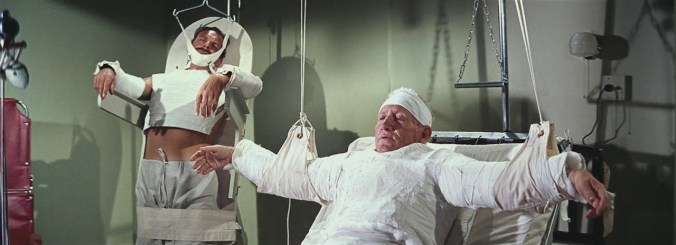
The movie, remarkable for a comedy, has no happy ending. All of the men, including Tracy, end up grievously injured (if amusingly bandaged) in a prison hospital. All of them, plus the three women, are headed for prison. Except that the director, Kramer, clearly believes this is a happy ending: justice has been served, greed and corruption have reaped the whirlwind.
And the mad, mad, mad, mad Sixties were just about ready to prove Stanley Kramer right about the United States of America.
 Ethics Alarms
After your posting i watched it. i found myslef interested inthe opening titles and the immensity of the comeidc talents the producers gathered. from the Boscht belt we had Buddy Hackett, Sid ceaser and Milton Berlem groudbreakers in the Televsion industry, Jonathan Winter, a prime time lumnary. Phil Silvers burlesque, cinemam and TV B star, but a billaint one. Even the supporting cast listed some greats-Rochester, Backus Brown, Demarest, Devine, keaton. knotts Pitts. Cameos with Benny, Lewis, the three stooges.
Thanks for the reminder!