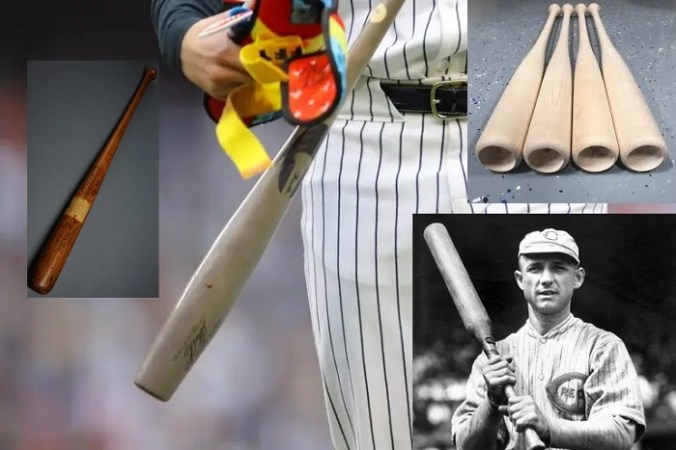
The New York Yankees opened their season by crushing the Milwaukee Brewers with a record number of home runs. Some of the homers were hit by players using a new bat design imagined by a one-time MIT physicist. The bat is shaped at teh end like a bowling pin, or a torpedo. The Yankees hit a franchise-record nine home runs in the first game—-notably the player who hit the most was Aaron Judge with three, and he used an old-fashioned bat. The series sweep served “as a live infomercial.”
The Yankees aren’t the only team with players using the new bats. The Cubs, Minnesota Twins, Toronto Blue Jays and Tampa Bay Rays have some players who are trying them out. “It’s legal,” says one enthusiastic player. “It’s under MLB rules and everything. Just basically moving the sweet spot down. Those balls that you’re getting jammed on are finding some barrels.”
Talk about a small sample size! Yet sports troll Dave Portnoy, a Red Sox fan, quickly declared on social media that using the completely legal bat–all the rules require are limits on length, weight and composition—is “cheating.”
“So listen, if MLB wants to sit on their ass and not outlaw this torpedo bat, then all the teams around going to do it and every game is gonna be 100-98, there’s gonna be 3,000 home runs,” Portnoy said, moronically. “I’m fine with it. Yankees have a long history of cheating and being scumbags and this just the latest. I think I saw the Twins or some other team using it, but you gotta get rid of the torpedo bats. It’s unfair to the pitchers, it’s stupid for the game.”
The myth of The Magic Bat is rampant in baseball fiction, notably in “The Natural,” but in real life, any advantages conferred by the tool rather than the skill of the workman are minimal in baseball: the batter still has to hit the ball. Babe Ruth used a 38 ounce bat (above, left), which is now unheard of: most players use 33 or 32 ounce bats. The heavier bat obviously could hit a ball harder IF you could get it around fast enough, which Babe, miraculously, could. The cupped bats (avove, upper right) were a thing a few years ago: supposedly the indentation made the barrel of the bat lighter without diminishing its power. The “torpedo bat” reminds me of the so-called “bottle bat” famously used by third-baseman Heinie Groh (above, lower right) in the dead ball era. Heinie was a good hitter, but nobody ever accused him of cheating.
Usually such “magic” bats have a beneficial short term result, if any, of increasing a player’s confidence, and if it can do that, then great. When enough players have used the “torpedo bats” to measure whether they hit any better with them than 1) they used to and 2) than equivalent players who do not use the new design, then baseball can responsibly decide if the bats are too good for the game. Based on history—a few years ago “axe-handle bats” were all the rage—I’m confident that difference, if any, will be minor.
__________________
Pointer: Old Bill
 Ethics Alarms
I hope someone sends a batch – or even some samples – to Atlanta.
It’s no longer a suggestion…now I’m begging someone to send those bats to the Braves. Or maybe Jurickson Profar (in his free time) is willing to break into the Dodgers’ locker room and steal some.
There’s got to be a way to objectively test a bat’s hitting power. Like setting up a robotic pitching arm that swings at an average pro batter level of force, have a pitching machine synced up so it hits the ball every time, and try it with different types of bats.
Agreed. I find the idea of moving/creating a “sweet spot” in a wooden baseball bat very intriguing. Tennis rackets and golf clubs have been all about larger and enhanced “sweet spots” for years. But of course, they are not of a monolithic construction. And drivers used to be simply persimmon blocks. If the reconfigured bats do allow batters to get to balls that would otherwise have jammed them into fouling them of and they allow batters to drive more pitches for hits, or at least keep them fair, that would be a significant development. And it should be verifiable over the course of a season. And the thing I find most interesting is perhaps the powers that be at MLB, and the networks, think the game needs more hits and fewer pitching duels?
And soon enough, you’ll have the vaunted “baseball men” opining on the bats. Scouts and hitting coaches will see .200 hitters driving balls and we’ll hear about it. Or not.
Should corking a bat stay illegal?
Of course. You’re not allowed to alter the bat’s composition, regardless of how.