Today we have Ethics Alarms’ first retroactive commenter banning! That’s historic, and so, by the current rules of Bonkers Left cant, it must be a wonderful thing.
In this post I took issue with “The Ethicist’s” assertion that one was obligated to reveal a secret to the one person whose life and relationships were likely to be upended by being informed of it because “the truth belongs to her.” The comment thread that followed featured the objections to my analysis by debuting commenter “Brandy,” whom, I discerned, was hostile to your host from the minute she appeared, but obviously thoughtful and intelligent if unconvincing on this particular issue.
“People have a fundamental right to know the truth about themselves, even if painful” was the entire thrust of her argument, which is just another way of saying “the truth belongs to her.” I also am dubious when anyone asserts a new “fundamental right.” I think Tom nailed the fundamental rights in his masterpiece, and this particular proposed addition undercuts the “pursuit of happiness” rather considerably. We have a right to be made miserable for no good reason?
But I digress. At one point in our exchange, Brandy called my argument a “Gish Gallup.” I had never heard or read that label before—the only Gishes I was aware ofwere Lillian, the silent movie star, Dorothy, her sister, and unfortunate Annabelle, whose intended star vehicle (“Mystic Pizza’) that was supposed to make her the latest famous Gish instead made Julia Roberts a star, while Annabelle was henceforward condemned to supporting roles and horror movies.
So I asked Brandy what a “Gish gallop’ was, a question she did not answer. However, after seeing the phrase for the second time on another site, I looked to up. Here’s the story (via Wikipedia);
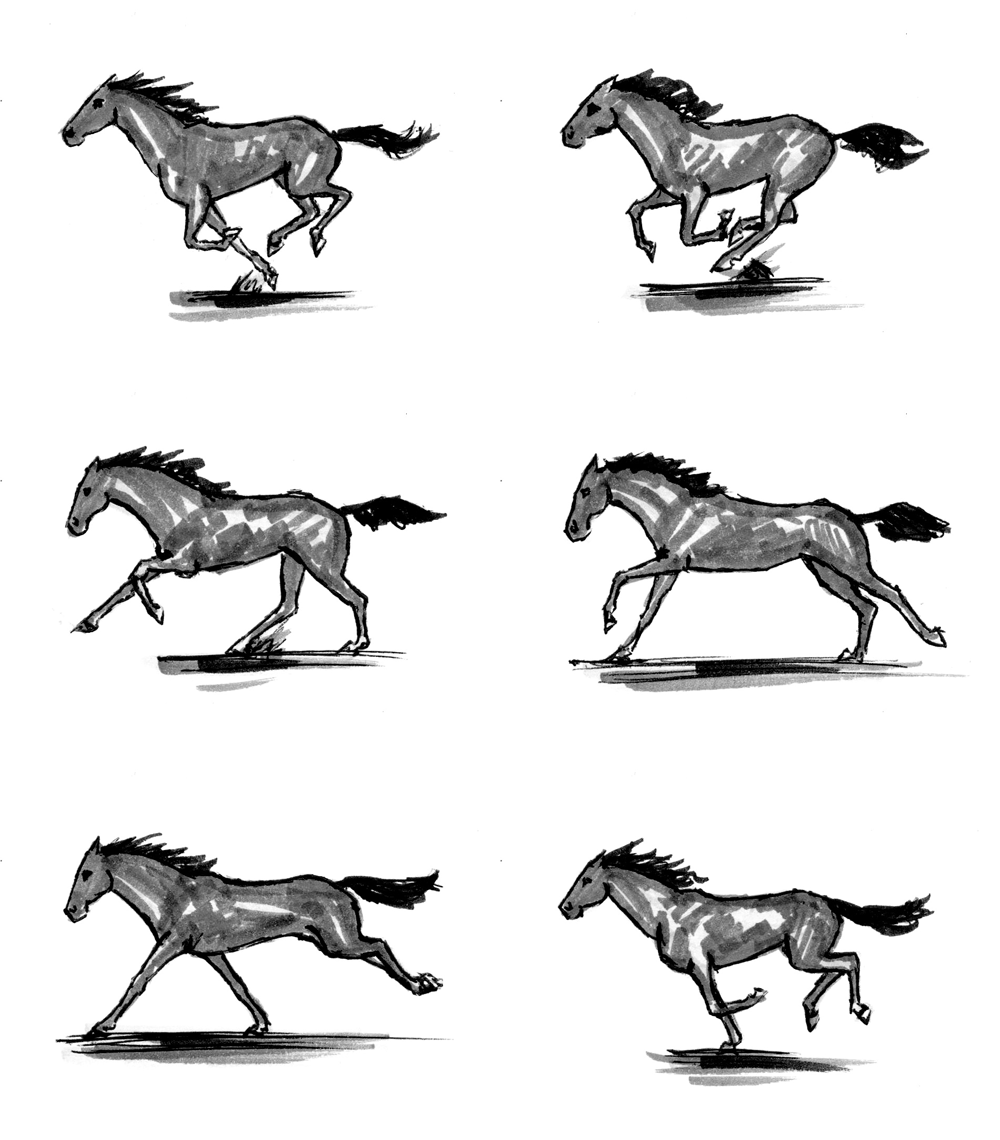
The term “Gish gallop” was coined in 1994 by the anthropologist Eugenie Scott who named it after the American creationist Duane Gish, dubbed the technique’s “most avid practitioner.”The Gish gallop is a rhetorical technique in which a person in a debate attempts to overwhelm an opponent by presenting an excessive number of arguments, with no regard for their accuracy or strength, with a rapidity that makes it impossible for the opponent to address them in the time available. Gish galloping prioritizes the quantity of the galloper’s arguments at the expense of their quality.
During a typical Gish gallop, the galloper confronts an opponent with a rapid series of specious arguments, half-truths, misrepresentations and outright lies, making it impossible for the opponent to refute all of them within the format of the debate. Each point raised by the Gish galloper takes considerably longer to refute than to assert. The technique wastes an opponent’s time and may cast doubt on the opponent’s debating ability for an audience unfamiliar with the technique, especially if no independent fact-checking is involved, or if the audience has limited knowledge of the topics. The difference in effort between making claims and refuting them is known as Brandolini’s law or informally “the bullshit asymmetry principle”. Another example is firehose of falsehoods….
Ah! So Brandy, failing to coherently refute my argument, was calling me a bad faith blooger and a liar. Nice! Also: BYE! The EA commenting rules do not give commenters leave to impugn me in that manner. I may not always express my points perfectly (and when I do, there are likely to be typos), but I do not lie or set out to use unfair debate tactics, and, as I state in the Comment Rules, when I do cross an ethical line, I will apologize for it.
In addition, Brandy used the insult incorrectly. A Gish Gallup only can be used orally, in a verbal debate. Written arguments cannot “overwhelm” a competent critic, as I and others on this site prove regularly when we fisk unethical articles, op eds or essays.
Accusing me of a “Gish Gallup” in a comment thread means,”I don’t have the wit or ammunition to argue with you, so instead I’m going to call your points dishonest without raising any viable rebuttal other than “you’re wrong.”
Brandy did make some substantive arguments, and there is some evidence that she didn’t know what “Gish Gallup” meant. Therefore a nicely worded, sincere apology promising never to similarly impugn this ethicist’s ethics will result in her reinstatement.
And I’m grateful for learning a new term.








 Ethics Alarms