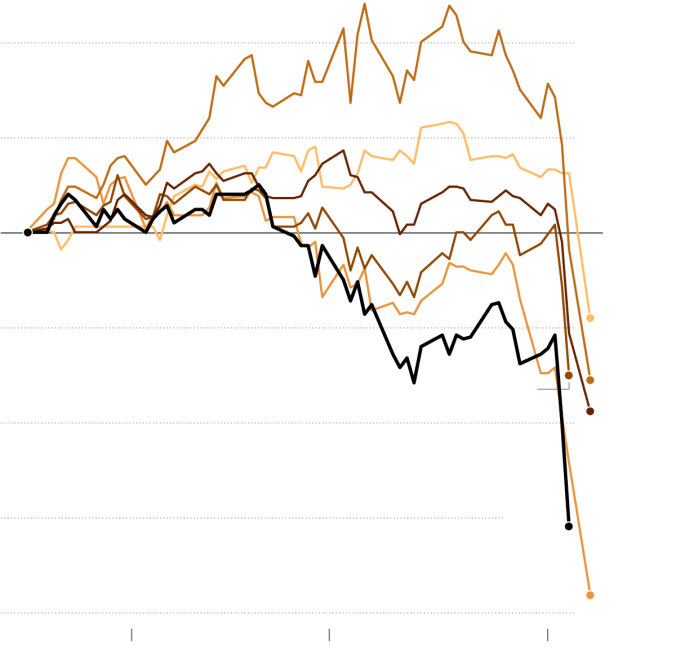
 That’s the New York Times graph this morning showing stock markets since President Trump’s inauguration. The lowest line (in orange) is Japan; the next lowest line is the U.S. The reason for all of those declines are believed to be Trump’s tariff policies.
A commenter last week asked why Ethics Alarms hadn’t discussed Trump’s tariffs. My response was, 1) I didn’t see them as an ethical issue and 2) I wasn’t informed sufficiently on the topic to opine on it. Veteran EA commentator Chris Marschner said, “Hold my beer!” The post below is the result: you van review the whole thread, which includes more from Chris, here.
***
I don’t know if this is an ethics angle per se but the tariff objections illustrate without question America’s unwillingness to suffer any short term discomfort in order to obtain long term security. I keep hearing that Trump is a narcissist such that he has this inappropriate sense of sense but one of the clinical signs of narcissistic behavior is a sense of entitlement. The minute anything Trump does causes some immediate discomfort or loss many in the public feel they are entitled to what they had before.
A large percentage of the stock market gains are illusory because much of that growth was driven by inflated profits and subsequently inflated stock prices. Consumer and producer prices rise before costs are actually incurred because labor costs are negotiated on longer term contracts as are so many of our commodities. The Biden administration fueled those inflated profits – and he said as much in a speech in the port of Baltimore – when he poured 2 trillion dollars into the economy with too few goods to buy. Employment gains in the last 4 years were in large measure government jobs that produce intangibles whose values are only measured in terms of their employment.
People need to realize that the algorithms used by traders are driving much of the sell off because tariffs are deemed to be anti-growth. What the buy/sell programs are not factoring in is the 6 trillion dollars worth of investment commitment which will revitalize our semi-conductor industry and other strategic industries. We have to buy spare avionics parts for our military and the base materials for our medicines from our political adversary who has a 100 year plan to dominate the globe.
Ironically, the people most concerned about the environment seem to be making the most noise about the expected reductions in consumer spending on imported goods. Would they have been happier if Trump did not raise tariffs but instead required all imported goods be manufactured in a manner consistent with the same environmental and child labor and safety standards we impose on our own manufacturers? I thought the United States was leading the way to global environmental Armageddon because it would not join the Paris Climate Accord. Environmentalism begins and ends with the amount of consumption demanded so lowering consumption should be a good thing right? Saving is deferred consumption and how people become wealthy through investment. Consider these rising prices a signal not to buy which will increase your savings rate and allow you to invest in money making productive ventures.
In my mind, in light of our debt that is approaching 37 trillion dollars which is roughly $255,172 per household we have an ethical duty and obligation to find ways to reduce our debt that will have to be paid by someone else. If we are actually concerned about individual rights, the global environment, and whether or not this nation does not fall to some Pacific rim totalitarian regime who possesses the manufacturing capacity that we willingly disposed of so that we can play with the shiny new trinket produced elsewhere because we wanted more stuff to buy, then we are ethically obligated to tighten our belts a little bit now or else the belt will be used on us later.
 Ethics Alarms
We want two things: Inexpensive Products. Higher wages. These are, too a degree mutually exclusive. Automation can, somewhat, bridge the gap, but even then only so much because automation also reduces demand for labor (lowering its cost).
We made a compromise with a world that was either almost completely undeveloped or almost completely wrecked (WW2). We’d let them make our products because they were happy with any wage at that point and we’d occupy higher salaried components of the world economy.
But, the rest of the world is finally catching up, and believe it or not, they also want higher wages and a better standard of living.
Almost *all* of our economic stresses can probably, in some way or another, point back to this reality. In a world that is slowly reaching a kind of equilibrium – whatever forces win out – almost all the forces will tend to push individual economies “back in on themselves”. Would there still be world commerce? Of course, but a very different type.
Tariffs might be a way of speeding up the process even while they can be used to show the “anti-free-trade-ness” of tariffs.
It’s almost like Trump and team read Peter Zeihan’s book “The End of the World Is Just the Beginning” – which predicts a coming world self-isolation as population demographics create a type of emergency forcing almost every single country to look more inwards or at least much more local for self-sustainment.
One bottom line takeaway, is 3 days into the tariffs, exactly 0 people can reliably predict what will come of them. Some of the guesses will end up correct – but you know…a million monkeys at typewriters and all.
But one thing for certain – the world is coming on a circumstance it either hasn’t ever experienced or has not experienced in anyone’s living memory or the living memories of their great great great great grandparents.
To be clear – the tariffs are *not* the “coming unexperienced circumstance” – rather the demographic change and the coming isolation.
To pile on also –
Global commerce is, to an almost exclusive sense, entirely due to American military might and American cultural magnanimity. With generally little help from supposedly reliable allies, the United States has ensured global commerce, leading to pretty much all of the other nations of the world increasing *by leaps and bounds* in standard of living.
So there’s very much a likelihood, that the coming isolation of nations is more like a return to the way the world always was absent a *completely* over powered nation policing the oceans that simultaneously has been the most generous in its use of that power (even taking into account the occasional mistake).
As all the nations slowly creep closer to equality – it seems more or less that the only reason the World has enjoyed a period of time more peaceful and prosperous and long lasting than the rest of the world history was because the United States was so far ahead of everyone else.
Hold my beer, indeed!!! Another tour-de-force from one of the many resident experts in this cul-de-sac of the internet.
Thank you for this, Chris, and thank you for the other responses you offered in that thread.
Cul-de-sac is encouraging. I often feel like “dead end” is more appropriate.
Chris Marschner wrote, “Employment gains in the last 4 years were in large measure government jobs that produce intangibles whose values are only measured in terms of their employment.”
This is a REALY important point that far too many people blow over as insignificant.
I would like to know what you think about Milton Friedman and Thomas Sowell on tariffs.
One of the things that these economists warn about is that good intentions may have unintended consequences. Assuming that Trump succeeds in his goal and brings back manufacturing to the USA, but the goods in made in the USA are more expensive, and the impact on the stock market is negative, is that desirable? As somebody who recently retired I have my misgivings about that.
I don’t know if this is an ethics angle per se but the tariff objections illustrate without question America’s unwillingness to suffer any short term discomfort in order to obtain long term security.
This is a natural reaction, as there is no ironclad guarantee of long term security.
Americans have been able to endure this discomofrt if they trusted those who promised long-term security.