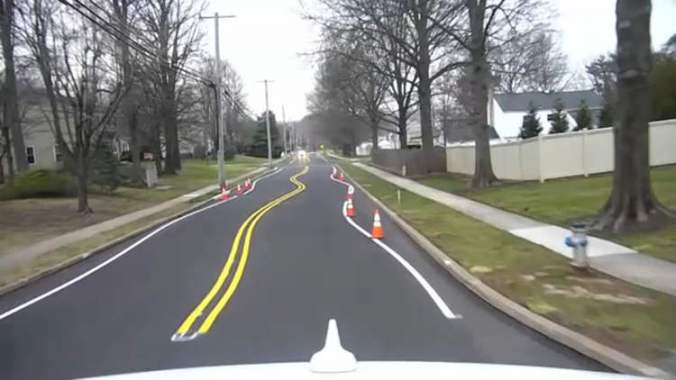
When I saw the photo above and followed the reports like this one…
… I was certain that I had posted on an almost identical story a few years ago. And I had…with one significant difference.
The photo above comes from the Montgomery Township in Pennsylvania, where authorities have introduced wavy lane patterns on some streets. The regular lane patterns have been replaced by curved and zig-zagged lines. Montgomery Township officials explain that the erratic lane margins are their solution to too many speeding automobiles on some of the most trafficked streets. They are “traffic-calming measures.” “Our Highway Safety Officers and Traffic Engineers have determined that this is the best course of action for the area to ensure the safety of the local residents,” Montgomery Township police wrote in a Facebook post.
That’s funny: back in 2022, an Ethics Alarms “Res Ipsa Loquitur” post featured this, from Hollister, California:
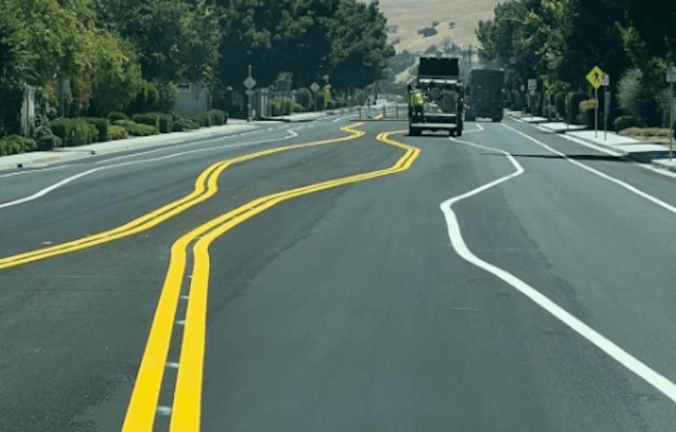
In that instance, the wavy lines were definitely not by design. Hollister Mayor Igancio Velzaquez explained, “It just comes down to the contractor. Somebody didn’t read the plans correctly. It was not designed to look very odd.”
You may agree with me that the intentional eccentric lines look like a mistake, and the the accidental lines in Hollister look intentional, but that is neither here not there.
And I’m with Hollister. If there’s too much speeding an a section of a street, put up speed limit signs with reduced numbers. Pull over drivers. Up the fines for speeding. Speed humps are a lousy way to control traffic, but they are better than this nonsense. Heck, why stop at wavy lines? Try broken glass! Puppies in glass cages in the middle of the road! Land mines! Okay, maybe that’s a bit extreme, but why not set up fun obstacles, and make the street like a miniature golf course?
 Ethics Alarms
I feel like I saw a report where some town somewhere painted one of those extremely elongated images on the street. Where viewed from a certain angle (in this case the angle of a driver about 40 feet away) the image is foreshortened to appear like a kid in the road.
Ugh. I think that would cause too many slammed brakes and rear endings.
Ha! I almost included exactly that when I was describing the miniature golf course approach.
About fifteen years ago, a Christian university in a nearby town installed some traffic-calming measures along a half-mile section of a campus street. This particular street had many crosswalks for students going from building to building along both sides of the street in question. To slow down traffic on the street, the university raised the height of the crosswalks and built a radiused approach for cars. This resembled nothing so much a a giant speed bump running across the street at each crosswalk. At each intersection, the university put up caution signs that their consultant had suggested. Each yellow sign bore the text “HUMP!” I don’t know how long it took the school’s administration to realize the double entendre at work here, but after a couple of months new signs appeared reading “BUMP!” I still chuckle to myself when I drive through the area.
Do you remember my story about the nuns who came up with a substitute word for El Gallo to use in place of “rape” in The Fantasticks’ rape song?
Sadly, I do not.
I told the tale in this 2021 post:https://ethicsalarms.com/2021/03/10/straining-to-smear-merrick-garland-the-national-review-and-conservative-lawyer-ed-whelen-beclown-themselves/
Just looked it up!
“Snatch.”
Clueless people!
Good road design aims to create a self-enforcing speed limit. Typically the speed limit should be set at or slightly below the design speed, which is the speed that 85% of drivers travel at or below regardless of posted speed limit. This ensures that the posted speed limit is safe and reasonable for most drivers, while also accounting for the road’s geometric design. There are other factors, that determine speed limit, such as pedestrian activity, presence of children, residential housing within city limits; however it is good practice to design the road in such a way that the design speed promotes safe driving, and is close to the target speed limit. So in a residential neighborhood with a lot of children, design the road in such a way that the design speed is 15 MPH or below. Road safety is something that needs to be part road design; it cannot simply be added later on via posted speed limits and traffic enforcement.
There are some interesting YouTube channels I can recommend for road design in the Netherlands as compared to the USA, such as https://www.youtube.com/@NotJustBikes. The Netherlands have some unique challenges such as lots of bikes and pedestrians, plus the high population density. Road design in the Netherlands is much less car-centric than in the USA. The traffic fatality rate per 100.000 is 4.19 in the Netherlands, and 12.84 in the United States.