The proper and necessary celebration of “The Shot Heard Round the World” and the Battles of Lexington and Concord is, for some strange reason—-I’m guessing apathy and incompetence—diffused and unfocused. Although April 19, 1775, was the momentous day, we haven’t agreed when it should honored, or even what the day should be called.
Only six states—Massachusetts, Maine, Connecticut, North Dakota, Wisconsin, and Florida recognize Patriots Day, though Maine, being perverse, calls it “Patriot’s Day.” It is a legal holiday in Maine, Massachusetts, Connecticut, and North Dakota. In Florida and Wisconsin, it is recognized without being a state holiday. Massachusetts and Maine celebrate the day on the third Monday of April. The other states that observe the date celebrate on the 19th, when they should. Why Massachusetts and Maine (which was part of the Bay State when “The Shot” was fired), of all states, don’t use the historically correct date is bewildering. Wisconsin designates April 19 is a special observance day for schools, which are required to teach students about the events and key figures of Patriots’ Day. but the observance is moved to Friday, April 18, if April 19 is a Saturday and to Monday, April 20, if April 19 falls on a Sunday. Got that?
It gets worse. Some genius decided to officially designate September 11 as “Patriot Day,” with no “s.” I know that “Thousands Being Killed By Muslim Terrorist Attacks” isn’t very catchy, but what does the fall of the Twin Towers have to do with patriots?
After President Bush the Second proclaimed Friday, September 14, 2001, as a National Day of Prayer and Remembrance for the Victims of the Terrorist Attacks on September 11, 2001, the House passed a resolution to proclaim September 11, 2002, as the first “Patriot Day.” I hadn’t realized that was the official name: my brain, as a loyal Bostonian who went to the Boston Red Sox morning Patriots Day game (the Sox won today, 4-2) almost every year before moving to the D.C. area, wouldn’t process that inexcusably confusing name.
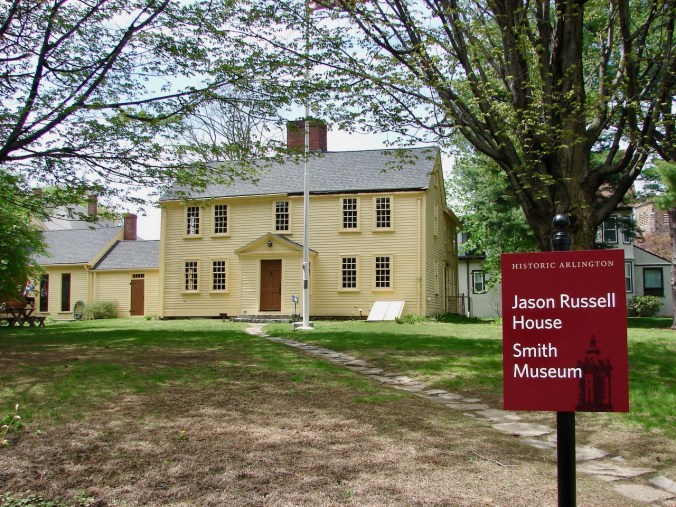
Also as a loyal son of Arlington Massachusetts, I must set straight the facts surrounding my home town’s claim to Patriots Day significance. When I mentioned snidely the Jason Russell House over the weekend, I was reflecting the traditional annoyance of Arlington students who were and are still forced to tour the place year after year until we tuned out. In fact, Arlington’s main Revolutionary War landmark was a genuine site of colonial courage beyond the unfortunate shooting of Jason Russell and some comrades in his closet.
Listen, my children, and you shall hear…
The Jason Russell House was the epicenter of what came to be called the Battle of Menotomy, though it is considered as an extension of the earlier battles in Lexington and Concord. As the British army was retreating from Concord, looting and burning homes along the way, it arrived in Arlington (then Menotomy). A plaque placed in Arlington Heights states that “British Troops in retreat from bloody first skirmishes at Lexington and Concord were here opposed by colonial forces gathering from four counties and thirty towns. More men fell at the Foot of the Rocks and on the plains of Menotomy than in every other locale through which the adversary forces fought, that long day, April 19, 1775.”
Russell’s house and the surrounding grounds erupted into a major conflict. Jason Russell (He was in his fifties, old by combatant standards) and eleven Menotomy Minute Men were joined by volunteers from Beverly, Danvers, Lynn, Salem, Dedham, Needham and other towns, having been warned the previous evening by messengers Paul Revere and Charles Dawes. The colonials set up resistance in and around Russell’s house behind trees, walls, embankments and a huge pile of shingles Russell had on his property as he was in the process of re-roofing his home. They knew that the British had to come through Menotomy on the way back to Boston.
There was no single commanding officer in contrast to the two earlier battles that day, accounting for the infamously messy and bloody battle. A letter by an unknown British soldier who took part in the battle is one of the few accounts historians have to reconstruct what occurred. It says in part,
“In another house which was long defended by eight resolute fellows, the grenadiers at last got possession, when after having run their bayonets into seven, the eighth continued to abuse them with all the [beastlike rage] of a true Cromwellian, and but a moment before he quitted this world applied such epithets as I must leave unmentioned…”
The Battle of Menotomy was a defeat, but an important part of Patriots Day nonetheless, obscured by the fact that it was considered an anti-climax following the more famous battles of Lexington and Concord, and also by the fact that the town of Menotomy, in a moment of madness, changed its name to the common and boring monicker “Arlington.” My home town gave up its identity, and has been searching for it ever since.
 Ethics Alarms
I never knew the story of Jason Russell. I learn something new every day. Thanks!