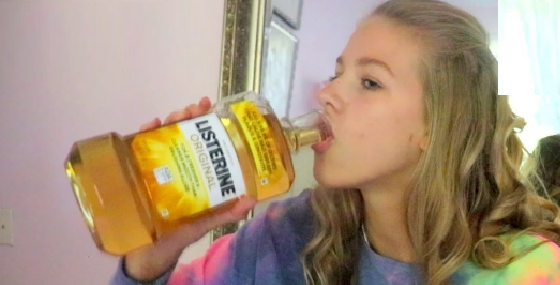
I last posted “The Amazing Mouthwash Deception: Helping Alcoholics Relapse For Profit” in March of 2024, about a week after my wife Grace died suddenly. Her death was almost certainly a direct consequence of her alcoholism, which she frequently serviced through the surreptitious consumption of alcohol-containing mouthwash, usually Listerine. I was not planning on re-posting the piece so soon afterwards, but today I discovered the weird story of how botched contract drafting in 1881 resulted in Johnson & Johnson having to pay six dollars for every 2,016 ounces of Listerine sold, (the equivalent to 144 14-oz. bottles) to Listerine’s many royalty holders. Even though the royalties have been split, sold and traded, they are still worth a lot of money because Listerine is the best selling mouthwash (and secret alcoholic beverage) in the world. You can read the whole, strange tale here , but what matters ethically is this: among the organizations making money off of this deadly stuff are…
- Wellesley College
- The American Bible Society
- The Salvation Army
- The Rockefeller Foundation
- The Bell Telephone Company
…and the Catholic Archdiocese of New York owned a 50% stake in Listerine royalties for nearly two decades, making almost $13 million over 16 years.
Shame on all of them. As I first explained in 2010 in a post that has been read over 50,000 times (it’s still not enough), Listerine is a destructive resource for alcoholics, and that use represents an untold, but definitely large, percentage of Listerine sales. The companies that have owned Listerine have deliberately maintained the deception that it can’t be guzzled, and the deception benefits their huge market of addicts, and of course, the companies, their shareholders, and royalty owners.
In my 2016 introduction to the post, I wrote in part, “Most of all, I am revolted that what I increasingly have come to believe is an intentional, profit-motivated deception by manufacturers continues, despite their knowledge that their product is killing alcoholics and destroying families. I know proof would be difficult, but there have been successful class action lawsuits with millions in punitive damage settlements for less despicable conduct. Somewhere, there must be an employee or executive who acknowledges that the makers of mouthwash with alcohol know their product is being swallowed rather than swished, and are happy to profit from it….People are killing themselves right under our noses, and we are being thrown of by the minty smell of their breath.”
And now I know that all sorts of nice people and admirable organizations profit from their deaths.
Once again, here is “The Amazing Mouthwash Deception: Helping Alcoholics Relapse For Profit,” dedicated, as it always will be, to brilliant, beautiful, kind, loving—and dead—- Grace Bowen Marshall:
It has been with us for centuries, as long as man has been fermenting vegetable matter to produce alcohol, and it is a plague on the human race. Virtually every one of us has friends, relatives or close associates with the disease, or we battle the addiction ourselves. Although accurate figures don’t exist, estimates of the prevalence of alcohol addiction in the U.S. range between 5 and 12%. Whatever the real figure is, it is a lot, and the disease causes a wide range of problems. For example, close to 50% of all automobile fatalities involve alcohol. Yet the public remains shockingly ignorant about alcoholism, to the detriment and convenience of alcoholics, and the devastation of their families
The ignorance is also profitable to some corporations that are not even officially in the beverage business. The ethics question whether those corporations knowingly and intentionally encourage and facilitate that ignorance? If so, they have a lot to answer for, and so do government consumer agencies and the media. This ignorance kills.
The corporations in question are those that manufacture mouthwash, specifically mouthwash containing ethyl alcohol. Most Americans don’t know or suspect that mouthwash containing alcohol is a primary tool of the alcoholic’s craft, which is deception. Keeping the progressive disease, a debilitating addiction with genetic roots, hidden from fellow workers and family is a full time occupation, and popular mouthwashes like Listerine, a Johnson and Johnson product, are a godsend. Original formula Listerine is 26.9 percent alcohol, making it approximately 54 proof , though other flavors contain less. This means it is more potent than beer or wine, and comparable to some varieties of hard liquor.
But, you may ask, aren’t Listerine and similar mouthwashes poison? I always thought so, because I read the labels, a typical example of which reads:
“Do not swallow. In case of accidental ingestion, seek professional assistance or contact a Poison Control Center immediately.”
This is effective, all right: effective at putting those who live and work around alcoholics off the scent—literally. The breath of an alcoholic who is drinking mouthwash will smell “minty fresh,” and in the morning, when liquor on the breath is a warning sign even the most trusting associate will notice with alarm, this is wonderful subterfuge. It just never occurs to a non-alcoholic that drinking Listerine or other mouthwashes is a possibility, because the bottle suggests it is poison.
It isn’t, and alcoholics know it isn’t. Drinking mouthwash is openly discussed and joked about at AA meetings, which are, for good reasons, confidential. Occasionally an endorsement of mouthwash drinking appears on the web. Here’s a typical example, from a British website:
“Been drinking Listerine on the streets for ages now, gets you mashed good and proper. Best bit, it’s cheap and makes you smell great. With 4 different colours and flavours, you just can’t get bored with it. Nothing beats going down the park on a Friday night with a bottle of Listerine and getting mashed with your mates. It even comes with that cap which doubles as a shot-glass. My favourite though is Listerine on the rocks you can’t beat that, add an umbrella and your south of the border.”
If you are surprised that anyone could actually drink the mouthwash “for ages” and still be active on the internet, it means one thing: you’re probably not an alcoholic.
There are other benefits of mouthwash for the secret drinker besides the convenient shot glass and the variety of flavors—and, of course, the misleading warning:
- The bottles come in small sizes that can be stored in purses and pockets.
- Mouthwash with alcohol continues to be sold at supermarkets and convenience stores, 24 hours a day, after sales of liquor are prohibited. “Watch the mouthwash aisles on a Saturday night some time,” an alcoholic friend suggested. She was right. There was a run on the shelves, and the purchasers looked like the cast of “Barfly.”
- Most people find the taste of mouthwashes so strong and medicinal that they can’t imagine anyone wanting to drink them. Of course, they aren’t thinking like alcoholic, who do not drink for taste.
- Mouthwash is relatively cheap, and
- If you are under age, you can still buy a jumbo bottle of Listerine without raising a store clerk’s eyebrow.
As I stated at the beginning, the consequences of the mouthwash deception are devastating. Alcoholism is a progressive disease that destroys families, businesses and lives, and recovery is difficult, intermittent, and never-ending. Families of alcoholics have to be vigilant for a recovering family member to have a fighting chance of surviving the illness. The existence of a secret back-door to intoxication, aided and abetted by a false warning that assists secret drinking by deluding non-drinkers, undoubtedly impedes the recovery of thousands and perhaps millions of desperately sick individuals. For many alcoholics, the alternative to recovery is death.
Do mouthwash manufacturers know this? I do not know for certain, but how could they not? They see the sales figures, and presumably they know the market; selling mouthwash is, after all, their business. Figures don’t exist, but it seems reasonable to assume that sales to drunks hiding their addiction must account for a significant percentage of profits, meaning that assisting alcoholics in sabotaging their recoveries and fooling their co-workers and families is worth millions of dollars. Would millions of dollars a year in sales motivate a corporation to keep the public in the dark about a widespread and destructive use of its product? Even if families are torn apart, businesses destroyed, and people killed as a result? We know it could, because we have seen other corporations do worse. We can’t know, at this point, if that is what is going on.
If it isn’t, however, then the naivete of mouthwash manufacturers is mind-boggling. They know that their mouthwashes are not poison, but place misleading labels on their products which only convince the consumers who would never dream of drinking mouthwash anyway. Meanwhile, it lets those who do drink it operate in secrecy. Is it possible that this practice, which has been going on for decades, is accidental and innocent? Are there no alcoholics in the families of Pfizer executives and the other companies?
They are not the only entities I wonder about, either. I find it difficult to believe that supermarket chains and convenience stores don’t know that when they sell Listerine to red-faced, homeless people on Saturday nights, they are supplying binges. The media’s failure to inform the public about this phenomenon is also inexplicable. Journalists are not strangers to problem drinking. Why hasn’t this story been in the New York Times? On “60 Minutes”? Where is Dr. Oz? We see alcoholism portrayed in television dramas frequently now, a good thing. Have you ever seen a character drink mouthwash? If it has happened, I missed it, and I watch more TV than is good for me.
This has to stop.
What needs to be done, and what manufacturers and the media have an ethical obligation to do:
1. Manufacturers should begin public service campaigns aimed, not at alcoholics, but at their families and friends, warning them that Listerine and similar mouthwashes are alcoholic beverage substitutes for those who abuse alcohol or have alcohol addiction, and that if they have a recovering alcoholic loved one, friend or worker, they need to be aware of the meaning of that mouthwash bottle the alcoholic is carrying around, and the minty-fresh morning breath.
2. Local television news, cable news, and talk shows should produce features and news segments on the misuse of mouthwash by alcoholics and teens as a liquor substitute.
3. Manufacturers must change the warnings and labels on alcohol-containing mouthwashes so that the people alcoholics need to fool will not be misinformed.
4. Legislators must change the laws so that purchases of alcohol-containing mouthwashes are covered by restrictions on beer, wine, and hard liquor.
5. Alcoholics should be counseled to reveal the mouthwash dodge to their families before they are in the throes of a relapse.
6. Families of alcoholics should be instructed in Al Anon and elsewhere to be on the look-out for mouthwash abuse as a sign of an alcoholic’s relapse.
Whether through negligence, ignorance, carelessness, irresponsibility or greed, a strange convergence of factors has been aggravating one of the nation’s most serious health and social problems. All that is required to address the problem is information and education. If those who have a responsibility to publicize this information continue to fail to do so, our ethical judgment of them should be harsh. As always, however, the priority is to fix the problem. If mouthwash makers, retailers and journalists won’t do the right thing, we need to do it for them, and fast. We can deal with their conduct later.
Spread the word.
 Ethics Alarms
Great article, I did not know that! Sadly I imagine a similar article being written in 30-50 years on CBD and/or marijuana
I am not convinced that this is the problem you make it out to be, Jack.
To be convinced, I would like to see numbers. If you say 5%-12%, you are talking about 18 Million to 44 Million.
Being a lawyer and of Irish extraction, I have seen a lot of drinking. Most alcoholic behavior I have seen is pretty traditional. They drink to excess and do it pretty openly.
That is probably the majority of alcoholics and it is probably a pretty high majority.
Then, you have the people who successfully quit.
And, we are not even talking about the number of people who drink but are not alcoholics.
I would expect that the Listerine drinkers fit into a couple of categories: 1) alcoholics that are hiding it; and 2) people who can’t afford booze (those are probably the people who are hitting the pharmacies on a Saturday night).
I have Listerine in my cabinet and would NEVER think of drinking it. Why, I have wine and whisky in my other cabinet, with some beer in the fridge. If I were hiding a drinking problem, it might be another story.
What percentage of that 18-44 Million are we talking about? 5%? 10% (I don’t know; like I said, I would like to see numbers.) But, 10% is, at most, 1.5% of the population. Yes, it is 4.4 Million people, but a small percentage.
And, how many of the Listerine drinkers drink themselves to death? That number has to be a small percentage too. But, even if it is 50% of Listerine drinkers, you are at a small percentage of the population. A percentage that small should not dictate policy.
Otherwise, you have to go after the paint and glue companies, because everyone knows that those are used for huffing and it is often children who engage in that behavior. (To be fair, I have seen public service announcement about huffing.) But, those companies know that some of their sales and profits come from the deaths of users.
If I saw the numbers, I might be convinced. As it stands, it feels like the rationale that, “If it saves just one life….”
-Jut
Like the vast majority of Americans, you are not aware of the extent of alcohol abuse, or the degree that the illness is incurable, or the danger of drinking. I don’t blame you: until I got into that world, I was unaware as well.
The bottom line is that Listerine is falsely labelled poison. It is no more poison than scotch. That label enables abusers and foils their caretakers. And it makes lots of money for Johnson & Johnson. I’m sure the company feels secure because of the factors you mention and causality problems. Maybe unethical lawyers have so advised them. And the fact that the bottle tops are shot glasses is just a coincidence…
Jack: “until I got into that world, I was unaware as well.”
that smacks of a selection bias. People who “get into a world” often have a biased view that exaggerates a problem because they encounter it more often in a non-randomized way.
that is why I said what I said: I need to see the numbers, not the shelves of an anecdotal pharmacy.
and shot glass caps? Not exclusive to Lusterine. Baby ibuprofen has it too.
-Jut
But you don’t drink ibuprofen
The recovering alcoholics I have raised this with are amused at the general ignorance and say that the use of Listerine for secret drinking is general knowledge and general practice. And that post in this little blog didn’t attract 50,000 readers because I was seeing things. But you have every reason to be skeptical, because it’s an ingenious scandal. I’ll be meeting with a mass tort/class action specialist this week to see if we can shake something loose. Even if we could just force J&J to ditch the fake poison label, it would be something.
Grace has been dead for more than a year, and I found two more empty Listerine bottles yesterday.
Yeah, the poison label could easily be challenged as false advertising, deceptive labeling or something along those lines. This is almost the opposite of a label for snake oil, as it deceptively exaggerates a negative side-effect.
But, I would be willing to be convinced if I had numbers that accurately illustrated the extent of the problem. I know that I don’t know what that is, so I am instinctively on guard from being swayed by mere rhetoric.
-Jut
To be honest, I always thought that it was common knowledge that drinking mouthwash was an old trick of alcoholics. I’m sure I had heard of it by my early teens. I had no alcoholics in my immediate family, though my maternal grandfather apparently was one.