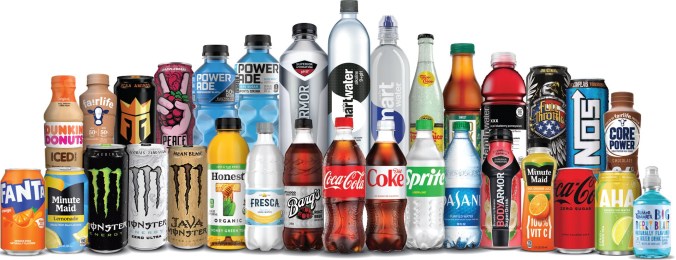
Back in my first year of law school we studied a case involving poor D.C. residents spending financial assistance checks on non-essentials like furniture thanks to a special deal offered by a local store. My contracts professor, the legendary Richard Alan Gordon, gave an impassioned speech decrying the court’s conclusion that the store’s promotion was wrong and the money was misused. “Why is sustenance for the soul less essential than sustenance for the body?” he asked in his famous stentorian tones.
Okay, food stamp recipients spending them on Coca-Cola products is not quite in the same exalted territory as the life enhancements at the center of that case (I can’t recall it the case cite), but to me, the principle is the same. Conservatives are on the wrong side of this ethics debate. I don’t care if Coca-Cola makes a lot of money off of food stamps. People enjoy their products. They make people happy. Poor people deserve to be happy too now and then in the Land of the Free and the Home of the Brave.
Robert F. Kennedy Jr., the Health and Human Services Secretary, and Brooke Rollins, the Agriculture Secretary, both advocate stripping soft drinks and junk food from SNAP, the Supplemental Nutrition Assistance Program. RFKJ has called for the government to stop allowing the nearly $113 billion program that serves about 42 million Americans to be spent on “ soda or processed foods.” “The one place that I would say that we need to really change policy is the SNAP program and food stamps and in school lunches,” Kennedy told Fox News. “There, the federal government in many cases is paying for it. And we shouldn’t be subsidizing people to eat poison.”
Well, one man’s poison is another man’s pudding. Rollins has said, “When a taxpayer is putting money into SNAP, are they OK with us using their tax dollars to feed really bad food and sugary drinks to children who perhaps need something more nutritious?” No, the correct question is whether Americans think that the poor and low of income should have taxpayers lightening their burden and allowing them to make the same choices regarding the pursuit of happiness that anyone else has, within practical limits.
Rep. Josh Breechan, an Oklahoma Republican, sponsored the Healthy SNAP Act. “If someone wants to buy junk food on their own dime, that’s up to them,” he said. “But what we’re saying is, ‘Don’t ask the taxpayer to pay for it and then also expect the taxpayer to pick up the tab for the resulting health consequences.’” Another Republicans in Congress said that he was disgusted when he visited a Circle K gas station and saw a poor family buying foods he thought they should not have bought. “In front of me is a family and I think they bought four ginger ales, a bag of chips, a bag of donuts, a Snickers bar and a Big Gulp and they paid with their food stamps,” the not-poor Congressman complained. And for a little while, that family was as happy as my family has been when we decided, “Oh, the hell with it, let’s eat some crap!”
“Let Food Stamp Recipients Eat Whatever The Hell They Want” writes Nathan Robinson in “Current Affairs.” “Trying to force the poor—and only the poor—to eat healthily is intrusive and humiliating. If we’re going to restrict junk snacks, we should restrict them for everyone.” And that’s not an option: if the government wants to stop me from having my occasional Ho-Ho, it can tear it away from my cold, dead hands. I work hard, try to be a good citizen, don’t smoke or drink, have never puffed a joint, and if I want to indulge myself when I’m depressed after a bad Red Sox game (like last night’s), it’s none of Uncle Sam’s damn business.
This is how government “aid” make serfs of its citizens: get them dependent on financial hand-outs then use the assistance to control their conduct. I don’t care if it’s keeping one’s weight down, getting regular check-ups, avoiding Diet Coke or tolerating a fake, demented President: the totalitarians can bite me.
In a paper advocating restrictions on SNAP benefits, bioethicist Anne Barnhill says that while “industry groups” try to present the issue as one of consumer choice, in fact there is no ethical problem with restricting benefits, because it is good for people. “It is ethically justifiable to modestly limit the consumer choice afforded by SNAP to improve the nutrition and health of SNAP participants,” she says. If you say so, Mein Fuhrer. “Liberty” and “the Pursuit of Happiness” are defined by the individual, not those who think they know best, like Anne.
Robinson ends his piece by writing,
I left out the part where he gives his formula for making the poor more healthy, which, of course, includes national health care (in which you better not have been drinking scotch every day if you want a liver transplant). The Left wants to control those it helps too. People are poor in part because of their own choices, and in this country, as it was envisioned, the power to make those bad choices is at the core of American rights and values. Conservatives should understand that, and support it.
 Ethics Alarms
Yes, Jack, Let them eat cake!
(Sorry, could not resist.)
-Jut
That’s used in the “Current Events” article.
Yeah…caught that (see below) … eventually.
-Jut
On a more serious note, there are issues to be considered.
SNAP already makes certain policy distinctions. You can but Papa Murphy’s pizza with SNAP because it is a “fresh food” or something. It is not a prepared item, so it qualifies for the benefit. Pizza Hut, however, is not allowed under SNAP because it is “eating out.” (I don’t have the terminology down, just the concept.). Why should there be that distinction (at least under your rationale)? Why shouldn’t people be able to use SNAP for McDonald’s?
Does anyone remember the days of “government cheese”? I vaguely recall it and I thought that people had to go to a special place to get government food. That was eventually turned into food stamps, which could be used like money (I remember that from my cashier days) and later as SNAP.
The broader moral hazard is, of course
[Frustrated Interlude: Ah Crap! On closer review, that quote contained my “Cake” joke!]
people on the public dole should not expect to be comfortable on it. It should not be pleasant; it should not be desirable. It should be an experience that you want to end.
That is a big criticism of the Welfare State: it allows complacency. When people had to rely on their communities for charity, there was an implicit (if not explicit) expectation that you would get off charity ASAP because, before you know it, one of your other neighbors would need the help. Help was not anonymous; free-loading became akin to the Tragedy of the Commons. Charity was temporary because people did not want to be a burden to their community. That structure, for whatever its faults, addressed the moral hazard.
Welfare does not. Government assistance is practically anonymous. Recipients are entitled to anything and accountable to no one. That is not a good combination.
That is why I think you are wrong about the conservative position. In the broad context of welfare, yes, they probably favor autonomy. But, to get there, you have to jump over the broader hurdle that, in general, the Welfare State is a bad idea. That conflict creates a cognitive dissonance that says, “the only way to deter government dependence (an inherently bad thing), is to make government dependence undesirable.
-Jut
There was one summer when I was in middle school (ca. 1970) when neither Mom or Dad was working (Mom was a teacher on a 9-month contract & no summer school assignment, and Dad was between jobs), and our family lived on “government cheese” (huge blocks of a Velveeta-like substance) and other government commodities for about 3 months. Lots of stuff in plain white boxes & cans with black lettering (like generic groceries from the supermarket, but you didn’t pay for them, and Mom & Dad picked them up from some food bank-like warehouse, I think). I got so sick & tired of generic grape “Kool-Aid” that summer! But we survived, and went back to normal groceries once school started again.
In order to have enough freedom, you need too much.
In order to help enough, you will end up wasting a whole lot more.
Rather than understanding SNAP as welfare, can we not conceive of it as subsidy(many things are subsidized for many reasons), and debate it’s merit in a free market from that perspective?
I believe that the WIC (Women, Infants and Children) Nutrition Program is already fairly restrictive as to what foods can be purchased, to ensure that pregnant and nursing women, as well as their small children, are consuming a healthy diet. (As a first-time mom in her 30s with special-needs twins back in the 1990s, I learned way too much about such assistance programs, even though our family’s income disqualified us for most of them.)
As to changes to the food stamp program, I agree that it’s silly that hot foods aren’t currently OK for food stamp purchases. (F.ex., a rotisserie chicken from the supermarket deli is an easy and relatively healthy main course for a family meal, and the leftover meat can be used in a wide variety of dishes.) If I were advising RFK, Jr., I would recommend lifting the ban on purchases of hot prepared foods with food stamps.
On the other hand, I’ve lived with “healthy food” restrictions at the public schools my kids attended while they were growing up (both in the school lunch programs and in which treats were allowed at class parties), so I’m not as opposed to restrictions on junk food purchases with food stamps as EA is. I would, however, be OK with a fairly narrow definition of what constitutes “junk food”; f.ex. baked chips (OK) vs. fried chips (not OK), unsweetened iced tea, flavored sparkling water and electrolyte drinks not exceeding the per oz. calorie count of a glass of whole milk (OK) vs. sugar-sweetened soft drinks not fortified with any vitamins or minerals (not OK), etc.. Basically similar restrictions as those already imposed on public schools, and I’d be willing to negotiate on the extent of such restrictions in both cases, so long as poor families (and people like my elderly mother on Social Security) could buy hot prepared food at the supermarket with their food stamps, too.
“People are poor in part because of their own choices, and in this country, as it was envisioned, the power to make those bad choices is at the core of American rights and values. Conservatives should understand that, and support it.”
We do understand it and support it. We also believe that third parties should not have to subsidize the poor choices people make so that the consequences of those poor choices are mitigated. If we were to extend that logic to apply to all citizens then all bad choices must be ameliorated by others in such a manner in order to ensure equivalency of outcomes. We are so afraid of imposing any stigma on others WE the electorate have created the dependency on government not just the politicians.
Ironically we have no problem stigmatizing others who are not living on the taxpayer dime. Bernie and AOC castigate the billionaires for being oligarchs. We don’t trust the word of known liars. We call each other all sorts of names such as libtards or repukes. Yet the poor, who have had opportunities to advance but stay poor because the government makes it easier are not allowed to be critiqued or otherwise challenged for their own behaviors.
I have no problem with hot foods that are take out from a grocery or convenience store/bodega but I do not agree that soft drinks and others with astronomical levels of caffeine should be subsidized. Nor do I want Ruth Chris Steak House to accept them as payment either. People need to make better choices or be permanently barred from claiming they they need more per month. My letter carrier just dropped off a bag for me to fill to help end hunger. Sorry, I am out of funds to p[ay for other peoples canned goods so that they may enjoy their daily Hostess Ho Ho or Rockstar energy drink. Every economic decision means ones must make choices. When there is no opportunity cost for that decision there is no scarcity. That is the illusion that is created when our government monetized our 38 trillion dollar debt. The money just grows on trees.
No one is saying they cannot have them just as no one is saying they cannot but cigarettes, alcohol or lottery tickets either. They are just saying that such consumer goods fall into a category that is not supported by the program. To say that such restrictions are tantamount to turning the poor into serfs or the government being an authoritarian would mean that no consumable item should be restricted.
I will also suggest that certain items that such as adult diapers, soap, toothpaste, feminine hygiene products SHOULD be permissible items. Social welfare programs should help people get off such assistance not help them have the same benefits as those who may have more and pay more in taxes than do they.
“Social welfare programs should help people get off such assistance not help them have the same benefits as those who may have more and pay more in taxes than do they.”
“We don’t want to turn the safety net into a hammock that lulls able-bodied people to lives of dependency and complacency, that drains them of their will and their incentive to make the most of their lives.” Paul Ryan (R-WI/retired)
PWS
In theory, I agree. It’s similar to the mentality out there that government must provide free tuition to any college or free healthcare for any condition. You run the risk that someone is going to use those opportunities to make poor educational or health choices.
It’s been my experience that people who have things paid for them appreciate them less A kid whose parents paid for his tuition is less likely to take full advantage of that opportunity than one who has a financial stake in it (Note: I mean there is a human tendency here, not that all students take a fully-funded education for granted). A person with free medical care is less incentivized to make healthy bodily choices. Why practice safe sex or abstinence – why wait until marriage to have kids – when you can just have a taxpayer-funded abortion?
On the other hand, I do remember a letter sent to Dear Abby – or someone like that – from a cashier who complained about a customer who used food stamps to buy a big bag of frozen shrimp and a birthday cake.
In this case, the customer saw the letter and sent her own to the columnist. She wrote how she thought the cashier was going to jump over the counter at her. She freely admitted she bought a bag of frozen shrimp. It would feed her family for three days. I can only imagine how sick her family was of shrimp. The birthday cake, she confessed, was probably an iffy purchase but it was for her daughter who likely had few birthdays left because she had a terminal illness. I won’t even try to imagine what that is like.
The point, of course, is that we don’t know the situation the customer is in. While it seems that frozen shrimp and a birthday cake are luxuries at a glance, knowing the whole story explains a lot. Should customers have to justify everything in their cart to everyone who notices and wants to pass judgement? So I’m willing to allow for most items available at a grocery store to be eligible, including hot food.
Anyone who has been well-trained in economics, even if they don’t have an economics degree, will tend to think that adding a constraint to the consumer makes the consumer worse off rather than better off. Therefore, reducing the “choice set” for SNAP purchases will a priori make the consumer worse off, if we are deriving our conclusions on the axiomatic basis of utility theory as developed by economists.
But there is a problem–humans are not rational, utility maximizing creatures who wnat what they need and buy that first, rather than buying what they want, or what catches their eye when they go into a store feeling hungry and thirsty. Nor are all adult humans in the US equally able to budget, defer poor impulse purchases, resist temptation, and maximize the “bang for the buck” for their expenditures. Real life is complicated.
Based on economic theory, it’s bad to add constraints. Based on reality, I’m not quite so sure.
= – = – =
By the way, as a semi-digression that is still relevant, the conservative journalist and talented polemicist Kevin D. Williamson has written that in Appalachia there is a flourishing second hand market in soda pop, sold by the case, used as a store of value and a intermediate vehicle for converting SNAP benefits back into cash. He claims this is a thing. How big, I don’t know.
He claims it’s a visible thing–just like back when moonshining liquor was more common in the region, you would see people buying so much sugar (in the old days) that you could infer that mountaineers were running a still. Now you see people in portions of West Virginia or Kentucky buying so much soda pop that you can infer it’s a store of wealth and a medium of exchange, not simply a household consumption good. (ok, end of that semi-digression.)
= – = – =
There is another problem–indulge me here. I’ve been ruminating on this off and on for years, actually decades, but perhaps still can’t make adequate sense. Many need-based benefits are constructed to shield households from not having enough money. They take the sting out of poverty, making it so that poverty isn’t really having less money. The point of all these need based programs is to take the poverty out of poverty, so that having less money isn’t really having less money–in the sense that it would change the “basket of goods and services purchased by the household.”
I don’t think most Americans like the idea of people on a low budget going hungry and forgoing medical care or dental care or eyeglasses or rudimentary dentistry. Most Americans don’t want to see poverty as an impediment to human flourishing and a baseline level of well-being, especially for children who are developing into (we hope) functional adults. When it comes to programs making it so that people on a low income can consume the same groceries as anybody else, maybe it’s gone too far. To restate, there’s a difference between not being able to afford rice and beans and onions and cabbage and apples, compared to not being able to afford soda pop and potato chips and candy bars.
There’s a difference between not having heat in the winter and not being able to keep the heat at 70 in the winter (rather than 58). There’s a difference between not being able to afford potatoes and not being able to afford potato chips.
I’m not sure where we should draw the line. We seem to draw the line at tobacco and alcohol, because they are intoxicants (or stimulants) restricted to those 21 or older. But another way of looking at it is to say that many Americans consider alcohol and tobacco luxuries rather than necessities.
= – = – = – =
Remember: Yeltsin came to a grocery store in the USA ca. 1989 and looked around and asked “This is just for the elites, right?” When he was informed that it served the public and anyone could shop there, he realized our level of baseline opulence and concluded that the Soviet system had failed.
Mother had some distant long lost relatives come from extreme Western post-Soviet Ukraine (near Uzhurod) in the early to mid 1990s and she took them to a big grocery store–probably the local flagship Wegman’s in the suburb of Pittsford here in Rochester NY. Afterwards, she asked the visiting relative, a lady of 40 or 50 with some English proficiency, “Well, what do you think?” The lady had to refer to her dictionary, spent a couple minutes looking for the perfect word. The summary she provided, one word, was “demented.” Or perhaps “deranged.” So the story goes. That is the level of choice we are confronted with now.
I’ll abruptly end here. Thanks for reading.
charles w abbott
rochester NY
Perhaps a consequence of the department, but a person I knew who worked a grocery counter claimed food stamps accounted for an outsized portion of crabs legs and prime rib purchases.
All kinds of speculations to the why, from recipients selling the cards to people who seek a discount splurge to buyers converting the goods on some black market–but one thing is certain–the food stamp users aren’t putting these purchases of luxury protein into their kid’s Mac and cheese.
From what your friend/acquaintance told you, it sounds like they either may be jealous, or be a person who assumes that being poor inherently means someone is guilty of moral and ethical failings.
How do you know things like crab legs or prime rib aren’t ending up in meals? I’m one person, and I’ve certainly bought a prime rib not with the intention of doing anything exciting with it, but fully planning to dice it into cubes and turn it into a beef stroganoff. Crab legs are an amazing addition to fried rice, and go a long way if being added to that. If you change your assumptions, and say “man, they must have figured out a way to stretch that ingredient,” would it be okay that the ingredients were being bought with their benefits?
Let’s say they are selling the ingredients on some black market out there – initially this sounds horribly misused. I won’t tell you it doesn’t happen – I’ve had it offered to me before. If your initial assumption is “oh, they’re just going to use those funds to feed an addiction or buy lottery tickets,” it might make you angry, because that’s not what the benefits are for. But what if you knew that selling that SNAP purchased prime rib let someone put gas in their car so they could keep their minimum wage job? Or buy a second hand coat for their kid in the depths of winter, when their old one got stolen? What if it was given away as thanks to someone who helped them apply for jobs? Or traded for a haircut when they got asked to come in for an interview? Or paid for a hotel room while trying to get away from an abusive partner?
All of those are real life examples that I’ve seen or been party to. I don’t know the whole tree of decisions that made any one of those events happen. Some of them probably weren’t stellar. But bad fortune seems to have more than a bit to do with someone ending up poor and on benefits. A factory closes in town, and you’re suddenly 50 years old with and unemployed, with no skills beyond running a very particular type of dying machine (and your pension plan is gone, and now you need to take an entry level job at a new type of factory). A freak downburst wipes out your recently planted crops, and drops a tree on your house. Your car needs repairs you weren’t expecting, and your accounts end up in overdraft. Your partner gets addicted to gambling, and spends your savings.
Being poor doesn’t only happen because someone is immoral. Just because someone uses a social safety net differently than you think they should, doesn’t mean they aren’t making a rational choice based on their circumstances.
I could not agree more with most of your analysis. The part about rationality is at the heart of the argument because no one defines what is considered rational. If we define it as maximum immediate gratification then drug users are fully rational and should therefore be jailed instead of being treated for a disease. Or is reason to be defined as thought patterns that move people to higher plains of thought and well being. Rationality is somewhere along a continuum. So the question is where do we want to establish that point.
I am trained in Economics and the issue is not necessarily utility theory but rather negative externalities as they relate to human consumption patterns. By removing constraints people will have no reason to economize and even less reason if they can claim victimhood when the resource provider says no.
I would suggest that even if we used utility theory the issue of taken from one to give to another is at best a zero sum game. If we assume that a recipient of assistance spends $1 per day on junk food that is $1 that is taken from another who cannot use it to further their utility. It is true that only the individual knows what they value so how can it be determined as fact that a poor person who consumes $365 per year on junk food that provides mere temporal value has not in fact taken far more value away from another who might have spent those resources on something that provides ongoing value. This is the equivalent of someone saying only paid half on what you spent so I am more frugal but I have to replace the item three times faster because it does not last as long.
Anyway wonderful post on this subject.
Just FYI, and maybe mostly irrelevant to your musings, but our AI friend Grok discounts the “soda as money” story:
“The claim that poor people in Appalachia widely use soda as money is not supported by substantial evidence and appears to be an exaggeration or misrepresentation of limited, anecdotal observations. The idea stems primarily from a 2014 article by Kevin Williamson in National Review, later referenced by outlets like Daily Kos….“
Like the DAILY KOS?????? AAARRRRGGGHHH!!!
Timeless Wisdom by Ralph Waldo Emerson that we should all heed:
Then again, do not tell me, as a good man did today, of my obligation to put all poor men in good situations. Are they my poor? I tell thee, thou foolish philanthropist, that I grudge the dollar, the dime, the cent I give to such men as do not belong to me and to whom I do not belong. There is a class of persons to whom by all spiritual affinity I am bought and sold; for them I will go to prison if need be; but your miscellaneous popular charities; the education at college of fools; the building of meetinghouses to the vain end to which many now stand; alms to sots, and the thousandfold relief societies; though I confess with shame I sometimes succumb and give the dollar, it is a wicked dollar, which by and by I shall have the manhood to withhold.
I thought this post would provoke a good discussion, and I was right! See, I’m smart! I’m not dumb like everybody says!
Jack, you stated “the correct question is whether Americans think that the poor and low of income should have taxpayers lightening their burden and allowing them to make the same choices regarding the pursuit of happiness that anyone else has, within practical limits.”
The answer is an emphatic NO.
When I am having to buy unbranded, generic grocery items to make my budget go farther and do without some items like a quality piece of beef anymore because the cost requires that I must forego other more important items that don’t really add to my happiness – like the doubling of car registration fees – I really don’t think another person’s pursuit of happiness trumps my own.
If 42 million are being subsidized with SNAP that means quite a few are not eligible or choose not to take government handouts and are having to make hard choices about what they can consume. Is it ethical to force them into doing without so that another with even less can live large on their dime? I don’t think so.
The SNAP program serving 42 million Americans does not include the free meal programs in schools. The children of those receiving SNAP benefits also feed at the trough of other nutrition programs offered in public schools. Most of that food is nutritionally balanced but more often than not finds its way into the waste stream because those on assistance have grown used to the endorphin stimulating high of junk food. If hunger exists in America it is because the recipients choose foods that make them never feel satiated. As Steve Witherspoon states so often You can’t fix stupid.
You said that in this country we should understand that people should have the right to make poor choices. I suppose that is true because we elect politicians who buy votes through give away programs. Isn’t that enough.
I’m glad to see you coming to the conclusion against overreach here Jack, but… I want to talk about some realities of being poor/unhoused/on assistance. I’ve had the opportunity to talk with a number of individuals who were on public assistance programs while I have worked in public libraries, and one of the things that I often found myself surprised by was how ruthlessly pragmatic their decision making process could be (although, as one of them once put it, “I don’t got no choice, do I?”)
Food choice in particular was an important area, and often not driven by concerns that were counter-intuitive to individuals who were better off. Outsiders looking in see something like Coke products and chips, and say “oh, they’re buying those things because they like them,” but my experience is that liking a thing was often a fourth order concern, at best. Contrary to the established wisdom for someone in a more robust economic status, the choice of food actually was driven by a balancing of concerns about nutrition, price, and stability/portability as the three primary drivers
Aside from water, the single most important nutrition need for your body is calories. That’s the ruthless, inescapable truth of biology – it isn’t open to debate or disagreement. You can get a perfect blend of all the vitamins, fiber, and trace minerals you need, and still literally starve to death if your body doesn’t take in enough calories. And you can live for a very long time with a major deficit of most vitamins and trace minerals, as long as you take in enough calories.
So, the decision on what to eat becomes driven by the concern, first and foremost, of weighing the calorie density of a food against its cost and shelf-stableness. Donuts can be eaten days after they were made without risk of ill health, and often pack as many calories individually as there are in a basic salad – and they’re cheaper to boot. Fried food, like chips, is a giant calorie bonanza – it’s why they taste so damn good and are near ubiquitous in cooking around the world.
I’ve known multiple homeless people who had memorized the foods on the various value menus of chain and fast food places, with the specific intention of knowing which items offered the most calories per penny.
Have you ever done that math? I know that I was brought up knowing how to stretch a dime – like buying the sausage off the manager’s special rack and planning to turn it into spaghetti that night, which we’d eat for days, because it was cheaper than the good hamburger. But we had the luxury of a kitchen to cook in, and place to store the food that had been cooked so this made sense. If I had to buy just what I could eat immediately or store on my person, and couldn’t buy anything that was hot? I’ve never had to personally try and plan my shopping around that, but I recognize that my choices wouldn’t look anywhere near as healthy as they do currently (and there are plenty of people who don’t think my current choices are all that healthy).
To the RFK Jrs of the world, and to all the others who are obsessed with the food choices of others – when you conflate healthy with moral (this includes the vegetarians and vegans who claim their diet is about ethics and morality), you need to construct that moral system not off what feels good to you and someone in your social strata, but from the beginning, based off the question of survival. If you don’t and the system you build renders those at the lowest end of the socioeconomic strata unable to survive, then your system is inherently invalid and flawed.
After reading all of the comments so far, I have come up with a solution to the problem.
Over the past 18 months, I have been following a carnivore diet – just red meat and fat. My heart health indicators have all improved, my sleep has improved, my mental clarity has improved, my energy levels have improved, etc. I can even go without eating for 4 days before I get bored and eat something because fasting is too easy.
However, I can’t seem to get my children interested in my food selection and I understand why. I prefer simplicity. So, I purchase a 20lb block of the least expensive beef I can find, slice it and dehydrate it until is is bone dry and super tough. In this condition it is shelf stable for at least 3 weeks and provides 100% of the nutrition I need.
Eating it though is a chore. It can only be nibbled because it is so dry and tough.
i propose that the govt eliminates snap and replaced it with my hard tack equivalent of beef jerky. If you can’t afford food, here is some free govt meat. Hard to eat, not fun, but 100% nutrition.
This would eliminate type 2 diabetes, heart disease, bone degeneration in 80% of the poor and thus eliminate the cost of the associated medical care. This the wealthy would become the unhealthiest.
This posts and all the comments raises the question why we have a food stamp program in the first place, instead of simply doling out the money value of food stamps.
A food stamp program, or any program that restricts how people can spend money is inherently paternalistic. Paternalism is not correct when people are spending their own money, however welfare is taxpayer money, and many taxpayers do not like to see that money unwisely spent. If people do not like the paternalism inherent in receiving food stamps, then they have to wean themselves off the taxpayer teat and earn the money themself; there is dignity in work and no dignity in dependence.
There is a reason for the paternalism: quite a few in the social underclass lack essential life skills, have no idea how to make ends meet and make stupid financial decisions (lottery tickets and payday loans), and have no idea how to put a healthy and nutritious meal on the table. The result is that those people will develop health problems such as diabetes and cardiovascular problem quite early in their life. So I am not surprised that RFK Jr wants to address this.
Removing all limitations, be it food stamps (EBT) or cash, on purchases, you set up a certain number of recipients of the aid to bad outcomes, eventually life-threatening. I’ll go out on a limb here and say that none here, regardless of their position on the restriction question, are willing to just stand aside and let those making bad choices just die.
The same reason we criminalize recreational drug use, but spend money equipping first responders with antidotes and providing treatments at emergency rooms, all to set the person up for a repeat performance. Something about the general makeup of the society in general will not let people reap the “benefits” of a flawed decision-making process.
There will never be agreement when it comes to arguing the best way to spend stolen money.
If the money is not stolen in the first place it is impossible to spend it wrong.
Cees’ comment is by and large correct, and I was hoping someone would make a point like that.
SNAP stands for “Supplemental Nutrition Assistance Program” and while that’s not dispositive, because the federal government is fairly famous for mislabeling things (See: Inflation Reduction Act), in this case, I think they got it right.
It was supposed to *supplement* food budgets, not replace them. It was supposed to provide *nutrition*, not poison.
And this seems so self-evidently obvious: I’m sorry, but if people were buying smokes and vodka with their food stamps, I think we’d all see the problem with that, regardless of how good smokes and booze are for the soul. Not willing to say that’s out of bounds? “Let them eat cake” you say? How about “Let them smoke crack.”?
There is, again, OBVIOUSLY going to be limiting principles for this, and that limiting principle is not going to be “what’s good for the soul, dude.”. The government had a goal in providing this program, and while we can discuss the relative benefits of what should or should not qualify as nutritional assistance, but they do get to set the parameters on the program. Coke and Pepsi aren’t human rights.
And there’s two prongs to this, the first is that the government shouldn’t be directly funding people’s bad choices. The second is that the government should probably be in the business of protecting people.
I actually fully agree with a lot of what RFK Jr. says about health in America: You have a situation where companies are putting a lot of R&D into finding the sweet spot: The perfect amount of sugar to put into their products to make them optimally addictive, the perfect dye to make them visually appealing, perfect balance of package size vs. price to make their products as psychologically appealing, health consequences be damned. Your food literally looks different than it does anywhere else on Earth because while the world had banned toxic or carcinogenic substances like Red 40, Yellow 5, Blue 1, and Yellow 6, in America, they get added to Froot Loops and fed directly to your children.
Seriously…. How does someone defend that? Does it build character? Because this isn’t a question of choices…. You don’t have a choice. You can’t buy the relatively healthier Froot Loops sold the rest of the world over. You are pigeonholed into purchasing poison, and the number of people outraged that this might end is wild.
Well said HT.
While some of the current and proposed conditions may not be reasonable, and need adjustment, there are valid reasons for limitations. There’s always been an assumption (often valid, sometimes not) that those requiring public assistance don’t have a history of making the best choices. Failure to be frugal (which doesn’t necessarily mean “cheap”, but rather prudent in economic choices) could easily be among recipients’ problems, so guardrails are deemed necessary. Wise parents, even if they’re affluent, attempt to teach their children this, even as they allow them some leeway as to how they spend their allowances or birthday money.
Older anecdotes of food stamps being used to buy luxury foods that the next person in line couldn’t afford, and the Circle K story of buying junk food at a place with maybe the worst possible value/cost ratio don’t help to convince people otherwise.
Point the First: My fabulous professor Deirdre McCloskey is given to say that there is nothing in a conversation such as this one that was not covered during the Parliamentary Debates on the Poor Law in 19th Century UK.
Point the Second: “Stigma makes generosity feasible” as Charles Murray put it in an essay at AEI roughly 17 years ago. The link is eluding me (I found it on my phone some hours ago), but here is a second hand link.
https://www.isegoria.net/2009/12/stigma-makes-generosity-feasible/
You could say that there is a minor but genuine message–not stigma but inconvenience, in having to remember that SNAP benefits can only purchase a subset of what people can buy with their own money.
Point the Third. This quote keeps popping into my head, often attributed to businessman and inspirational author Napoleon Hill:
“In every adversity there lies the seed of an equal or greater benefit.”
To expand the point, there is a witticism that “Death is nature’s way of telling you you’re dead.” We could say that “Poverty is nature’s way of telling you that you don’t have enough money.” The message that you don’t have enough money is a useful one, because it’s genuine information. If you can insulate yourself from that message by buying discretionary comfort food just like everyone else, it impedes the message from getting out.
Point the Fourth:
Obviously not everyone has a kitchen to cook in. If you have a kitchen to cook in you might be purchasing a lot of rice and beans. If you don’t have a kitchen to cook in you are likely (in my case) to be eating something like peanut butter sandwiches, or cheese sandwiches, or tuna fish sandwiches.
I definitely understand that notion that some highly processed food is shelf-stable and therefore desirable, and that the shrewd SNAP shopper may be optimizing something that makes perfect sense once it is explained.
Small World: Deirdre McCloskey’s family lived next door to the the Marshalls in Arlington, Massachusetts. Her father, Supreme Court expert and Harvard prof. Robert McCloskey, was one of my Dad’s best friends and favorite people. Her mother, Helen McCloskey, was an old friend of my mother’s from when they were both secretaries at Harvard and one of my favorite characters of all time, a real life “Auntie Mame.”
Her sister, Laura, was a fiend of mine and my sister growing up. Laura and Deirdre’s brilliant brother John is a Facebook friend.