Good to know, don’t you think?
I’m stunned that Robert Prevost, who just became became the American pontiff, had been accused by Survivors Network of those Abused by Priests (SNAP) of failing to act upon allegations of abuse in the U.S. and Peru. The group says that Prevost ignored allegations of sexual abuse by predator priests in Chicago after Augustinian priest Father James Ray was allowed to live at the St. John Stone Friary in Hyde Park despite being removed from ministering to the public over credible evidence that he had sexually abusing children. SNAP says Provost didn’t notify the heads of St. Thomas the Apostle Catholic school, an elementary school half a block from the friary on the grounds that Ray was being “closely monitored.”
You know, like the Church closely monitored all of its priests to make sure they weren’t molesting altar boys.
Prevost was also criticized for not pushing for a formal church investigation into alleged sexual abuse by two priests in the Diocese of Chiclayo, Peru, which he led from 2014 to 2023. Chiclayo is one of the places that appears on the huge list at the end of “Spotlight” revealing all of the cities where child molestation by priests was covered up by the Catholic Church. Victims claimed that Prevost’s Diocese downplayed details and documentation of their allegations in 2022, intentionally preventing the Church from taking action against the priests accused. “The allegations … are particularly significant, since Prevost’s current post as head of the Dicastery for Bishops oversees complaints and investigations of episcopal negligence in abuse cases around the world,” a September 2024 article in the episode by the Catholic publication “The Pillar” stated, also noting that Prevost had met with the accusers in April 2022 and encouraged them to take their case to the civil authorities while the church investigated. Then the probe was halted “for lack of evidence and because the statute of limitations had expired.”
SNAP and other victims groups alerted the 135 eligible cardinals who selected Pope Leo regarding Prevost’s disturbing connection to the worldwide scandal. Lopez de Casas, 65, a victim of clergy abuse who is national vice president of the Survivors Network of those Abused by Priests, said yesterday that Leo “was high on our watchlist at SNAP to make sure he was not selected for Pope. But now, here we are.”
Here we are indeed. What massive ethics dunces the cardinals are to choose as Pope an individual who has been implicated in any way in the cover-up and scandal involving millions of victims—-unless there are no high officials in the Church who have metaphorically clean hands. If that’s the case, what does it say about this church?
That is a rhetorical question.
In the New York Times piece today headlined, “Who Is Pope Leo XIV?: Here’s what to know about Robert Francis Prevost, who was chosen on Thursday as the first American pope,” only one sentence, 21 words, reference his involvement in the sex abuse debacle: “Like many other leaders of the Catholic Church, he has drawn criticism over his dealings with priests accused of sexual abuse.” Note the “everybody does it” spin the Times employs here. The reference is an afterthought midway through a story with over a thousand words, when it ought to be a major focus of the analysis. The Times also alludes to the matter by saying that “accountability for sexual abuse by clergy” is one of the “complex debates” in the church.
Boy, I can see that, all right! Should priests who raped children and the Church officials who protected and enabled them be held accountable, or not? Tough one!
I think the choice of this Pope settles that controversy, don’t you?
UPDATE: Here’s a post in “Religion News” called “Five things to know about Pope Leo XIV.” Guess what: the fact that he has been accused of a role in the predator priest scandal and cover-up isn’t one of the five things.
 Ethics Alarms
Jack, this makes my comment on the open forum tame by comparison.
Oh, you are too modest.
I just don’t think it is fair that you post these when I’m eyeballs deep in work, Jack. Just saying. This looks like it will require substantial research for me to make any suitable comment.
I will say that the complexity of the debate on the abuser priests is not whether they should be held accountable, but what actually transpired. The vast majority of credible accusations come from the 90’s or older, with very few from the current day. Many of the accused, or those who covered for them, are dead. And while I agree that an “everybody does it” argument does not excuse unethical behavior in general, I will state that the handling of abusive priests in the 90’s or earlier was in line with the handling of abusive people in general. The Church has made drastic changes since the scandal was uncovered, to the point that insurances hold the Church to be very safe nowadays, other Christian bodies are looking to the Church for guidance on making their congregations safer, and the number of accusations has fallen dramatically since the implementation of all these changes.
I have said this before, and I’ll keep repeating it until I’m blue in the face. The problem of sexual molestation is a world-wide problem which has infected most of our institutions. The Catholic Church was infected, yes. Its leaders did not handle the crisis well. Admittedly. But the Church has drastically changed its vetting, its day-to-day operation, and is far more vigilant now.
Is Prevost a part of the problem? I’m not sure. Regarding the Peruvian case, if an abuse case was dismissed for lack of evidence, and that statute of limitations had expired, is that evidence of cover-up, or evidence that nothing occurred? It seems that the expectation is that as soon as there is an accusation, the accused must be guilty without any further examination required. There couldn’t possibly be false accusations. Especially from people seeing an opportunity to make a lot of money by peddling such accusations. (Here’s a link to the Pillar article mentioned above.) The victims seem to claim that documentation sent to the Vatican must have been doctored, that no one interviewed them, and that one of the accused priests even admitted to Prevost he had done what the victims claimed. Are these victims telling the truth, or are they making things up?
One particular question that should be asked is how many such abuse cases did Prevost see? If the Diocese of Chiclayo handled numerous such accusations with investigations, and it is this one case that stands out, that says something different than if this questionable case was the only such one brought to the diocese. I would also think that if Prevost had a track record of failing to investigate accusations, that would have been plastered in the headlines. So I think this probably deserves much closer scrutiny before coming to any conclusions.
Regarding the older case, Prevost was provincial superior when Fr. Ray was placed in the friary that was close to an elementary school. There are three Augustinian provinces in the United States, which means there’s a lot of territory to cover. If the local Augustinian chapter reported that there were no issues with housing Fr. Ray because there was no nearby school, that means that the local chapter was initially at fault. When scrutiny fell on the chapter after the 2002 Spotlight article, Fr. Ray was removed from the premises, and he was ultimately removed from all public work and laicized. The question I have regarding this case is how much due diligence Prevost gave the case, and what his reaction was upon finding that there was indeed a school nearby. Nothing I have found yet reports on that. How would the evaluation of Prevost change if it were uncovered that he knocked a few skulls around for being deceptive?
I hope we’ll learn more in the upcoming days.
Brief comments, since I expect we will be discussing this is more detail later:
1.One particular question that should be asked is how many such abuse cases did Prevost see?If he was responsible for one signle child being abused because he was overly protective of a predator priest, that should disqualify him for the office of Pope. In “Conclave,” the fact that a Cardinal had fathered a child in an adulterous relationship was deemed disqualifying. Allowing an innocent to be abused is worse by far, and if the Church still doesn’t think so, well: “res ipsa loquitur.”
2 You write, “Is Prevost a part of the problem? I’m not sure.” Neither am I but that a cardinal whose role in this scandal is in doubt would even be considered to head the Church is damning enough. That was the premise of the post.
3. You write, “The problem of sexual molestation is a world-wide problem which has infected most of our institutions.” My answer: So what? Most of our institutions do not present themselves as representing the word of God.
4. “Its leaders did not handle the crisis well.” Ya THINK? This is the rationalization, “It wasn’t the best choice.” How could the Church have possibly handled it worse?
5. “But the Church has drastically changed its vetting, its day-to-day operation, and is far more vigilant now.” So a group that is perfectly positioned and inclined to engage in sexual misconduct—Priests are supposed to be celibate, after all—have magically stopped? Why would anyone believe that?
Jack, I hope to have time to respond in greater length. But two quick points:
The church absolutely could have done worse. It could have continued to hide, pretend nothing was going on, and refused to do anything about the issue. Instead, it actually made changes, many of them, and it has had a dramatic effect on the rate of incidents.
Statistics and real world experience show that the vast majority of Catholic priests have lived celibate lives without any tendency to molestation. Your assertion here assumes Old Bill’s rancor is correct, and that all priests are molesters covering for each other. Priests have not magically stopped abusing. The abusive priests have largely been dealt with, and new measures are in place to prevent abusers from becoming priests in the first place. (Yes, there will be some who slip through. The abuse rate is never going to be zero, sadly.) The priests who have lived good, holy, celibate, chaste lives simply continue doing what they have been doing without any change, save for now being more vigilant in case they encounter one of those few who slip into the ranks. No magic involved.
The church absolutely could have done worse. It could have continued to hide, pretend nothing was going on, and refused to do anything about the issue.
History shouldn’t need a spoiler alert, Ryan, but I’ll give you one anyways.
IT. FUCKING. DID.
The church didn’t start making any of those changes you’re touting so much until their dirty laundry was forcibly exposed. They didn’t realize they’d been on the wrong side of morality, history, and common decency and start taking steps to repair themselves while keeping a low profile – not a single one of the morally reprehensible fuckwits in any position of authority cared, until they realized that they were at the risk of being burnt at the metaphorical stake for what they had done when they couldn’t hide it any more. The institution doesn’t get or deserve one iota of leniency for its actions, any more than a sex trafficker gets kudos for not starving their victims.
Every single member of the church’s hierarchy who EVER failed to bring a priest they heard about to the authorities should have taken vows to retreat from the world and power, and any who hesitated to do so willingly should have been locked in the most desolate cells in the most isolated monasteries still in operation. Possibly with the cell entrance bricked up behind them after they were placed inside.
I grew up near some of the ‘out of the way’ parishes that abusers were shuffled around between, so I’m hardly a disinterested party. But when it comes to the actions undertaken, the Church was a pox-ridden back alley whore who will say and do whatever you want for pocket change, and the people in power were just common pimps. They didn’t care about the health of the church or it’s well being when they decided to take action – they cared about how to keep the money flowing in their direction.
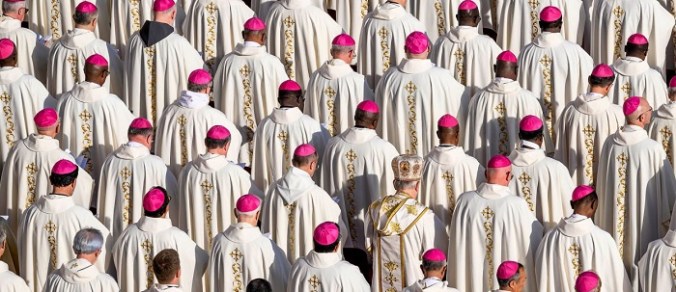
The cardinals even dress the part.
In some ways I miss the days of the Borgias and other failures. At least popes who turned their palace into open orgy festivals knew they were pretending to piety.
Second. Bravo.
I am eternally grateful to my mother and father that they were collectively a strong presence in our parish and our Marist Brothers’ boys’ high school, thereby rending my brother and I safe from being messed with by any of the priests or brothers. Predators prey on the kids who are, for some reason or another, essentially on their own and forced to fend for themselves.
The priest predators were protected for two reasons: one, the protecting priests were largely themselves predators and two, if the predators were jailed, there’d be no priests left to staff the church. It’s as simple, and cynical a problem as that: staffing.
Ooof. My brother and me. Sheesh.
Funny how the New York Times is content to cover for this new guy. I’m sure it’s because the new guy is a standard issue Commie and progressive, just like Frank was. Amongst the hipsters, Catholic priests are essentially given a pass and regarded as okay because they’re all gay and therefore part of the team.
I think “my brother and I” is actually more grammatically correct, at least from what I remember in English classes.
Pretty sure it should have been the objective GR. I was the object of my parents rendering. Mrs./La Senora Vargas. Sixth grade diagramming. St. Mike’s. Miami, Florida. 1962.
Not in this context. The easiest way to check is to take any additional nouns or pronouns out of the list and see how it sounds by itself. Take “my brother and” out. “Me” works but “I” sounds wrong
Grammatically, it’s the object of the verb, not the subject, if I remember the terminology correctly.
I agree that “… brother and me” is correct. It’s a compound Direct Object of the verb “rending” so it demands the objective pronoun.
Had the verb been some conjugation of the word “is”, the objective pronoun form would be correct. (i.e. “The people my parents rending safe were my brother and I.”)
–Dwayne
Grrr . . . “Had the verb been . . . , the subjective pronoun form would be correct.”
And to think I read it three times before posting, then saw it immediately once it was posted . . . .
–Dwayne