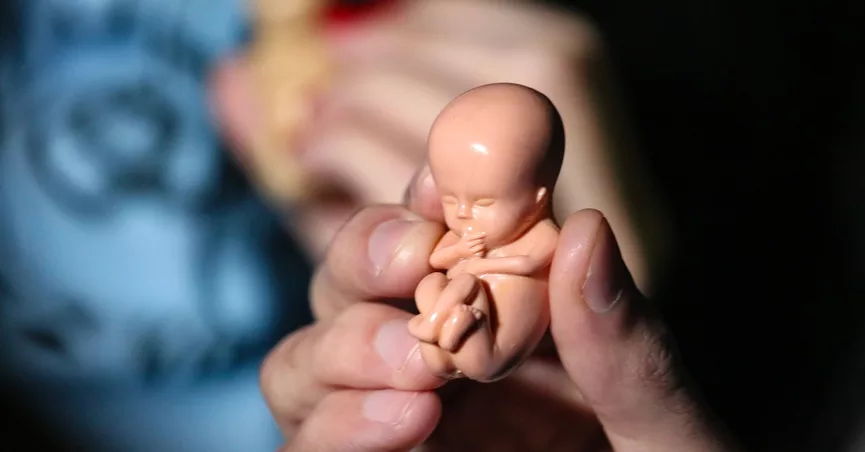
The topic is abortion.
This is discouraging, if not unexpected. After all, “The Ethicist,” aka. NYU philosophy professor Kwame Appiah, works for the New York Times, Where Ethics Go To Die. Nonetheless, the clueless certitude of his latest column is as offensive as it is indefensible for someone in the ethics field.
An inquirer asked The Ethicist “Does My Spouse Get a Say in Whether to Carry an Unplanned Pregnancy?” That framing alone was foreshadowing for what was to come; notice that the issue is a “pregnancy” and whether it is wanted. and not the snuffing out of a nascent human life, which is where this ethical conflict becomes difficult to resolve.
This time, I’m going to do running commentary on both “Name Withheld’s” query and Prof. Appiah’s answer. First, the question:
“I’m 46, unexpectedly pregnant despite having entered perimenopause, with three children already (the youngest is 4).” COMMENT: And your age and the number of children you have affects the right of an innocent life to continue how?
“My husband calls this a “disaster,” and believes abortion is the clear choice because we didn’t want another child or plan on this pregnancy.” COMMENT: Ending a human life is only a “clear choice” for psychopaths.
“I feel differently. Though I am pro-choice, the idea of terminating a pregnancy makes me deeply uncomfortable, and I’m afraid I would regret it.” COMMENT: If it feels wrong, that should be a strong clue that it is wrong.
“He thinks I’m hung up on the moral question. But doesn’t that indicate that keeping the pregnancy is the more moral option?” COMMENT: The dumbest line in “Airport” comes when pilot Dean Martin says to his mistress stewardess, who reveals that she is pregnant and says she isn’t sure she wants the baby aborted, “You mean you have scruples?”
“(We live in a European country where abortion at this stage is legal, so access is not an issue.) I’m taking the long view: Looking back at the end of my life, would I really regret one of my children?” COMMENT:It’s all about you, is it? Think hard now…is any other human being besides you and your husband involved?
“My husband’s arguments are that a baby will upend our professional lives, that he doesn’t want to return to the exhaustion and social isolation of early parenthood and that he’s unwilling to take on a full-time caregiver role again. We each work in a precarious field — humanities research and the arts — and it’s true we can’t predict how another child might affect our work. But I find myself wondering: Will I even remember, let alone regret, a “lost” year of work when I’m older? We have a stable family, as well as access to the financial benefits afforded to families living in a social-welfare state. Choosing to end this pregnancy feels like a decision based on short-term disruption, and that seems too small a reason.” COMMENT: Too small a reason to justify…do you need any more hints?
“Recently, our circle of friends has experienced real tragedies: the sudden death of a young mother, a severe stroke, the loss of a baby carried to term. These, to me, are true “disasters” — not an unplanned pregnancy.” COMMENT: Funny, isn’t it? When the baby is wanted, it’s suddenly a human being. When it is “unplanned,” there’s no human being, just “a pregnancy.”
“My husband’s most powerful argument (though it’s more a feeling than a rationale) is that he feels angry and powerless.” COMMENT: That’s his best argument for making you abort a baby?
“As someone who writes about agency and its absence in historical lives, I genuinely empathize with him.“ COMMENT: Have you ever written about agency and its absence in the case of the most vulnerable human beings, like, say, just to pick a wild example out of the air, the child you’re carrying, whose life is in your care?
Ugh. re-reading that drivel made my brain hurt. But “The Ethicist’s” reply is worse. It’s also long, so I’m going to omit extra verbiage here and there:
“Having a child…transform[s] not just your life but also a landscape of values: You come to care about someone whose existence previously wasn’t part of your world. And that care can be deep, irreversible and defining.” COMMENT: Sure sounds like a human life is at stake to me!.
“…That’s why, when your husband calls the prospect of another child a “disaster,” the word feels inapt. You’ve seen real disasters, and this doesn’t feel comparable. He’s worried about disruption: the toll on careers, on sleep, on a hard-won sense of stability. These are legitimate concerns. But you don’t see them as permanent in the way that having a child is.” COMMENT: Now, a real disaster is what occurs to a human being who is killed before he or she gets a chance to breath or see the light of day…
“… First, the decision is ultimately yours; it’s your body and you alone can decide whether you’re comfortable having an abortion.” COMMENT: Ah yes, the single body fallacy: so facile, and such a lie. Let’s do some ethical balancing, shall we? On one hand, Name Withheld’s comfort level. On the other, a human life’s continued existence. Tough one!
“Second, it’s a decision that will reshape a shared life, and your husband has a stake in that reshaping. He’s not wrong to feel conscripted into something momentous without his consent.” COMMENT: You know what other life is facing “reshaping”? The one that faces extinction.
Although you think that abortion can sometimes be justified, you sense that it involves a moral dimension, even if you’re unsure what that dimension entails. Psychological unease can linger when we act under moral uncertainty — not because the act is necessarily wrong but because we fear it might be. And this complication wraps around a question that’s deeply personal. You’re asking: Can I bring myself to step away from this surprising future that has suddenly opened up before me — perhaps for the last time? What has weight for you is the sense that you’re unlikely to regret this child, even decades from now.” COMMENT: You have to give this guy credit: he gives us all that ethics-babble without ever acknowledging the existence of the human being who is at the center of the moral question.
“And yet ‘regret’ isn’t the real axis of decision. Many women who choose abortion believe it was the right decision, and still understand that, had the child been born, the love and meaning the child would have brought to their lives would have been real.” COMMENT: Great, an “ethicist” stoops to “Everybody does it.”
“Like them, you’re choosing between two different futures: One contains a person whose life you will shape and be shaped by; the other preserves space, energy and attention for the people and commitments already in your life.” COMMENT: Again! The professor dodges the issue at hand: the two futures at stage for the living being with separate DNA from his or her mother. Will that future be a life of unknown promise, joy and adventure? Or part of the contents of a medical waste disposal bag?
Your doctors will have told you that at your age, you face elevated risks of miscarriage and of chromosomal abnormalities. There’s no guarantee the path ahead will be smooth, or even viable. That uncertainty can make the future feel both more fragile and more urgent. Wanting to sustain this pregnancy means acknowledging such risks and still feeling the pull.” COMMENT: Wanting to sustain this pregnancy also means acknowledging what an abortion really is. Why can’t The Ethicist do this?
“Your husband’s concerns, meanwhile, deserve real acknowledgment. He believed this phase of life was behind him, and the prospect of reliving it without any say in the decision is understandably distressing. Even if you separated, this child would still affect him, materially and emotionally. His frustration, you make clear, isn’t just about sleep or workload; it’s about agency. In a shared life, that matters.” COMMENT: Aww, poor baby. John Rawls would tell hubby to evaluate the situation from the viewpoint of one who doesn’t know if he is the father or the baby. Suddenly, it becomes a rather easy problem to solve.
“But in a shared life, it’s also true that sometimes one person feels something the other doesn’t — at least not yet. And still, you go forward together. That process may take time. It may involve grief, friction, adaptation. The hope isn’t perfect agreement. It’s that mutual care persists, even when agreement falters.”
Comment:
“Ullmann-Margalit wrote that big decisions transform us not just because of what they require but because of how they realign our sense of meaning. You’re in the midst of that realignment now. You are choosing between two possible lives — each with its own appeal, its own costs. You find yourself at a threshold. And whatever lies on the other side, you’ll meet it as the person this decision is already helping you become.” COMMENT: Choosing between just two possible lives? Something’s missing there…huh. What could it be? Prof. Appiah is evidently stumped!
If a professional ethicist can’t bring himself to clarify the central issue in abortion—that a human life is involved beyond that of the mother and father—because he is unwilling to verbalize uncomfortable truths that progressive can’t tolerate, then he is not only worthless and untrustworthy but craven as well.
 Ethics Alarms
“Funny, isn’t it? When the baby is wanted, it’s suddenly a human being. When it is “unplanned,” there’s no human being, just “a pregnancy.”
Which is the real litmus test between a person and a parasite in far too many decisions to abort. Is it wanted?
I wonder what would happen if people looked at animal, children outside the womb, the sick and the elderly that way?
COMMENT: The dumbest line in “Airport” comes when pilot Dean Martin says to his mistress stewardess, who reveals that she is pregnant and says she isn’t sure she wants the baby aborted, “You mean you have scruples?”
That line isn’t dumb, it is implicitly, firmly, pro-life.
Unless the writers didn’t realize what the were saying. Then it is the dumbest.
Dean’s tone is as it would be if she had said she had three nipples.
The Ethicist should change his title to something like “Fortune Cookie Ethics” or “Horoscope Ethics”.
“My husband’s arguments are that a baby will upend our professional lives, that he doesn’t want to return to the exhaustion and social isolation of early parenthood and that he’s unwilling to take on a full-time caregiver role again”
Early parenthood? Your’e 46 years old and have a 4 year old? Who’s the full time caregiver now for that child? He [and you] are not very good at this not wanting to have more children thing.