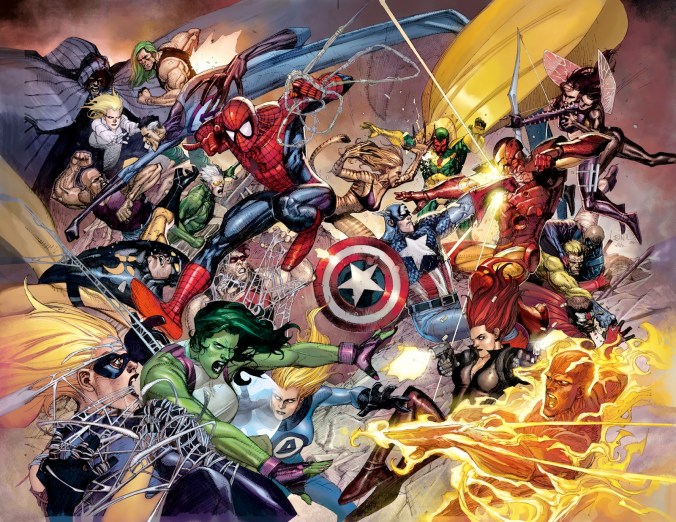
The “Jaws” post, predictably, set off a lively debate about cultural icons, though, significantly, nobody yet has tried to maintain that “Jaws” isn’t one. Along comes halethomp with this Comment of the Day exploring the matter of whether Disney’s Marvel movies, now in decline, qualify as “iconic.” Personally, I don’t think so. There are iconic super heroes to be sure, but perhaps because they were late to the party, no Marvel character qualifies to stand next to Superman and Batman. No single film qualifies either in that genre by my standards: I think TCM host Ben Mankiewicz nailed it when he compared the Marvel film franchise to MGM musicals. Both genres have intense, loyal devotees, but neither has produced a societal- and culture-wide icon. Maybe “Singing in the Rain,” qualifies, but its a close call. Icons create lasting images, quotes, values and lessons that cross generations, ideally gaining vigor over time and becoming powerful cultural influences. Personally, having been familiar with the principle that great power confers great responsibility from other sources, I have been surprised that Spiderman’s Uncle Ben has been getting credit for it. No, I don’t think resuscitating a classic maxim that younger generations missed because of galloping illiteracy should qualify one for icon status, but that’s just me.
Here is halethomp’s Comment of the Day on the post, “Jaws Ethics.”
***
Two quotes within the original post and the comments stood out to me as examples of the cultural arrogance that Jack often laments, both applying to the Marvel franchise (I include the various streaming series in this). “A competent, curious, responsible member of society wants to see “Jaws” because 1) it is famous 2) it is a cultural touch-point 3) one should understand why people remember and care about it and 4) when the public embraces anything so completely,” and “Marvel movies like their predecessor print comics are just good versus evil with different characters.”
First, regarding cultural impact, there are few as great as the line “With great power comes great responsibility” which Uncle Ben tells Peter Parker just before dying. I believe a great cultural reference is one that most people know regardless of whether they know its origin. It is not necessary to have ever read a comic book or seen a superhero movie or cartoon to know that quote: in fact, it has been applied and misapplied by many people for generations. In Jack’s own words, Marvel must be recognized as a cultural touch-point.
With regard to this blog, Marvel movies and television shows should be required viewing for their ethics implications. I have not watched all of the Marvel programs. I have no interest in Ant Man, Doctor Strange, Ms. Marvel, etc. However, the best ones represent not just conflicts between heroes and villains but within individuals and society at large, and provide a visual, cultural reference to real conflicts that have existed in our society in parallel with those of the comics and screens.
The first lies with the quote “with great power…” “Street level” heroes (Spiderman, Daredevil, Power Man/Iron Fist) as well as DC characters like Batman deal throughout with the question of vigilantism. Is it OK to act outside of the law if you turn the bad guys over to justice in the end? If you have this great power, can you look away when you see bad things happen because society hasn’t empowered you to act?
As vigilantes, the hero often spawns copycats who either wish to emulate the hero, as in Batman: The Dark Knight, or those who believe that the hero doesn’t go far enough, i.e. The Punisher. This may seem to some to be mainly a comic book issue, but it reflects the rise of terrorists, many of whom begin as activists. As activists they become frustrated by the lack of results of protests and move to direct action: bombings, hostage taking etc. (interestingly enough there was a terrorist organization named Direct Action).
Regarding the more powerful heroes (Superman, the Avengers), the question throughout the comics and movies is whether those with power should be free to use that power and decide when and where to act. What happens when the use of that power results in death and destruction? Should they be under some government control and if so, which one? What happens when you give a government, council, etc. that kind of power, and what happens when those thinking individuals refuse to be controlled? I think we can all see where these questions apply to the use of our bombers to strike the Iranian facilities. No matter which side you are on WRT the strikes themselves, most thinking people can recognize the ethical questions surrounding the strikes.
Now let’s look at the villains and their actions. The most prominent so far has been Thanos, who wiped out half of the population because he believed that the universe was over-crowded, resources were stretched too thin, pollution was making habitable planets unliveable. There are advocates of this thinking in the world today. Endgame actually addressed the effects of the population loss: the air was cleaner, whales were spotted in the Hudson river. However, the environmental effects could not compete with the depression felt by the population over the incredible loss of humanity. Humanity would prefer to restore the status quo, with all of the impacts, than kill off half of humanity to fix them. The fixing of problems did not justify the removal of half of the population.
Falcon and The Winter Soldier explored the after-affects of restoring the human population after a 5 year absence. With a need to replace the lost workforce countries invited workers from all over the world, provided housing and jobs and pay, to ensure that essential industries could continue to produce. The return of the population saw these same countries face the problem of who to prioritize: those who were missing or those who kept the economies going while they were gone? This ethics conundrum is a reflection of our own country’s experience during and following WWII. The men were shipped off to war and the essential industries turned to the only remaining workforce: women and minorities. This workforce kept the wartime industries running, built ships and planes and tanks, ensured much needed supplies made it to the front lines…and were dismissed when the war ended and the troops returned.
Nemo, the villain of Civil War and others, seeks revenge for the death of his family, caused by the actions of The Avengers in Ultron; The Kingpin, played impeccably by Vincent d’Onofrio in the Netflix and Disney+ series and just as well by Michael Clarke in the Daredevil movie, acts not only as the head of a criminal enterprise, but also from a belief that he can restore order to a dangerous city.
Throughout we see the manipulation of media, the best and worst of politicians and populations, the growth of terrorist groups, self-righteousness and revenge. We see the consequences of the actions of super-powered individuals on the common man, and we see it first from the perspective of the hero who must act against an implacable foe, then from the perspective of those helpless against the incredible forces brought to bear.
Finally, the use of CGI. I will admit that I find the use of CGI to be a bit much, but Jack dismisses the MCU as just CGI-driven, low-brow entertainment. If this were the case, Transformers would be the most popular movie franchise in the world. However, I would argue that CGI is just the latest attempt to visualize for the audience the stories imagined by their authors. From the time of storytellers creating shadows on the wall, to the use of lighting tricks for the stage, stop-motion animation (and animation in general) creators have sought greater and more effective special affects to bring their vision to life. I can imagine a theater goer in 1870 complaining about the use of lighting in the theater “in my day the actors could transport you through the strength of their voice. They didn’t need all these lighting gimics!”
But, if you would like to dive into the MCU without the CGI, I would recommend the Dardevil series. Originally on Netflix, now on Disney+.
 Ethics Alarms
Marvel movies are definitely iconic. They defined the interconnected universe culminating with End Game, there were cultural milestones like Black Panther, a huge global influence, now there’s cultural references everyone knows like “I am Iron Man” and the Thanos snap. You can’t meet a child or young person who isn’t a fan or isn’t wearing some sort of Marvel shirt.
It’s ironic only “old things” are iconic but nothing new…said the old people. Sigh. Nothing new.
I direct you to Bad Bob’s observation, and also to look up “fad” and “cult” and “Ozmandias” (and no, I do not think “Watchmen” is iconic.) I will be surprised if any of the Marvel movies are being widely watched or talked about even 20 years from now. I’m not saying it’s impossible, just that I will be surprised.
I don’t expect anything in the Marvel Cinematic Universe to reach “Jaws” level of classic, but I expect the outfit as a whole will be studied in future film classes. It was a fad unlikely to be duplicated, but the reach it achieved at it’s peak should keep it alive as a media study.
Studied in film classes? Absolutely
I don’t think icons are created overnight.
When I saw Jaws as a young person, I never thought anything in the movie would be used literally decades later.
And, as a Marvel fanboi from the time of my youth (about the time of Jaws, ironically enough), none of the Marvel characters are to me iconic, except perhaps Spider Man, and I don’t equate it to the movies.
The great power one is, frankly, lame. Not that it’s not a neat quote, but it feels awfully trite as related to the movie and trying to carry it forward off of that.
The iconic Spider Man phrase is “Spidey Sense”. I’ve heard it from people my age (yes, I’m old now) as well as a couple generations behind me. And those are the generations that wouldn’t necessarily be comic fans, because the industry pretty much died between “me” and the first Spider Man movie.
I think icon status takes a while to grow.
I agree.
Not just icon status, but even status of “being remembered 40 years later” takes a while to become apparent.
Steve Martin gave a public talk once (I heard it on NPR, probably from their archives) and he was discussing the…”lodged in the public consciousness” factor. It was ameandering talk, I caught only fragments of it while doing chores.
Related to our topic du jour, he was discussing movies. Martin noted that some movies are commercially successful and critically well-liked, but 20 years later they are forgotten. You mention the movie at a party and get a blank stare. You try to jog peoples’ memory but they don’t remember it, neither do any of their friends, you have to look the data to prove that the movie ever existed, who was in it, did it make any money, etc.
There are other movies that are critically lambasted when they come out, and economically they fail, but 20, 30, 40 years later they still occupy space in the public consciousness. Their trajectory varies. Sometimes they endure as cult films, other times the plot or some fragments of dialogue are viewed as still worth remembering.
charles w abbott
rochester NY
He may have been late to the party, but I think Spider-Man will persist in the legendary heroes pantheon alongside Batman and Superman. In movies alone the first Tobey Macguire Spide-Man movie set the trajectory for the character in the general public eye the same way Michael Keaton’s first Batman movie did. Then you have the Spider-Verse movies with animation techniques that should cement them in film history.
The character himself has appeal that crosses generations just like the other superhero greats, albeit for different reasons.
lasting images
Spider-Man in his red and blue costume swinging through New York like Tarzan swinging through the jungle.
quotes
I fancy myself pretty literate, but the only place I’ve seen a quote like “With great power comes great respsonsiblity” besides Uncle Ben was the movie “Teen Wolf”. “Spider-Sense is tingling”, easily applicable to any sense that something’s not right.
values and lessons that cross generations
Doing the right thing even when you get no praise for it. Moreso than Bruce Wayne or even Clark Kent, Peter Parker is a near-perfect everyman character. He doesn’t have a billion dollars or even a secure reporter job. He’s a photographer getting paid per picture by a newspaper that regularly criticizes his alter-ego. Speaking of which, Parker’s one of those heroes who suffers the most for his heroics. He gets beaten up on a regular basis both literally in costume, and figuratively out of it. Yes others play the trope of superhero work putting severe strain on one’s school life, social life and professional life, but Peter is (usually) a young adult who doesn’t have the resources to alleviate these pressures that other supers do. His suffering makes himr relatable, and the fact that he soldiers on anyway makes him admirable.
Part of the problem for Spider Man was that he couldn’t translate well on screen until the advent of pretty sophisticated CGI.
Superman and Batman didn’t have that problem, and were in movies and TV early on, and at a time when viewing entertainment choices were much more limited. So, a bigger portion of the audience would’ve tuned in.
They both literally have decades of “fairly constant” exposure, from comic books to screens.
Comic books were dying as other forms of visual media were exploding between the mid 80s (when comics were dying off) and the Spider-Man movie, and it’s my generation that went, and took their kids, to see the first Spider-Man/marvel movies. They really didn’t have any exposure between, and I think that hurts their chances.
Because of those factors, I don’t know if Spider-Man (and the rest of the Marvel stuff, which really needs the CGI to be compelling on screen) can reach icon status.
I do agree that Spider-Man is at least as compelling a character as Superman and Batman, if not a little moreso because of his everyman nature and his constant short end of the stick circumstances. And I think that comes though better in the comics than the movies.
Because of that, I think the Marvel stuff misses icon status. And at least in the case of Spider-Man (my favorite), I think that’s a bit of a shame. I hope I’m wrong, btw.
If any of the Marvel cast reaches icon status, it will be Spidey. I’ve used variations of “My Spidey sense is tingling,” and catch lines help, but one line alone doesn’t make one an icon.
Spider-Man has at had a decent representation on small-screen, which is another contributor in him staying relevant. I didn’t read superhero comics much as a kid, so my first real intro to Spider-Man was the 90s animated series. The 3rd movie took direct inspiration from that series for certain features in the symbiote storyline. There have been plenty of other Spider-Man cartoon series since, ranging from forgettable to mixed reception, but Disney’s Spectacular Spider-Man blew fans away (that Spider-Man had a speaking role in “Across the Spider-Verse”). Even if the movies never happened, Spidey would still be known through the cartoons.
Well articulated Halethomp. It made me rethink what it means to be an icon. I tried to reply to your original comment but after a lengthy response using my Iphone I tried to make an edit and WP erased every bit of text twice. When I rewrote it on my computer WP decided to tell me to log in because I was not using the correct log in credentials – I do not log in to WP.
Suffice it to say your comment made me come to a more nuanced evaluation of what is an icon. So congratulations on your COTD.
Fascinating discussion. I have never been a big superhero type fellow. I enjoyed comics in the 1970s, especially the artwork, but they just didn’t appeal to me. I was more interested in music.
Your comment makes me think I missed something when I was growing up.
jvb
PS: “Halethomp” is a cool name.