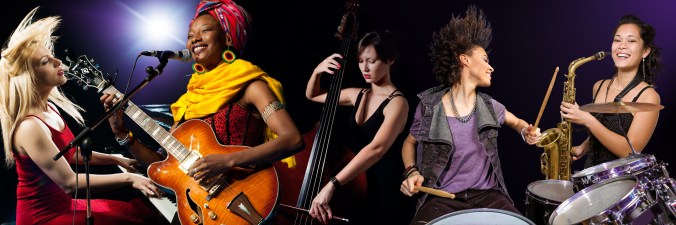
The recent essay about the efforts of an apparently bonkers music school to apply DEI policies to the jazz world was really a “Bias Makes You Stupid” post, and perhaps I should have framed it that way. After all, nobody, no institution, no profession, no workplace “needs” DEI discrimination. As my father would say, the nation and society need DEI “like a hole in the head.” In fact, DEI is a metaphorical hole in the head of the nation allowing core American principles to leak out.
I found Sarah B’s Comment of the Day, prompted by Chris Marschner’s comment regarding the correlation between jazz improvisation ans mathematics ability, both fascinating and, as usual with Sarah’s comments, illuminating. (I also found the context of her use of the phrase “toot my own horn” brilliant. )Here it is, in response to the post, Does Jazz Really Need DEI?:
…
As a woman musician and mathematician (my husband would claim engineers aren’t mathematicians, but the lay person sees no difference), I think there is one aspect of Jazz that you are forgetting. I tried Jazz and not only do I hate the sounds of Jazz (I like Chopin, Beethoven, and Holst as my personal preference), but I also found the emphasis on improvisation impossible. I cannot improvise music, or anything really. I have no skill at making up music, though if you give me sheet music not horrendously above my level, I’ll play it for you, at least with adequate practice. I can sing nearly anything (in my range) that you can throw at me in at least seven different languages, and with a little time, I can do them from memory. I have a repertoire of several hundred songs that I can pick up and perform adequately on a given day without much more than a little warmup. I read soprano and bass clefs before I read English (my only language). I dabble in 7 instruments, with 2 of those mastered “enough”.
All of this is not to toot my own horn. I have much I could do to improve my music, but I have other priorities and I am happy at “good enough”. However, with all this musical study, I have found that while I can do a lot, I CANNOT improvise, nor can I make up my own lyrics. This means that Jazz musicianship is beyond my reach. It takes a different type of mind than mine to be a good Jazz musician, and not just someone who knows the math and the theory. There is another element besides musical and mathematical thinking, that of a certain type of creativity.
This is an area that I am deficient in for many disciplines. I can knit, crochet, cross stitch, and embroider a hundred different patterns, but I cannot make my own pattern to save my life. I can take a basic programming language and instructions for a set of functions and program up a large variety of operations, but I cannot write a full program from scratch. I can critique mathematical proofs (at my level, not that of my husband’s doctorate), but don’t ask me to write one. I can cook or bake from a recipe, but I cannot throw food together and make it work. Don’t ask me to decorate, as I cannot create a vision and make it come to fruition.
In addition to this, most girls choose instruments in a band (or in rich communities, orchestras) that are not sterotypically Jazz instruments. Flutes, Clarinets, Piccolos, Violins, and Oboes were the majority female instruments in my middle, high school, and college experiences. Males tended to choose the heavier instruments. As a French Horn player, I can tell you that I was an anomaly. There were a few girls who played alto sax, but tenor saxes were almost typically male. No one told us that we couldn’t play the other instruments, but these were the instruments we chose, not unlike the choice between teaching and engineering. Women make choices based on interests, just as men do, and our agency should not be denied for “equity”.
There have been some issues in the past with the equality of musicianship. Compare the famous Robert Schumann and his wife Clara. I would say that Clara has the more interesting and challenging pieces, but Robert is the one that everyone knows about. He was more socially acceptable and highly thought of than his wife, which may or may not have contributed to his significantly larger number of compositions, which may or may not be why he is more highly regarded. Indeed, for the longest time, male composers were approved of, but women were forbidden the art. We can say this for nearly any profession in history, however, including teaching, whereas today the majority of teachers, at least in the lower grades, are female. Historical precedent does not equate to today’s reality. We have made huge changes in society.
Some women have creativity in the kitchen, but not in sewing, others can sew without a pattern and never do anything but burn food. Others excel at all of the above, so I don’t necessarily think that creativity is lacking in the feminine as a whole. However, the subset of women who like Jazz, have the ability to play the instruments that are Jazz oriented, and have the mathematical, musical, and creative skills to excel in Jazz are few, not even counting the women who wish the work of Jazz, as mentioned before, in smokey bars and long road tours not conducive to the family that many women want. This does not mean there is an equity problem in Jazz or that the patriarchy is destroying everything and we have to rewrite the entire societal contract to give women a leg up on something they don’t want/are able to compete in. Merit and skill should be what we deal with, not some statistical version of “equality”.
 Ethics Alarms
an indepth self examination, only to say that each and all have unique gifts. these gifts, skill, capabilites, do nto derive from college studiieis. Albeit they can be improved by studies but more often they are improved by practice.
No amount of DEI qualifaction changes that reality
True. Neil Peart wrote that we can twist perceptions but reality won’t budge.
jvb
Delightful, Sarah. As usual around here, the heavy hitters produce expertly crafted essays on topics I spitball.
It’s my understanding Clara Schumann was a vastly superior player than Robert was and she debuted all of his work. I was marveling about that to a concert pianist once, wondering how, given all her domestic responsibilities she had time to practice, to which the concert pianist said simply, “She didn’t need to practice.”
I don’t know why the article focused on Jazz.
Google “100 greatest composers of 21st century” and you’ll be able to pick from a list. Regardless of your pick, you’ll find that upwards of 70% of composers are male, regardless of genre.
And that should surprise because I believe women actually overrepresent in music, generally. I think there’s something to what Sarah said, and that women will tend to have a better time playing music than writing it, and that this ends up with women disproportionately self-selecting out of genres that rely on a lot of improvisational writing.
This is another example of the paradox of sex self-selection: Social scientists (if that’s not a contradiction in terms) expected that as women were more empowered to make their own choices in life, they would choose to disperse into the job market roughly the same way men did. This didn’t happen. As women are more empowered, their work choices become more disproportionately out of line with men’s choices. Some of that has to do with biological realities or the difference between male and female intelligence curves, but in very general terms: Women tend to like different things than men do, and it leads them towards different career paths. While it might be great if women had equal attendance in STEM, as an example, even if you were willing to give 100% affirmative credit to admissions, the applications often just aren’t there.
And I don’t know, even if one were of the mindset that this was a problem in need of equitable correction, how you’d go about doing it. Do you hold a gun to someone’s head and force them to play jazz? Make them do math? That doesn’t sound very empowering.