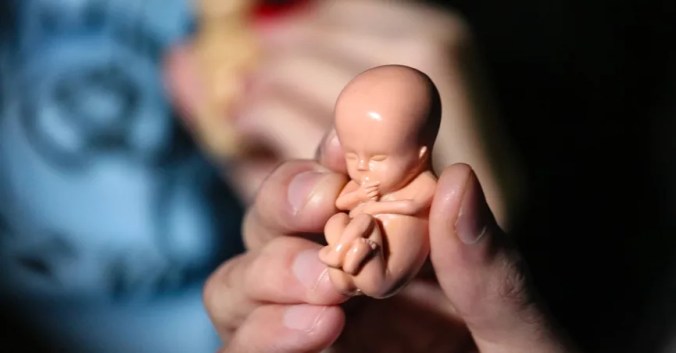
Ok, explain this: In the UK abortion is generally permitted up to 24 weeks of pregnancy, with some exceptions for special circumstances. Now the UK has extended its bereavement laws for miscarriages, which currently is two paid weeks off if the unborn child was 24 weeks old, to a week of paid bereavement for an unborn baby who is less than 24 weeks old.
Got that? A mother can kill the gestating embryo if it’s less than 24 weeks because that child is not viewed by the law as a human being worthy of protection, but if a child of the same age dies of other causes, it’s human enough to warrant bereavement benefits. Actually, I’m not sure if a mother who kills her child legally can still claim bereavement benefits. I don’t see why not.
Musician and broadcaster Myleene Klass, an activist who led an awareness movement in Great Britain, has said, “You’re not ill, you’ve lost a child, there’s a death in the family.” Why is it a death in the family when the child dies in a miscarriage, but just a matter of “choice” when the death is engineered by the mother herself?
“It’s a taboo,” she added. “Nobody wants to talk about dead babies – but you have to actually say it as it is. To lose a child is harrowing, it’s traumatic.” Well, it’s harrowing when the child dies of natural causes. When the cause of death is an abortion, it isn’t a child at all. Or something.
If there were any honesty and integrity in the abortion debate, the pro abortion movement would be recognized as not having an ethical leg to stand on.
 Ethics Alarms
My wife and I are at 24 weeks tomorrow on our fifth child. We just sat through the ultrasounds where they took all kinds of measurements to make sure the baby is developing well. We could see Quintus’ face, heart, hands, legs, and spine (though we deliberately asked not to try to sex the little peanut, since we like that to be a surprise at birth). Quintus (and by the way, that’s just our affectionate way of referring to the baby until the sex is revealed; currently we’re looking at either a Maximilian or a Kiara) would shy away from the ultrasound, not liking the jostling and the vibrations, and apparently managed a few well-placed kicks, according to my wife. It is so unbelievably difficult to understand, truly understand, how anyone can dehumanize a baby just because it is still in the womb, especially as late as 24 weeks.
I would not be surprised to find out many women who procured abortions in the UK take advantage of the week or two off. It is just additional windfall, right? No baby to take care of, and some R&R to go with it. But I can also wonder if this bereavement policy was a pro-life push to try to force that exact conflict between aborting a baby at 24 weeks, and getting 2 weeks bereavement if the baby dies at 24 weeks. The biggest pro-life argument remains, “What is an abortion? What is it that is being aborted?” This seems like a measure to make people really ask what it is that is being aborted at 24 weeks, when the nation has on the books a policy that says you are bereaved of a family member if that pregnancy ends in the death of the baby.
In an effort to helping grieving would-be mothers, they have made it glaringly obvious that a significant number of abortions are performed because the baby is not wanted, not because it isn’t a life.
There is no sense in the caldron of immorality. The immoral act proffered agaisnt another person, or even an animal, denies the perosn his perosnhood and the animal itss animalhood. But that only makes sense to the moral person.
We know that in some us jurisdictions causing the death of a pregant mother and her child is often prosecuted as a double homicide. That is morally correct. However, too makes little sense to the immoral.
It is my understanding from canonical law that law whcih permits must be apllied generosly, whereas law that restircts must be apllied restrictivly. And all law must be apllied equally. Thus ,these laws which permit bereavement leave must be applied equally and generosuly.
24 weeks does seem a rather late for an abortion, since the quickening has probably happened by then.
Be that as it may, I don’t think is hypocritical for the government to allow bereavement for an event that some people choose to cause voluntarily. The experience of bereavement is almost inherently subjective; it is the aftermath of a strong emotional attachment being severed. Just because some people have not developed that attachment does not mean other people do not deserve time for bereavement in the same circumstance. Some people have disowned their parents; does that mean that others shouldn’t be allowed to attend the funerals of theirs?
Funerals are for the living, and so is bereavement. In other words, the bereavement leave for an early miscarriage is for the benefit of someone who had become emotionally attached to the potential future child who may not yet have started existing as an individual person. The child may not have existed, but the emotional attachment did, and that’s why the bereavement helps. It’s for the same reason that people often need emotional support after finding out they are infertile, even though they did not have any children whose deaths to mourn.
I think whether an early miscarriage falls under “bereavement” or “medical leave” is a matter of culture. Cultures with high infant mortality rates would hold off on naming babies until they were a certain age, to avoid emotional attachment. I suspect they would feel similarly about early miscarriages. As with many life events, how an early miscarriage is treated is a combination of how individuals feel about the situation and how their culture prescribes they ought to feel about it.
Human consciousness and identity has more distinct aspects and gray areas than a lot of people are willing to admit, possibly because it makes the ethics of life and death murkier and more subjective to navigate. Nevertheless, this is what ethics looks like when we strip away simplistic assumptions about the ethical weights of various kinds of entities. Such assumptions can be useful guidelines for creating rules that maintain societal trust, but there are important questions that can’t be answered correctly under them.
Maybe an infant can be both alive and not living simultaneously on your planet, EC, but not on this one. Laws can’t have it both ways (have their fetus and kill it too). Either a 26 week-old unborn child is a human being alive enough to be mourned when it dies, or it isn’t a human being and can be removed like a wart. One or the other. Not both.
It is both since women who have abortions can feel guilt, remorse, depressed, etc even after choosing to have one.
Marisa,
I would argue that it can’t be both. The subjective experience of guilt, remorse, and depression does not determine whether an unborn child is a human person deserving of the right to life. Women who have miscarriages also experience guilt, remorse, and depression, especially since many wonder if something they did caused the miscarriage.
I could also argue that the remorse and guilt many post-abortive women feel could be an indication that they understand that they actually did kill an individual human person, not some inhuman clump of cells. But that argument is undermined by the women who claim they feel nothing but relief over their abortions. Or those women who feel nothing but relief over their miscarriages.
The ethics of abortion cannot rest on the subjective experience of people. It has to rest on whether or not the unborn have the same right to life that the born have.
That’s not what “bereavement” means, Marissa.
It is both since women who have abortions can feel guilt, remorse, depressed, bereaved, even after choosing to have one.
So do you give an employee bereavement leave after she kills her husband?
The law has to decide if the fetus is alive or not. Simple as that.
It’s pretty simple. The fetus is not a person. It has living cells, but a person’s mind hasn’t started living in it yet. Until it does, there are no laws protecting it.
However, when a pregnancy ends–naturally, accidentally, or artificially–that affects the emotions on both the psychological and the physiological levels. I’m not a doctor, but I imagine that suddenly not being pregnant triggers a hormonal shift. It does that even if someone successfully gives birth. Plus, even if someone does not consider a fetus a person, most people still imagine and grow somewhat attached to a set of potential futures with their theoretical child. Rejecting those futures is a heavy decision for most people. I’d consider it a good idea to give people time to recovery from that.
Besides, even if laws do not recognize a fetus as a person, isn’t it ethical to allow bereavement for those who believe it is one? Are you arguing against that?
EC,
You stated that “Funerals are for the living,” which to an extent I won’t disagree. There is definitely an aspect for the living, especially in making a formal “goodbye” to the deceased. However, did you know that Catholics believe that funerals are for the deceased, as well? The funeral Mass and the prayers at the burial site are actually said for the benefit of the deceased, commending the deceased into the God’s mercy, and offering intercession for the deceased should the deceased find himself in Purgatory. Of course, if the deceased is in Heaven, such prayers are not needed for him specifically, but can still be expiatory for the souls in Purgatory in general, and if the deceased is in Hell, the prayers can’t help him. But since it is not given to us, usually, to know whether the deceased is taking the up or down escalators, the Church prays for all the dead.
Historically, I believe you’ll find many beliefs that show funerals are not simply for the living. If I understand them correctly, Egyptian funerals prepared the deceased for their journey through the underworld, equipping them with the materials they would need, including a Book of the Dead, with the spells the deceased would need to answer the challenges of various figures they would encounter in the underworld.
I will agree, though, in our post-modern, secular society, that bereavement policies and funerals have become aimed at the survivors only. I think that’s to our detriment, but that’s another discussion altogether.
Just to put these comparisons of 24-week ending of pregnancy in context, both miscarriage and abortions at this stage are very rare.
I know this is about the UK, but let’s assume for now the rates are similar to the US.
In 2022 in the US, 92% of abortions were in the first trimester (first 13 weeks, which depending on how weeks are counted, may be 11 weeks of pregnancy + 2 weeks before conception). Only 1% of abortions occur at 21 weeks or more.
80% of KNOWN miscarriages (after pregnancy has been confirmed) occur during the first trimester. Important to specify “known” because it’s estimated that about half of all pregnancies end spontaneously in the first 6 weeks, when most women don’t know they are pregnant, and assume the miscarriage bleeding as (perhaps slightly delayed–lots of women have irregular menses) menstrual bleeding.
Stillbirth (which is what the article I read termed miscarriages after 20 weeks gestation) are less than .01% of births, so, like abortions-by-choice, quite rare.
So you are comparing two quite rare events.
Looking at the rates in the UK, I found some statistics that place abortions at or after 24 weeks at about 260 a year. I also found that the number of murders annually is about 590. This places both late term abortions and murders on the same order of magnitude. So one could reasonably argue that murders in the UK are quite rare.
What does this mean? It means that rarity is not a sufficient measure for ethics. Rarity might be a factor in ethical triage, but it also has to be weighed against the severity of the action in question. Defrauding people of millions of dollars is fairly rare, too, but I doubt anyone would base an ethical analysis of defrauding people on how rare the level of fraud is.
Rarity also ducks the main ethical conflict in this situation, which is allowing laws on the books that that deny any right to life for the unborn, while also allowing laws on the books that treat the unborn as any other human being. If the unborn do not have the right to life, then a bereavement policy is incoherent. Certainly the mother experienced trauma, but if there is no human life involved, it can’t be bereavement. If the unborn do possess that right, then laws that allow them to be intentionally killed to achieve an end are incoherent.
I suppose I could also explain some premises I’m using. A human being possesses an unalienable right to life. This means that it is wrong, or as EC would term it, a breaking of societal trust, for another human being to deliberately deprive a human being of his life. Therefore a law that permits abortion must deny one of two things. Either it has to deny the unalienable right to life, or it has to deny the humanity of the unborn. Most arguments defending abortion reason from the latter, because reasoning from the former ultimately fails to assign any unalienable right to life to anyone, and most people find that conclusion untenable.
Thank you that’s helpful information. I was finding UK statistics a little harder to come by. Did you happen to also come across any information about the circumstances of those very late abortions? If a pregnant woman’s own life is in danger, does that affect your assessment?
Not to be one, but so what? The issue at hand in the hypocrisy of the law saying that the human rights of the unborn depend on whether or not the mother wants to kill it or not. “It’s rare” is a rationalization: it doesn’t make the dishonesty any more tolerable.