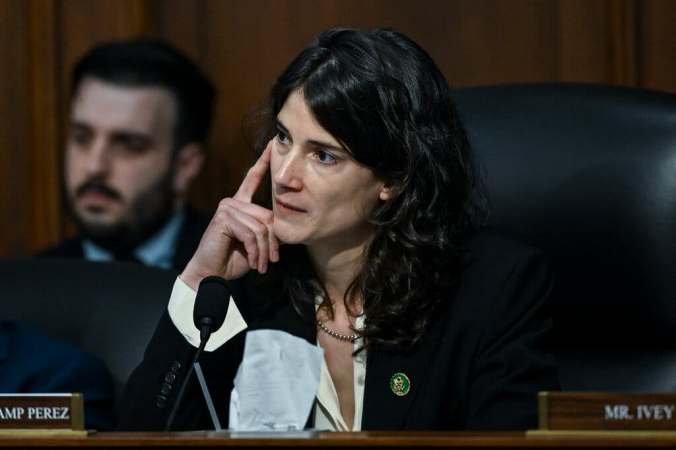
Perez, a 37-year-old auto shop owner, second-term congresswoman and co-chair of the center-leaning Blue Dog Coalition, horrified colleagues on both sides of the aisle by offering an amendment to the “Legislative Appropriations Act”, H.R. 4249. Her addition would have required Congress to create basic guidelines in Congress to ensure that members were able to serve the public “unimpeded by significant irreversible cognitive impairment.” The amendment was unanimously rejected, but she is not giving up. In a poll of the 230,000 people who subscribe to her newsletter, more than 90% supported the proposal. Perez says her constituents raise the issue frequently, and their belief that elected officials are frequently too impaired by age to be effective is causing spreading distrust of our government.
Gee, I can’t imagine why they would feel that way…
 …but I digress.
Rep. Perez noted that she found it disturbing that among the oil paintings of the past chairs of the powerful Appropriations Committee is a large portrait of Kay Granger, the former Republican congresswoman from Texas who suffered from mental decline for years when a conservative news outlet found her, at the age of 81, living in an assisted living facility that included a memory care unit while she still held office.
There are now more members of Congress age 70 and above than ever before, while the second oldest President ever to serve is in the White House. Perez insists that there should be standards that prevent members from serving past the point where they no longer have the capacity to cast votes and do business on behalf of their constituents.“It’s a question of whether the elected member is making the decisions,” Rep. Perez said. “It’s really not about a single member; it’s about a systemic failure.”
Bingo.
 Ethics Alarms
Here’s the full text of that proposed amendment: “Clarity and Acuity for Constituent Representation: Direct the Office of Congressional Conduct to develop a standard for what constitutes conduct that does not reflect creditably upon the House, as it relates to a Member of Congress’s ability to perform the duties of office unimpeded by significant irreversible cognitive impairment.”
If her intent was for the ouster of those deemed mentally unfit, then she should have proposed an amendment that provided for that. She didn’t.
Is it even possible to create the standard she proposed? Doubtful. One could, perhaps, create a list acts that do not reflect creditably upon the House. One could then, perhaps, refine that list by labelling specific acts on the list as relating to cognitive impairment, and call that the standard. But, how could any such act be considered to the due to “significant irreversible cognitive impairment”? How would it be distinguished from a one-time rant, or a series of misjudgments over a limited period of time.
Assuming that a reasonable standard somehow was created and a member was believed to be in violation of that standard, then what? She doesn’t say.
Given the virtual impossibility of developing the desired standard, and given that there is no provision for acting on a violation of that imagined standard, I cannot see how this is an ethical proposal.
You’re right of course, but I give her Ethics Heroes props for even raising the isuue. She’s bucking some of the most powerful elected officials in the country, in both parties.
She took office in 2023 (re-elected in 2024). Had she raised the issue then or in 2024, she would have been a leader on the issue and her hero badge would shine more brightly.
Also, the amendment was not to the “Big Beautiful Bill” AKA H.R.1, but to the “Legislative Appropriations Act”, H.R. 4249 which, when combined with a similar Senate bill, provides funding for Congress, which makes Chris’s point below even more poignant.
1. Thanks, incidentally, for tracking down the amendment and the bill. I wasn’t concerned with either, since the point was that she raised the issue in an official act, but still, your contribution makes everything clearer. Naturally, my mains source for the story mentioned neither the bill by name nor the text of her rejected amendment.
2. To be fair, a) no freshman House member would (or should) dare making such an issue public unless she wanted to end up on the House Styrofoam Garbage Committee or something equally marginal as her only assignment, and b) I’m sure it took a while for her to realize just how bad the problem is.
#2 – I agree for would, not so sure I do for should. Might have been political suicide, but, it would’ve been, I dunno, kinda heroic, ethically.
#1. I think I mentioned on here previously that a major grad school failure for me was not going to original sources. That still haunts me sometimes.
How would such an amendment be related to the budget in this reconciliation bill? The Parliamentarian had had nixed a bunch of other amendments that were believed by her to not be appropriate in a this type of bill. It is hard to tell whether this is grandstanding or even if it was voted down because it was not budget related.
“where they no longer have the capacity to cast votes and do business on behalf of their constituents.”
And what state security apparatus will make *those* decisions and how quickly will progressives infiltrate and control that institution?
No thank you. Good sounding amendment with terrible implications.
If the electorate wants to keep voting in the mentally incapacitated then so be it.
I see no reason why all candidates for high elected office shouldn’t be required by law to take a simple cognitive function examination that must be publicly disclosed, since we obviously can’t trust the officials themselves to be ethical and transparent.
Oh the doctor who administered the test is a known Democrat donor!!
I know that doctor he’s a complete MAGA shill!
How could that ever be Constitutional, absent an amendment? Pretty sure the Supreme Court has ruled that States cannot add qualification requirements beyond what’s in the Constitution. Could Congress by legislation? I doubt it. Maybe public pressure could make it so, same as releasing tax returns – oops – wait, never mind. Guess we’ll have to let voters decide. Damn democracy.
So you think the example mentioned, where a rep. is secretly in a rest home without her district knowing it, is acceptable? The Constitution doesn’t require that a member of Congress be alive, either, because presumably it’s an obvious qualification. I’d say requiring a member to be compos mentis might also be found to be withing the Framers’ intent. Worth a try.
Dealing with Rep. Kay Granger’s situation is different than requiring a mental test for candidates.
The House Ethics Manual has provisions for dealing with Granger’s failure to perform her duties. It provides that: “… Congress has bound itself to abide by certain standards of conduct, expressed in the Code of Official Conduct (House Rule 23) and the Code of Ethics for Government Service. These codes provide that Members, officers, and employees are to conduct themselves in a manner that will reflect creditably on the House, work earnestly and thoughtfully for their salary … .”
In Granger’s case, many members of the House had to be aware that she could not perform. Voters in her district were responsible for electing her and had a duty to pay attention to her performance as well. To an extent, other members of the public, family members, news media representatives, had a similar duty.
Any of them could have prompted an ethics investigation that could have led to expulsion or a resignation. Had anyone, spoken up, it would be on the Ethics Committee to investigate and recommend action. Anyone? Anyone? Bueller? But, no one did until a reporter for a small newspaper got onto the story, more than a year after she said she would not run for re-election and about six months after she definitely quit working “earnestly and thoughtfully”. By then, with just a few weeks until her term would end, it was too late for the Ethics Committee to do anything worthwhile.
This, of course, would be evaluation after election, not the cognitive function examination for a candidate which would be, I think, adding a qualification requirement beyond what is in the Constitution. What the framers may have had in mind is debatable and probably irrelevant. An argument could be made that the age requirement the framers established was intended, not only to ensure a proper level of maturity and experience, but also was intended to ensure sufficient mental development and ability. But, it seems more likely that they believed voters could make the judgment about a candidate’s cognitive ability. They certainly would have last fall, had not an incumbent office-holder, a few months before the election, declined to run.
“What the framers may have had in mind is debatable and probably irrelevant.”
To the contrary: SCOTUS decisions regarding what is or isn’t unconstitutional frequently is determined by the Justices’ analysis of intent. SCOTUS could easily find (not that they would) that the stated qualifications were not the only ones assumed, like “being of sound body and mind.”
Are you OK, Jack? Sending good thoughts —