I’m sorry to have to default to this format now; I’m really and truly feeling better, but getting posts up has been more laborious than I imagined. Up here in my office I can’t elevate my wounded leg, and I still haven’t mastered my new laptop sufficiently to where posting there isn’t frustrating. Everything, it seems, takes five times longer than it should right now.
Meanwhile, the ethics topics I should be writing about, like the sudden battles over gerrymandering with the Democrats being shocked—shocked!—that Republicans would consider such treachery, require the kind of nuance and detail I can’t muster for a while.
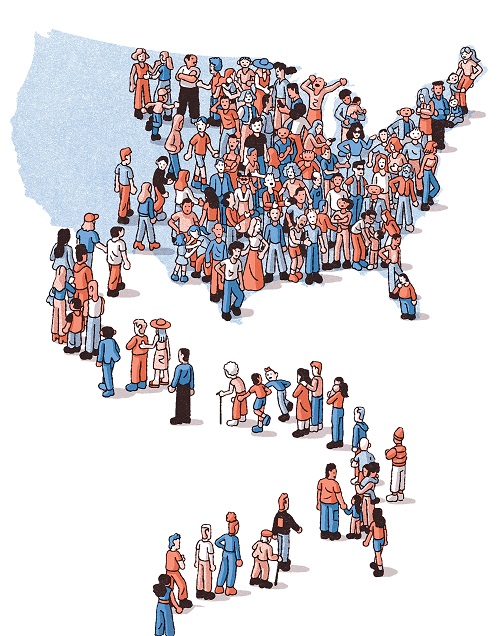
I will make an ethics observation about today’s Trump Deranged freakout over the President’s decision that we need a new census. Of course, like everything he has done or will ever do, this proves the President is an autocrat and violates the Constitution.
I very much doubt that the ultimate decision will be that the U.S. can’t have a census for good cause more frequently than every ten years. The Constitution’s requirement of one every ten years can be (and should be) read as a minimum. If I decide to have a physical six months after my last one, should my doctor forbid that, saying that the best practices limit me to only one a year?
Trump’s larger problem is the inclusion of illegal immigrants in the census. This is an anomaly ( there were no such things as illegal immigrants when the Constitution was written), but the courts have upheld the counting of illegals; it would take a Constitutional amendment to fix this, or maybe a law declaring that illegals do not “reside” in the U.S.
It is wrong that states and cities defying federal law by their “sanctuary” status should benefit from it, but that’s what the current system permits. If Trump thinks we can deport sufficient numbers of illegal immigrants to make a difference in the apportionment of House seats, ICE has got to get a lot bigger, and fast.
I swear, I’ll get back to the traditional 3-4 posts a day soon…
 Ethics Alarms
A law defining “resident” for purposes of the census is in order. If I sneak into you home and eat your food, put my feet up on your furniture and otherwise “make myself at home,” does that make me a legal resident of your home? Of course not. I am not against an enumeration of illegal aliens in order to learn who and where they are, but conferring most of the privileges of citizenship on those people is not just wrong but infuriatingly so. And letting the “sanctuary” providers profit from practicing nullification of federal laws is equally maddening.
Ethics? Or Ick?
https://www.msn.com/en-us/news/world/denmark-zoo-asks-people-to-donate-unwanted-pets-to-feed-predators-and-imitate-natural-food-chain/ar-AA1JUyYS?ocid=BingNewsSerp
-Jut
I wondered about that, particularly the assertions that the animals would be humanely euthanized before being fed to the predators. One, i understand most of the more common euthanization drugs remain in the animal’s body, rendering them dangerous to consume. And two, if the goal is to keep the predators in fighting trim, how is handing them corpses going to help? Surely the predators would benefit most from tracking and killing their own prey. Not that anyone wants to think about anything hunting and killing anything else the days.
I’m reminded of the staked goat in Jurassic Park (movie, it’s been too many years since I read the book).
You do make a good point about the euthanasia and drugs. Maybe it’s more a lobster meets knife method.
I don’t see this anywhere. It seems like evidence that Colorado is in fact acting as a sanctuary state even if it denies being one.
The following link has some more info. Form an ethics perspective this is a Res Ipsa Loquitur issue. The sanctuary states are following the doctrines of Senator John C Calhoun on nullification, and are pulling out all the stops to defy federal law.
https://townhall.com/tipsheet/saraharnold/2025/08/02/colorado-cops-punished-for-helping-ice-as-sanctuary-state-law-takes-priority-over-public-safety-n2661307
I might be out of my mind, but why is the Colorado Attorney General’s name emblazened on a pride flag?
jvb
Get yourself well first. That’s the most ethical thing you can do.
Here’s a site detailing what the census has cost for the 2+ centuries (a former boyfriend has worked for the census a few times so I have a little bit of a sense of the huge workforce that needs to be recruited for this). What strikes me is the huge increase in cost/person in 2010 and 2020. Why, I wonder? Seems to be greatly outpacing inflation. Maybe an increase in pay for the census workers? https://www.genealogybranches.com/censuscosts.html In any case, I wonder about the spending priorities, and whether they plan to pay for this by simply adding to the national debt….
I agree that authorizing, coordinating and conducting a census by 2028, just two years earlier than scheduled seems wasteful. Can’t they just work on prepping and planning to ensure the next census meets all expectations? I’m sometimes in a “data nerd” mode and I hate that a lot of data privacy problems have come from other agencies. I would like the census to figure out a proper way to count everyone, whereever they are, in whatever condition they are – and then slice and dice that data according to whatever rules they establish after the fact. (We live in a time of big data, so why not?) We can count citizens, legal residents, foreign visitors (long term, short term, expired term), document places of birth, names of parents, adoptions, children, occupations, earnings, household owership, etc. Seeing this data from centuries ago is fascinating. I’d hate for our great grandchildren to look at our data and just shake their head like “what a bunch of idiots.”.
Like you I am a big fan of historical census data! Have learned all kinds of interesting details about my ancestors that way…
“Have learned all kinds of interesting details about my ancestors that way“
I myself, as well…’specially the misspellings!
PWS
How far off would the numbers be if the census could simply reference irs tax return tax payer id and dependents, medicaid and medicaire id numbers?
Here’s an easy action to start a large positive ripple: On your Facebook page, blog, or other public platform, prove to Blue voters that you understand one of their concerns. Pick from the list below or make up your own. You don’t have to agree that their concerns are likely to happen. You don’t have to agree with their methods of addressing these concerns. You just have to agree that something they fear is bad and you don’t want it to happen. That’s it.
Comment below what kind of responses you get. What assumptions do they make? If you don’t want to get into a long discussion, you can tell them it’s an experiment requested by a group that’s finding win-win approaches to policy issues and that welcomes their perspectives. Finding real points of agreement is the first step in that process.
“I’m a Red voter, AND I can find things Blue voters believe that I honestly agree with.”
(Pick one below or write your own–it has to be policy-specific and sincere, not snide.)
As interesting an idea as this is, it’s probably disingenuous to state your position followed by a presumption of what you believe is the nuanced view of the reader. On guns, the left has a whole spectrum of nuanced takes, ranging from “Utopia Gun Free existence through jack-boot enforcement” to “Never, you’ll have to pry it from my cold dead hands.”
But maybe that’s because “Guns” is a topic and your experiment requires “Policy Specific”. So what policy in the realm of guns is “Policy Specific”? Well, a personal example would be (and this is coming from a self-described 2A guy) that in my town, we had one particular gun store get burglarized 3 different times in smash and grabs. The targeting would usually involve busting up a liquor store or the Apple Store to create a distraction and then the gun store would get cleaned out. The store eventually moved to a new location and the front door was no longer the front of a strip mall. It was now in a stand alone building with the door at the top of a set of concrete stairs. Then it happened yet again. After 4 times, the store still had no desire to exercise responsible storage and put product in a secured room or vault at the end of each business day. So, the city stepped in and made a law for gun stores in our jurisdiction: “All firearms for sale by a licensed dealer must be stored/locked up in secure storage outside of operating hours.” I’d had enough and I supported this because the store owner couldn’t be bothered to exercise good judgement. (Kind of like the “will you return the grocery cart” experiment question.)
So – after writing all of that, do I have a point? Not yet – my brain is fried. My bad.
These are just my suggestions based on what I’ve heard and read from people both sides of each issue. Feel free to use phrasing you think would be more accurate about what someone actually believes, as long as it’s a point of sincere agreement. Maybe get some rest first, though? Take care!
But these are contrived accommodations that are basically pandering to irrational Leftist or conservative cant.
Guns: I want people to be able to independently defend themselves, their families, and their neighbors, AND I don’t want people to use guns for random acts of violence. I acknowledge that some people may feel that preventing any possibility of the latter is worth giving up the former.
There is no way to prevent any possibility of the latter. As you know. As anyone should know.
Vaccines: I don’t want people to be forced to take vaccines that they’re not convinced are safe, AND I would be happy if we prevented infectious diseases from spreading and hurting people. I acknowledge that some people may feel that mandatory vaccination is an acceptable tradeoff to achieve that goal.
The Supreme Court says it is. It doesn’t matter what people “feel.”
Illegal immigration: I don’t want to let violent criminals enter the country AND I want people to be able to leave poor, violent countries and find places to thrive economically and culturally.
You want people to be able to violate laws at will. No excuse for such a belief.
Welfare: I am concerned about the incentives that welfare can create and about our communities going bankrupt helping people in poverty, AND I want people in desperate situations to have basic necessities so they can focus on more than just surviving.
Who pays for “basic necessities,” who decides what they are, and they don’t focus on surviving, they focus on the same toxic life patterns that make them poor in the first place.
Climate: I don’t want climate regulations to crash the economy and cause people to struggle, AND I want future generations to inherit a healthy, hospitable planet.
And that presumes that you know how to accomplish the latter. But you don’t and nobody does.
This is navel gazing to avoid inflicting reality on partisan narratives and fantasies.
I find it hard to believe that you refuse to accept the concept that some positions have no legitimacy.
I find it hard to believe that you refuse to accept the concept that some positions have no legitimacy.
We’ve been over this. Whether a position has any legitimacy has no bearing on the principles of how to engage with a person and get them to rethink that position. It’ll affect the outcome, but the start is the same.
If you’re trying to help someone navigate to Boston from New York City, you start from where they are and plot the route that would take you there. If you’re trying to help someone navigate to Boston from Anchorage, you use the same process. You don’t hit them with a stick until they appear in New York City because they should be ashamed of themselves for being in Anchorage, are they stupid? That’s not a place for serious people! They’ll either find their way on their own or I guess they’ll just stay there–not worth my time. But if they cause problems then I’ll whine about it.
If Daryl Davis thought like you do, a couple hundred people would still be members of the KKK.
Well now I feel like a failure, because you haven’t learned anything from me after all these years. You’re consistently missing the point. You’re like a person who tries to smash through a wall because it walking around it would temporarily take you further from your destination. You’re refusing to do the easy, effective thing because it doesn’t resemble people agreeing that you are objectively correct in all the ways that matter, and that any concerns they have about what you say are unimportant. You’ve worked with people for over five decades and never figured out how to connect with someone who doesn’t already share what you consider to be your core beliefs.
Have you ever read The 7 Habits of Highly Effective People? “Seek first to understand, then to be understood”? If I remember correctly, Stephen Covey tells a story where he’s working on something and his young son is pestering him about wanting to go outside. Stephen has an epiphany and says to his son, “You really want to go outside, don’t you?” His son agrees, and then he quiets down and waits patiently.
Human opinions are like shear-thickening fluids. If you shove them, they will solidify and not go anywhere. If you are gentle and create a space for them to flow into, then you can shape them more easily. Ironically, speaking in less certain terms is more persuasive. Just acknowledge what people are concerned about, and then talk about your concerns. What are the bad things that you think will happen? Don’t phrase them as facts, just things that you’re worried about happening because of what you’ve seen, heard, and read.
I don’t care if someone says that lizard people from Mars are going to destroy the Eiffel Tower unless we all wear xylophones on our heads. What they fear is ridiculous. The method for addressing it is stupid. Establishing those things is the last step. The first step is realizing that we care about not wearing xylophones on our heads because that would be expensive and uncomfortable. The second step is telling the person, “I don’t want the Eiffel Tower to be destroyed, either.”
After they’re satisfied that you care about the Eiffel Tower, then they’ll listen to you talk about why you don’t believe it’s in any danger. If they don’t think you care, they won’t trust your judgment. That’s just basic business.
That’s what you’re missing. What people feel is the reason why anything matters, why we think things are good or bad, why we struggle to achieve anything. Feelings are why we have a United States of America, and a Constitution, and a Supreme Court deciding what abides by that Constitution. They’re not the only things in the mix, but they’re where everything starts. If you don’t pay attention to the feelings that lead people to try to destroy something you care about, then you will never stop them. If you think that the extent of your capability is to write about your opinions and hope someone from the other side listens to you, then knock yourself out, but I don’t see why they would if you aren’t willing to listen to them.
Any good engineer knows that before you go about deciding what’s possible and what’s not, you need to figure out what everyone involved with the situation cares about. You seem to have started the process on your own, and now that you’re hearing about people who don’t like the policies you’ve decided are best, you’re saying that their opinions don’t matter. They just need to grow up and accept the world as you see it, because you say so.
If you don’t listen to the stupid things people ask for, you won’t see the smart ways you can give them what they actually care about. You’ll perpetuate a needless conflict. That’s ethics malpractice.
well, hot damn, not sure that I would have ever been in the position to quote the lyrics to My Stars from Alice Cooper’s 1972 album, School’s Out:
”The power alone stored in my little hand
Could melt the Eiffel Tower
Turn the Sphinx into sand”
but I care about both the Eiffel Tower and the Sphinx.
-Jut
After reading that comment I think it would be entertaining hearing a lengthy debate between you and Jordon Peterson.
I’ve stated something similar to this multiple times.
Extradimensional Cephalopod’s approach is a good approach when you’re in a one-on-one controlled clinical environment, or something really close to that, but in the political arena this participation trophy equivalent pandering to feelings (that’s what I call it) unethically encourages the pandered to continue to use unsupported emotional arguments instead of arguments that are supported by critical thinking, facts, logic, and common sense. Pandering to emotional arguments in public debates gives unwarranted credence to unsupported emotional nonsense and when their nonsense eventually gets the rug pulled out from under it, and it will, the “how dare you not agree with me” and “you hurt my feelings” pandered narcissistic snowflake reacts very negatively…
Debating in the political arena is no place for pandered narcissistic snowflakes that have psychological shelves full of participation trophies. Either participants in political debate can support their arguments with something other than emotional tripe or they can’t, period.
It’s unethical to rhetorically give a participation trophies to morons presenting irrational emotional nonsense as arguments. You’re not helping them by pandering to them. Don’t pander to their “feelings”, openly challenge their content.
It doesn’t take laboratory conditions, just a space where people don’t feel pressured to put on a performance and play to the audience.
There is a difference between pandering and acknowledging where people are coming from. Pandering is letting something go unchallenged in the hopes of currying someone’s favor. Acknowledging where people are coming from is a necessary part of the process of challenging them effectively.
Why do you think I use the tradeoff concepts of costs, risks, habits, and trust to describe people’s values? One of the benefits is that they simplify the process of acknowledging where people are coming from emotionally without affirming that their predictions or methods are reasonable.
The tradeoff concepts are anti-pandering tools. They peel away the psychological defense mechanisms that protect fragile people from considering a perspective that challenges their own. They are honest, they are kind, and they are efficient. They are what allow me to not merely pull the rug out from under someone, but instead to lead them to solid ground.
“Your plan is stupid because it causes XYZ problem!” isn’t persuasive.
“Walk me through this; what do you expect to happen here?” is persuasive.
“Is there a reason you’re not using this other approach?” is persuasive.
“If we do it this way, you’d have a lot more suppor,” is persuasive.
I’m an engineer who handles customer support. My employers wish I was willing to pander to people.
Extradimensional Cephalopod wrote, “It doesn’t take laboratory conditions, just a space where people don’t feel pressured to put on a performance and play to the audience.”
Do you honestly think you’re going to create this “space where people don’t feel pressured to put on a performance and play to the audience” in the midst of some kind of public’ish debate? Yu can’t create these safe space bubbles anywhere.
Gotta go for now. I might post more later.
For many people, taking the debate away from the public eye is the easiest way to remove the pressure on people to publicly profess a position.
However, there are other approaches. By identifying the kernels of value in their position, the tiny grains of “legitimacy”, anything that you can concede, you can give them those victories and thus remove the need for them to be seen to push back. They’ve “won”, so they can afford to be magnanimous in victory. If they are, that magnanimity takes the form of realizing that you also have kernels of value in your position that they may want to take into account when they’re designing policies.
Creating the safe space means dissolving the illusion that people have to be enemies. It means looking at the proverbial table from the same side.