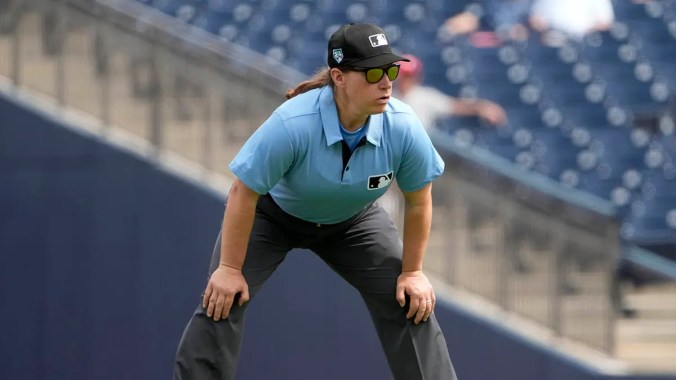
Over the weekend, minor league umpire Jen Pawol became the first woman to umpire in a Major League Baseball game, handling the bases in Game 1 of an Atlanta Braves-Miami Marlins doubleheader then moving behind the plate to call balls and strikes for Sunday’s game. Of course, MLB made a great hullabaloo over the momentous occasion. At various times during the season, minor league umpires are brought up to the big leagues to fill in for umpires getting their union-dictated vacations. Pawol is the only woman currently umpiring in the minor leagues. Thanks to baseball’s (and Commissioner Rob Manfred’s) wokeness obsession, she took her place in baseball history with a lingering and unavoidable doubt: would a man with her record and credentials have been chosen by MLB for the weekend umpiring chores? Were there more qualified and deserving male umpires who were passed over because they had y-chromosomes?
This is the scourge that the DEI fad has created. I feel sympathy for Pawol, but there is no avoiding it.
Naturally, MLB was ready for the questions and the suspicion. “Jen Pawol’s MLB debut is no PR stunt — she earned it the hard way” blared a Fox News headline, following an MLB press release. Methinks they doth protest too much. My suspicions were raised because just a few days earlier, the Boston Red Sox created team “history” by having an all-female broadcast team for a game. Why? Well, you know, because. The women were fine, professional play-by-play and color announcers, but nothing special except for their high voices. I’m sure there were plenty of long-time minor league male broadcasters who would have loved the chance to do a big league game, but, again, they wouldn’t be “historic,” so they were out of luck.
As with umpires, almost all baseball broadcasters are male and white. There’s no demonstrable discrimination at the heart of this: it’s self selection. Women don’t play hardball; blacks tend to be drawn to other sports as well. Why should that circumstance provide a special advantage to the minorities who do enter the field? Baseball doesn’t benefit from diversity of umpires: what matters is getting the calls right. Baseball fans want engaging, knowledgeable game broadcasts, and couldn’t care less about the sex and color of those providing it.
Meanwhile, there is still room for Manfred to carve out some more gratuitous history: baseball still hasn’t had a heterosexual female ump in the major leagues.
 Ethics Alarms
Only time will tell. However I am more inclined to see it as a publicity stunt than anything else. Why make a big deal of it? If she umpires in the minors and MLB brings some up occasionally then she is just as entitled for the chance as any male umpire in the minors. That is how it should be. No one should derive special attention by virtue of their sex or race.
We need to stop the “historic” BS. It is not fair to anyone especially those who may wish to follow a failure who was actually first.
Two words: Doris Burke. I would be okay with women doing play by play, but why on earth are they doing color commentary? Unless you’ve played or coached the game, you have no business whatsoever doing color commentary. If you haven’t played or coached in at least elite college basketball, or preferably, the NBA, you are not qualified to comment on play. If you haven’t thrown or faced Major League pitching, you’re not qualified to comment on MLB. Playing women’s basketball (in college, no less) or women’s softball doesn’t count. And can’t guys have anything left to just guys anymore? Nex thing you know, they’ll let girls into the Boy Scouts. Oh. Wait…
So, I guess if we haven’t held a professional position in ethics, perhaps as a professor of ethics at a major college or as a corporate ethics officer, then we have no business commenting about ethics on a professional ethics blog.
Oh, wait, never mind. We all learn ethics through formal and informal education and through discussions with others as we grow and develop. And, thus we become qualified to render ethics opinions. It’s just professional sports that cannot be learned except by actively playing at a high level.
There’s no reason why a non-player couldn’t be a competent color commentator, I guess, but a non-player would have credibility issues. “Color” is supposed to be inside stuff; that role has been filled by a former MLB player or coach 99.9% of the time. ESPN had a cutesie pro softball player doing “color” and it was embarrassing. Good color analysts are rare anyway, but the good ones (like Jerry Remy and Dennis Eckersley for the Red Sox0) really enhance the game because of their anecdotes and learned observations. I’ll give you this: non-playing female color analysts can easily be as good as 75% of the typical male color guys, who are lousy and a waste of air time.
“the good ones (like Jerry Remy and Dennis Eckersley for the Red Sox0) really enhance the game because of their anecdotes and learned observations.”
And the GREAT** ones make you feel like you’re right there at the ball park with ’em.
**RIP Robert George “Bob” Uecker, who the White Hot Milwaukee Brewers sorely miss!
PWS
Old Bill,
What is your rationale for this comment? I don’t know why someone like Jack would not be qualified as a color commentator for the Red Sox (apart from his foul-mouth).
-Jut
Doris Burke is the worst color commentary person in the history of broadcasting. That prompted it, plus the pro softball woman Jack mentioned who was put on the air with Alex Rodiguez. How many even serious fans could identify a slider vs. a sinker vs. a curveball vs. a four seam fastball. (I know, there’s probably a computer program that does them for them.) It’s a question of both competence and legitimacy. To me, something that’s just wrong is unethical.
Here would be a cool way to handle the issue:
“Officiating tonight’s game between the Astros and the Rangers are:
“Let’s have a round of applause for the officials! Ms. Trout, the game is yours.”
Ms. Trout: “Thanks. Play ball!”
jvb
exactly!!!
Jack,
Did you see her first call?
I saw a highlight that her first call was a strike that was way insde.
She sure made the case for the robo-ump.
https://ftw.usatoday.com/story/sports/mlb/2025/08/10/umpire-jen-pawol-bounced-back-badly-missing-first-mlb-call-behind-plate/85601089007/
-Jut
I will bet, without any evidence, that players, coaches and managers were instructed not to complain about any of her calls no matter how egregious.
Also makes the case for 3-d replay; given the angle of the release and the curvature of the ball flight, probably a lot closer to the strike zone when it crossed the front edge of the plate than when it hit the glove.
Ms. Pawol’s worst call was better than any of a thousand made by the thankfully-put-to-pasture Angel Hernandez.
F Y L T G E.
I read the story and it said she got every other call right even the close ones.
I do not understand why she is criticized for that first pitch when much ink has been spilled on robo umps to prevent bad calls from the other umpires.