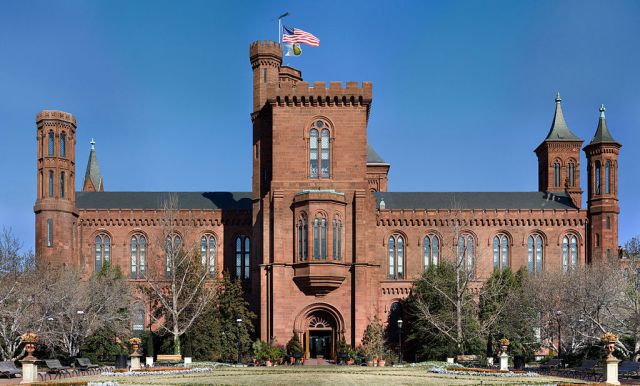
The latest freakout by the Trump Deranged and the Axis media is over President Trump’s assault on the woke and often anti-U.S. propaganda that has seeped into the Smithsonian museums over the past decades while conservatives, Republicans and patriots were metaphorically asleep at the switch.
That the Smithsonian had become dominated by curators, scholars and ideologues who genuinely don’t like their nation very much and who wanted to use the museum exhibits to promote an “America is racist, sexist and a blight on civilization” narrative is, I believe, beyond reasonable debate: smoking guns include the original signage for the Enola Gay (portraying the bombing of Hiroshima as a war crime) and the deliberate omission of Clarence Thomas in the National Museum of African American History & Culture.
The problem is real, and President Trump’s understanding that the museums are a significant battlefield in the culture wars should be welcome. However, I question whether there is any way to avoid over-correction, with the Smithsonian swinging from being an agent of cultural self-hate furthering the agenda of victim-hustlers, to being a purveyor of jingoism, God Bless America revisionism and “My country, right or wrong” historical air-brushing. I also question…oh, heck, I know that Donald Trump does not possess the broadness of mind, the historical sophistication, or the objectivity necessary to avoid botching what is a very important mission.
I pride myself on having at least a substantial amount of those qualities, but I’m not sure about how much to emphasize slavery and racial discrimination in our history between the disparate poles of “The 1619 Project” and the “America courageously expiated the curse of slavery in blood” position. Was Western expansion a saga of heroism and American exceptionalism or “genocide,” as today’s Left would have it?
I wish I believed that there was an achievable, non-political, societally beneficial middle ground, but try as a I may, I don’t. All I know is that the Smithsonian’s orientation has become anti-American, and that this is destructive, foolish, unfair and wrong. Trump’s targeting of the museums is as justified as his assault on colleges and universities, but whether the cure here will be worse or at least as bad as the disease is a troubling question.
I don’t think I’m going to like the eventual answer.
 Ethics Alarms
I am not sure why anything other than the facts should be presented. With that said exhibits can help understanding by not telling people what they should think about the events now, but what was the thinking in that era when decisions were being made.
Values are important as well. Museums ultimately are telling a story, and values then, are as important as facts.
There will always be a battle over narrative.
Currently the America-haters are in control of the narrative. Since there’s not ethical obligation to hate oneself or one’s community, then let’s have the non-haters in charge for once.
It’s more than just facts and values though. There’s only so much physical space and time you can allocate, so every fact you omit and every fact you focus on reveals your bias.
Some people choose to believe that the fact that most Americans were not taught about Tuskegee experiments or the Tulsa race massacre is proof that history is being white-washed, but that’s silly. There are an infinite number of historical events that have not been covered in a museum or textbook or high school class, and what is significant enough to include in a curriculum is in the eye of the beholder.
We can never get true unbiased history just based on that fact.
That sounds nice, but in fact choices need to ne made. For example, there was a time a few years ago when the most prominent exhibit related to the US in WWII was about the illegal internment of Japanese-American citizens. Yes, that’s a fact. Yes, it’s bad. But how are the choices made regarding what to highlight?
History is a story. That’s why it interests people — we are hard wired to respond to stories. I like your idea of presenting the stories told from different perspectives at the time of the events. For slavery we would need the stories of slave-owners, those opposed to slavery, and of course the perspectives of the enslaved people as well. Ideally with multiple points of view from each group, as no category of people is a monolith.
They don’t want true stories.
Just as an example, do you remember the kerfuffle regarding the Florida curriculum where they said that some slaves learned marketable skills as slaves?
People complained that this was somehow a defense of slavery or was trying to make slavery look good?
That account came from a former slave from Florida who explained that, after freedom, he had skills that he could put to use to make a living.
I had read that man’s account and I knew immediately where that story came from.
People do not want to hear that, even if it was true.
They only want to hear how brutal slavery was (and it was brutal). I have read accounts about slaves that were killed for the most trivial of reasons.
But, apart from the inherent indignity of being property, many slaves lived a mundane existence. They found ways to find joy, love, and connection, even with the people who owned them.
I know this because I have read literally hundreds of accounts by former slaves about their experiences.
But, somehow, telling those stories is considered “whitewashing” history.
-Jut
Thanks for your comment, Jut!
People can be amazingly resilient in all sorts of terrible situations. War, poverty, chronic illness, slavery, torture.
It’s definitely a lesson worth keeping in mind — and one cherished in the African-American tradition as the central lesson of Black Joy.
IMO a central distortion in the narratives of the left is an infatuation with “victimhood,” which (when not appropriately balanced by tales of resilience and the possibility of still living one’s best life in whatever circumstances one finds oneself) dehumanizes those categorized as victims and ignores their power and continued humanity. It attributes outsized agency to those who harm/exploit others.
Given your deep reading in this area, could you recommend a favorite title or two (maybe an anthology) of narratives by formerly enslaved people? Thanks!
During the 1930’s, the WPA employed writers to collect recollections of former slaves. The collected thousands of short narratives from people.
they shared a similar format so it can be easy to compare and contrast accounts.
however, some deviate from the format and you get some unique vignettes.
not to plug a specific publisher, but Blair has compiled the WPA accounts from different states, each state getting its own volume They do not reprint all of them, but they give a good selection.
then, you have the longer narratives. Douglass wrote 3 autobiography. I would recommend the lady one because he details his trip through the Underground railroad, something he omitted in the first two (because it was still operating)
mind you, I have not read some of these in decades, but I recall liking Equiamo; I believe it was a British narrative from the 1700s. I remember enjoying it, but I forget why.
then, I think Mary Brandt’s is a well known one that was very good at highlighting some of the sexual violence in slavery.
-Jut
not Mary Brandt, Linda Brent, which was written under a pseudonym, Harriet Jacobs.
and, then there was Cuguano, who was another Brit in the 1700s
Equinao and Cuguano are less well known because they were British and the Brit’s abolished slavery before we did.
but the Brits also had a standoffish view. They allowed it in their colonies but then banned it.
the U.S. had to deal with colonial reality, but persistently struggled to limit/eradicate slavery.
now, the 1850 compromise was , maybe slow point in eradicating slavery.
at the same time, I think that slavery created an intractable problem with the full faith and credit clause of the Constitution.
Dred Scott (if I recall), faced that problem.
unfortunately, I don’t think the Supreme Court could fix that issue; Taney disagreed, but, if he was right, the better choice would have been to rule the other way.
anyway, I only meant to correct my earlier comment, not to multiply my errors
-Jut
Thanks!! Along with the thought-provoking conversation, this blog site has been very productive in adding things to my reading list I would not otherwise be looking for.
“this blog site has been very productive in adding things to my reading list I would not otherwise be looking for.”
Careful what you ask for, Holly; I have stacks of books and a treasure trove backlog of links…staring at me…mocking me…
PWS
BTW, for others who might be interested in this literature, I just purchased the Kindle editions of the Equiamo and Linda Brent autobiographies for a combined total of $3. Two books for less than a gallon of milk these days!
for what it is worth, I think I got all of Dickens novels in audiobook for 5 bucks (500 hours or so of content)
I am halfway through (almost up to Bleak House)
-Jut
I have been frequenting consignment shops, looking for hardback books in good shape that I can buy for a dollar or two. Years ago, I donated all my paperbacks (about 200 of them) to the library to clear some space, but I miss some of them…hence my roaming to find them cheap. Two weeks ago our library had a sale of donated stuff, and I got an almost new copy of Grudem’s “Systematic Theology” and my two favorite Ludlum novels…$0.50 each.
Who needs the lottery ?!?
I’m finding it really hard to actually see the difference between “I think the stated values and understood goals of our country are better than those of other countries even while at times we haven’t lived up to them, but that’s not going to dissuade me from loving and supporting my country’s values” AND “my country right or wrong”.
I think the latter is an intentionally dumb sounding phrase invented by America haters with the explicit goal of making you feel bad about the way I verbalized the sentiment.
No. An overcorrection would not be to say “my country right or wrong”. The overcorrection would be to say “my country has always done right and cannot do wrong”.
I don’t think Trump will do that. And if he does the “my country right or wrong”… well that requires talking about the wrong as well as the right.
Doesn’t sound bad to me.
We toured Monticello this past summer and our tour guide, some little progressive acolyte of the latest grad program, gave us a very summary run down of the facts around the place and then spent the rest of her time talking about Sally Hemings.
I mean, ok, we get it. She opened up the tour to questions and everyone seemed pretty hungry for other aspects of Jefferson’s life and times at Monticello. She did everything should could to work the answer back to slavery and Sally Hemings.
Ok we get it. Yawn.
At one point she was visibly annoyed no one was asking more about slavery and even made sure to ask “feel free to ask other questions about Sally Hemings.”
Congratulations tour guide, you actually managed to make me care less about the evil of slavery. And that’s a virtually impossible task.
As I understand it, the original quote from Carl Schurz is, “My country, right or wrong; if right, to be kept right; and if wrong, to be set right.”
Ah, so the original quote is specifically misquoted by people who want to poke fun at patriotism.
Thanks.
Interesting. I looked at this phrase on the website “thoughtco.com” and here is what they said.
Carl Schurz was a US Senator from Missouri. He had been a revolutionary in Germany in 1848 and later emigrated to the United States. He became a Senator in 1868. The quote is from a debate in the Senate in 1871 or 1872. Interestingly, Wikipedia (which is soliciting donations today) does not mention this quote at all that I could find.
So that.
But, a few decades earlier, Stephan Decatur, an American naval officer and heroic daredevil, returned home in 1816. At a banquet in his honor he made the following statement:
So, this phrase has an interesting provenance. But I think it safe to say it has been mis cast from the original usage.
I pulled it from WikiQuote, which describes Schurz as responding diplomatically to Decatur’s statement.
From what I was able to glean, it seems to have been a response to another senator on the Senate floor. There was also a quote from 1899 where he revisited the speech, expanding on it, but basically affirming what he said originally.
I would assume that, yes, he was aware of Decatur’s statement and gave his own adaptation.
Unless there has been a complete changeover in Smithsonian leadership, this example from 2020 makes the case for some type of review and overhaul: https://www.newsweek.com/smithsonian-race-guidelines-rational-thinking-hard-work-are-white-values-1518333
So far as I can tell, that particular display was online for less than two months in 2020 in the Teaching and Learning section of the National Museum of African American History & Culture. It was criticized and then removed, and Museum officials apologized, saying it did not work in the way intended and that they had erred in including it.
Seems to me that’s the way teaching and learning should go. When either the teacher or learner errs, they should admit it, make whatever correction is needed and move on.
The review and overhaul going on now is quite different. Trump has all but screamed ‘GET THE WOKE OUT’. Okay, maybe he did scream it on social media; I don’t follow him there. Whether or not, the result will be that the process of ‘getting the woke out’ will be a confused over-reaction by those fearing job loss mixed with intentional over-reaction intended to make Trump look even worse than he is.
“Museum officials apologized, saying IT DID NOT WORK IN THE WAY INTENDED and that they had erred in including it.” (bolds/caps/italics mine)
Curious, how did all those six (6) figure officials intend it to work? To illustrate that principles of success and wealth-building are tools of the White Devil to further subjugate marginalized groups, and that the opposite (laziness, sloth, et al) are not only nothing to be ashamed of, but to be applauded as enviable characteristics?
Framing this as “sorry bro, our bad” is signature significance!
PWS
Anyone responsible for putting that placard up, i.e., who ignored the effect of that placard and its meaning, should be removed. As should any Smithsonian employee who knew about the posting before it went up, and any employee who was aware of the posting after it went up and who did not raise an alarm.
Teaching moment? I assume you’re joking.
Bravo India November Golf Oscar!
PWS
It seems to me that we talked about that poster here back then.
But what struck me reading it again just now — where is the corresponding poster that exemplifies black culture and values? I mean, if there is one for white culture it only makes sense that there is one for black culture as well.
The prosecution rests: https://x.com/robbystarbuck/status/1958600913054310614
And any employee who saw or heard of the placard, and any employee who saw an article about it in mainstream media, especially articles attributed to those not identified, and any janitor who cleaned the glass in front of the exhibit, and anyone else in the vicinity. Heresy cannot be tolerated
I saw that “info Sheet” posted elsewhere and found it odd.
The implication is that “black” culture values none of those mostly (bland food?) admirable and effective traits, and had to have those attributes forced upon them. I can’t imagine that’s what they intended to do; are they really that stupid? Were they trying to criticize blacks who “act white”? Sounds like they may have shot themselves in the foot with that list.
Like in “The White Shadow” where the kids tell their one classmate “yu has developed a bad case of oreo mentality…outta here!” before they shove him in the pool with all his clothes on?
I don’t think I’ve ever seen an episode of that show, but I’ll take your word for it 😉
Have they transferred all the exhibits on music and inventions to the African American museum yet?
I have some questions about the term “stated values and understood goals of our country” that I see in some post. What are these values? Are we here referring to documents as the Constitution and the Declaration of Independence? My observations are twofold:
Regarding the first bullet point, it’s my understanding that the values of the USA’s founding docs are not quite universal. For example, few other nations care about free speech as much as we do, same goes with the right to bear arms. Plus other modern nations are still emeshed in totalitarianism and tribalism. It’s also worth noting that concepts such as individual rights and equality under the law regardless of wealth or social status have only relatively recently gained widespread traction. For much of human history society has only been concerned with group rights and knowing one’s place in the pecking order.
I wonder what it is, most especially among those farther out on the left and the right, those not close to the center, that they are so anxious and distraught over displays and messages and exhibits that portray something other than their world view.
Could it be they are so familiar with the gullibility and susceptibility of those within their own echo chamber that they have no confidence in freedom of speech and the rational exchange of ideas? Could it be that they cannot muster solid arguments for their beliefs?
Better, I suppose, to just blot out any indication that your opponents might have a point, even if poorly stated.
Sadly, this purification by the right (this time) reminds me of the iconoclasm by the Khmer Rouge in the 70s.
Yes, I know this is the government, and the government should not be biased. But, dealing with bias is better done through counter-argument than by ruthless suppression.
The issue whether a museum that is paid for taxes present such a slanted and ideological picture of history? Let’s assume that the Smithsonian presented history in line of the ‘Lost Cause’ view of the Civil War?
The question is similar as to whether NPR/PBS should be supported by the tax payer. So this is not about free speech, or a rational exchange of ideas. Nothing stops a billionaire from erecting a museum that fully conforms to his vision of history.
A history museum that is financed by the tax payer should present a view of history that is objective, and can be thought as such at a public school. The focus should be on learning and understanding, not on indoctrination. E.g. I am more interested in the motivations of General Robert E. Lee to fight on behalf of the Confederacy, than on why he was wrong to do so.
A history museum should also be an enjoyable experience for every person interested in American history. If I know that a particular museum is a mere presentation of woke ideology illustrated with exhibits, then I will pass. Such a museum has as much relevance for me as a museum about the Arc of Noah that follows a particular theology.
The President of the United States wanting an American taxpayer funded museum about American history to be less biased against America is similar to the regime that executed people for, amongst other things, wearing glasses. A(n over)correction to anti American sentiments in an American museum is similar to the regime that destroyed its nation’s history and reset the calendar to year one. It’s a more obscure regime than the Nazis, but the intention is the same.