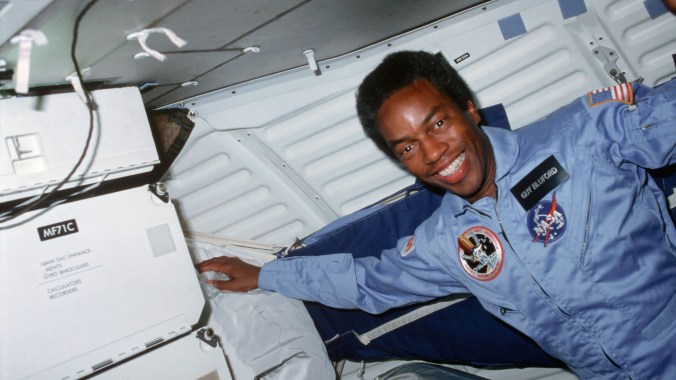
This date, I am told by the History Channel, constitutes two race barrier landmarks. On August 30, 1967, Thurgood Marshall became the first African American to be confirmed as a Supreme Court Justice. U.S. Air Force Lieutenant Colonel Guion S. Bluford became the first African American to be shot into space on this date in 1983. I get it: there were clearly social and legal barriers to black Americans for a very long time, and both of those achievements represent progress for the race and the nation. Still, I find myself wondering if the marking of such “trailblazers” hasn’t become a sop to race-obsessed victim-activists who want American society to forever pay reparations to blacks, and for that matter all minorities and women, at the expense of the merit based society the U.S. aspires to be.
Thanks to computers, it is now possible to find all sorts of records and distinctions that nobody dreamed of commemorating before. The Boston Red Sox just went 7-1 in a short road trip, and we learned that it was the first time in the team’s history that it won seven games in a road trip of eight games or less, and so what? Wait, let’s check: Yes! There has never been a gay, Portuguese-African-American intellectual property specialist under 5’8″ hired as an associate at a major D.C. law firm! Obviously that should elevate an applicant in the hiring competition, no?
No.
Enough musing…
1. Pam Bondi fired a Justice Department intern paralegal for middle-fingering a member of the National Guard in Washington, D.C., on her way to work earlier this month, adding “Fuck the National Guard!” to her outburst. Bondi explained, “This DOJ remains committed to defending President Trump’s agenda and fighting to make America safe again.If you oppose our mission and disrespect law enforcement — you will NO LONGER work at DOJ.” I see nothing inappropriate in this, particularly in the atmosphere fostered by the Left in which working within the government to undermined policies the Axis deplores is being lionized and encouraged. The Justice Department can’t and shouldn’t trust such an individual. It is too bad we have come to that: once, lawyers and other good citizens could be trusted to do their jobs without allowing political biases and dissenting opinions to lead them to abuse their positions. No longer.
In related news, Sean Charles Dunn, the DOJ paralegal who was fired for throwing a sub sandwich at a Customs and Border Protection agent, has been charged with a misdemeanor after a D.C. grand jury refused to issue felony charges. A D.C. grand jury would probably refuse to indict President Trump’s assassin. I can see the argument that a felony for assaulting an officer with a non-lethal missile isn’t felony-worthy, but I hope this jerk gets jail time.
I’m sure he won’t.
2. The Ethicist answers an infuriating question: “Should I Report My Neighbor’s Animal Abuse?” Of course you should, you trepidatious idiot! This is a pure “Fix the problem!” situation. The inquirer ladles on all the reasons why he has allowed the poor animal to be abused for months, and the conduct described absolutely shows abuse. He had seen the dog kicked. The dog is kept outside on a short chain in freezing and hot weather. The writer sputters, “I can’t take him in; my own dog is elderly and won’t accept another. And while I believe [the dog] is neglected, nothing I’ve seen clearly violates the law. I feel trapped: afraid of overstepping with unpredictable neighbors, afraid of doing nothing and regretting it if [the dog] suffers or dies...What, ethically and practically, should I do to safeguard this dog’s well-being?“
Oh, fix the problem, you revolting weenie! How much has the dog suffered while you do things like whine to advice columnists? Tell the neighbors that you will buy the dog, and then give it to a humane dog rescue group. My dog Spuds was rescued from abuse by one rescue volunteer going up to the door, knocking, and saying, “Either turn that dog over to me or I’m calling the police.” The Ethicist gives his usual prolix response to fill up the column and comes around to the right answer eventually, but what would this pathetic inquirer do if he saw the neighbors abusing a child?
3. Nah, there’s no mainstream media bias! This is classic. Most of the news media reported the President curtailing Kamala Harris’s Secret Service detail so that the usual semi-illiterate, gullible readers would see it as more of Trump’s “revenge tour.” CBS: “President Trump has revoked former Vice President Kamala Harris’ U.S. Secret Service protection.” Ditto ABC, NBC, BBC. Only the Associated Press included the rather relevant information that former VP’s, unlike former Presidents, typically only get six months of Secret Service protection, and Harris’s would be up under normal circumstances. But President Biden, or his autopen, extended Harris’s detail to 18 months for no discernible reason. Writes Ed Morrissey: “So the actual story is that the Biden administration gave Harris a stealth extension of taxpayer-funded benefits to which she was not entitled. If Congress wants to extend those benefits for former VPs, then let Congress propose and pass those into statute as amendments to the pension system for former presidents and VPs. Otherwise, Harris is no longer a public servant, and she can use her own resources for personal protection rather than sponge off the taxpayers. Trump simply canceled the illegitimate extension and restored the normal post-office benefit limitations to which all VPs are subject.”
But most of the public won’t see it that way, and this is intentional. Enemy of the people.
4. Look, the evil EPA fired employees who made it clear they couldn’t be trusted to carry out the policies of the agency! Yes, the EPA has started firing some of the144 employees it placed on leave for endorsing a public letter that said the changes President Donald Trump and his appointees had made at the agency “undermine the EPA mission of protecting human health and the environment.” More than 270 employees initially signed the letter, with over 170 choosing to be named. The open letter “contains information that misleads the public about agency business,” an EPA official said. “Thankfully, this represents a small fraction of the thousands of hard-working, dedicated EPA employees who are not trying to mislead and scare the American public.” “This is to provide notification that the Agency is removing you from your position and federal service consistent with the above references,” said one termination notice. “I have determined that your continued employment is not in the public interest.”
Naturally, the federal workers’ union called the action a violation of free speech and illegal, and I’m sure some Democratic judge will block the move, which is not only fair but necessary. Employees from other agencies, including the National Institutes of Health, National Science Foundation and NASA, have signed similar letters without any adverse action so far. They should be fired too. The Washington Post says, “Federal employees and advocates worry that similar suspensions will serve as a weapon to suppress dissenting views and force career staff to comply with the Trump administration’s political agenda.”
What? Staff is obligated to comply with an agency’s agenda. That sentence is exactly why we know the Deep State is no myth, and why the second Trump administration’s efforts to purge the saboteurs is correct and reasonable.
5. Oh yeah, this is a trustworthy political party...”We do not have the luxury to fight amongst ourselves while that thing sits in the White House,” said Democratic Party co-standard bearer Tim “Knucklehead” Walz last week. President Trump has been excoriated for referring to Mexican gang members as animals and illegal immigrants as “cockroaches”: “Dehumanizing language!” Donald Trump, however, is the elected President of the United States of America. Dehumizing the nation’s leader as a “thing”….

….is the worst kind of hate, and is begging for a slightly more deranged than the rest progressive to try to murder him. I can say with confidence that no other national political leader from the GOP has ever described a Democratic President as a “thing.”
 Ethics Alarms
Responding to the DOG abuse segment….
FEAR, TREPIDATION….. INACTION
The observer of said abuse writes: “I feel trapped: afraid of overstepping with unpredictable neighbors, afraid of doing nothing…”
Now maybe the writer has what would be deemed a “reasonable fear” that confronting the neighbor might evoke a violent, dangerous-to-self response? I guess the writer has seen the neighbor kick the dog… does he think the neighbor would kick HIM too? And he’s not confident he could evade such kick, were it attempted?
On balance, the rather mild “unpredictable neighbors” makes me doubt the writer ACTUALLY has reasonable fear of danger to life and limb if he/she confronts the asshole owner. Especially since he is ALSO afraid of doing nothing… seems to me he has a fear problem (the weenie problem is downstream of that).
THE USES AND MISUSES OF FEAR
A quick flash of fear when confronted with an imminently dangerous situation (head-on collision danger! Active shooter!) is clearly functional in focusing attention and readying the nervous system / body for whatever action might be protective of self and/or others.
Otherwise, I think the adage “fear is a poor advisor” is sound.
Why, then, do some many people seemingly persist in being so fearful? Do they not realize it’s a poor choice of emotion? Do they realize the drawbacks but are unable to self-regulate to put fear aside except for the “quick flash–watch out” function?
How is this related to ethics? Well, in the animal abuse case, it is the stated reason for failing to act appropriately and decisively to stop animal abuse…
More broadly, the media and politicians do their best to exhort people to “be afraid, be very afraid” — to drive clicks and “engagement” and sell advertising in the former case, to manipulate people by touting whatever boogeyman serves their political agenda in the latter case.
Do people genuinely not see that they are being manipulated? I guess if fear is a prepotent response, it kicks in obediently and the prefrontal cortex remains unengaged….
YOUR THOUGHTS / EXPERIENCES?
I’m curious about other commenters’ experience with this IMO massively overused emotion…
Did you learn early on to put fear aside (either dispense with it or counter it with courage — i.e. “feel the fear and do it anyway”)? What situations or mentoring … or something else helped you do this?
Thanks in advance to those who decide to share!
Excellent comment, Holly.
The phrase that comes to mind is do not take counsel of your fears. I fear the exact verbiage is awkward but you get the idea.
An example from our history that is apt, I think: George McClellan, Union general in the Civil War. He employed agents to scout the Confederate armies who invariably gave him wildly inflated numbers for the Army of Northern Virginia. It was what he wanted to believe and it made him afraid to attack and risk his army, which in fact significantly outnumbered the Confederates. He is rightly reviled as an incompetent general who squandered his chances to end the war in 1862.
Contrast that with his ultimate successor, Ulysses S Grant. After many attempts, Grant succeeded in landing an army in Mississippi. He mostly cut loose from his supply lines, he was outnumbered in theater by the Confederates, but he was on the right side of the river . His Vicksburg campaign is still studied today as a classic of boldness and maneuver and he captured one entire Confederate army while holding off another.
In our everyday lives, it translates as you just cannot not do something because there is a chance of bad results. Do what you have to and deal with the results if they happen.
Thanks for the example… basically it’s fine to acknowledge your fears but don’t let them drive your behavior. Seem like Grant kept his eye on the prize and focused on success, rather than fretting about possible bad results if the strategy failed… while McLellan was immobilized by his fears…
I’ve been thinking more about the more mundane example of the man afraid to confront his neighbor, possibly because he knows the neighbor is physically violent with the dog.
I’ve encountered quite a few women who seemed very afraid of physical violence, which makes them vulnerable to being manipulated by this fear. Turned out a common denominator was that they had no experience of physical fighting so the idea of being hit in the face, for example, was frightening in part because it was part of the unknown.
Recalling this led me to wonder if this fearful fellow also has no experience with physical violence and this is exaggerating his fear. Martial arts training does convey some useful skills, for sure, but I think the psychological impact is also huge — people learn they can be kicked or punched and these become things to watch for as potential problems to counter, not dreadfully scary possibilities.
We see this impact of experience as diminishing fear in war, too (not for McLellan, apparently, but for civilians being bombed). When the bombs first start falling on cities, civilians are terrified — it is a horrible new reality and of course fear is reasonable–people are being injured and killed.
It doesn’t take long, however, for people to adapt and no longer react to the air raid siren with fear. Bringing your life to a halt is not really an option, so you make do and adjust. This was the central flaw in the theory behind “strategic bombing” (the Blitz for London), later rebranded as “fear and awe” for the Iraq war–as a psychological tactic — civilians quickly begin to cope, and react with anger and determination instead of fear.
What is the difference between fear and risk avoidance? Are we using the term fear when we perceive the costs outweighing the benefits? For example: Is it fear when we say nothing to the teenager who appears to be using someone else’s handicap placard? We may have a duty to confront somethings but where is the line drawn to say hell with it when a positive outcome not forthcoming?
What’s the difference? Simple:
Fear is an emotion (an internal experience, with physiological components). Risk seeking or risk avoidance are behaviors (observable actions, or in this case inaction) and can also be described, at a more meta level, as strategies.
“a Justice Department intern paralegal for middle-fingering a member of the National Guard in Washington, D.C., on her way to work earlier this month, adding “Fuck the National Guard!” to her outburst.”
“Sean Charles Dunn, the DOJ paralegal who was fired for throwing a sub sandwich at a Customs and Border Protection agent”
Incredible. I remember attending a school sponsored welcome barbeque or some such at the opening of my first semester of law school. All of a sudden, I felt I was on the inside of something different. I felt as if I was entering a guild or a semi-secret society. In any event, I was becoming a lawyer and that makes you different. You have to think like a lawyer and carry yourself in a certain way at all times. Evidently, that’s no longer the case. These are lawyers who are being paid to work for the federal government! Again, “What is wrong with these people?”
Similarly, “what is wrong with these federal employees?” There really is a deep state and it’s an Augean stable. They sound like five-year-olds saying, “You’re not the boss of me.” The modern left is such an odd combination of authoritarianism and anti-authority. When they’re in charge, you must obey. When they’re not in charge, they and you must disobey.
4. And whatever happened to trying to work within the agency you work for? And whatever happened to resigning if you could no longer tolerate working somewhere. I left two law firms because of the way they treated me. It’s called voting with your feet. Assholes.
3. Never fear, Gavin Newsome will anti-up the California taxpayers’ dollars to protect Kamala get points for righting a Trump wrong.
Ooops. California Highway Patrol offers Harris security: LA Times
Typo: protect Kamala AND get points
Regarding the neighbor who doesn’t treat his dog adequately well…
The person who wrote in very well may be a weenie.
On the other hand, it’s easy people to get into disputes with neighbors, and a crazy neighbor can really make your life miserable.
Presumably the report to animal control / animal welfare can be made anonymously. But that doesn’t mean that an ornery neighbor might not figure out who made the complaint. It seems that we really don’t have all of the information.
If I can organize my thoughts, perhaps I’ll have more to say.
charles w abbott
rochester NY