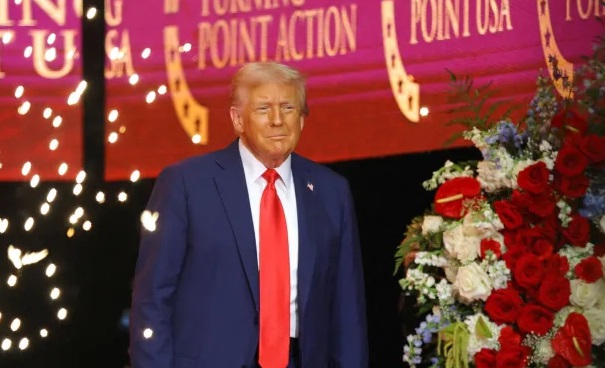
“He did not hate his opponents. He wanted the best for them. That’s where I disagreed with Charlie. I hate my opponent and I don’t want the best for them.”
President Trump, in his eulogy for assassinated conservative activist Charley Kirk at the massive memorial service in Phoenix
Can a quote be both ethical and unethical at the same time? You have to hand it to Donald Trump: his statement above at the Kirk memorial service had progressive heads exploding all over the map, and some conservative heads too. It was a genuinely provocative line, rich with contradictory meanings and implications. Did the President intend it that way? Who knows? They will be arguing about Trump’s brain in history and psychology tomes for a hundred years. I find myself hearing Wilford Brimley’s voice echoing through my brain in his iconic scene from “Absence of Malice”: “Mr. Gallagher, are you that smart?” Except in this case, it’s “Mr. Trump.”
Of course the line triggered the Trump-Deranged into self-identification, as with this guy…
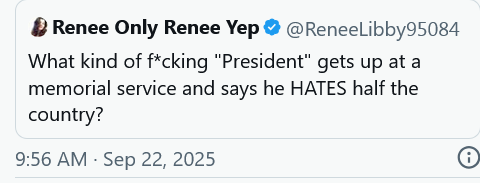 But Trump didn’t say he hated half the country. Now Joe Biden came a lot closer to doing that when he accused Republicans of being fascists who are existential threats to democracy, though it was in a national speech to the nation not a memorial service. (I think that’s worse, myself.) We can’t be sure whom Trump regards as his “opponent.” Those who want him dead, as about a quarter of all Democrats according to one poll? Those who tried to impeach him twice and put him in prison using contrived prosecutions? Those who call him Hitler? The journalists and pundits who have been lying about him since he was elected in 2016 and before?
I wouldn’t blame Trump if he hates those people. They and other have tried to prevent an elected President of the United States from doing his job to the detriment of the nation, using any means necessary. As a citizen, I deeply detest and resent these people, but I don’t hate them…then again, I’m not their target and the victim of their vicious conduct. Trump is. How dare he take their hate personally!
I find it deeply ironic that Trump, who is accused of lying all the time (with the word “lie” distorted beyond all meaning in order to make that slur) is also attacked when he is candid and honest. I’m sure he hates many of his opponents: who wouldn’t hate Adam Schiff, Hillary Clinton, or Nancy Pelosi in Trump’s position? Trump is being criticized for not pretending: Presidents aren’t supposed to say they hate anyone, but we all know they do, don’t we?
John Adams hated lots of people, and made it clear in his letters. Jefferson hated Aaron Burr. Andrew Jackson didn’t just hate people, he killed them. Andrew Johnson hated the Radical Republicans who impeached him, with a passion burning like a white hot flame. Teddy Roosevelt could hate with an intensity unmatched by his fellow Presidents, even Jackson.
When Patton said that it was a soldier’s duty to hate the enemy, do you think General Eisenhower thought any differently? Lyndon Johnson, his biographers say, hated the Kennedys. Yet the only President who admitted hating his opponents was Richard Nixon, and he only was candid about it after he resigned, saying before he flew away, “Always remember, others may hate you, but those who hate you don’t win unless you hate them, and then you destroy yourself.”
Trump is admitting the same intense feelings that many, maybe all, of his predecessors have felt but deemed it impolitic to say out loud. Another “democratic norm” breached! His copping to hate also burnishes his carefully crafted image as a fighter: Patton wasn’t wrong that hate is an asset to a warrior.
I think a strong case can be made that Americans like to have a leader who isn’t pretending to be someone he is not, like, oh, just to pull a random name out of the hat, Barack Obama. Or Jack Kennedy.
But hate is an ugly word and an ugly emotion. Clarence Darrow claimed to “hate the sin but never the sinner,” but he did many hateful things. In one of his most famous closing arguments, he said he wished that could have love in his heart at all times, which I interpret to mean that Darrow did hate his opponents sometimes. There is a fair translation of Trump’s self-description as a hater that is admirable, and I think that is what he was trying to communicate. I think President Trump was telling Kirk’s mourners and admirers that Charley was a better human being than Donald Trump.
If so, it was a remarkable tribute indeed. And an ethical one.
 Ethics Alarms
Ethical, or unethical?How about neither.It was a moment of self-deprecating levity as an indirect way to praise Charlie Kirk’s character.
It was either an appropriate statement or it wasn’t. I can see “both”: “neither” is impossible.The wild card is Trump’s office.
It was either an appropriate statement or it wasn’t. I can see “both”: “neither” is impossible.
Your post was with respect to ethical or unethical. Trump’s statement had no ethical valence.
Appropriateness isn’t either/or. I would have said “differed from” or “was a lesser person than” rather than “disagreed with”.
So, what, 98% appropriate?
But the POTUS is a role model whether we like it or not. If Trump was endorsing hate from his position, that’s a bad thing, unethical. A President has to maintain the illusion of virtue. Trump doesn’t care about that, and it’s both a weakness and a strength.But statements like his corrupt the values of the nation. That’s irresponsible, dangerous and unethical—unless it does more good than not. I’m not at all sure that it did.
Is the illusion of virtue really a good thing? And if not, is maintaining it a good thing?
The fish indeed rots from the head down, and the head of state has the power to elevate the national character, or degrade it. Trump degrades it. He has other virtues as a leader, by that is a major, major flaw.
Machiavelli said that a leader must either be loved or feared. Kirk chose “loved.” Trump has given up on loved, and now opts for feared. The dichotomy he laid out between Kirk and himself may have been strategic.
It is an act of genius. The Left already hates him and continues to let that hate make them do stupid, revealing things. The entire rest of the memorial service, except for the one Evangelist, who talked about the sword, talked about their faith and being Christian.
Erika Kirk stood tall and forgave the man (alleged) who murdered her husband in cold blood. She even explained her reasoning. In a Christian context btw.
Trump did the same thing in an opposite way. He stated how he truly feels and took the hate upon himself. In three years he will no longer be president, but TPUSA will still be involved in politics and culture. TPUSA is now born again, between the two declarations.
Trump is narcissistic and vain, he is also a father and a patriot. He is stepping between his country and family with the enemies of America, both foreign and domestic.
It took me a couple viewings of the memorial service to come to this conclusion, your mileage may vary, thank you our Founding Fathers for this.
Erika’s declaration
https://rumble.com/v6zbrca-erika-kirk-forgives-her-husbands-assassin-behind-the-scenes-of-her-courageo.html?e9s=src_v1_sa%2Csrc_v1_sa_o%2Csrc_v1_ucp_a
Trump’s
https://rumble.com/v6z9cbs-live-now-building-a-legacy-remembering-charlie-kirk.html?start=29915
I also hope that this is the beginning of BOTH sides using more than a soundbite to bolsrwe their sweeping statements, though I am not holding my breath for most folks.
Benny Johnson’s discussion at the 5:00 to 8:30 minute mark or so is insightful. Erika Kirk was speaking as a wife, a mother, and a friend to her husband, and as a Christian who is called to forgive those who have done evil to her and her family; Pres. Trump, though, is speaking as the Chief Executive Officer whose obligation is to serve and protect the nation and its citizens. He is meting out justice for the man accused of murdering Charlie Kirk. To me, there is no dichotomy.
jvb
Excellent post. Maybe even “Ethics post of the week!”
I was a bit perplexed by the quote. You can interpret the quote at multiple levels. Trump expresses a very human feeling that he shares with many of his conservative base, namely hatred for the murderer.
However as this was an eulogy for Charlie Kirk, Trump admits that Charlie (and Erika) would disagree with him, and his statement is an acknowledgement that Charlie and Erika are better people for it.
Trump statement is not perfect, and Trump knows that, and stating it the way he did makes him human. Because real forgiveness is hard. You only have to watch official recordings during the sentencing phase of many murder and rape trials when it is time for the victim impact statements.
Erika’s eulogy was the highpoint of the memorial service. Trump’s eulogy was anticlimactic, at times self-indulgent, and too long.
Donald Trump, self indulgent?????
For one reason or another, Trump cannot help being very … Trumpian.
But to come back to the ethics quote in question, and having his eulogy right after Erika’s eulogy that includes forgiveness at a personal level, there is still the role of the courts to enact vengeance which in this case may carry the death penalty. It is fitting to bring this tension to the foreground in a eulogy, and as this memorial service had all the characteristics of a Christian revival meeting somebody (the President?) could have quoted Romans 13 about the role of the government. However the President did not do that, and talked about his personal feelings about hatred.
There is a natural tension between “an eye for an eye” (a Biblical construct), and Jesus’ call to forgive those who persecute you (also a Biblical construct). Each side of that equation was well demonstrated yesterday.
Erika beautifully displayed Christ’s command to forgive…and the President reminded us of our justice system (also put in place by God, if He is sovereign), which will extract the full measure of “an eye for an eye” when a killer is convicted.
Both sides are necessary.
Trump’s statement was a moment of clarity and veiled humility we almost never see from him. He tacitly admitted his own weakness when dealing with hatred, and realized his need for change. Will he actually change?
THAT is the question …
It’s a very easy question: never.
I pray you’re wrong, but fear you’re right.
I knew when I heard it it would be fodder for the progressive left and thought it not a good move. The problem is many – including me- did not hear the entire message, or did not want to.
That’s where I disagreed with Charlie, I hate my opponent, and I don’t want the best for them. I’m sorry. I’m sorry, Erika. But now Erika can talk to me and the whole group and maybe they can convince me that that’s not right, but I can’t stand my opponent. Charlie’s angry, Looking down, he’s angry at me now. He wasn’t interested in demonizing anyone. He was interested in persuading everyone to the ideas and principles he believed were good, right and true.
It makes more sense when you don’t just take the sound bite that his opponents are using to demonize him. This was a Christian themed event and he was acknowledging that he was a sinner. Seeking redemption to help him overcome his human feelings and failings is not a bad thing. Looking to find a darker theme in every statement he makes reduces our understanding to only that which we want to believe is not healthy which accelerates the rot.
The whole message doesn’t change the revelation that Trump hates his opponents, and openly admits it. The rest is a separate issue. Also he made the eulogy about him, which is, of course, typical Trump narcissism, and at a particularly inappropriate time and place. But “fish gotta swim…”
I agree that he spent too much time on relating things to himself. However, while it would be great to have presidents model virtue we must acknowledge that it may be that current presidents are far more visible because of ubiquitous media.
I think it’s easy to underestimate the importance of Chris’ observation “this was a Christian themed event” (which was also alluded to or assumed by the other knowledgeable Chirstian EA commenters). Having been raised a Catholic and never having been to a revival type event, it’s a phenomenon with which I am completely unfamiliar.
Catholics confess their sins to a priest while sequestered in a confessional (or at least that’s how it was done in the ‘sixties and maybe now it’s done face to face in an office). Catholics don’t admit their sins to the congregation during a service., you simply pray together and partake of the body and blood of Christ (which is kind of gruesome).
I once attended an AA meeting with a friend. I suspect it’s the closest thing I’ve experienced to a revival. Every one states their name and says they’re an alcoholic when they stand up to say anything. But I think there are a bunch of Americans who are Protestant Christians of one stripe or another who understand what cloth that memorial service was cut from. And I also bet Trump was a bit of a fish out of water and got carried away extemporizing amidst all the revival like stuff with which he’s had little experience. I think he goes to an Episcopal church from time to time?