Ethics Quiz: The Lawyer’s Facebook Post

Insurance litigator Bradley Dlatt was fired by law firm Perkins Coie and has been erased its website after he posted on Facebook,

“Charlie Kirk got famous as one of America’s leading spreaders of hatred, misinformation and intolerance.The current political moment—where an extremist Supreme Court and feckless Republican Congress are enabling a Republican president to become a tyrant and building him a modern-day Gestapo for assaulting black and brown folks—is a result of Charlie Kirk’s ‘contributions’ to American media and politics. Hell, Kirk would likely be flattered by the underlying claim. His Turning Point USA began as a sort of Misbehaved Young Republicans and eventually overshadowed traditional right-wing organizations like CPAC in dictating the shape of American conservatism. Not to diminish Donald Trump’s media instincts, but when polls suggest young men turning more conservative helped get Trump to this point, that’s all Kirk. And he can take credit for all that flows from that, including the current Supreme Court making a straightfaced proclamation that forgiving student debt is executive tyranny and then deciding that sending people to South Sudan without due process is just “practicing executive authority the right way.” It’s not “celebrating” a murder just because you decline to whitewash Kirk’s legacy by acting like he “was practicing politics the right way” as Ezra Klein belched out onto the pages of the New York Times. Klein apparently believes saying that the guy who tried to murder Paul Pelosi with a hammer should be bailed out by some “patriot” or responding to the murder of George Floyd by calling him a “scumbag” is “the right way.” It’s a stunning display of pathological centrism brain: a compulsion to champion an angle that almost no one in the real world shares and then preen as though being an outlier is a sign of genius. Because while liberals didn’t think Kirk practiced politics the right way… neither did conservatives! If they’re being honest with themselves, the highest compliment conservatives give Kirk is that he broke politics. He saw the dusty, genteel norms of the post-War political divide and tossed them aside to build a following. He took Rush Limbaugh’s model and pushed it beyond its limits. That said, no one in this country should be murdered for their political speech. Wishing comfort to his wife and children in this difficult time.

Your Ethics Alarms Ethics Quiz of the Day: Continue reading
The Irrational Premature Death Response

At least I am consistent. The phenomenon of public figures and celebrities immediately having their influence and perceived importance and value elevated by a sudden death that they had no control over has always bewildered me. I got my first taste of hostility for bucking conventional wisdom when I wrote an editorial for my junior high school newspaper questioning the fairness of the rush to rename airports, highways and buildings after President Kennedy in the aftermath of his assassination. “Honor Him…Quietly” was my title, and I questioned whether it was responsible to strip names honoring other worthy Americans from various landmarks because Lee Harvey Oswald happened to have access to a warehouse window in Dallas. Since I was living in a Boston suburb at the time and Kennedys were considered just short of deities, this was not a popular point of view.

When his rival and frequent adversary Truman Capote drank and drugged himself to death at 59, Gore Vidal famously said, “Good career move!” Nasty as that assessment was (and was intended to be), whether at the the hand of another or the public figures themselves, early death is almost always a good career move.

Continue reading

Most Fascinating Ethics Quote of the Year: President Donald Trump

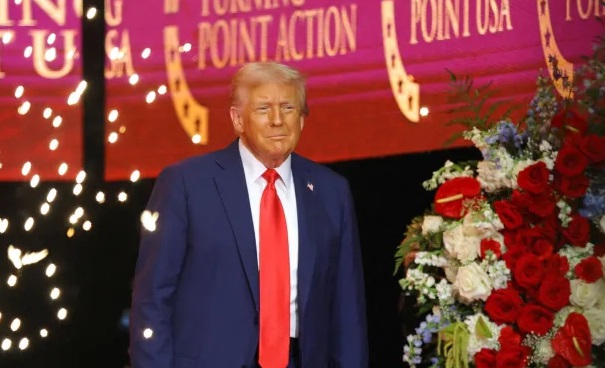
“He did not hate his opponents. He wanted the best for them. That’s where I disagreed with Charlie. I hate my opponent and I don’t want the best for them.”

President Trump, in his eulogy for assassinated conservative activist Charley Kirk at the massive memorial service in Phoenix

Can a quote be both ethical and unethical at the same time? You have to hand it to Donald Trump: his statement above at the Kirk memorial service had progressive heads exploding all over the map, and some conservative heads too. It was a genuinely provocative line, rich with contradictory meanings and implications. Did the President intend it that way? Who knows? They will be arguing about Trump’s brain in history and psychology tomes for a hundred years. I find myself hearing Wilford Brimley’s voice echoing through my brain in his iconic scene from “Absence of Malice”: “Mr. Gallagher, are you that smart?” Except in this case, it’s “Mr. Trump.”

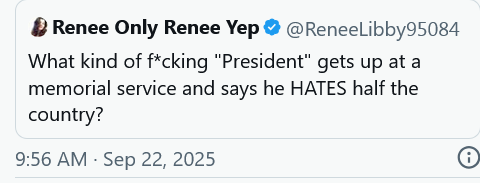
Of course the line triggered the Trump-Deranged into self-identification, as with this guy…

But Trump didn’t say he hated half the country. Now Joe Biden came a lot closer to doing that when he accused Republicans of being fascists who are existential threats to democracy, though it was in a national speech to the nation not a memorial service. (I think that’s worse, myself.) We can’t be sure whom Trump regards as his “opponent.” Those who want him dead, as about a quarter of all Democrats according to one poll? Those who tried to impeach him twice and put him in prison using contrived prosecutions? Those who call him Hitler? The journalists and pundits who have been lying about him since he was elected in 2016 and before? Continue reading

Why Fake Ron Howard Doesn’t Know What He’s Talking About, The Final Chapter…

We are finally at the last installment of the Make Fake Ron Howard Eat His Words Ethics Alarms Challenge, and it is the longest and most thorough of all. Again,I would be impressed greatly if one of our progressive-minded readers would rise in “Ron’s” defense, but “his” facile, talking-point besotted declaration of liberal pride is as indefensible as much as it is pandering to the Left’s fondest delusions—as the four posts including this one demonstrate. Fake Ron’s manifesto is here; rebuttal #1 is here, #2 is here, and #3 is here.

Now you have #4, a thorough fisking by John Paul, masterfully done.

Take that, Fake Ron!

***

I’m a liberal, but that doesn’t mean what a lot of you apparently think it does.

Good for you? But I’m willing to bet 95% of the time, I know exactly what it means. Studies (I can cite them if you want) often show I know you a lot better than you know me. The big problem with a statement like yours is that your views are often highlighted and celebrated, while republican views are not.

Because quite frankly, I’m getting a little tired of being told what I believe and what I stand for.

The same, but see point one. If you don’t like this characterization, maybe you should do a better job of reigning your side in. If people actually cared about things, they should spend more time looking inward than outward.

 Spoiler alert: not every liberal is the same, though the majority of liberals I know think along roughly these same lines:

True. No one is the same. But giving where this is going, I’m having a hard time not seeing you about to do what you accuse us of doing.

I believe a country should take care of its weakest members. A country cannot call itself civilized when its children, disabled, sick, and elderly are neglected. PERIOD.

Great in theory….You do know republicans do this? But that really isn’t the issue. The issue is how it should be done. The biggest question: Who’s gonna pay for it?

I believe healthcare is a right, not a privilege. Somehow that’s interpreted as “I believe Obamacare is the end-all, be-all.”

No, its not. As far as I know, never in human history has it been. Since you’re claiming it is, the burden of proof is on you. You can’t just make a statement. Also PERIOD? What are you five?

“I believe Obamacare is the end-all, be-all.” This is not the case. I’m fully aware that the ACA has problems, that a national healthcare system would require everyone to chip in, and that it’s impossible to create one that is devoid of flaws, but I have yet to hear an argument against it that makes “let people die because they can’t afford healthcare” a better alternative. I believe healthcare should be far cheaper than it is, and that everyone should have access to it. And no, I’m not opposed to paying higher taxes in the name of making that happen.

Strawman. Has any republican ever said this? There was a lot of (justified) critiques of the ACA (not to mention subterfuge). Also, if you don’t know better critiques of cheaper healthcare, you’re not listening to them. Additionally, everyone has access to it. You can walk into any ER and get anywhere in the country, but that’s not what you’re talking about, is it? I bet you’re also talking about Hormone therapy and abortion. But I’m willing to give you the benefit of the doubt. Tell me how you would get healthcare cost down without making someone do their work for cheaper/free. This is going to be a problem with one of your later arguments.

I believe education should be affordable. It doesn’t necessarily have to be free (though it works in other countries so I’m mystified as to why it can’t work in the US), but at the end of the day, there is no excuse for students graduating college saddled with five- or six-figure debt.

Setting aside the big problem with a significant number of colleges, the short answer: it can be. Trade schools, community colleges, military, are alternative methods to higher education that don’t break the bank. I’m willing to bet 999/1000 an employer doesn’t care where you went to college, only if you can do the job. I know one of Charlie Kirk’s talking point was almost 50% of people working aren’t in a field they got their degree in (I’ll admit, I don’t know if this is true). Still, this is you’re talking point. I also understand (Maybe I’m doing exactly what you accuse me of doing earlier) that colleges are one of liberals sacred institutions. If you think there is a problem, maybe, as I suggested earlier, you look inward towards a solution instead of asking for the government to step in and fix it.

Continue reading

On Re-Watching “The Magnificent Seven” and Finally Realizing What It’s About

I am trying hard to write about something other than the Charley Kirk Ethics Train Wreck despite the din making even thinking about other ethics issues difficult. Naturally, my default solution is the Great American Ethics Genre: the American Western.

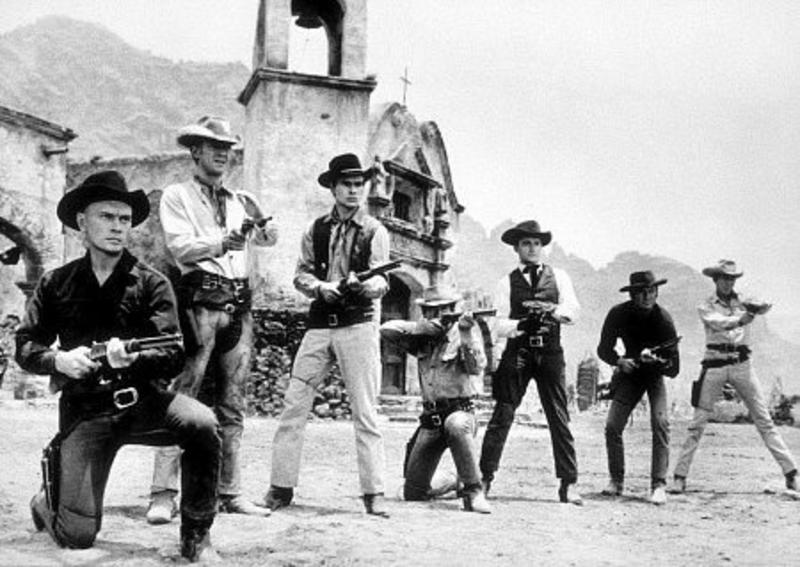
I have been bringing a younger friend up to speed in his cultural literacy pursuits, and recently had him view the original John Sturgis-directed version of “The Magnificent Seven,” a great ethics movie and one of the ten best Hollywood Westerns ever made, a tough field. I have written about the movie several times on EA, but I am abashed to say that it never quite sunk in what the film was really about until that last viewing.

The film is about professionalism. Once that bell rang, I couldn’t believe that I hadn’t realized it before. It is a filmed course in professionalism—the quality of justifying the trust a particular practitioner of an occupation dedicated to public service must maintain to be considered a professional. I would love to teach a professionalism course using the movie as the centerpiece.

Years ago, retired EA commenter Bob Stone-–I hope he isn’t Trump-Deranged now—wrote a piece for his own blog about how the film illustrated the difference between law and ethics. He wrote in part,

Continue reading

Comment of the Day: “It’s Come to This: a Majority of House Democrats Chose To Avoid Angering Their Radical Trump-Deranged Base Over Appealing To Sane Americans”

Certain long-form comments on Ethics Alarms (most blogs don’t get them or don’t allow them: I love ’em) just scream “Comment of the Day.” This one, by emerging Ethics Alarms commentariate star CEES VAN BARNEVELDT, was one of those. It concerns the decision by about half the Democrats in Congress to eschew a symbolic vote condemning political violence because apparently they couldn’t bear endorsing any sentiment complimentary to Charlie Kirk, whom their radical base considers a an evil fascist (mostly because Democrats said he was.) Here is that Comment of the Day, on the post, “It’s Come to This: a Majority of House Democrats Chose To Avoid Angering Their Radical Trump-Deranged Base Over Appealing To Sane Americans”:

***

The assassination of Charlie Kirk is a moment of absolute moral clarity. And almost all moments of absolute moral clarity have a villain. I became aware of the Charlie Kirk assassination via Ethics Alarms. When I switched on the television the news was that Charlie Kirk had died. Soon thereafter the news changed to “Republicans pounce after the death of Charlie Kirk,”following the main stream media.

But as everybody with two eyes and a couple of braincells can see, the real news since that day has been “The left goes mental after Charlie Kirk’s assassination”.

American history had more moments of absolute moral clarity. The most recent one with similar significance is the attack on the World Trade Center at 9/11/2001. Another one is the lynching of Emmett Till, among many more that are related to Jim Crow and the struggle for civil rights.

The one moment that strikes me as most comparable is another famous example of political violence. In May, 1856 Senator Charles Sumner of Massachusetts took to the floor of the U.S. Senate to denounce the use of force and fraud to plant slavery in the territory of Kansas. This speech is known as the “Crime Against Kansas” speech. A couple of days later, Representative Preston Brooks of South Carolina, with two other Southern Representatives, entered the Senate Chamber and gave Sumner such a beating with a cane that he nearly died. The other Southern Representatives made sure that the Senator could not get any help. The Southern newspapers praised the attack, and blamed Sumner for bringing his fate on himself. The cane had broken in two, and Southern supporters made sure that Preston Brooks got a new cane. An attempt to oust Brooks from the House of Representatives failed.

In 1856 the country was deeply polarized about the issue of slavery, even more polarized than today. Sumner used words and debate to persuade; however Brooks, with full support, used force and violence in order to extend their power and way of life, which included an oligarchy supported by slavery.

The caning shocked the conscience of the United States of America. The Southern Democrats had let their mask slip; they stood exposed for the entire nation as a party that disdained free speech and republican norms, and instead chose force and violence to get their vision realized.

Continue reading

Why Fake Ron Howard Doesn’t Know What He’s Talking About, Part 3

Four EA commenters took up my challenge to fisk the possibly AI bot written screed explaining why liberals/progressives are the salt of the earth and are completely reasonable as well as thoughtful and compassionate. “Ron Howard’s” name was attached to the thing though it is well-established that he didn’t write it. As promised, I am posting all four, each of which is persuasive and effective in its own way.

I was hoping that at least one of the lurking progressives out there, maybe even AWOL Curmie, would enter the fray to try to rebut one or more of them, but so far, no takers.

If you missed it, Fake Ron’s manifesto is here. Fisking #1 is here, and #2 is here. Below is #3, an epic take-down of the”renewable energy” obsession so dear to the Left. The fisker is Sarah B, and she leaves fake Ron, the fiskee, in shreds as you will shortly see…

***

To no one’s surprise, I’m sure, I’m going to pick apart #15.  If I find extra time in my schedule, I’ll work on some others, but 15 is in my area of expertise and my favorite soapbox. 

I will also note that the reason people throw out lists like this is to make attacking the ideas difficult as it takes a lot of time and effort to debunk even one point, and 16 points is a lot to get to.  I believe the term for a verbal list like this is a Gish Gallop, but I could be wrong.  However, I have to spend as much time and paper, or more on one item than they did on all 16.  Sorry, it’s long, but you asked us to fisk this.

15. I believe in funding sustainable energy, including offering education to people currently working in coal or oil so that they can change jobs.  There are too many sustainable options available for us to continue with coal and oil.  Sorry billionaires. Maybe try investing in something else.

“Ron,” you say that you want to fund sustainable energy.  Now, part of the definition of sustainable is that it can sustain itself.  Dumping a few billion or trillion dollars into something is great, but only if it starts paying for (sustaining) itself.  We will discuss that in more detail below.

Continue reading

Charlie Kirk Assassination Ethics Train Wreck Update, 9/21/2025

I have to say that I’m pretty sick of hearing and reading about Charley Kirk. The hagiography on the Right and the desperate spinning from the Left, which fears, with considerable justification, that the activist’s assassination will be a devastating tipping point that will doom their prospects in the 2026 election, are both relentless. The Kirk memorial service i is being compared to a state funeral, and that diminishes the tradition and the status of state funerals. Whatever Kirk was, he was not a national public servant. He wasn’t Charles Lindbergh either. The Democrats approached this level of creating exaggerated status when they held a Capitol Rotunda viewing for a Capitol police officer on the pretense that he was killed by the mob on January 6, 2021. He wasn’t, but the charade was all part of the coordinated effort to demonize Republicans, just as the deification of Kirk, a partisan organizer, is a Republican effort to show that the American Left approves of and encourages violence as a political weapon. (It does, you know.)

The obvious comparison is with George Floyd, but like most obvious comparisons, it’s not valid. To begin with, there really are good reasons to mourn Kirk. George Floyd was a blight on society, if an insignificant one. His ambiguous death was brilliantly exploited despite the fact that it signified nothing except that some cops aren’t very good at their jobs (we knew that). Floyd’s death didn’t result from racism or bigotry. Sure, the lifetime petty crook and drug addict’s life “mattered,” but it didn’t matter enough to him to do something positive with it. Also, to state the the most vivid distinction, conservatives didn’t use Kirk’s murder to go on a destructive nationwide “mostly peaceful demonstration” spree resulting in billions of dollars in damage, over 30 deaths, and the disruption of daily life for Americans who had nothing to do with Floyd’s demise.

Continue reading

Unethical Quote, Ethics Dunce, Incompetent Elected Official…the Usual EA Designations Are Inadequate For Rep. Jasmine Crockett’s Latest “It Isn’t What It Is” Idiocy

Rep. Crockett—-remember, she’s considered a “rising star” in the reeling Democratic Party—actually said this:

“And so I do want people to know that just because someone has committed a crime, it doesn’t make them a criminal.”

Interesting. The definition of “criminal” is literally “a person who has committed a crime” or the equivalent in every dictionary in existence, but never mind: this is the totalitarian Left of 2025, for which Big Brotherish denial of reality—you know, like “War is Peace” “or “Biden is as sharp as a tack” or “Harris ran a flawless campaign” is foundational.

Lest you think I have pulled Crockett’s latest nonsense out of a context where it is defensible (I can’t imagine what that would be, though), here is her whole rant, from an appearance on the podcast “Getting Better with Jonathan Van Ness.” Incidentally, you know everything you need to know about Van Ness to avoid him and his podcast like the plague by the fact that her statement didn’t prompt him to say, “What? What the hell are you talking about?”

Here’s Crockett’s whole statement:

Continue reading

Why Fake Ron Howard Doesn’t Know What He’s Talking About, Part 2

This is the second of the Ethics Alarms commentariate’s critique of the smug and facile defense of Progressive World offered by “Ron Howard,” placed in his metaphorical mouth by someone who thinks that the popularity of the messenger is more important than the quality of the message. Sadly, the fallacy is too often borne out.

#2 is the work of DaveL, and it is notable for its succinctness. Part I is here. “Ron’s” screed is included in my original post. Now here’s Dave:

***

The piece as a whole tends to suffer from 4 main flaws in its thinking, all of which are related to one another:

  1. External locus of control: The piece refers in many places to the idea of the strong helping the weak, the wealthy helping the poor, etc. But it doesn’t ask where rich and poor people, or strong and weak people, come from. They’re assumed to just be. Some mysterious force beyond mortal ken makes them that way. Sometimes that’s the case – often it’s not. Which leads to:
  2. Ignoring effects of the second order and beyond: You want regulations to make things “safe”, but what does that do to make housing affordable? What does it mean for a job to be well-paid when so much of your earnings are diverted for the use of others? What happens when you make it more comfortable to be dependent, or more of a strain to be a contributor?
  3. Refusing to see tradeoffs: These things they want are often interrelated in a way that makes them actually oppose one another. You don’t get to have everything you want, only to choose where to strike a balance. Which leads into…
  4. Black-and-white thinking: You want housing to be “affordable” but also you want regulations to make them “safe”. How “safe” is “safe?” How “affordable” is “affordable?” One reason they can’t see tradeoffs is because they collapse these ideas from continuums to dichotomies.