Hollywood actors are freaking out over fake actress “Tilly Norwood.” That’s already a plus to the AI-generated performer’s credit: Hollywood actors deserve to be freaked out as often possible (within the boundaries of law and ethics, of course). It gives them something to scream about other than how the President of the United States is a fascist, or how as more unborn babies should be killed. And cases like this one, where their freaking out reveals just how hypocritical and intellectually shallow they are, it’s a public service: NOW do you understand why you shouldn’t pay attention to these one-trick millionaires?
Tilly Norwood, in case you never watch E! or read Variety, is an AI-generated fake actress with about 40,000 Instagram followers who don’t have a life. Tilly was created by Xicoia, the AI division of the production company Particle6, from the rib of an AI-created actor. OK, I’m kidding about that.
Eline Van der Velden, the Dutch producer who founded Particle6, claims to be seeking an agent to represent Norwood to place her in real films, ads and TV shows, unlike the fake, AI created scenes in her videos.
Actress Emily Blunt quickly became the voice of the “Kill Tilly” movement. “Good Lord, we’re screwed. That is really, really scary,” Blunt told Variety. “Come on, agencies, don’t do that. Please stop. Please stop taking away our human connection.” How does a fake AI actress take away Blunt’s “human connection”? Oh, whatever. Read your lines, Emily.
The biggest performers union, SAG-AFTRA, released a statement condemning Norwood and her inevitable clones.“To be clear, ‘Tilly Norwood’ is not an actor”—- like Cybil Shepherd, Gal Gadot, Victor Mature and Dwayne Johnson?—-she’s a character generated by a computer program that was trained on the work of countless professional performers — without permission or compensation,” SAG-AFTRA wrote. “It has no life experience to draw from, no emotion and, from what we’ve seen, audiences aren’t interested in watching computer-generated content untethered from the human experience. It doesn’t solve any ‘problem’ — it creates the problem of using stolen performances to put actors out of work, jeopardizing performer livelihoods and devaluing human artistry.”
Huh. If audiences aren’t interested in watching “computer-generated content untethered from the human experience,” what is the union worried about, then?
“Stolen performances”—-give us a break! Every aspiring actor and actress from college through community theater to Broadway and Hollywood learns from and imitates the performances of established stars. As a director, I’ve used videos of particular moments in film to show my actors what they should be aiming for. Performances that have been made public can’t be “stolen;” they are the epitome of work in the public domain.
The freaked-out stars weren’t concerned when CGI became standard practice to put extras out of work, so now almost all big crowd scenes include fake bystanders. They didn’t sound the alarm when dead performers like Elvis were computer-regenerated for concerts that people paid money to attend. One of the joys of watching old movie spectaculars like “The Ten Commandments” and “Ben Hur” is realizing that they really had all those people in the big scenes: “a cast of thousands!” was a box office lure. The Hollywood stars weren’t threatened by the fake actors who took the place of those “thousands.” Nor did any Steve Buscemi-like character actors who George Lucas put out of work by using a CGI-created Jar Jar Binks get any support from the unions. Explain why Tilly is any more of a threat than Jar Jar, or those whateverthehelltheywere computer-generated things…
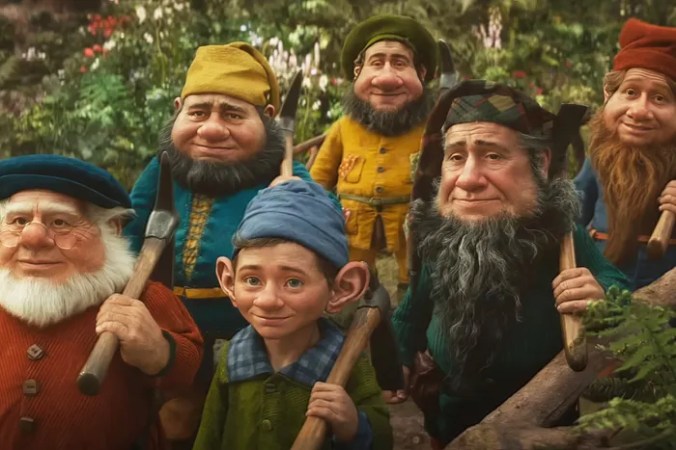
… that Disney gave the roles of the Seven Dwarfs to in its politically correct “Snow White” fiasco.
I don’t recall any SAG-AFTRA complaints over technology being used to make a 70-plus Robert DeNiro look like a 30-plus Robert DeNiro who moved like a seventy-year-old man in “The Irishman,” or Harrison Ford being artificially “de-aged” for flashbacks in the last Indiana Jones movie. Uh, how about just hiring younger actors? But younger actors don’t have their own union, and the established stars were thrilled with technology that could keep them earning pay checks after their pull dates. As usual, the protests are arriving only after a new tool starts threatening the power elite.
But no genuinely talented actor need feel any threat from Tilly and her inevitable ilk. Audiences like to see their stars show versatility and range: Meryl Streep’s accents, DeNiro, Hanks and Charlize Theron changing their physiques, Julia Roberts suddenly faking boobs in “Erin Brockavich,” Tom Cruise playing a bald, fat guy in “Tropic Thunder,” Christopher Walken and Richard Gere showing they could dance. Tilly just needs a programmer’s tweaks to suddenly have a perfect Italian accent, be built like Jayne Mansfield, look like she weighs 240 pounds, sing like Judy Garland or dance like Ann Miller. What’s the fun in that?
Tilly Norwood should pose no more of a threat to real performers than Bugs Bunny or Buzz Lightyear, and if our current crop of human actors can’t be more entertaining than the new wave of fake ones, that’s their problem. It’s an old, old tale, with new technology taking away the jobs that human beings can’t do as well or as cheaply. The ghosts of millions of bank tellers, factory workers, elevator operators, cashiers, switchboard operators, customer service agents and data entry clerks may not be rooting for Tilly, but they’re not exactly weeping for Emily Blunt either. Prove you’re better than Tilly, Emily, or learn to code.
 Ethics Alarms
One of the complaints about AI art is that it’s “trained” on the works of real artists, and hence is supposedlt using their work to replace them. I’ve never cared for thar logic, because I see no material difference between training a student vs. training a computer. Also, computer-generated actors have kinda been tried before. The movie “Final Fantasy: The Spirits Within”, was supposed to kick off a franchise of CGI “actors” (though voiced by real people) that would appear in other projects, but it never took off. As it is, I think I would take less work to direct a real-life actor than tweak an AI image and voice to get the exact performance you want.
I also wouldn’t trust either a director or a programmer to know what the best performance is more than a good actor.
I wonder how this is any different from me spending hours listening to, and then trying to copy (quite competently, I might add) Alex Lifeson’s guitar parts from innumerally fantastic Rush songs. There was a time I could almost all of “La Villa Strangiato” note-for-note, except that second guitar solo, which still terrifies me. I worked hard on those songs, learning his bends, his phrasing, and his approach. When I play my own stuff, there is an obvious influence that cannot even modestly approach his beyond human abilities but were it not for my dedication, I would not have developed what style I have. Same with other musicians. In the 1970s, there wasn’t a guitar player around who didn’t cop a Juimmy Page lead line.
jvb
Imitation is the sincerest flattery and certainly has a long history in the arts.
Congrats on the guitar prowess! Lifeson is stunning and I think no amount of practice would enable me to get very close, unless air guitar counts.
I don’t want to get lost in the weeds on this one because I know it crosses a line when you’re making a movie with an AI character and no human performance. It’s no longer a “performing art”, it’s just computer generated.
Is the expectation here that any actor can play the role and Tilly Norwood is expressed as an avatar? Ok. That at least just makes it really good CG akin to Jar Jar Binks.
…but if you’re suggesting filming everything else live action and just dropping her in there in post production? Why bother?
Let’s be a little honest here. To be properly classified as an AI Actor – the thing needs to be able to listen and react and contribute to a scene the same as a real human being. Otherwise, it’s just a script reading, direction adhering CG character. It also needs to do the performance live so others can react and deliver their performance.
But why is “Tilly Norwood” the first foray into this new world? Wouldn’t it be more appropriate to make Robocop or Terminator or a T-Rex or Stitch or an Alien or a Predator? Humans have to be the cheapest labor point in all of this – they pick big name stars and pay them big bucks because we care about these actors almost as much as we care about the characters they embody and create. We pay to see the magic of these actors disappearing into a new role, or aging with their well known roles. We cringe when we see 60 year old Tom Cruise hanging from a real airplane in jaw dropping amazement that he would undertake such a feat at such an age. That’s inspiration for the audience. That’s an experience. That’s also why we grow out of cartoons as adults – we lose the ability to connect and relate to things that aren’t real – it takes significantly more effort to draw us back to them and when they do, it’s because they’re creating artistically creative imagery. Coco and Into the Spiderverse climb high on that list for me.
No, we have a backroom full of geeks who created a young girl barely of consenting age – and I guarantee you with every fiber of my being that there are things they’ve created with it that would make your skin crawl, stored on some secure server.
Where was the Chess Players Union when IBM’s Deep Blue beat Kasparov thirty years ago, or the Steel Drivers Union when John Henry died after competing against a steam drill?
There is no holding back this progress.
While AI produces a bland beyond-meat hamburger, not a filet mignon, hamburger is good enough much of the time.