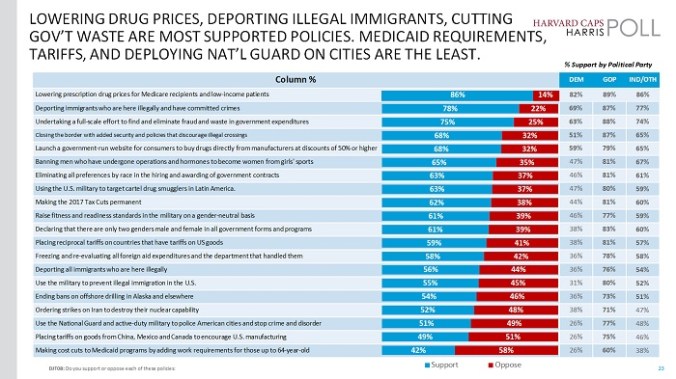
You can find the poll, released last week, here. The charts are easier to read there.
I know: polls. This one, however, has special significance since it comes through Harvard, currently fighting Trump’s efforts to hold it accountable for its toxic influence on education, politics, its students, the culture, and more.
Is the poll tainted with bias? Of course it is. For example, I found it fascinating that in the chart above revealing how popular various Trump policies are with the general public, the pollsters neglected to ask whether the public approved of elite institutions like Harvard being pressured to stop discriminating against conservatives, whites, and men. A related omission: eliminating DEI. How could they ignore that one?
Nonetheless, the chart above, relatively buried at page 23 so it could be preceded by data showing how unpopular Trump is and how the majority of the public thinks the U.S. is off course, is the most important revelation in the poll. It shows that almost all of the Trump Administration’s policies are favored by the public, in most cases by a large majority. Only so-called Medicaid “cuts” are substantially disfavored, one of many areas where the biased news media has (and continues to) mislead the public.
Wait…if so many of Trump’s policies are supported by the public, why is the President still so unpopular? Easy: the news media and other Axis of Unethical Conduct allies have been engaged in character assassination and relentless negative publicity regarding Trump for nearly a decade. One would think, however, that eventually reality would begin to dawn. The Democratic Party ran its entire campaign on the smear that Donald Trump was an existential threat to democracy. If the public believes his policies are good ones, it means that democracy functioned just fine, thank-you.
It also means that Democrats, who will uses any means necessary to reverse most of those policies, are the real threat to democracy.
The latter part of the poll report includes other news Democrats (and therefore Harvard) must find hard to accept. Israel is overwhelmingly supported, as is Trump’s efforts to broker a peace. But symptoms of the effect of the relentless anti-Trump propaganda persist, as in this chart
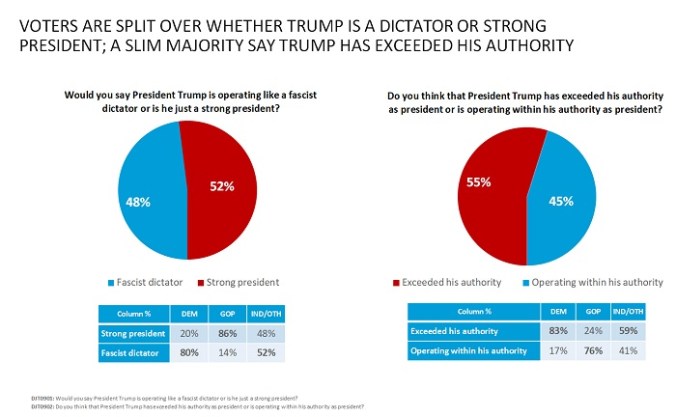 asking whether the President is a dictator or just a strong President. Morons. Trump is a strong President. Those calling him a “dictator” who know better are trying to deceive the public, and most of the public is too ignorant of history and the Presidency to avoid being deceived.
There are some tell-tale signs of partisan and confirmation bias; for example, in the list of approval ratings of various figures, the pollsters state that Zelenskyy recieved the most positive response. You can see right on the chart that he didn’t. Charley Kirk is more popular. In the chart above, the pollsters neatly narrow the objection to biologically male competitors in women’s sports to those who have had gender-changing surgery. Men who have eschewed surgery and turned themselves female by just declaring so are competing against women.
And where are the numbers telling us how many approve of Trump’s declaration that English was the national language?
The main takeaways from the polls are, however, that….
1. President Trump is performing very well in Term Two, and that any other President with that level of success would be extremely popular.
2. Unethical journalism works. The Enemies of the People are still having success undermining the elected President of the United States for partisan, emotional and biased reasons.
3. Democrats and progressives, in their Trump Derangement, are depressingly immune to processing reality. Look at this chart:
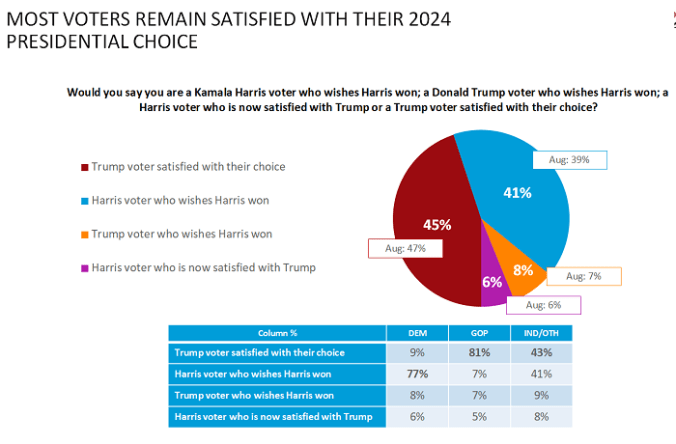 How could anyone say today that they are satisfied with a vote for Kamala Harris?
4. This is a mostly positive poll for Republicans and Trump, presented in as negative a framing as possible.
5. You can’t trust polls or pollsters.
 Ethics Alarms
One would think, however, that eventually reality would begin to dawn.
A familiar, and rational, conclusion that remains stubbornly wrong.
This poll makes no sense. The lowest priority does not mean that they don’t want it, it just means other things are a higher priority. When I shop for things items like soap and toothpaste have a higher priority than doughnuts but that does not mean I don’t want the doughnuts.
To make this have an value you would have to list Democrat priorities if we are ranking things