I have combined two related comments by prodigal son commenter jdkazoo123 to make one, big, bang-up Comment of the Day on the post, “Ethics Observations on Another Progressive Academic Meltdown.”
The “great column” jd references at the beginning was not mine (humph!) but his fellow D.C. area prof Jonathan Turley’s blog post which I referenced in mine. The result is an example of the very best EA commenters are capable of producing when they are civil, analytical, generous with their time and thoughts, and have direct experience with the subject matter, which fortunately is often.
And here it is…
***
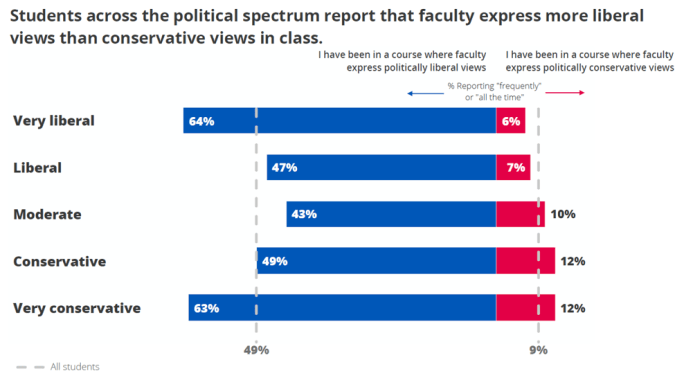
It’s a great column. I agree that there is to my knowledge no comparable violence on the right on college campuses by faculty. I disagree that there is a systemic effort to exclude conservative voices from higher education. I coauthored a book in 2008, Closed Minds? about ideology and politics in higher education. We conducted a nationwide random sample survey of professors. We confirmed that profs are even more liberal than they were 20 years ago, and they’ve been on the left as an occupation since the first scientific polls of faculty in the 1930s. BUT–the causes of the initial and the intensifying tilt are not a conspiracy, or at least, Occam’s Razor would suggest several other better ones.
First, folks who are on the right are often believers in markets. Folks who believe in markets are often motivated by them. Academia has a very low ceiling for money. The big money on campus is in administration and in sports. Some superstar profs (usually in hard sciences, but sometimes business or econ or every now and then something else) gets north of 180K, but it’s rare. And there’s many tens of thousands scrapping by as adjuncts, who would risk that? It’s far more likely you end up teaching 8 adjunct courses a year for less than 50K with no benefits than that you get tenure at a high paid place and clear 170K at the end of your career. My friends who went into business, law, medicine…all make significantly more than me.
Second–most profs are at public universities. In 1950, both Ds and Rs were for spending on higher ed. Today…in most states…if an R wins the governorship, profs get no raises for a while. We are not shocked when oil and gas executives vote GOP because that makes them richer. Professors are not saints. We like money, too. Finally, and perhaps most importantly–campuses are places where the gay rights debate was over by about 1988. The rest of the nation was still having huge arguments about this in 2010. Similar thing happened in the 1950s with race–profs got their first on racial equality, on average. The GOP doubled down on anti-gay in elections like 2004, and also allowed figures who believe stuff like young earth creationism and the divine right of men to lead, to speak at their conventions. This was smart politically, because there are many more believers in creationism than there are college professors, but when you take those positions….you lose support on campuses.
Final reason–the few campuses that are conservative (like GMU’s law school, Hillsdale, Catholic U, etc) sometimes explicitly refuse to hire liberals, and thus the very small number of conservative profs become even rarer on regular campuses. This is worse for the liberal students than it is for the conservative, because part of college should be having your core beliefs challenged. Liberals don’t get that enough. They might graduate never taking a course with someone more conservative than they are….whereas as a conservative student, you’re going to graduate constantly having your ideas tested. I was a young Republican at a VERY liberal school, and almost never heard a conservative thought in my classes, and really appreciated the profs who gave conservatism a fair shot.
[In response to Ryan Harkins’ question, “What do you make of the general drive to push everyone through colleges and universities?”..]
I don’t know enough to really answer your question well, but I know enough to know it is the right question. And AI may be making it an even better question, in two key ways. Many jobs currently done by college graduates are going to be done by AI. Also, AI University is coming. Imagine me being replaced by an AI prof, who knows MORE than I do about many things, is never impatient, never late with grading, much better looking ( at least online–you’ll be able to select the looks, voice, accent of all your professors, just as some do now with AI porn)…and in the aggregate, AI University doesn’t have to be better than the typical University, it just has to be acceptable, because it will cost 1/100th? 1/20th? of what colleges cost now.
As for your original excellent question–yes, I suspect the education establishment created a largely liberal establishment consensus that EVERYONE should go to college. Which is bananas. It also contributed to the impression among many people who didn’t go to college that the Democrats looked down on them and their choices. Not only did I know a lot of people who wasted a lot of money on college, I knew people who went to law school for no other reason than…they didn’t know what to do, and they were good arguers.
I like parts of the German system, where you can get an apprenticeship that leads to manufacturing or some other sector, without shame. The DOWNSIDE of that system, though, is high stakes testing early in life that almost eternally determines your chances. They don’t make much allowance for late bloomers. Higher ed is mostly free…but scarce and admittance (to grad school in particular) is conditional on years of doing great work. But again–this is not my area, so don’t take anything I say as definitive.
 Ethics Alarms
I have conservative viewpoints. Whether they are “moderate” or not is a matter of opinion. For what it’s worth, I more often find myself in agreement with the master of this blog than not. So, using this blog as a referent, I’m probably moderate. That said, I’m in academia for 2-3 decades. At no institution, including my current institution, would I risk sharing my viewpoints. That would put any promotion at risk, and likely would have my initial hiring, and will future employment. No, not Hillsdale, but several private and public universities. Definitely agree with Turley on this. Definitely. No question. Definitely.
American Association of University Professors
@AAUP
“Fascism generally doesn’t do great under peer review, but perhaps it’s the intellectual values of academia, which emphasizes critical inquiry & challenges traditional norms, that may be inherently less appealing to those with a more conservative worldview.”
My experience in academia is that the skew toward liberal (including departments that appear to have ZERO conservative voices) depends a lot on what sort of department it is.
Social sciences are very strongly liberal, including 100% (at least of people who are speaking up?) in departments like sociology that are often the academic home for those who teach women’s studies, gender studies, disability studies etc. Partial exceptions are economics, which in my experience tends to be one of the most balanced departments, and business, with both more liberal and more conservative voices and (based on my own brief stint teaching at a B school) reasonably civil conversations among viewpoints.
Hard science departments seem more apolitical, but likely also skew toward liberal because (as CotD notes) they get huffy at creationism etc. — the old church vs science hostility still pursued by some fundamentalists (who tend to be quite vocal!). Biology is heavily grounded in evolutionary theory. (Interestingly, evolutionary psychology — which is actually an interdisciplinary field that brings together biologists, anthropologists, and psychologists — gets attacked by both sides, which I think actually promotes a bit of moderation among those of us who work in this field).
Not sure about land grant professional schools, but I suspect engineering and agriculture (because of the rural bent) are somewhat more balanced (?).
The arts (music, dance, film, visual arts) tend to attract a reasonably high proportion of LGBT etc., and view the GOP as hostile to them. For which there is evidence. Some voices on the right (I haven’t seen this on the left) especially delight in making fun of arts majors as pursuing pointless activities that often don’t make much money (so how could they be valuable?) People in the arts tend to support each other so straight folk support their non-straight colleagues. For these groups I agree with CotD that the culture wars have driven them left.
My experience was that Engineering and Agriculture skewed to the right a bit. Of course, to be an Engineering professor at my school, you had to have 10-15 years experience in the industry and chemical engineers as a whole tend to skew right, especially if they are in fossil fuels based industry, which is about anything we can do, except some pharmaceuticals, make-up, and semi-conductors, all of which are still fossil fuels based, but a little more removed from them, which sometimes allows for a non-right skew.
As for the negativity from the hard sciences towards the arts, I think that is a chicken/egg conundrum. As an engineering student, the Arts/Fine Arts/Soft Science majors tended to make fun of us a lot as we tended to not have time for all the partying and socializing that they did. So we made fun of them since we’d have jobs when we graduated, and usually $60,000+ a year jobs at that, while they tended to migrate towards flipping burgers and getting mad at how they were in debt for minimum wage jobs. I don’t know who started it, but for me, my roommates (who somehow were always in Art, Education, Fine Arts, or Soft Sciences) always harassed me about how much studying I did before I even got started on them. In addition, I had 8 AM classes and they stayed out until 2-4 in the morning. This made for a tense situation. Then they would, at the end of semester, complain about their horrible 10 page paper due, while I had been turning in 100s of pages of homework a week all semester. My sympathies, and those of my classmates tended to be low, at which point we started into the “Paper or Plastic”/”Would you like fries with that?” jokes. I’m not saying somewhere along the line, we didn’t start it, but my experience was that they started it with me.
This was enhanced by the fact that whenever I took a “cultural context” course required by the university, the classes were so much easier, but with so much more scorn for any opinion outside of the professors, that you could not give an answer outside of the prof’s bias. If the professor thought that Beowulf was about lesbian orgies, then it was about lesbian orgies. You had to write your 5 pages on how the usage of some word meant that Grendel’s arm was really a pseudonym for a dildo, like the prof wanted, or you’d flunk. Of course, by the time we had gotten that far into the class, we all knew how to BS a 5 page paper in less than an hour, but the idea that people got degrees in this seemed preposterous. On the other hand, my engineering courses stayed almost totally away from politics and the answers we gave were right or wrong based solely on whether or not we were right or wrong. Either the distillation column worked, or it didn’t. The only political thing we discussed in my undergrad was how most of us did not see enough evidence for CO2 being a problem and so we wondered why we had to learn all these Global Warming (TM) prevention technologies that made no sense. The answer we got was that it didn’t matter if it was right or wrong, it was what customers wanted, so we needed to know how to provide the technologies with correct operation and ROIs.
If it wasn’t the response to scorn or ridiculous claims, it seemed to me that the scorn for Arts/Social Sciences majors was less about the low paying jobs as it was the lack of personal responsibility most took. This may sound like making fun of low paying jobs, but if you go tens of thousands of dollars (or more) in debt for a job that has a tiny possibility of getting a job in your major, and that job makes $20-30K a year, there are a lot of us who have no sympathy. It isn’t the money they make, it is the bad financial sense that got them into this position and then they talk about how unfair life is, and how the rest of us should pay for their college. I know that I made my choice in major based on not only the money I’d make, but the placement rate of the major I chose. I was interested in multiple fields, but chemical engineering managed to merge some interests with marketability, which is a good choice when making a multi-thousand dollar, life altering decision. People who went for what felt right, with a focus on how easy college would be seemed like a good target for scorn when they started whining.
Thanks for sharing your experiences!
I experienced grad school in the arts and then subsequently in the sciences. The work ethic was the same — basically work obsessively all the time. A nontrivial number of the art grad students lived in their studios (this was not allowed, but no one checked). Saved on rent and that way they could work on their art day and night. In science version no one lived in the research labs (not really feasible) but the computer lab had students there 24/7 struggling with their statistics homework and data analysis for their research jobs.
However, I did get to experience the stark difference between engineering majors and liberal arts majors when I taught writing at the university level for a while. The absolute WORST students were education majors — super entitled, whiny, and utterly deluded about the quality of their work (not entirely their fault after many years of false feedback). I had one of these treasures come to “talk to me” about the grade she got on her paper — a C. Her evidence that this couldn’t be right “because I am an A student” was that she had turned in THE EXACT SAME PAPER for an education class and gotten an A. Apparently she didn’t realize that (as far as I could tell) EVERY ed major was an “A student.” I informed her that turning in the same paper to two different classes without prior approval of the teachers was unacceptable per the student conduct code, changed her grade to an F, and told her to write a replacement paper. You can imagine how well she liked that!
In comparison, I LOVED the engineering majors, who were mostly also not very good writers and also knew this and were working hard on improving. Prototypical conversation with an engineering student who came to talk to me about his paper, which had earned a D: Student: “It really should have been an F, right? Me: “Well, that would also have been a reasonable grade. Student: “What can I do to improve? I REALLY need to learn how to write well enough to pass this class… ” He managed to pull off a C, and was grateful for the education.
I’m in a dept. of sociology, I’m in a dept. of medicine.
I meant I’m NOT in a dept. of sociology (typo), and my comment above was under a different name and I don’t know why it does that. Anyway, Turley is right, and it’s not limited to the social sciences.
Yes, my generation (1973 English B.A., 1981 J.D.) went heavily into making money rather than academia. But even the doctors and lawyers and even MBAs are lefties to this day. Maybe because they were largely from the northeast. But some went into academia, and they are lefties. And look at the Clinton’s. They went into politics because that’s where they keep the money. I think it’s a generational thing. The WWIi generation that taught us generally weren’t as greedy and they could probably live pretty well and retire on a tenured prof’s salary alone.
None of which is to say the academy hast been turned into a toxic, liberal to the point fascist ghetto, a no go zone for anyone other than their fellow travelers, which has nothing to do with compensation. It’s happened because they could.
Jerry, congrats on the COTD! I have one other question for you: is your book, Closed Minds?, available on Kindle? I looked at Amazon, and that didn’t seem to be an option.