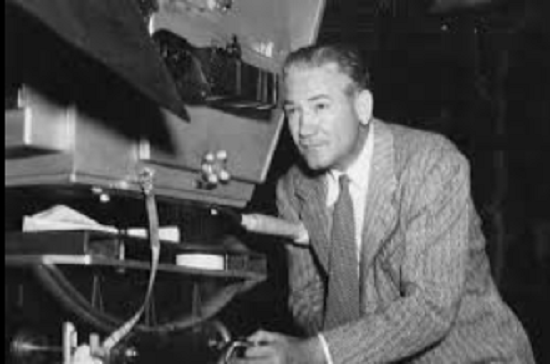
And attention should be paid.
Victor Fleming is never included in the list of immortal Hollywood film directors. I never understood why, and now I really don’t understand why. Everybody knows, or should, that Fleming pulled off the all-time film directing achievement of helming two deathless classics in two distinct genres in the same year, 1939. The films: “The Wizard of Oz” and “Gone With the Wind.” The closest to that amazing performance anyone else ever came was in 1993, when Stephen Spielberg delivered both “Schindler’s List” and “Jurassic Park.” But Spielberg is automatically in the discussion when great film directors are the topic, and Fleming is not.
I could make the argument that Fleming belongs in that discussion based on his output alone. Though he died at the age of 59 and had only 20 years to create movies in the sound era, Fleming had several other classic films that still hold up: “The Virginian,” “Captains Courageous,” “Treasure Island,” Dr. “Jekyll and Mr. Hyde,” “A Guy Named Joe” and “Joan of Arc” in addition to his two 1939 icons. But that isn’t the reason for this post.
Victor Fleming was ahead of his time, way, ahead, in two respects that only noticed recently:
1 Post-modern Meta humor in “The Wizard of Oz.” The gag in which a character comments on features of the movie he or she is in, thus momentarily sharing with the audience the knowledge that it is a movie and thus breaking interrupting “suspension of disbelief” is now commonplace in films and TV. Woody Allen and Mel Brooks both made frequent use of the routine beginning in the Sixties, but Fleming did it twice in more than 20 years earlier, “The Wizard of Oz.”
In both the Tin Man’s solo “If I only had a heart” and when the snow revives Dorothy and the Cowardly Lion who have fallen asleep in the poppies, the Scarecrow (Ray Bolger) and Dorothy look around quickly at voices in the soundtrack, as if they hear what the audience is hearing and think, “Where is that coming from?” It’s funny both times, and in 1939, revolutionary. It is true that the Marx Brothers were engaging in post-modern humor in the Thirties, but no one had tried injecting the device in standard musicals. I’ve never heard the Meta bits in TWOO commented upon, possibly because the whole film is so familiar that we look past a lot of things in it, like Judy’s ever-lengthening and shortening pigtails.
2. The No-Blink Rule. Michael Caine famously stated that he practiced not blinking so his face would not convey any weakness or lack of focus during close-ups in dramatic scenes. When movie acting and cinematography became more sophisticated in the Sixties, many directors adopted the practice of telling actors not to blink during especially intense scenes, on the theory that it subliminally reduced the scene’s effectiveness. This was progressively easier to demand as shots became shorter and cross-cutting edits more common.
Fleming, however, was way ahead of them. In “Gone With The Wind” the director insisted that his actors not blink during important speeches and dramatic scenes, and they don’t, even during very long scenes. It is one of the thousands of little details that make the movie so effective even today. If the so called “No Blink Rule” was in evidence before GWTW, I haven’t seen any evidence of it yet when I view other classics films of the period.
My conclusion: Victor Fleming wasn’t just an excellent director. He was an innovator, and ahead of his field. He enriched the movie-making art, and not just by happening to make two of the greatest and most popular films ever in the same year.
 Ethics Alarms
Something I noticed in “Wizard of Oz” which I’m sure wasn’t meant to be a joke, but is funny if you think about it:
Glenda’s famous first line is “Are you a good witch, or a bad witch?” But then explains that only bad witches are ugly. So what was she implying with that question?
Jenna Ortega took the no-blink rule to the max in the Netflix series “Wednesday”. She never closes her eyes when the camera is on her face, even when playing dead.
If we take the line at face value (hah), she’s saying that Dorothy is not ugly, and that therefore it’s not possible to tell by looking at her whether she is a good witch or a bad witch. While logical, that does raise the question of whether a bad witch would be expected to answer truthfully.
If so, we can guess that the variation on “knights and knaves” logic puzzles based on good and bad witches would be rubbish.
Re: Glinda’s line. Never noticed that either!
Gamereg wrote,
I’m not sure if it was meant to be a joke, but this sentence is funny if you think about it.