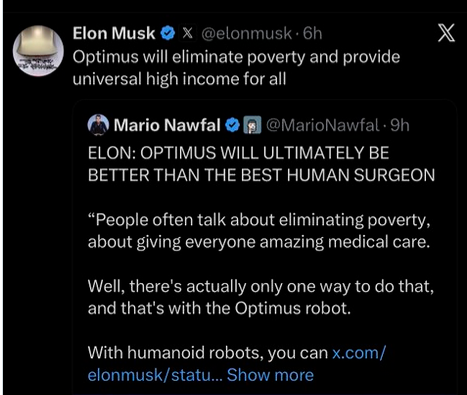
A twitter user I have never heard of (but who somehow has amassed over half a million followers posted that tweet above with the comment, “I don’t understand why people continue investing in a company whose CEO is self-evidently delusional and whose plans for the business have no basis in reality.” Another user quickly pointed out that the eccentric billionaire entrepreneur “reduced the cost of launch to orbit by ~90%, mainstreamed electric cars, and gave a paralyzed man the ability to control a computer with his mind.” Yes, that’s a complete rebuttal to the “influencer’s” snark. Why do investors trust Musk? Because he’s an out-of-the-box thinker with the resources to make impossible-seeming ideas reality, and has a track record that says, “Don’t bet against him.”
Regular readers here know that I detest John Lennon’s anthem for idiots, “Imagine.” John identifies himself as a “dreamer,” which he rationalizes “Everybody does it” style: He’s not the only one who thinks we can achieve his juvenile version of utopia (“Nothing to live or die for…”). But John was a minimally educated lifetime musician and poet: like the Everly Brothers, all he could do was dream (and they were silly dreams anyway). Elon Musk has shown that he is capable of making some previously impossible dreams possible. That deserves awe and respect.
Over at the Independent there’s another familiar—and equally stupid— complaint about Musk:
If Musk earns $1 trillion over the next decade, he could earn an average of $100 billion each year. At that rate, the world’s richest man could make $3 billion more each year than all 1.4 million elementary school teachers in the nation combined, according to a new data analysis project by The Washington Post.
Teaching isn’t the only essential profession Musk is set to out-earn, according to the outlet’s analysis. Each year, Musk will earn $72 billion more than all 107,950 family medicine physicians in the U.S. Musk will also out-earn all 1,057,660 construction laborers by about $46 billion.
This reminds me of my smart, funny, and greatly missed Aunt Bea. On our Marshall family vacations with her family, she and my father would have frequent, often loud arguments over her knee-jerk liberal beliefs, one of which was that it was “ridiculous” that star professional athletes and entertainers receive more money than teachers or doctors. The basic economic concept escaped her, that unique talents valued by society are always going to be more lucrative than more common talents possessed by large numbers of people regardless of how important those individuals functions are.
In Elon Musk’s case, this point should be much more palatable than if the focus is on Aaron Judge or Tom Cruise. (I also think, giving the current performance level of U.S. teachers, it is a rebuttable presumption that they deserve the salaries they currently receive.)
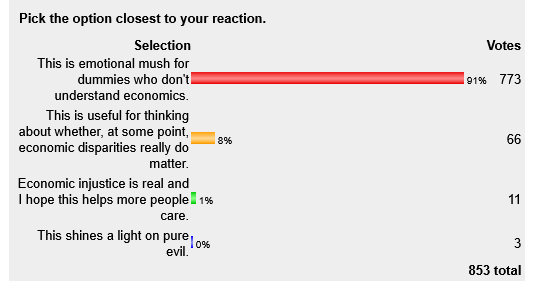
The Independent Marx-ish blather prompted Ann Althouse to give a poll to her readers on the Musk-teacher comparison. (Her free poll service doesn’t work on WordPress). The results were encouraging…
I find it very difficult to accept that Musk is going to succeed in eliminating poverty and guaranteeing universal high income for all. I keep thinking back to how its inventor believed that the Segway was going to revolutionize transportation. Still, never underestimate the dreamers who have a track record of making their dreams reality. Bobby Kennedy was a bit of a con-artist, but his most famous quote, which wasn’t really his but originated with playwright George Bernard Shaw, applies to Musk: “Some men see things as they are, and ask why. I dream of things that never were, and ask why not?” Another one of Bobby’s quotes is also germane. This one is a short and catchy summary of Teddy Roosevelt’s famous “The Man in the Arena” speech, but it also applies to Musk…
“Only those who dare to fail greatly can ever achieve greatly.”
 Ethics Alarms
Musk should just learn to underpromise and overdeliver. But maybe he learned early that overpromising is required to get necessary capital (not that he needs it now!) or hype.
My answer is that he can deliver on some amazing things but won’t on everything.
That does not appear to be in his nature. He seems to shoot for the stars hoping he will hit a planet or solar system.
jvb
We can already 3D print organs. AI/robotic/ surgical chambers are a really common science fiction concept. It would be more surprising to me if it doesn’t happen.
A neighbor of ours, a very recently retired Boeing rocket engineer who was the launch master at Vandenberg and lead engineer for the anti-missile missile program says Musk is brilliant. And our neighbor is one of those super smart guys who is loath to consider most anyone else anything other than dumb.
Forget trivial accomplishments like SpaceX or Tesla. Let me give you just one word:
PayPal
When I’ve pondered the difference between the salaries of athletes and school-teachers, I realized that the roots of it are “scale”, and “feedback”. “Scale” means that one athlete can provide entertainment to millions of fans, while a teacher can only work with 20-30 students. So, income “per client” is hardly as unbalanced as it looks. “Feedback” means that a good athlete draws more attention to his team (and it’s businesses) while even a great teacher has the same room full of students for the year, and the same number next year, and the next. A good school might raise property values, but that’s a very indirect form of feedback to the individual teacher. No matter how good your 3rd-grade teacher was, you’re not going to repeat the grade to absorb more of that goodness, and you’re not going to pay the school for the privilege.
Maybe some of our YouTube teachers can achieve the scale and feedback that they deserve. I like Veritasium, for example, and have heard good things about the Khan Academy.
Lathechuck
When we’re talking about poverty, we should be very clear what exactly we’re talking about. We can and absolutely will eliminate poverty in a baseline way. There is a future where NO one will be hungry and NO one will go without shelter and beyond that there is a future where the food and housing needs of every individual will NOT eat up the majority of their expenses.
All of this is accomplishable in a free market capitalist system.
If we want to talk about “relative” poverty. Well – that will never go away. But I don’t inherently see the problem with that. If in 2087, the “poorest” people all have access to inexpensive communications devices, food, housing, entertainment, transportation, creature comforts etc…so what if the world’s quadrillionaires have access to expensive interplanetary travel, homes that heat and cool rooms instantly when they enter them, holodeck entertainment, etc…?
I am, however, understanding of the arguments that as technology progresses our baseline for tolerable “poverty”, can and should be updated. That is to say in my 2087 hypothetical, when the poorest person is still 100 times better off than the 1920s King of England, that doesn’t mean we should automatically assume that massive wealth disparities perfectly fine.
It’s the mechanism of wealth disparity that should matter. If the poorest person has, based on their own efforts, the ability to keep moving upwards (if they so choose), then we don’t have a problem. Do we?
If the poorest person, given their absolute best efforts, are systematically harangued back down…then we have a problem.
But is that true of our current context? Possibly. I don’t fully see it yet outside of times large industries can get government to regulate competition out of existence or government-backed structural incentives that make it virtually impossible for new entries into various industries.
One of the things that Bjorn Lundberg (and now Bill Gates) have stressed when talking about climate change is that, while it may be a problem it is not an existential problem. If we’re looking at a lost of 5% of our potential worldwide GDP by 2100 that’s a big number in absolute terms. However, what it means is that we’ll be a little less affluent than we would have been otherwise.
So where can you put your money so that it will actually have the biggest impact?
Their answer is to harvest some of the low hanging fruit that will have a disproportionate impact on masses of people. For instance, if you threw a few tens of millions at eradicating malaria, great strides could be made. The cost/benefit ratio of saving hundreds of thousands of lives every year, and curing millions of people from a debilitating disease is extremely high.
Or build a few dozen gas fired power plants in Africa or Asia each year — eventually you’ll have fairly cheap, abundant energy for billions of people now. And speaking of pollution — would electric or gas stoves pollute a whole lot less than wood or dung stoves?
Lundburg made a list of a dozen or so things that could be done relatively cheaply every year that would have an outsized impact on the people who need it the most.
I think you and I are on the same page regarding what a healthy capitalist future could look like.
From your last paragraph, I get the impression of “Other than that, Mrs. Lincoln, how was the play?” Or was that what you intended?