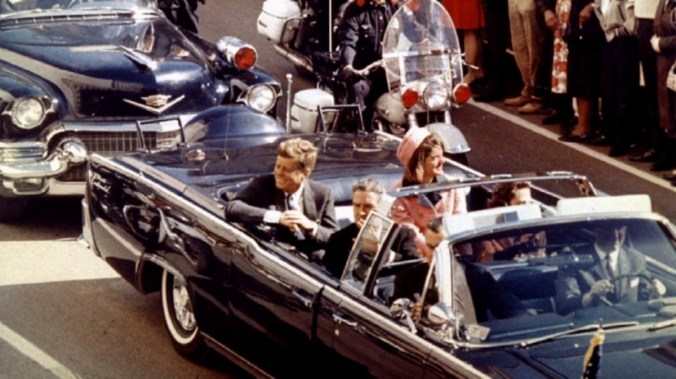
Sixty-two years ago I was up unusually late in my Arlington, Massachusetts home as my parents, my younger sister and I watched the coverage of that day’s nation-shattering event, the assassination, in Dallas, of President John F. Kennedy.
Like everyone else in my generation, much of that day is vivid in my memory, literally as if it were yesterday. My friend Paul Connolly and I were were walking home a little after 3:00 from Junior High West when Charlene Lamberis, a classmate, shouted out of her mother’s car as they passed us on the street, “The President has been shot! The President has been shot!” I had recently lost the election for president of the 8th grade, so my mind was still on my rival. I turned to Paul and said, “Who would want to shoot Marty Toczylowski?” (Marty is alive, well, and thriving today as an executive recruiter. I just checked.) Paul set me straight on what Charlene was referring to, and he pulled out his transistor radio. Soon a solemn voice announced that the President of the United States was dead, and that they would return to the station’s regular programming, whereupon wildly cheerful country fiddle music took over. It was so inappropriate we both couldn’t help laughing.
My friend came home with me and joined my mother, who was already in front of our old Capehart black-and-white TV console. TV news had never covered anything this important; all three networks and PBS were hustling trying to find new angles, scoops and people to interview. I’ll never forget that Paul, who was a brilliant kid, turned to me and said, with his face like a death mask, “Richard Nixon will be the next President.” It took five years and many twists and turns including a self-mocking cameo on “Rowen and Martin’s Laugh-in” (“Sock it to me?”), but Tricky Dick indeed was indeed the next President after Lyndon Johnson, sworn in as POTUS that day.
There was no regular programming on television from November 22 through November 25, when Kennedy was buried at Arlington National Cemetery. The Marshall family hardly left the living room (where the TV was) the whole time. We knew that this was a timeline altering, culturally explosive event, the first such event since the Japanese attack on Pearl Harbor in 1941, and before that, the 1929 Wall Street Crash that signaled the beginning of the Great Depression. On the way from the Friday of the assassination to John-John’s salute on Monday, we saw Jack Ruby shoot assassin Lee Harvey Oswald as it happened. It seemed like the world was spinning off its Axis, and metaphorically, it was.
From a policy perspective and in his personal character, Jack Kennedy was far from an outstanding President or even a good one, but he played the role magnificently. With his impressive shock of thick brown hair and his undeniable charisma, JFK seemed even more youthful than he was (only Teddy Roosevelt, 42 when he became President, was younger than Kennedy, and just by two years) and more significantly, wildly unlike the grandfatherly elder statesman, Dwight Eisenhower, that Kennedy was replacing. Even after the frightening Cuban Missile Crisis that Kennedy had blundered the U.S. into the year before, the changing of the guard to this vigorous young man (he pronounced it “vigah”) and his glamorous wife (the most striking First Lady in the 20th Century up to that point) had the nation energized and optimistic: all of the staid conformity of the post war era was clearly about to change to something new, exciting and promising.
The last Presidential assassination had been in 1901; as much time had passed between President McKinley’s death and JFK’s assassination as the period from Thomas Jefferson’s Presidency to Lincoln’s assassination. No one even considered the possibility of Kennedy dying in office, while the possibility of Eisenhower dying had been ever-present after his serious heart attack in 1955. JFK’s seeming invulnerability probably assisted Oswald, as the security in Dallas seems astoundingly lax by current standards. (The Kennedy vigah was, like so much about him, a sham as we found out later. Kennedy was not a healthy man.)
After Kennedy’s death and because of it, everything changed. The nation was different, politics were different, the mood was different, everyone’s life was thrown into a new orbit. In 2025, the importance of that clear day in Dallas has been over-shadowed by the next event on the U.S. cataclysm list, the Twin Towers attacks of September 11, 2001. Today I barely saw a mention of Kennedy’s assassination, and, frankly, I very much doubt that anyone who didn’t experience the national reaction to the events of November 22, 1963 and its aftermath could comprehend what it felt like to be an American jerked violently out of the sedate 1950s into the turmoil, anger, fear and upheaval of the mad 1960s.
November 22, 1963 was the catalyst for that cultural shift, and we will never know what was lost or gained. All we can know is that all of our fates, and the fates of everyone who follows us, was altered forever.
I have always looked back on November 22 as a cursed day. Tomorrow is my wedding anniversary, now another sad day, but I changed our wedding date from the 22nd, when it was originally scheduled, because I could not conceive of being completely happy on the day John F. Kennedy, so young, inspiring and full of hope, died
And you know, I sometimes think that this country has never been as happy and optimistic as it was before Lee Harvey Oswald fired his rifle from that warehouse. I wonder if it will ever be again.
 Ethics Alarms
OB’s personal theory on the most significant event of the Kennedy administration:
Attending Notre Dame Law School from 1978 to 1981, I became acquainted with two absolutely first-rate human beings and Vietnamese refugees. One was my commercial transactions teacher; the other was her husband, the university provost. While in their home country during the war, they had been sent to Danang to open a law school to place a metaphorical stake in the ground delineating to Ho Chi Minh the point at which North Vietnam ended and South Vietnam began.
How, I wondered, had these two elegant people come to be at a university in northern Indiana?
In retrospect, my theory flows from the fact Father Hesburgh, the Holy Cross priest and long-time all-powerful president of Notre Dame was also the Kennedy family’s personal priest. Having been a French colony, Vietnam was heavily Roman Catholic. The Church considered itself mortally threatened by Communism. The Church, and Hesburgh did not want South Vietnam to fall to the Communist North because it would imperil the Church. It’s as simple as that: at Hesburgh’s urging, Kennedy initiated the process of getting the U.S. military to come to the aid of South Vietnam, something LBJ continued (See: The Gulf of Tonkin Incident), to save the Roman Catholic Church and its followers and interests in South Vietnam.
In any event, more than Kennedy’s assassination, I think it was the Vietnam War that knocked our world off its axis and precipitated the tragic, destructive and pointless upheaval that was the ’60s.
That is really interesting Bill; it’s the first time I have seen this religious dimension to US involvement in Vietnam explained.
And then there was Kennedy’s tepid support of Alpha 66 and their invasion at the Bay of Pigs, whose defeat solidified Castro’s regime and established a still flourishing thorn in the side of the U.S. and the western hemisphere (See: Venezuela and Bolivia) ever since.
We got the news that early afternoon over the P.A. in Sister Ann Patricia’s seventh grade classroom. She turned on our classroom television. Angela Trujillo made a nervous but audible giggle and got in trouble for seemingly laughing. I’m sure it was just a nervous response to an inexplicable stimulus. As I recall, we were out of school for at least a couple of days. Everyone was at home, glued to our TVs. One of the bad things that came out of it was Walter Cronkite and Chet Huntley and David Brinkley became elevated to near God status, something that led to the current awful mainstream media.