[Johnny Mathis finally announced his retirement this year—he’s only 90. His has been one of the most recognizable, enjoyable, seductive voices in American popular music for almost 70 years. My college room mate always had his records on hand to create the proper mood for his dates. An old time crooner’s chances of being remembered rests now on whether there is a Christmas standard he can be associated with. Johnny’s best shots are “It’s Beginning to Lot Like Christmas,” and “We Need a Little Christmas” from “Mame.” He sings all the others beautifully too, but they are taken.]
I was informed by a fellow Christmas movie fan that it is almost impossible to watch the original “Miracle on 34th Street” film on streaming services or the networks. They prefer to show the various remakes, all inferior in every way. What made director-writer George Seaton‘s movie (it won him an Oscar) so superb in addition to the casting, his straight-forward style and his obvious love of Christmas is that it instantly felt perfect despite its many suspension of disbelief challenges. Why do they feel this film has to be remade? Is it the lack of color? (“Miracle on 34th Street” was one of the first movies Ted Turner colorizes, and that version is unwatchable.)
As I’ve stated here before I believed in Santa Claus until I was 12. I didn’t want to give the fantasy up: I loved magic, and my parents always tried to make the season magical. My late wife Grace and I tried to do the same with Grant, now “Samantha,” but he was a non-believer by the third grade. Is there anything more joyful to see than the look on a child’s face as he or she wakes up to find what Santa has delivered? Will anything feel that wonderful again?
“Miracle on 34th Street” is an ethics movie in many ways. The movie is about the importance of believing in good things, hopeful things, even impossible things. The movie reminds us that wonderful things can happen even when they seem impossible, and that life is better when we believe that every day of our lives. I’m engaged in that right now: all of 2025 has required it. I’ve had serious injuries, successes, new projects and setbacks. My father taught me to be ready for the worst but to never to give up on the best.
One thing this film does well is to concentrate on the secular holiday without any allusions to the religious holy day, but not being obnoxious about it. “It’s a Wonderful Life” also straddles the line very cleverly: it begins in heaven, after all. All the “A Christmas Carol” films include Bob Cratchit telling his wife that Tiny Tim mused about how his disability reminded people of Jesus’s miracles at Christmastime, and that’s Dickens’ only reference to Jesus in his story.
On the offensive side is the Rankin-Bass animated “Rudolph the Red-Nosed Reindeer”—I can’t believe they still show that thing—when the “stormy Christmas Eve” causes Santa to decide to “cancel Christmas.” I’d say that’s above Santa’s pay grade, wouldn’t you agree? It also suggests that Christmas is only about gifts and children. (Do parents today explain that the singing snowman who narrates the story is based on, and looks like) the real person who also sings the most memorable songs? They should. Burl Ives had a fascinating life and a varied career, and those kids will probably be hearing him sing “Have a Holly Jolly Christmas” for the rest of theirs.
Interestingly, all of the perennial Christmas movies have been made into stage musicals of varying success—“White Christmas,” “It’s a Wonderful Life,” “A Christmas Story,” “Elf”—- but “Miracle on 34th Street” flopped so badly when Meredith Willson [“The Music Man”] adapted it as “Here’s Love” on Broadway that nobody has tried again. The show included the song, “It’s Beginning to Look a Lot Like Christmas,” which Willson wrote long before the show was assembled. But as with all the movie remakes, the show missed Edmund Gwynn, the best Kris Kringle of them all. He was a distinguished classical actor until that movie: he complained that after the film he wasn’t allowed to get rid of his bushy white beard and was type-cast as jolly old men.
I decided to post the Companion earlier this year; I also was moved by the fact that a number of EA readers had sought out the 2024 version today. When I’ve posted it on Christmas Eve, it has lacked views for the obvious reasons.
The 2025 companion reflects some additional thoughts upon my re-watching “Miracle on 34th Street” last week—I even took notes. Mostly, I though about how important the holiday, the stories, the music, the movies and what they signify taken as a whole is to our nation, our society and our culture. Thus it was that I decided that here was a good place to re-post “Christmas, the Ethical Holiday” Besides, I need to read it myself.
Christmas: the Ethical Holiday
Benjamin Franklin recognized the importance of regularly focusing one’s attention on ethical conduct rather than the usual non-ethical goals, needs, desires and impulses that usually occupy the thoughts of even the most virtuous among us. He suggested that every morning an individual should challenge himself to do good during the day. In the 21st century psychologists call this “priming,” a form of beneficial self-brain-washing that plants the seeds of future choices.
The Christmas season operates as an effective form of mass population priming, using tradition, lore, music, poetry, ritual, literature, art and entertainment to celebrate basic ethical virtues and exemplary conduct toward other human beings. Kindness, love, forgiveness, empathy, generosity, charity, sacrifice, selflessness, respect, caring, peacefulness…all of these are part of the message of Christmas, which has become more universal and influential in its societal and behavioral importance than its religious origins could have ever accomplished alone. Secular and cultural contributions have greatly strengthened the ethical lessons of Christmas. “It’s A Wonderful Life” urges us to value our ability to enrich the lives of others, and to appreciate the way they enrich ours. “A Christmas Story” reminds us to make childhood a magical time when wishes can come true. O. Henry’s story “The Gift of the Magi” proves that it is not the value of gifts, but the love that motivates them that truly matters. Most powerful of all, Charles Dickens’ “A Christmas Carol” teaches that the admirable conduct the spirit of the season can inspire need not be short-lived, and that if we use Christmas properly, as Ben Franklin used his morning exhortation to good conduct, it can make all of us better, happier, more virtuous human beings.
At this point in civilization, the religious context of Christmas almost does more harm than good. Though the day chosen to celebrate Jesus of Nazareth’s birthday has been spectacularly successful in promoting the ethical and moral ideals he taught, the idea that Christmas is indistinguishable from the religion he founded has made it the object of yearly controversy, as if celebrating Christmas is an affront to other faiths.
This is a tragedy, because every human being, regardless of religious belief, can benefit from a culture-wide exhortation to be good and to do good. “Happy Holidays!”—the bland, generic, careful greeting of those afraid to offend those who should not be offended—does nothing to spur us toward love, kindness, peace and empathy. “Merry Christmas!” does.
This is not just a religious holiday; it is the culture-wide ethical holiday, the time when everything should be aligned to remind us to take stock of our lives, think about everyone else who lives on earth with us, and to try to live for others as well as ourselves. Christians should be proud that their religion gave such a valuable gift to humanity, and non-Christians should be eager to accept that gift, with thanks.
It is foolish and self-destructive for there to be a “war on Christmas.” Charles Dickens understood. There is hardly a word about religion anywhere in his story. There doesn’t need to be. Christmas is the ethical holiday. Christians and non-Christians can celebrate it or not as they choose, but whether they do or not, the Christmas season is more important than any one religion, even the one that gives the holiday its name.
Christmas is important because it primes us to be good, be better, be more ethical, for the rest of the year. There should be nothing controversial about that.
***
And now, back to “Miracle on 34th Street”….
Chapter 1.
Meet Kris Kringle
The movie tells us right at the start that 1) the charming old man in the white beard can’t possibly be Santa Claus, and 2) that he’s nuts. He tells adults who are paying attention this as soon as he starts complaining to a New York City storekeeper that his window display has the reindeer mixed up: “You’ve got Cupid where Blitzen should be. And Dasher should be on my right-hand side. And another thing…Donner’s antlers have got four points instead of three!”
Let’s see:
- No Christmas display has ever distinguished between Santa’s reindeer (except for Rudolph), because the individual reindeer have never had any identifying characteristics in reality or myth. Are we to assume that there are name-tags on the models? If so, why wouldn’t Kris be complaining about the features of all of them, not just “Donner’s” antlers?
- The names of the reindeer, even if there are flying reindeer, were 100% the invention of the poem “A Visit from St. Nicholas,” or “The Night Before Christmas,” originally published in 1823. No one has ever claimed that the author had some kind of special info on the actual names of the reindeer when he wrote,
More rapid than eagles his coursers they came,
And he whistled, and shouted, and called them by name;“Now, DASHER! now, DANCER! now, PRANCER and VIXEN!
On, COMET! on CUPID! on, DUNDER and BLIXEN!…and anyway, if he did, those were their names 120 years before the movie takes place. Nobody has ever claimed the reindeer were immortal, either. I suppose Santa Claus, in a nod to the poem’s popularity (it has been called the most famous poem of all time), could have adopted the practice of always having the reindeer named after the poem’s versions, and when one Vixen dropped of old age, the young reindeer that took her place became the new Vixen.
I suppose.
- A bigger problem is that the movie’s alleged “St. Nicholas” calls the seventh reindeer “Donner.” It gets confusing here. The original St. Nicholas was Greek, the Christian bishop of Myra, now Demre, in Lycia. Nicholas gave gifts to the poor, in particular presenting three impoverished daughters of a pious Christian with dowries so that they would not have to become prostitutes. THAT would be neat poem! Saint Nicholas is buried in Italy. He was later claimed as a patron saint of children (also archers, sailors, pawnbrokers, and the cities of Amsterdam and Moscow). The name “Santa Claus” is derived from the Netherlands version of St. Nick called Sinterklaas, or “the Christmas man,” de Kerstman in Dutch. This explains “Dunder and Blixen,” meaning thunder and lightning in Dutch, and the movie later confirms Kris’s Dutch origins. (But why does he speak in a British accent?)
Never mind that: why would he call Dunder “Donner”? The “real” Santa wouldn’t. Though the original version of the poem got the names right (we know it’s Blixen and not “Blitzen” because it rhymes with Vixen), various editors, transcribers and the author himself kept changing the names in subsequent printings. Dunder became “Donder” and eventually “Donner,” which is a meaningless Anglicizing of “Dunder.”
Santa Clause, aka Sinterklaas, wouldn’t be confused: he named the beasts. He’s correcting the shop-keeper while passing along a misnomer?
OK, are you really Santa Claus, Kris?
- There’s always the chance that Kris wrote the poem himself, since nobody is 100% sure who did.
Well, enough of that. The next scene shows Kris encountering the Macy’s Thanksgiving Day Parade Santa pre-parade. He instructs him in the use of his whip on the reindeer! In the German Santa mythology, the jolly old elf used the whip on naughty children, but nowadays, using a whip on either kids or reindeer is pretty much excised from Santa’s methods, and should have been in 1947. It’s an unethical image…

…even though artists have worked hard to confuse us….
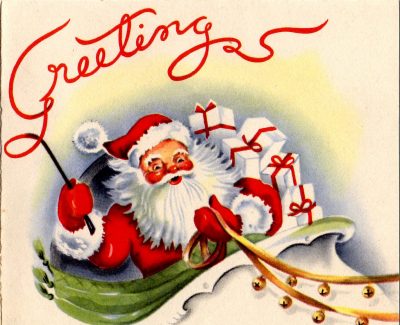
No, an ethical Santa Claus wouldn’t use a whip. He also wouldn’t put a poor old guy with a drinking problem out of work during the holidays, but that’s what Kris does next. He smells liquor on the costumed Santa, and shows no mercy:
“Don’t you realize there are thousands of children… lining the streets waiting to see you… children who have been dreaming of this moment for weeks? You’re a disgrace to the tradition of Christmas… and I refuse to have you malign me in this fashion. Disgusting!”
Indignant Kris tracks down Doris Walker, who is in charge of the parade, and gets the man fired. That’s just mean; there’s no way around it. I bet a lot of Macy Santas have had a few nips before and during the parade, and so what? How hard is it to say “Ho Ho Ho”?
Kris manages to get Drunk Santa’s job, having single-handedly gotten him sacked, no pun intended. Incidentally, Drunk Santa was played by Percy Helton, an ugly little man with a raspy, high pitched voice who appeared in too many movies and TV shows to count, never in a role requiring more than a few lines.. Percy was also almost always uncredited, as in this film. He’s the train conductor in “White Christmas” (uncredited); he’s in “Jail House Rock” with Elvis (uncredited); he was a motel manager in “Where the Boys Are” (uncredited); he was a train conductor again in “The Music Man,” and also uncredited. My favorite of his roles in films (Percy appeared in almost every Fifties and Sixties TV show, and in those, he was credited) was as “Old Sweetface” in “Butch Cassidy and the Sundance Kid,” where he had a funny scene with no lines at all
Why is Kris, if he’s the real Santa Claus, hanging around New York City and moonlighting in the Macy’s parade when the big night is just around the corner? This is no time for a vacation or boondoggles. If he’s really Santa, he’s goofing off, and he has the gall to tell a temporary parade Santa that he’s risking disappointing children!
Kris is not off to a good start.
Chapter 2.
Bad Mother, Sneaky Lawyer
While Kris is enjoying his starring role in the Macy’s Thanksgiving Day Parade, we meet Susan Walker, Doris’s young daughter. Doris is played by Maureen O’Hara, who never was quite regarded as a top rank a movie star as lovely and strong an on-screen presence as she was. Talk about appearing in classic films! O’Hara was the female lead in four genuine classics: “The Hunchback of Notre Dame,” “The Quiet Man,” “How Green Was My Valley,” and “Miracle on 34th Street.” She also starred in the original “The Parent Trap” for Disney. How could an actress anchor so many great films and yet never be recognized as a top star? It’s a mystery to me: many other higher regarded actresses did not equal the quality of Maureen’s vehiciles.
Susan is famously played by Natalie Wood, one of those Hollywood child stars who was never as good an actress as an adult as she was as a child. Fortunately, she grew up to be gorgeous, which makes up for a lot in Hollywood, but personally, I never enjoyed any of her adult performances: I found her self-conscious and stiff.
We also meet Attorney Fred Gailey (John Payne) who lives in the apartment next door. Susan has been raised to be a joyless little cynic, the victim of an arrogant and misguided single mother who needed to read more Bruno Bettelheim ( except that Bruno didn’t write The Uses of Enchantment until 1976). Doris, as we soon surmise, has allowed a bad marriage to make her suspicious of men, love, dreams, hope, and wonder, and she is passing her own disappointment in life off to her daughter at the tender age of nine. Nice.
Lots of parents do this, I suppose, but that doesn’t mitigate how cruel and damaging it is. I remember how horrified I was at Susan’s brainwashing when I first saw the film at about the same age as Natalie Wood was in the movie. My parents, particularly my mother, surrounded my sister and I with fantasy and whimsy. They went to elaborate measures to make not just Santa Claus seem real, but the Easter Bunny and the Tooth Fairy too. At one point my sister, having read a story about a lollypop tree, planted a lollypop stick in the back yard. My mother pooh-poohed the idea, telling my sister that this was just a fantastic story she was believing, and that she was going to disappointed. Then, three days later, my father exclaimed as he looked out the kitchen window, “I don’t believe it! Look at that!” And there, about four feet height and covered with lolly pops of all the colors of the rainbow, was the lollypop tree.
My sister and I weren’t idiots; we knew that our parents had made the tree. But we played along, and the lesson was taught. Life is more fun and bearable if you believe in the unbelievable, and are open to a little magic in the world. Our parents gave my sister and me that understanding that led us to love music, literature, humor, mystery, and surprises. Doris Walker, out of ignorance, grief or anger, was an incompetent and selfish parent. ” We should be realistic and completely truthful with our children and not have them growing up believing in a lot of legends and myths like Santa Claus, for example,” she says. Oh, shut up, Doris. Your authority for this proposition is what? Generations of children have grown to healthy, happy maturity being raised on myths, legends and fairy tales, and you, with your invaluable perspective as a department store employee, are confident in your certitude that their parents were wrong, and you are right. Wow.
Fred Gailey, we quickly learn, is making friends with Susan because he has romantic designs on her mother. When Doris is informed by Fred this was his scheme, we hear this exchange:
GAILEY: I’m fond of Suzie, very fond, but I also wanted to meet you.
I read someplace the surest way to meet the mother is to be kind to the child.
DORIS: What a horrible trick.
GAILEY: It worked!
Now we know, unfortunately, what kind of lawyer Fred is: an unethical one who believes that the ends justify the means. He just anticipated Horrible Harry Reid’s smug reply to the question about why he lied about Mitt Romney during the 2012 Presidential campaign. One reason Fred doesn’t creep anyone out at this point is that John Payne’s super-power was seeming to be charming, harmless and lovable while behaving somewhat deviously, even when he was playing villains. Every time I watch the film, I come away wondering why he wasn’t a bigger star either.
Payne’s last performance was in a memorable “Columbo” episode as an old movie veteran trying to protect a fading actress (Janet Leigh) from the ravages of dementia.
In case the audience hasn’t grasped that Fred has a loose concept of ethics, Susan talks her mother into inviting Fred to dinner, as Fred demurs, says he can’t, that he’ll “just have a sandwich,’ and convincingly acts as if the 8-year-old is responsible for the idea. Then, once Doris is out of earshot, she asks him, “Did I ask all right?”
“That depends,” he says, indicating that Gailey is a Consequentialist. (I hate consequentialists! ) Then, after Doris announces when he”ll be expected for dinner, Fred tells Susan, “Honey, you asked just right!…It worked!”
There he goes again. And he has made an innocent child complicit in his deception.
Chapter 3.
Kris Joins the Macy’s Family!
Kris’s rave reviews as Santa in the Thanksgiving Day Parade are so good, Doris hires him play Santa at Macy’s flagship New York City store on 34th Street. He agrees, which is strange when you think about how busy he should be at this time of year, supervising the elves and all. If he really is Santa, or even if he thinks he is, taking the job in New York is irresponsible.
I have begun to wonder about Doris’s integrity. If she is so certain that fantasy is bad for children why is she aiding and abetting that harm by inflicting the myth of Santa Claus on them? She’s like a gourmet chef who believes that the rich food she makes will kill her patrons.
Kris’s Macy’s floor supervisor gives him a list of toys to “push”—toys that are overstocked. “Now, you’ll find that a great many children will be undecided as to what they want for Christmas. When that happens, you suggest one of these items,” Kris is told. “You understand?”
Kris says he understands, but later makes it clear in his comments to a co-worker, that he has no intention of “pushing” the merchandise:
“Imagine…making a child take something it doesn’t want…just because he bought too many of the wrong toys.That’s what I’ve been fighting against for years!”
That being the case, there is exactly one thing Kris needs to do. He needs to quit. What he cannot do, and must not do, and has a clear ethical obligation not to do, is to accept a job when he has no intention of doing what the job requires. This is a sales job. If Kris doesn’t want to sell, then he will be accepting a pay check under false pretenses. This isn’t noble conduct, as the film would have you believe. It’s unethical conduct. It’s wrong. But Kris tears up the list.
“Pushing” merchandise one knows is inferior creates an ethics conflict and a conflict of interest as well as a classic workplace ethics challenge. I ran up against this in my very first real job, as Baskin-Robbins ice cream scooper in Belmont, Mass. The company’s special new flavor of the month had bombed; it was awful stuff called “Jolly Green Mint.” We were sent several cartons of the stuff, which was a sickly green and included marshmallows and green mint hard candy. We were indeed told to “push it” which some of my fellow clerks did by offering a taste to customers in those little pink spoons. Some said, “Try our popular/wonderful new flavor!” I tried to sell the junk by describing it as “new,” and in a maneuver I was quite proud of, “cool.” I now know that was deceit, a lie.
But I digress. I hadn’t thought about that terrible ice cream for decades. Flashback, man! The Sixties! I do need to mention that if an employer tells an employee to “push” a dangerous product, ethical options are limited. They are 1) Refuse. 2) Tell the boss that this is irresponsible and you won’t do it. 3) Become a whistleblower and/or 4) quit. This scenario would have arisen if Macy’s told Kris to push its lawn darts.
Back to the movie….
Chapter 4.
Employer loyalty is not Kris’s thing…
On his first shift, a mother (played by Thelma Ritter, one of Hillywoods all-time great character actresses) whispers to Kris, as Macy’s Santa Claus, not to promise Peter, the little boy on his lap, that he’ll get a toy fire engine for Christmas. “Nobody has any,” she says. Kris ignores her request (do we see a pattern here?) and tells the boy he’ll get his wish. Mom is hacked-off, but Kris informs her that another store, presumably one that the mother wasn’t aware of or hadn’t checked, has what she’s looking for, and at a great price, too. Mom is amazed, but grateful, and trots off to “Schoenfeld’s” on Lexington Avenue.
This is just the next step in Kris’s betrayal of Macy’s. The situation is exactly what he was instructed to prepare for. “Oh, Santa has a much better gift in mind for you, Peter. You’re been such a good boy this year, what if Santa brings you a new toy cement mixer truck that mixes real cement! You’ll be the only one of your friends who has one! Ho Ho Ho!” (Actually, I had a truck like that when I was Peter’s age, and I liked it a lot better than my fire truck…)
Now, Kris is not only not pushing Macy’s toys, he’s sending customers right out of Macy’s to another store! What else will Mom buy while she’s there that she otherwise would have bought at Macy’s?
Added: Michael West, commenting on the 2023 Guide, has a different take.
“I’m not 100% sure this is unethical. My role as a salesperson in my pursuit of making sure clients get *as close to what they want as possible* is to give people a thorough education on what we have to offer and if what they want cannot be matched by what we offer or we cannot reasonably fabricate, my duty, still to give them what they want, has sometimes involved directing them to different companies.
“More times than not they come back to us realizing we are able to better match their vision than other companies and of the balance of times more often than not, we’ve made allies of other companies built relationships with them and overall advanced the ability of our industry to provide a better product for future customers.
“The key here is that we’re doing everything we can to provide the best products and keep our clients educated as much as possible.
“On a side topic – it’s one of the dissonances of real goods and service industries. You’d think educating your clients on how to do something right would end up giving people the power to not need you to solve their problems. Counterintuitively, it actually shows clients that they don’t want to expend the mental energy to solve that particular problem but we’ve already done it for them.”
Let’s pause a bit to ponder exactly what Kris, who we later learn, but now only suspect, thinks he’s really Santa Claus, believes are elements of the iconic role. Kids ask him for stuff, he sends the parents to buy it, and his function on Christmas Eve is…what, exactly? If he isn’t providing the toys, he doesn’t need a sack, or a sleigh, or flying reindeer. He doesn’t need a workshop or elves, if everything a kid wants is at Gimbel’s or another store. And if the job is for Santa to let parents in first world countries do his job for him, and he handles poor children elsewhere, why the hell is he hanging around Macy’s in New York City?
Another ethical issue is Santa’s promising a child that he or she will receive something the child has asked for. In a later Christmas movie, “The Santa Clause,” two adults reminisce about losing faith in Santa after they didn’t get the treasure (a “weenie whistle” and the “Dream Date” board game) they had asked Santa for on Christmas morning. No Santa has the authority to promise a kid on his lap anything, since he has no direct control over what the child’s parents give him.
Peter’s mother is touched and impressed with Santa’s apparently ethical, non-capitalistic conduct and, flushed with gratitude, she tells Shellhammer, the head of the toy department, that she will now become a loyal Macy’s customer….after she buys the fire truck elsewhere. She assumes that Santa’s shopping consultant role is a store policy.
This is moral luck. Kris didn’t care whether his tip to the woman benefited Macy’s or not; it just did. Then Shellhammer overhears Kris as he escalates: a little girl wants ice skates, and Macy’s has ice skates, but he tells her mother to buy the skates at Gimbel’s, Macy’s arch rival, because their skates are better.
Meanwhile, Fred Gailey, still lusting after Doris, takes the young Susan to see Santa. This would seem to contravene Doris’s explicit wishes: if she doesn’t want her daughter being enchanted by the Santa Claus myth, why is he doing this? In fact, he is trying to undermine Doris. His belief that her child rearing theories are harmful may be 100% right, but they are, as Doris eventually tells him, none of his business. This is a minor equivalent of trying to indoctrinate a neighbor’s child into a new religion or culture behind the parent’s back.
Doris catches Fred in his attempted counter-Doris mission, and tells him that she expects him to respect her wishes. In the process, she confirms his suspicion that it’s her own disillusionment with her broken romance with Susan’s father that is making her inoculate her daughter against illusions, hope, and idealism. Her reaction, however, when she blurts out a direct reference to her ex- is telling:
“They grow up considering life a fantasy instead of a reality. They keep waiting for Prince Charming to come along. And when he does, he turns out to be a…
…and she stops, embarrassed. Gailey says, “We were talking about Suzie, not about you.” So Doris knows, or should know, exactly what she’s doing, and should know it’s wrong.
I wonder if she was going to say, “…he turns out to be a lawyer.”
Susan’s skepticism about Santa is shaken when she sees Kris speak Dutch to a little girl from the Netherlands. Hmmm. Wasn’t Kris Kringle Dutch? Kris is on a lucky streak, leaving the audience to wonder what would have happened if the little girl was from Mongolia. Alarmed that Kris’s verisimilitude has pulled Susan into–in her mother’s view—a dangerous fantasy, Doris asks him to tell Susan that he is not Santa. He refuses.
Ethically, this is a dilemma. She is asking him to lie to a little girl, from Kris’s perspective, since he sincerely believes that he is Santa Claus. (I suppose he could be a method actor: Daniel Day Lewis, on the set of “Lincoln,” reportedly insisted that he was Lincoln) refuses. Now what? She has a conflict of interest. Macy’s doesn’t care whether he’s a brilliant Santa portrayer or deluded–he’s a hit! Doris regards him as a threat to her indoctrination of her daughter. She decides to fire him, but she is biased in too many ways to be capable of an objective decision.
Before she can can Kris however, R. H. Macy himself calls her and Shellhammer for an audience. (Aside: Rowland Hussey Macy died in 1877, 70 years before the film. Showing him still alive is kind of creepy, making Macy seem like the immortal, rotting castle owner in H.P. Lovecraft’s “The Dunwich Horror.” Or, I suppose, Santa Claus. The Macy family had sold its ownership of the company in 1895) Doris and the toy department manager are getting a bonus! Ah! Money makes Doris abandon her principles, and resolves her conflict.
Now Macy directs that sending customers to Gimbel’s and other stores is going to be the new store policy, creating good will. We see Mr. Gimbel presiding over an emergency meeting: the Gimbel’s Department store won’t be outdone; he directs that his staff be directed to show that Gimbel’s puts Christmas spirit over profit. It would now send customers to other stores if necessary, even Macy’s.
[ Digression: There really was a Mr. Gimbel when “Miracle on 34th Street” was made. Bernard Gimbel, head of the Gimbel’s chain and the latest in the line that began with the store’s founder, Adam Gimbel in 1842. As it turned out, Bernard Gimbel did have a heart and placed people above profit, once he had a little nudge. He attended an early performance of Arthur Miller’s “Death of a Salesman” on Broadway in 1949. The plight of Willy Loman, an aging traveling salesman being pressured out of the only employment he had ever known, shattered Gimbel. He was filled with guilt and remorse: his company had fired loyal employees who had become “too old,” just like Willy. After a sleepless night, he called his managers together in a real life emergency meeting, and told them and all of his stores that announced a new and, for the times, a unique policy. There would be no more firing of over-age employees. Why hasn’t there been a movie about that?]
So far, so good for Kris. But his luck is about to run out.
Chapter 5.
Is Kris crazy or what?
The story really begins going off the ethics rails at this point. Doris decides that it would probably be responsible to have Kris checked out by the company psychologist, Mr. Sawyer, since her Santa is, after all, nuts. Yah think? In truth, it is per se irresponsible for Macy’s to knowingly employ a Santa Claus operating under the delusion that he is really Santa. The first authority a store would consult in real life, yes, even in the 1950s, would be a member of the legal department. If anything happened to a child in Macy’s store while sitting on the lap of a man who openly claimed to be a mythological figure the lawsuits would write themselves. Thus the story really takes a turn toward an indictment of capitalism and corporate ethics: Macy’s is willing to put children at risk for some extra profit. Luckily, nobody has noticed this in the past half-century.
Next we have a rare breach of competence by the director/screenwriter, George Seaton. While boasting to Doris about all the mental acuity tests he has passed, Kris says,
“I’ve taken dozens of them. Never failed one yet. Know them by heart. “How many days in the week?” Seven! “How many fingers do you see?” “Four!”….No damage to the nervous system! “Who was the first President of the United States?” George Washington! “Who was Vice-President under John Quincy Adams?” Daniel D. Tompkins! I’ll bet your Mr. Sawyer doesn’t know that!”
He doesn’t know that because it isn’t true. Tompkins was Vice-President under James Monroe, the fifth President, not Adams, #6. It drives me crazy when Hollywood allows historical misinformation to pollute the minds of the historically ignorant public, because there’s no excuse for it. Even before the internet, this fake fact could have been checked using any dictionary or encyclopedia. Nobody cared enough to bother. To make the mistake worse, John Quincy Adams’ VP was, unlike Thompkins, an important historical figure, John C. Calhoun. He’s cancelled now, because Calhoun was a proponent of slavery. I bet Disney would cut the whole line if it dared to mention such an obviously evil historical figure. Maybe they would just have a trigger warning: “Contains a reference to racist historical figures.”
Kris dutifully goes to his appointment with Sawyer, and behaves, it is fair to say, like a complete jerk. He is condescending and openly contemptuous, harassing Sawyer with his own diagnostic questions. We are supposed to be amused at this because Sawyer is portrayed as an irritable, officious man with a comb-over, an ugly mustache and an irritating voice. He also pretends to have expertise that he doesn’t have.

And his first name is “Granville.” Boy, the kids in grade school must have had a ball mocking him for that. Where does an old guy who is playing Santa Clause in a department store get off behaving superior to an actual professional trying to do his job? Kris is the ethics dunce here, but by shrewdly playing on stereotypes and biases, the film successfully turns the audience against Sawyer. We get to hear him talking irritably to his wife on the phone, and he complains about her brother and tells her that she needs to be more frugal about “the allowance” he gives her to run the household. This means, of course, that Kris was right to be disrespectful to him.
Actually, the film throws doubt on whether he is a psychologist at all. I missed this until my most recent viewing of the film. Kris accuses him of being a fake, and using his assumed expertise to make diagnoses he’s not qualified to make. Later, it appears that Sawyer’s passion to have Kris discredited and institutionalized is motivated by self-preservation against a potential whistle-blower.
So maybe Kris was right about Sawyer after all. The film engages in shameless Cognitive Dissonance Scale gamesmanship:

The nice, pleasant, jolly old soul is being a jerk, but all of Sawyer’s characteristic point to creepiness, and, in fact he becomes a genuine villain, validating the stereotype.
Homely, cranky Mr. Sawyer reports to Doris that Kris should be fired, while Dr. Pierce, who is employed at the nursing home where Kris lives–this little detail is conveniently soft-peddled as the movie goes on—defends his employer’s resident. Dr. Pierce looks a bit like Walt Disney, with good hair and a pleasant, sonorous voice. Again, these are more manipulative Cognitive Dissonance games. If the actors in the two roles were reversed, Mr. Sawyer’s assessment would seem like the reasonable one: Kris is laboring under a delusion, and such people are inherently dangerous and unpredictable. Dr. Pierce stoops to the logical fallacy of anecdotal evidence: there’s a famous restaurateur in Hollywood who thinks he’s a Russian prince, or so they say, and he’s never hurt anybody, so, ipso facto, Kris Kringle, who thinks he’s Santa Claus, isn’t dangerous! Thus does Hollywood is undermines critical thinking. But then…it’s Hollywood.
Sawyer predicts that Kris will eventually snap and become violent (“Look at the way he carries that cane!”) and Doris is worried: if something happens, she’ll be responsible. She can see him getting into trouble—“All that’s got to happen is a policeman to ask his name. A big argument. Clang, clang! Bellevue!” So Dr. Pierce suggests that Kris stay with someone who can steer him away from confrontations.
Pro Tip: If your Santa Clause needs a chaperone to keep him out of trouble, children shouldn’t be sitting on his lap. But Doris’s aspiring lawyer boyfriend Fred volunteers to have Kris stay with him. He has an ulterior motive: he sees Kris as an ally to chip away as Susan’s cynicism, while Fred works on bitter Doris. This, of course, means leaving Susan to spend a lot of time alone with a man Fred barely knows and who thinks he lives at the North Pole.
Good plan! The fact that this works out in the end is, again, pure moral luck.
Chapter 6.
Susan makes an unreasonable request…
Susan tells Kris he can prove that he is the real Jolly Old Elf himself if he brings her what she wants for Christmas: a house. This would be a good time to inform the child that Santa doesn’t bring houses down the chimney on the night before Christmas, but instead, Kris succumbs to emotional blackmail, as little Natalie Wood—I mean Susan—says that if he can’t get her a house—with “a backyard with a great big tree to put a swing on” yet—then she’ll know he’s only “a nice man with a white beard, like mother said.” Kris irresponsibly gives the girl hope, saying that “he’ll do his best,” and asking if he can keep the picture.
Sometimes adults—even adults who think they are Santa Claus—heck, even Santa Claus— have an ethical obligation to say “no.”
Back at Macy’s, aspiring Santa stand-in and fresh-faced young employee Alfred tells Kris that he is depressed. Mean Mr. Sawyer told him that because he likes to play Santa Claus at the YMCA and hand out presents to the kids, he suffers from a guilt complex. After Alfred reveals that he has sessions with Sawyer every day, and the psychologist has told him he hates his father—did you expect to find anti-Freudian propaganda in a Christmas movie?—Kris is furious. And what happens? He barges into Sawyer’s office and hits him in the head with his cane…just like Sawyer said he would.
How this is supposed to help Albert is never made clear.
Incidentally, Albert sets off my Gaydar, which after many years in theater, is pretty good. Gays were so closeted in the Fifties that I guess the somewhat swishy actor didn’t set off any alarms even in Hollywood, which was protecting many gay performers at the time: Rock Hudson, Liberace, Barbara Stanwyck, Raymond Burr and many more.
EA commenter Michael West wrote, “The minor character Alfred is a great character to study. Loyal, humble, hard-working, self-questioning, no presumptions of greatness but aiming towards whatever greatness he can achieve.” He’s right: Alfred is used as a prop by the film, but he seems to be terrific guy.
Sawyer, however, exaggerates the seriousness of his wound, as if that should matter. Kris battered him with a weapon. That he was, in Kris’s estimation, abusing his authority is no excuse.
Chapter 7.
Boy, this guy sure doesn’t ACT like he’s Santa!
Everything so far has been laying the foundation for the climactic and justly famous courtroom scene. But before that can happen, there needs to be a pretext for getting the story into court. Of course, the fact that Kris committed assault and battery on Mr. Sawyer would normally be enough to get him there on a criminal charge, but that wouldn’t have anything to do with Santa Claus, so we have a lot of dubious plot machinations that make no sense at all. in rapid succession—got to get to that courtroom scene!—we get…
Chapter 8.
Sawyer’s perfidy
First, Sawyer acts like he’s been grievously wounded so he can credibly insist that Kris be committed. He’s a liar as well as a weasel! He’s also not very bright. He knows Macy’s has been using Kris as a public relations cornucopia. He has to know that in any feud with a store Santa Claus who has made money for Macy’s, he’ll lose. Sawyer’s antipathy towards Kris to his own likely detriment makes no sense at all.
Chapter 9.
Doris’s failure
Doris refuses to have anything to do with sending Kris to Bellevue, the NYC mental hospital, to be examined. She is, however, unlike Sawyer, responsible for Kris, and has said as much. Her duty is to Macy’s, and her employee attacked someone. This is where conflicts of interest get you in the workplace, and she should have seen this coming. Her job is to fix the problem, and instead she acts helpless.
I find this to be nascent sexism in the film: “just like a woman,” Doris is being sentimental when she needs to be practical and decisive. Actress Maureen O’Hara, a tough proto-feminist, must have been seething. Let’s see now: Doris hired an inherently questionable old man as her Santa Claus. Then she has him room with her sort-of boyfriend, and have regular concourse with her young daughter, in defiance of the recommendations of the company psychologist. (He’s an ass, but that’s beside the point.) When the predictable crisis involving her oddball employee arrives, she can’t deal with it without her workplace actions also affecting her boyfriend, her child, and her personal relationships with both of them. And this was hardly unforeseeable. Doris doesn’t understand the crucial life skill of ethics chess. You have to think of likely ethical problems before they happen.
Good job, Doris!
Chapter 10.
Ethics incompetence at Macy’s
A Macy’s manager, Mr. Shellhammer, takes over for Doris and says that the Bellevue examination is no big deal: all that will happen is that Kris will again answer all the questions (which do not appear to have any reasonable connection to mental stability: I bet most crazy people know who the first President was) correctly and “If he passes the test, he can return to work at once!” What kind of place is Macy’s? I have never worked anywhere that wouldn’t immediately fire an employee at any level who hit another employee on the head with a solid object. It wouldn’t make any difference what the reason was, what the object was, or whether the victim was injured. I’ve run (lets see now…) at least 15 staffs and organizations, and that doesn’t count theater productions. Engage in physical violence on my watch, and you were out.
Kris is not only a low-level employee, but he works with children. I find this plot cheat an insult to the audience’s intelligence, and dramatically, a turn that makes the audience’s suspension of disbelief impossible (well, impossible for those older than 12 or with an IQ above that of a radish.) It’s lazy screenwriting, and lazy screenwriting is incompetent screenwriting. How hard would it have been to come up with a reason to send Kris to Bellevue that didn’t involve violence?
Well, let me take some of that back. Plot and motivation holes that nobody notices until they’ve seen a movie more than once is a mark of deft direction and screenwriting. It didn’t bother me, for example, that nobody sees the T-Rex in “Jurassic Park” until it snatches the raptor mid leap to save Dr. Grant, Ellie and the two kids until the third time I saw the film. And why didn’t they hear it coming? Earlier in the film, the ground shook when a T-Rex approached.. The entrance to the building was too small for a 40 foot dinosaur to sneak in. I didn’t pick up on any of that on first viewing. Back to the movie without dinosaurs…
Sawyer and Shellhammer get Kris out of the store and into a car that takes him to the loony bin—having him in his Santa suit is a nice touch— by telling Kris that Doris has set up a publicity shot with the mayor. Later, they tell Kris that Doris agreed to the ruse, and to taking him to the hospital. Now, sometimes one has to lie, but pulling an unwilling, non-consenting party into the lie is unconscionable.
Chapter 11
Kris forgets who he is, or thinks he is, or something…
Stuck in Bellevue, Kris is author of the most unforgivable plot foolishness of all. He forgets that he’s Santa Claus! As he tells Fred, he was so disillusioned that Doris would betray him that he deliberately flunked the same test he’s passed so many times: he even said that Calvin Coolidge was the first President. (At least he knows Silent Cal was a President: how many current high school grads do?) He’s given up! He doesn’t want to go down any more chimneys or fly his sleigh, and will disappoint all those millions of children all over the world, leave Mrs Claus alone in the freezing Arctic, and put the elves and reindeer out of jobs, all because a mid-level Macy’s flack who didn’t believe in him anyway let him down.
Sure! Makes perfect sense, Kris! That’s keeping your priorities straight.
Kris’s conduct at Bellevue would undermine the whole flimsy pretense of the film for anyone paying attention and not emotionally invested in the characters. He can’t be Santa Claus, because Santa Claus would never abandon his duties because of any single person or disappointment. My favorite line in his exchange with Fred, a classic of the “sounds good if you don’t think about it too hard,” is when Kris says,
“There’s Mr. Sawyer. He’s contemptible, dishonest, selfish, deceitful, vicious… Yet he’s out there and I’m in here. He’s called normal and I’m not. Well, if that’s normal, I don’t want it.“
Uh, Kris…by definition Santa Claus isn’t normal. There’s only one, after all, and we’re giving you the benefit of the doubt here.
Fred talks Kris Kringle into not giving up his suit and sack after nearly 2000 years because of Doris, and Kris persuades Fred to represent him as he tries to avoid a permanent padded cell at Bellevue. “I believe you’re the greatest lawyer since Clarence Darrow!” he says.
Wait—how does Kris know anything about what kind of lawyer Fred is unless…he really is Santa Claus? Moreover, Darrow would almost certainly have been on Santa’s naughty list. He was an adulterous husband and a neglectful father. But he was indeed a great lawyer….
Chapter 12.
Kris gets justice
It could be argued that the hearing (it’s not a trial) that serves as the dramatic climax to “Miracle on 34th Street” is the most memorable courtroom scene in movie history. That tells us something, though I’m not sure what. A more legally and ethically absurd spectacle would be difficult to imagine.
When we last saw Kris Kringle—if that indeed is his name—he was preparing to go to a hearing in which his sanity would be determined by a judge. (Insert Marx Brothers “Sanity Clause” joke here.) Lawyer Fred Gailey actually quits his law firm to take on the case, which he is handling pro bono. The hearing will he presided over by a judge played by Gene Lockhart, who is among the rare group of actors of note to appear in two genuine Christmas classics, having played Bob Cratchit in the “A Christmas Carol” with Reginald Owen as Scrooge. OK, it’s only the third best (after the Alistair Simm version and my personal favorite, the George C. Scott version), but it still makes the recently departed June Lockhart’s dad Christmas movie royalty. No, I don’t count Macaulay Caulkin, because “Home Alone” and its sequel are the same movie. Bing Crosby qualifies, especially if you count “The Bells of St. Mary’s,” which is the movie playing at the Bedford Falls movie house in “It’s a Wonderful Life.” Lionel Barrymore was a mixed media champ, as he plays Mr Potter in IAWL and was the annual Scrooge in radio productions of “A Christmas Carol.”
By the way, this means that if you are playing “Six Degrees of Keven Bacon,” you can get from Santa Claus to Lassie in only two steps, using June Lockhart.
Sorry, I was off on another tangent there. Back to “Miracle…”
Like me just now, the logical, legal and ethical aspects of the story go off the rails at this point, never to return. Mr. Macy orders Sawyer to have the case dropped, which makes no sense: if Sawyer were suing Kris for assault and battery, or if Macy’s had pressed criminal charges, Macy would have some say. But this is the state of New York saying that Kris is a threat to himself and others because he’s deluded. It’s a state matter now. Sawyer can’t “drop” it.
Sawyer goes to Fred and tries to get him to drop the case, saying “I represent Mr. Macy.” What, he’s a lawyer now? Not only does Macy have no role in this matter, Fred’s defending Kris, not prosecuting the case.
When Sawyer mentions that Macy’s wants to avoid publicity, Fred sees a little light bulb go on in his skull. “Very interesting,” he says out loud. “Publicity. Hmm. That’s not a bad idea! If I’m going to win this case… I’ll have to have plenty of public opinion!” Except that’s unethical! From New York’s Code of Professional Conduct, which wasn’t in force when the film was made but the principles were:
DR 7-107 [1200.38] Trial Publicity.
A. A lawyer participating in or associated with a criminal or civil matter, or associated in a law firm or government agency with a lawyer participating in or associated with a criminal or civil matter, shall not make an extrajudicial statement that a reasonable person would expect to be disseminated by means of public communication if the lawyer knows or reasonably should know that it will have a substantial likelihood of materially prejudicing an adjudicative proceeding in that matter….
Saying that one’s client will need publicity to influence public opinion is a clear statement of intent to violate the spirit if not the letter of the ethics rules. Fred breaches the rules again when he goes to see the judge to persuade him not to sign Kris’s commitment papers. In an adversary proceeding, a lawyer must not meet with a judge without opposing counsel present; that an ex parte communication, and strictly forbidden.It’s also unethical for the judge to let him do it.
That’s not all there is to wonder about in the realm of judicial ethics. After suggesting that the fact that Kris says he’s Santa Claus makes his insanity a forgone conclusion, Judge Harper, who is apparently an elected judge (a situation I regard as a “pre-unethical condition”) is visited by his campaign manager, Charlie, an old pol played by none other than William Frawley, now immortal for co-starring in “I Love Lucy” as Fred Mertz. He suggests that Harper withdraw from the case:
“This Kringle case is dynamite. Let some judge handle it that isn’t coming up for reelection..I’m no legal brain trust. I don’t know a habeas from a corpus. But I do know politics. That’s my racket. I got you elected, didn’t I? And I’m gonna try to get you reelected….You’re a Pontius Pilate the minute you start!”
Then the judge’s grandchildren make a convenient entrance, and snub him because he’s being mean to Santa. Later, when the hearing somehow is turned into a referendum on whether Santa is real, Charlie returns with a dire warning:
I don’t care what you do with old whisker puss… but if you rule that there’s no Santa Claus… you better start looking for that chicken farm. We won’t even be able to put you in the primaries….All right. Tell them the New York State Supreme Court rules there’s no Santa Claus. It’s all over the papers. The kids don’t hang up their stockings. Now, what happens to all the toys that are supposed to be in those stockings? Nobody buys them. The toy manufacturers are going to like that. So they have to lay off a lot of their employees, union employees. Now you got the C.I.O. And the A.F.L. Against you. And they’re gonna adore you for it. And they’re gonna say it with votes. And the department stores will love you, too. And the Christmas card makers. And the candy companies. Oh, Henry, you’re going to be an awful popular fellow! And what about the Salvation Army? Why, they got a Santa Claus on every corner, and they take in a fortune. But you go ahead, Henry. You do it your way. You go on back in there and tell them that you rule there’s no Santa Claus. But if you do, remember this: You can count on getting just two votes: your own and that district attorney’s out there
Can we say “conflict of interest”? Sure we can. This is a screaming conflict, and if Judge Harper’s judgment regarding Kris’s case is going to be affected by the considerations Charley listed, he has to recuse himself. Of course, we now know that at least one Justice on the current Supreme Court has allowed himself to be entwined in such a web of conflicts, near conflicts and the appearance of conflicts that Judge Harper looks like Chief Justice William Howard Taft, but thinner and with no mustache. I wonder: did Big Bill ever play Santa at a White House Christmas party? He would have been terrific!
Incidentally, Kris’s case is supposedly being heard by the New York Supreme Court, which would not hold such a hearing today. Now hearings like the one involving Kris would be handled by New York City’s “Mental Hygiene Court,” but whether jurisdiction fell to the state Supreme Court in in the 1940s, I haven’t been able to determine. [Pointer: Catherine McClarey]
Chastened by Charlie, Judge Harper refuses to rule that there is no Santa Claus, and says he’ll hear evidence on both sides. Fred immediately calls Mr. Macy to the stand, who, when asked if he believes Kris to be the real Santa Claus, lies through his teeth, under oath, and says yes. He also has a conflict of interest. See what that can make you do?
Gailey can’t ethically allow Macy to get away with this. All state ethics rules require a lawyer to avoid presenting false evidence and perjured testimony, which this clearly is. A lawyer might (as many have in similar situations) argue that he can’t say for certain that Macy doesn’t really believe Kris is Santa, but that a dodge, and a dishonest one.
Next, Fred calls the prosecutor’s young son to the stand. There are so many things wrong with this tactic it’s hard to know where to begin. The judge is obligated to refuse to let the kid testify: he isn’t a material witness, nor an expert, nor does he have any information with a bearing on Kris’s competence. The lawyer’s sole purpose in calling the boy is to discredit the opposing attorney, but attorneys are not parties, and what an attorney believes about a case is absolutely irrelevant. Attorneys don’t advocate what they believe; it’s what their clients want that counts. Not only is it unethical to try to impeach an opposing attorney, it’s meaningless.
At the same time, Fred is intentionally creating a conflict of interest for Mara, who represents the state. He can’t zealously cross-examine his own son! The prosecutor has no choice but to hand-over the job of grilling the boy to an assistant, but he doesn’t. He just looks embarrassed and lets the child make him look like a hypocrite, which he is not. The public in “Miracle on 34th Street” doesn’t comprehend that; the public in 2025 still doesn’t understand that lawyers do not endorse the positions of their clients, and should not be assumed to be doing so.
As he leaves the stand, Mara’s son reminds his father that he wants a football helmet, and Kris shouts, “Don’t worry, you’ll get it!” Wait: how does he know the kid will get it? He can’t promise that; he has no control over it at all, especially if the judge sends him to Bellevue. At this point, it is fair to question whether Kris is engaging in strategic dishonesty, which isn’t like Santa. At least, it isn’t like the Santa we think we know….
Mara tries to explain his lawyerly duty to his wife in a scene that is the closest thing to an accurate representation of what lawyers do in the whole film. For his part, Fred is being reprimanded by Doris for risking his career trying to prove the impossible: that an old man wandering around New York when Santa should be preparing for the big night is really Santa Claus. Fred doesn’t defend his strategy by explaining that its the best and maybe the only way to keep Kris out of Bellevue. Instead, be blathers on about faith, as if a lawyer believing his or her client on faith is a virtue. It’s not; it’s dangerous and incompetent. The ethics rules require lawyers to be partisan, which means to give their clients the benefit of the doubt. Faith, in contrast, precludes the possibility of doubt. If Fred’s passion is faith, he’s in the wrong profession. The ethics ruled also require a lawyer to be independent, partisan, yes, but at arm’s length. Fred’s handling of his client is like what got David Boies in trouble trying to help Harvey Weinstein.
They have a nasty spat, which concludes in a nice speech by Fred about the value of “intangibles” over practicality:
Fred Gaily: “Someday, you’re going to find out that your way of facing this realistic world…just doesn’t work. And when you do…don’t overlook those lovely intangibles. You’ll discover they’re the only things… that are worthwhile.”
What are Fred’s intangibles? I’d guess ideals, hope, faith, ethics, aspiration, courage, spontaneity, trust, loyalty, sacrifice, wonder and compassion.
Of course, Mara has already proved himself to be a rank incompetent too. He began the hearing by having the opportunity to examine Kris on the stand, and let him get away unscathed. Kris agrees to take the stand, which IS insane, and it was malpractice for Fred to let him. Although Kris says he’ll be glad to answer “any questions,” Mara asks him only three: what’s his name, where does he live, and does he believe he’s Santa Claus. In response to the question about where he lives, Kris gives an evasive reply: “That’s what this hearing will decide!” Hahahaha! Very clever. Mara should have asked, “Do you live at the North Pole? Are you married? How old are you? Do you have a sleigh? Does it fly? Is it pulled by flying reindeer? Will you be coming down people’s chimneys on Christmas eve? Everywhere? How do you do that? Tell me about the elves…” and so on. This is the easiest case for the state to win ever devised. Kris’s claim makes no sense; a strong examination should have him questioning whether he’s Santa Claus. And Mara only asks three questions, one of which he allows Kris to dodge.
After being humiliated by his son, Mara shifts gears, telling the judge that the state will concede, arguendo, that Santa Claus exists, but that Kris must show that he is “the one and only Santa Claus.” Of course, Mara could have conclusively proven he wasn’t when he had Kris on the stand, but never mind: Fred is stumped, even though that was the issue to begin with. If someone claimed to be J. Edgar Hoover, it didn’t matter that there was a real J. Edgar Hoover; the question was whether the guy claiming that identity was Hoover.
Then we see workers at the Post Office complaining about all those letters to Santa at the North Pole they have in the dead letter room. Seeing the headlines about the sensational Santa Claus hearing, one of the postal workers (played by a young Jack Albertson, long before he played Shelley Winters’ husband in “The Poseidon Adventure”) has the brilliant idea of getting rid of the letters by sending them all to Kris. [Aside: the hearing is going on forever! This would normally be a one-day affair. The headlines remind me of the gag in “Airplane!,” where newspapers al over the world report the plane’s plight while the crisis is in progress.]
Fred, while this is going on, tells Kris that he’s at a dead end. He has no evidence or testimony that can show Kris is the one and only Santa Claus. That’s OK, says Kris in response. Practical Doris has come around, and signs the bottom of a letter, written by little Susan, that says she too believes in him after all! So even though the judge deciding to commit him will make delivering toys and fulfilling the dreams of millions of little girls and boys impossible this Christmas and probably others, Kris is satisfied with the trade-off. He is nuts.
Incidentally, Susan is supposed to be in the second grade, meaning she is at most 8, but probably seven, since she’s described a precocious. (Wood was eight.) How many 8-year olds could physically and mentally write the .letter Kris gets from Susan? I’m guessing none.
But those letters Jack Albertson sent to the courthouse are delivered, so Fred tricks Mara into agreeing that the U.S. Post Office is a definitive authority for the purpose of deciding who Kris is. Mara, apparently a moron, doesn’t figure out that if Fred is promoting the Post Office as the world’s expert on Santa Claus, then he has some kind of argument that the Post Office has endorsed Kris as Santa Claus up his sleeve. Mara should concede nothing until he sees what Fred is trying to pull.
“United States postal laws and regulations make it a criminal offense to willfully misdirect mail or intentionally deliver it to the wrong party,” Fred says, and when the judge and Mara say, “yeah, yeah, whatever,” he produces the sacks of mail delivered to Kris because they were addressed to Santa Claus, burying the judge at his bench and ending the hearing with Kris averting the loony bin.
But the evidence isn’t what Fred said it was! The Post Office made no official ruling that Kris was Santa. In fact, the two postal workers who came up with the idea of delivering them to the courthouse violated the law, or at least committed a firing offense. Fred hasn’t laid a foundation for admitting the letters as evidence. Who decided to send them to Kris? Did he have the authority? What was his thinking? How does the court know other letters to Santa weren’t delivered to someone else?
This part of the movie reminds me of an episode during the height of the popularity of cartoonist Robert Ripley’s “Believe It or Not!” strip, radio show and books. People started sending Ripley letters with riddles as addresses, “ripply” lines, clues like “if your pants are too tight and you bend over to pick up a nickle, what happens?” after he did a show about all the goofy letters he received. So the Postmaster General, who had nothing better to do, issued a statement that the post office employees were spending too much time deciphering addresses on letters to Ripley. Henceforth, he decreed, any letters without a standards address would be sent to the dead letter room.
Ripley reported that hundreds of people cut the Post Master General’s statement out of their newspapers, pasted it onto an envelope, and all of the letters contained in those envelopes were immediately delivered to Robert Ripley.
It’s interesting that all three of the Christmas movies Ethics Alarms has analyzed ends with a surprise appearance of a Christmas Eve mob at their climaxes. In “It’s a Wonderful Life,” it’s all of George’s friends and neighbors with money. In “White Christmas,” is all of the veterans surprising old General Waverley. In “Miracle on 34th Street,” it’s all those guys carrying sacks of letters.
On the way out of the courtroom, Kris says that it’s Christmas Eve and he has a lot of work to do. Now what? If he doesn’t go to the North Pole, what does he do that could possibly support his convection that he’s Santa.
This has always bothered me.
Chapter 13.
The tell–tale cane
Free at last, Kris invites Doris, Fred and Susan to a Christmas party at the nursing home, where he will be Santa Claus, naturally. How and why he gets back to a small institution in New York City after his Christmas Eve flight around the globe is a mystery. At the party, Susan mopes because she didn’t get that house. This means that Santa is a fraud, in her mind. I think Santa should have left coal in her stocking. She tells Kris that her mother was right all along: he was just a nice old man with whiskers.
As Fred drives Doris and Susan home, taking a special short cut recommended by Kris, they pass exactly the house Susan wanted, and it’s for sale. Doris and Fred decide to buy it and make a family, and Susan finally believes, not only in Santa Claus, but in THIS Santa Claus. And when Fred finds what looks like Kris’s cane in the house, he starts to wonder himself.
Yes, Kris Kringle is one hell of a realtor.
[Aside: I realized as I reviewed this that if Stephen Speilberg had directed the film Kris’s cane would have been striped like a candy cane. Spielberg can’t resist that kind of thing, as with the shameless rainbow E.T.’s spaceship makes as it departs.]
It’s just moral luck that there happened to be a house nearby that met Susan’s expectations, and Kris got lucky. It doesn’t prove he’s Santa Claus any more than the letters did, but a lot of reputations are created by moral luck. I won’t begrudge Kris Kringle his.
***
And From Ethics Alarms, Have A Wonderful Christmas, Everybody!
And don’t worry about me.
I have my ethics to keep me warm…
 Ethics Alarms
Christmas: The Ethical Holiday. You might enjoy this essay, which makes a similar point about the holiday’s meaning to non-Christians. https://www.rodmartin.org/p/why-charlie-brown-is-wrong-about-982?utm_campaign=post-expanded-share&utm_medium=web&triedRedirect=true
Nice to see that you’re still continuing this Christmas tradition. Whenever we watch Miracle on 34th, my mom always laughs when Thelma Ritter says, “Momma wants to thank Santa Claus too.”
Kris’ handling of Peter and the Fire Engine is definitely a lesson in moral luck.
I can’t imagine why Peter’s mother would say that no one has the fire engine if she hadn’t already checked the ads and the stores themselves. Nevertheless, when Kris pulled out an ad for Schoenfeld’s and showed her that the competitor carried the item, she seemed surprised. So did she not check the stores or ads at all? Did she overlook Schoenfeld’s because it wasn’t a major department store? Did she not get the Schoenfeld’s ad with her paper? Otherwise, how could she have been so sure that the toy couldn’t be found?
What if she hadn’t wanted to buy the fire engine? Maybe it cost too much. Maybe she didn’t want Peter to have toys that wee loud or would cause him to be loud. Maybe she was dumped by a fireman and, like Doris, was passing her grief onto her child. Was if she was just telling Santa she couldn’t find them so that she wouldn’t have to buy it? She was pretty upset when Kris told Peter he would get it.
I’ve mentioned before that I’ve had some experience working with the public. While working at McDonald’s during college, there were many parents who didn’t want to have to buy their children Happy Meals or desserts and would expect us to back up claims to their child that we were out. You would be amazed how often parents want store and restaurant employees to lie to their children. The child wants an ice cream cone and the parent says, aloud, in front of the cashier, “No, they don’t have those here”.
Now, here’s the dilemma. Does a fast food employee do what the boss would want and say, “Oh, yes, we actually do have ice cream cones!”? After all, it’s possible the parent has made a mistake and really doesn’t know they serve ice cream cones there. It’s also very possible the parent just doesn’t want to buy the kid a cone, is lying to them and will become very angry at the cashier for revealing this information. What is the ethical thing to do when you know the customer is telling the child something that isn’t true, know that your boss would want you to correct that information in the hopes of getting a sale and suspect that doing so will get you a tongue lashing because now the customer has to buy an ice cream for the child (for lack of the ability to say, “No” to the kid, I guess.)?
On the other hand, Peter’s mom seemed delighted at the service Kris has performed for her so it doesn’t appear that she was trying to avoid having to buy the toy. But it could’ve happened that way. Since it didn’t, better service would have been handing Peter’s mom a fire engine – He was Santa Claus, after all – because…
Ads mean nothing. Merchandise sells out all the time, even if the store isn’t trying to pull a fast one. Just because a store has something in an ad doesn’t mean that it will still be available when you get there to purchase it, especially during the biggest shopping season of the year. What if Peter’s mom had already been to Schoenfeld’s that day and found that, despite the advertisement, they were sold out of the fire engine? Kris was lucky she didn’t bat him over the head with the flyer, complain that she was just at Schoenfeld’s, was told the fire engine is completely out, ad or no ad, and demand that he stop contradicting her in front of her child? Or what if the relieved mother – after praising Kris’ noble action – made a special trip to Schoenfeld’s only to find out that the fire engine is gone, despite the ad?
Would she still have been a regular Macy’s customer then? Like you wrote above, it’s just moral luck that it apparently worked out since we didn’t get a scene where angry customers march on Macy’s with pitchforks and torches because their Santa Claus sent them to competitors for sold-out merchandise.
Anyway, these are just a few thoughts based on my own customer service experience from back in the day. I doubt it’s changed much and has probably gotten worse. Opening up cans of worms when trying to be helpful is an occupational hazard most people who work with the public have to deal with regularly.
Kris took a big risk giving Peter’s Mom this information. In the real world, Mr. Macy (the original or his successor) would probably have fired Kris for violating store policy and for sending customers to the competition, regardless of how old Kris was.
I’ll add some of this to the 2026 companion.Great job. The fire engine episode highlights the conundrum of Kris. If he is Santa Claus, that would explain him having exhaustive knowledge of the availability of various toys…or would it? I thought Santa made the toys. If he’s not Santa, how does he know this stuff? Is he a personal shopper, or what?
The Happy Meal dilemma is easy: the staff tells the truth, In the case the truth and the employer’s interests are aligned.
So what did you yourself do in the McDonald’s situations, and what was the fallout, if any?
We told the truth and, if the parent had actually wanted us to lie, got a tongue-lashing from the parent because, “Now, I have to buy one! You should learn to agree with the customer!”
“I was informed by a fellow Christmas movie fan that it is almost impossible to watch the original “Miracle on 34th Street” film on streaming services or the networks.”
Your friend is incorrect. It’s available, non-colorized, on Paramount +, Peacock, and Hulu. (Different branches of the same corporation, but three separate streaming services.) There may be more, but I got tired of checking after three, especially since I had to sit through ads on the Peacock one so I could get to the movie and make sure it wasn’t colorized.