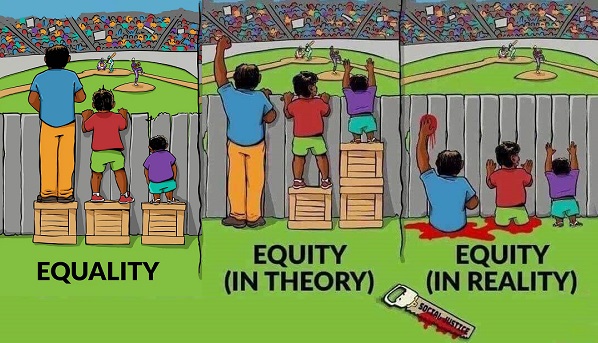
In the post earlier this week, “Donald and the Terrible, Horrible, No Good, Very Bad Week, Part II: The Important Stuff,” one of the items I included as important was Jacob Savage’s disturbing essay on how white males of the Millennial generation were crushed by the DEI policies that even predated the term. He wrote in part,
“As the Trump Administration takes a chainsaw to the diversity, equity, and inclusion apparatus, there’s a tendency to portray DEI as a series of well-meaning but ineffectual HR modules…This may be how Boomer and Gen-X white men experienced DEI. But for white male millennials, DEI wasn’t a gentle rebalancing—it was a profound shift in how power and prestige were distributed.”
The rest of the article was so powerful regarding how white males saw their ambitions and futures hamstrung purely because of their race and gender, with striking statistics to back up his narrative, that it landed like a splash of ice water on the still-raging policy debate. DEI was, and is, simply wrong, unethical, as well as being unconstitutional and illegal. My Trump Deranged Facebook friends keep calling the President “inhuman,” but, strangely, he was the only one with both the power, the guts and the perception to set out to end what has been a cruel form of societally- approved prejudice and discrimination.
I should have devoted a whole post to Savage’s article, but a substack called eugyppius: a plague chronicle did, and expands on what Savage began, well, savagely. He writes,
“This is recent history that I experienced first-hand. I got my first and only professorship in the early 2010s, just before the hammer came down. Of all the white men among my graduate school acquaintances, I’m the only one I know of who got a tenure-track job at all. Then, after I took up my appointment, I had the dubious pleasure of watching my university go crazy. After 2015, intense pressure from the administration and an increasingly powerful minority bloc within my own department made it all but impossible to hire white men, whatever the situation. In some cases merely interviewing a white guy was enough to risk veiled accusations of racism from the diversity enforcers. After I was nearly cancelled a few times, I decided that near-daily racial harassment wasn’t worth the salary. I abandoned my job and moved back to Germany, just a few years into the glorious American cultural revolution. I wasn’t getting paid nearly enough to recentre my professional life around the tiresome intellectual pretensions and imaginary racial grievances of undertalented, overpromoted angry black women.”
Savage pulls his punches, presumably to avoid being called racist and sexist for noting that a lot of blacks and women, and black women, have been given big jobs that their talents were too tiny to fill. [See: Gay, Claudine; Jean-Pierre, Karine; Harris, Kamala; et al.] “Savage’s ‘Lost Generation’, or: Thoughts on the DEI scam and what happened after 2015” does not pull punches at all. Like in this passage, for example,
“In case it wasn’t obvious, the hordes of (mostly gay and/or female) “minoritised” black and brown people taken into the junior ranks of American cultural institutions do not represent a groundswell of heretofore neglected talent. Fifteen years ago it was still common to hear that minoritoids were an untapped resource whose genius promised to raise our institutions to new heights, but by 2015 nobody dared talk like that anymore. Everyone had long since realised that insisting on meritocratic standards was a great way to fill your schools not with the modern-day descendants of slaves, but rather with a lot of white and Asian people. The unspeakable truth is that disadvantaged minorities are precisely and inexorably those whom any kind of meritoracy, however conceived, would tend to exclude. This makes a lot of good liberals so uncomfortable that they have spent decades inventing ever more elaborate bedtime stories explaining why their evil patriarchal ancestors are to blame for this state of affairs.”
Sorry not sorry: bingo.
Read it all. The author is not hopeful that the DEI snake can be easily dispatched, and if foolish, gullible Americans fall for the various manufactured issues ( Epstein, “affordability,” the cruelty of enforcing litigation laws) being concocted by the Axis of Unethical Conduct for the the mid-terms, watch out. The essay concludes depressingly:
“Just because some centrist-trending progressives profess mild regret over this era today, and just because some DEI administrators have received new job titles, does not nearly mean that these practices are over with. Meritocracy, we must admit, is a weak position, and one that can never be fully realised – not least because ethnic preferences are intuitive, powerful and self-perpetuating. These people are now fully entrenched, and many of them will continue to agitate for special racial privileges until they retire.”
 Ethics Alarms
“Meritocracy, we must admit, is a weak position, and one that can never be fully realized – not least because ethnic preferences are intuitive, powerful and self-perpetuating. “
A couple of decades back Richard Herrnstein and Charles Murray published “The Bell Curve”, a book that has been so taboo that it has never been adequately rebutted in academia but shouted down and suppressed instead as racist and evil. Some of the main implications of this book are:
I am not a social scientist so I cannot weigh in on the scientific debate, however it appears to me that all those who propagate DEI act like they believe in the conclusions of this book, and therefore believe that positive discrimination is needed as certain minorities would not be able to compete on merit in environments where performance depends on intellectual skills.
I am a bit puzzled by eugyppius’s stated reason for why meritocracy is a weak position, as meritocracy is color blind. However colorblindness may result in different outcomes for ethic groups, e.g. when universities primarily select on SAT / GPA for admissions and the students with high SAT and GPA are mostly white or Asian. If Herrnstein and Murray are correct this phenomenon is inherently unsolvable by any policy that does not explicitly takes race into account.
The problem is that whatever policy you follow you are doomed to be “racist” in some form. Meritocracy following color blind procedures will lead to unequal outcomes by ethnicity. However DEI which explicitly takes race into account is by definition racist. If whatever option we choose is racist, should we still maintain that racism in all forms is absolutely evil and taboo? Or should we accept that racism is unavoidable and part of the human condition, and certain forms of racism are more benevolent to society than others?
For the first couple years of reading this blog, I tired of seeing the ‘cognitive bias scale’. I placed cognitive bias along with other common fallacies of intuition, such as survivorship bias, sunk costs, begging the question, tribalism, etc. as traps to be avoided in personal thought and action.
Only recently did it click that it doesn’t matter how sharply I’ve personally honed my abilities to recognize and counter these biases–the point is they’re pervase and permanent fixtures in the human condition and society as a whole will reflect them no matter what I do.
America might just be the least racist county in existence–it necessarily must be in order to exist with the proportion of foreign-born here–but it probably tracks on par with everybody else if you consider the “reverse” racism we are inflicting on ourselves.
I kind of took his position to be similar to the statement about how democracy is the worst form of government, except for everything else.
There’s nothing wrong with meritocracy in theory, but in practice by humans it’ll always be horribly flawed, in large part due to our biases. But any other system we might employ to try to “overcome” those biases will invariably make things worse, not better.
I don’t think it’s over yet. Those pushing it don’t see anything wrong with stymying the careers of straight white males.
The Marxist line is never to fix the system. It’s to break it or to make people think that it is broken so it will be easier to convince them to change it to something else.