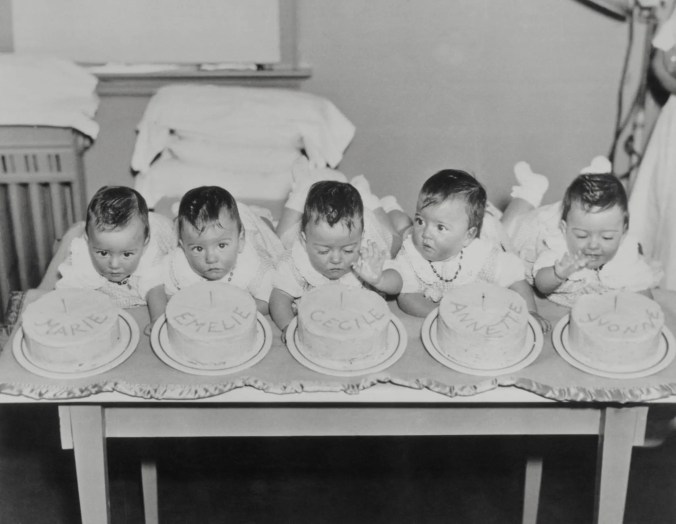
The last of the famous Dionne Quintuplets died last week. Annette Dionne, who seems to have been the strongest of the five identical sisters from the very beginning, was 91. The New York Times has an obituary that is also an excellent feature on their unusual lives (Gift link!)—this is the kind of thing the Times still does well. There isn’t a single slap at President Trump anywhere, at least that I noticed.
The article begins by noting that Annette, like all of her sisters, “resented being exploited as part of a global sensation.” I get it: the five girls were celebrities from the second they were born, and their fame was such that they never really escaped it: thus the last surviving quint being deemed worthy of a Times obituary more than 60 years after her birth. But resenting something that any objective analysis would find unavoidable is not just pointless, it’s unfair. In this case, the resentment was unfair to the quints’ parents and the public.
In 1934, the birth of surviving quintuplets in Ontario, Canada was considered, justifiably, a medical miracle. All five of them together weighed only 13 pounds, 6 ounces. Yes, in a way they were freaks and treated as such, extraordinarily cute little freaks. Medical miracles give people hope; they suggest that the world is getting smarter, safer, more beneficent. This miracle happened in the pit of the Great Depression, when celebrities like Babe Ruth and Shirley Temple became icons because they made Americans forget their troubles.
To the girls’ parents, Oliva and Elzire Dionne, the arrival of five babies to a family living in poverty was a looming catastrophe. The parents and five children already lived in a run-down farmhouse lit by kerosene and serviced by an outhouse. The new babies were nursed on water and corn syrup until the family started receiving breast milk donations. The fact that the public was so interested in the quintuplets was a blessing that saved the family from disaster.
They were indeed exploited. The parents for a time surrendered custody of the girls and they were cared for by a government-appointed guardian, the doctor who had delivered them. The were housed and cared for by the doctor and a staff at “Quintland,” where they were displayed several times a day on a balcony as 6,000 spectators watched them through one-way glass.
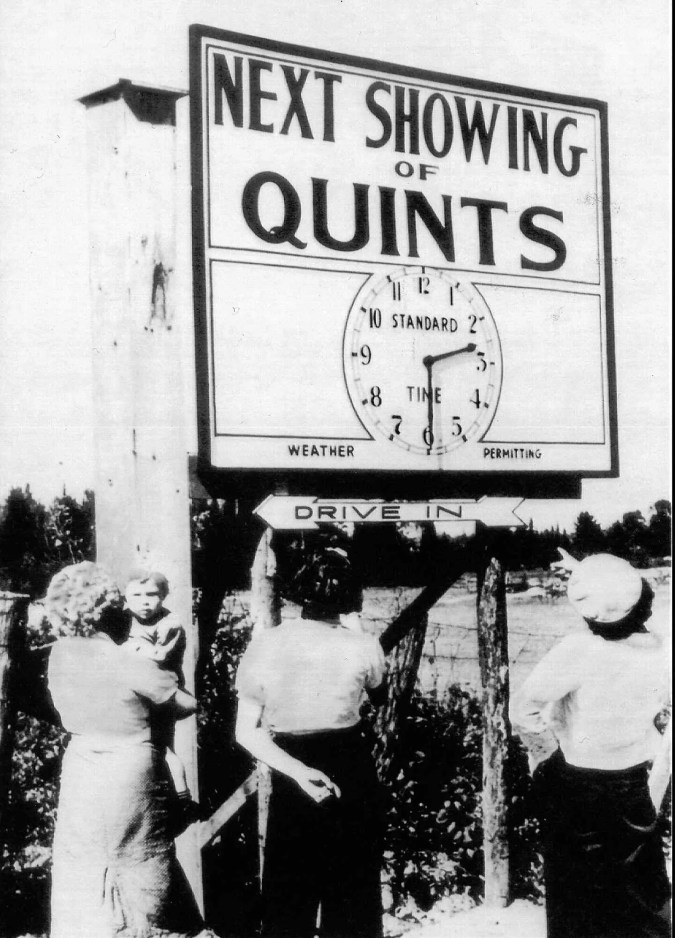
Émilie, Marie, Yvonne, Cécile and Annette led the lives of the rich and famous well into their teens. They had photos taken with movie stars; they met King George VI; they were paid to advertise Colgate toothpaste, Lysol disinfectant and Quaker Oats among other products. In the midst of the Depression they were secure and comfortable, and had trust accounts that ensured that none of the girls ever had to struggle like their parents. “The public, almost literally, suffocated them with love,” historian Pierre Berton observed in “The Dionne Years: A Thirties Melodrama” (1977). Well, if you have to be suffocated by something, love is a good alternative.
“It’s tiring, always being watched,” Annette complained when she was an adult. “It was exploitation. We were not animals.” Oh, cry me a river. This inspires in me as much sympathy as when actors who depend on public attention and popularity complain that they have no privacy.
I was struck by the fact that, the article tells us, the two sisters, including Annette, who married resumed using their original names after getting divorced. They resented being “exploited,” but not enough to seriously seek anonymity.
The Dionne Quintuplets had strange lives to be sure. Still, as Clarence Darrow said, you play the hand fate deals you. Complaining about that hand is self-defeating, and resenting the cards when so many would gladly trade their hands for yours is, if not unethical, really obnoxious.
 Ethics Alarms
“There isn’t a single slap at President Trump anywhere, at least that I noticed.”
Lucky. For the first time in ages, I stopped reading a book last night. A 2025 attempt to get at the truth of the author’s mother-in-law’s exploits as the first female journalist to cover both the Atlantic and Pacific theaters of WWII completely derailed less than 100 pages in when a section on the history of factchecking included a few paragraphs accusing Donald Trump of following the Goebbels’ “Big Lie” philosophy and accused him of being responsible for Zuckerberg’s and Musk’s “de-truthing” of social media by firing their factcheckers “in the name of Trump’s First Amendment”. That is literally what she wrote “Trump’s First Amendment”.
I stopped reading there and took my bookmark out. Finding that quote to include in my comment, I just saw chapter 10 in which it looks like she quotes Mary Trump on the President’s relationship with his parents and compares his growing up to Hitler’s relationship with a harsh father and warm mother.
So, as I’ve complained here before…what is this book about? Is it really supposed to be about the late Pat Lockridge? Or was that just an excuse to write a book comparing Trump to Hitler?
So this book is going back to the library unfinished.
Rant over.
As for the quintuplets, I’m going to quote L.P. Hartley: “The past is a foreign country: they do things differently there.” From the perspective of someone who has spent most of her life in comfort, Annette did not witness the fear and uncertainty of her parents. She did not have to worry about where the next meal was coming from. For this reason, like the social justice warriors of today, she has the privilege of looking back on the past with judgement in her eyes, not willing to recognize that things were different. It isn’t that children aren’t still exploited, but that we now understand more of what exploitation is and what it can do to a child. In those days, it was seen otherwise. So, I feel sorry for Annette that she cannot recognize what a remarkable life she’d had an give her parents some credit. Just as I feel sorry for the author of this book I just put down…a little bit. The story she wanted to tell won’t reach a reader deeply interested in the time period involved because she cannot recognize that not everything is about Trump.
AM, I had a similar experience with a good friend. He insisted on putting a slap at Trump in every correspondence. I told him to stop, and he has. Other Trump deranged friends are now erstwhile friends. A strange time we live in.
Yeah, my Trump Deranged sister makes an aside about what protests she participated in to protect our rights or marginalized communities or some other boilerplate verbiage during our weekly Zoom calls. Annoying.
But she and my MAGA brother were on their best behavior at Christmas so I can be grateful for that.
I can appreciate that the publicity aspect of the Dionne quintuplets was difficult to deal with, but one of the things so many people seem to forget about is how hard life really is. My grandparents and my wife’s grandparents saved every scrap, salvaged every castoff from the gutters in anticipation that it might be useful someday, because the Great Depression taught them to utilize everything last thing to its utmost. (Contrast that with our throw-away culture with its planned obsolescence!) Life could have been much, much worse for the quintuplets if not for their fame. Malnutrition, disease, poverty — that’s just the tip of the iceberg for their era.
If we look at some of the historical options, their parents could have followed many ancient cultures that would abandon their babies in the wilderness to die of exposure. They could have sold the girls off as slaves. They could have sacrificed some of the girls as burnt offerings to Baal. More recently, they could have selectively aborted several of the babies so that they only had to deal with twins or triplets.
I know that comparing our lives to what could have been elsewhere in the world, or else-when in history is not making apples-to-apples comparisons. Still, the sheer misery most of the world and most people endured up until modern times at least reminds me to count all my blessings.