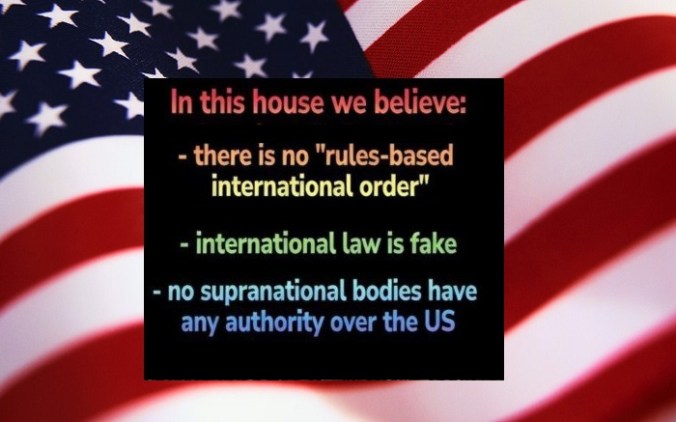
“All the bleating about “international law” shows just how completely deluded some of our elites have become. International law was a pleasant fiction that lasted for a few decades…It was never real. Laws are based on submission to an overarching authority backed by force. There is no such international authority and even if you view the UN as one, it does not have the ability to use force against those who violate “international law”…
—Someone named Konstantin Klein on Twitter/”X.” I have no idea who the hell he is, and I could have just as easily said that myself, but I’ve been waiting for someone else to point exactly this out, because it is true..
As a general rule, those criticizing the U.S. action in Venezuela based on “international law” don’t know what international law is, and those who criticize the seizing of Maduro and his wife who do know what international law is are deliberately misleading those who don’t. Why hasn’t the new media clarified the issue? Well, 1) it would undermine the Axis’s anti-Trump narrative and 2) most journalists are lazy and not too bright.
On The View yesterday, Sunny Hostin, who appeals to her own authority frequently because she is a lawyer and was once a prosecutor, again proved she was an affirmative action botch by her law school (Notre Dame) by showing beyond a reasonable doubt that she’s an idiot. According to her, the Trump administration arresting Maduro and extraditing him the United States was a “kidnapping,” “100 percent Illegal,” and akin to “piracy.” Piracy? Then she played the frayed international law card, babbling “And international law doesn’t allow it unless there is — unless Congress declares war, and Congress did not do at. So, this country was founded on the premise of the balance of power. Right? So, you have a checks and balances. So, you have co-equal powers — co-equal branches of power. So, you have the Judicial Branch and then you have the Executive Branch, which the president is a part of, and then you have, of course, the Legislative Branch and that’s Congress. And they are supposed to check each other!”
Psst, Sunny! International law doesn’t “allow” or disallow anything. The United States was actually founded on the premise that the people who lived here wanted to decide on and enforce their own laws and not be subject to foreign rule.
Another conservative blogger writes, archly but accurately, “For a lot of people (Canadian Liberals and American Democrats in particular), the invocation “international law” has a mesmerizing effect on their ability to reason… They seem to have a quasi-religious belief in the UN as if it were some kind of God-given supergovernment that is always right and must always be obeyed. “World opinion” might as well be the hand of God to them, so any time the legacy media can portray the US (and Trump in particular) as going against “world opinion” they want to get out the sackcloth and ashes … or sack a city and turn it into ashes, whichever comes first.”
To get to the basics, a law, to be a law, must be enforced by a lawful authority. I foolishly took a course in international law in law school, and discovered how illusory and toothless the concept was and is. Although the Orwellian Left would love to have a world government that could dictate to the U.S. (Climate change! Universal health care! Reparations!), it doesn’t, can’t and won’t. The United Nations has less credibility and power now than it did 60 years ago, when it helped focus pressure on the Soviet Union during the Cuban Missile Crisis, though if Khrushchev had decided to start World War III, there was nothing the U.N. could have done about it.
Since then, as the U.N. has gradually become dominated by anti-American powers like China, Iran and others, and the U.S.’s participation in and substantial financing of the corrupt institution has become increasingly indefensible. Predictably, the Trump Administration’s military intervention in Venezuela drew condemnation at an emergency meeting of the United Nations Security Council yesterday. French U.N. envoy Jay Dharmadhikari said that the U.S.-led operation to seize Maduro “chips away at the very foundation of international order” and that “…the military operation that has led to the capture of Maduro runs counter to the principle of peaceful dispute resolution and runs counter to the principle of non-use of force.” What “international order”? What “principle of non-use of force”? The Russians invaded Ukraine and the United Nations did nothing. Gaza (“Palestine”) launched a terror attack on Israel, and the U.N. has been condemning Israel for defending itself. Nigerians have been killing Christians and the U.N., again, is just watching and maybe thinking, “Oh, tut-tut! How sad.”
U.N. Secretary General António Guterres said the U.S. had violated the U.N. charter where it says that member countries “shall refrain in their international relations from the threat or use of force against the territorial integrity or political independence of any state.” “I am deeply concerned about the possible intensification of instability in the country, the potential impact on the region, and the precedent it may set for how relations between and among states are conducted,” Guterres said. Who cares what he thinks? His bias is that he has a cushy job with an organization that pretends to have authority that it does not, and has proven itself to be thoroughly corrupt.
As I quickly learned in law school, Maritime Law is the closest thing there is to genuine international law, and even then, if a major nation decides to breach it (as China is doing right now) the only enforcement mechanism is another sovereign state stepping in. As we all should have learned from the Biden administration’s deliberate refusal to enforce immigration laws, a law without law enforcement is no law at all.
 Ethics Alarms
ESR had a good point about this. https://xcancel.com/esrtweet/status/2007544995666874609#m
Key section IMO:
International Law 100% exists in so much as it is the World Order imposed by victorious allies after world war 2 with the United States as the leading entity. In which case, it still follows the definition of the tweet above.
The world was so wrecked by the devastation of WW2 (except of course the USA) that the USA was able to exercise this outsized authority. Unlike previous world hegemons, our wielding of power actually benefited the rest of the world in ways they will never admit because on the way we’ve had occasional hiccups and missteps.
But, our incredible magnanimity as a nation has allowed the entire rest of the world to rise from virtual starvation to modernization rapidly. And now, nations whose very success is directly tied to our generous management of global trade routes are becoming powerful enough to challenge the world order (International Law) that we’ve defined.
Too bad for them because it won’t pay off for anyone.
If I understand you correctly, you claim that the law is determined not by ‘international consensus’ or agreed-upon legal rules, but rather is solely defined by the supreme power that won and dominated after WWll. The one that has the most power is the one who makes the law because ultimately that one has the power.
Following the devastation of WWll, which rendered many nations powerless because they were destroyed, the position of law-giver and law-exerciser was given to the United States and you believe that, on the whole with perhaps a few mistakes, it upheld the law (which means it managed the Order relatively well).
It is an interesting position to have and seems to be be pretty much the definition offered by Thrasymachus:
Thrasymachus, a Sophist in Plato’s Republic, argues that “justice is nothing but the advantage of the stronger,” meaning rulers create laws to benefit themselves, and justice for subjects is merely obeying these self-serving rules, viewing “might makes right” as the true principle, where injustice on a grand scale is superior to justice.
The main problem I see is about what could happen to a powerful entity that gave the law but then became too weak to enforce it. It would then have to submit to the rulership of a more powerful entity that created its version of ‘good law’.
(I do largely agree with your view of the US in the Postwar but I do not think your definition of what is or should be ‘international law’ can hold up to scrutiny.
There are two options depending on what you want “International Law” to be. It’s either exactly as I described or it doesn’t exist. Either way, it is closer to anarchy than it is to ordered consensus as it has always been and always will be until the world figures out how to federate itself (and I’m guessing that isn’t going to happen) or a single entity successfully subjugates the entire thing under some sort of empire.
I didn’t say the United States was the *sole* arbiter of “international law”. Here’s what I said:
“International Law 100% exists in so much as it is the World Order imposed by victorious allies after world war 2 with the United States as the leading entity.”
All law, whatever it is, is maintained entirely by consensus of power wielders. In the case of current International Law, the consensus was met by the victorious allies, with the communist Russians being early “dissenters” from the arrangement and with the United States being an outsized voice in the consensus.
Even an nation’s internal law is ultimately just a consensus of power wielders. Thank the Founders for enshrining the 2nd Amendment which codified the idea that the final power wielders of a society are armed and equal citizens.
And no, might doesn’t make right. Law can still be wrong. But luckily, unlike many modern western squish-minds, I recognize that the United States and friends represent the “good guys”. So, in our case, our might has allowed for ALOT of right.
Michael West wrote: “There are two options depending on what you want “International Law” to be. It’s either exactly as I described or it doesn’t exist. Either way, it is closer to anarchy than it is to ordered consensus as it has always been and always will be until the world figures out how to federate itself (and I’m guessing that isn’t going to happen) or a single entity successfully subjugates the entire thing under some sort of empire.”
On the whole my concern, if you will, is how this capture of Maduro is perceived in Latin America. My own view is that only by bending the present understanding of the concept of “international law” (as understood by average people and also ‘experts’) could the US operation be justified. And I say this as one entirely happy that Maduro was captured.
The Trump interpretation of Monroe Doctrine is quite absurd, except for someone — you perhaps? — who chooses to hold to the view that the continent is your property, or your domain. However, I do very much understand that the US is in a sort of early stage of warfare with China and that the US is a power that, through mismanagement precisely by the capitalist class that allowed China to build powerful industrial base, is now in a weak and struggling position. And if it could come about, myself I would be very happy to see China’s power curtailed and the US power increased. I am not convinced that Trump’s programs can or will achieve the goals that he promised, and indeed with stories of outrageous self-enrichment by family member (rumored, I have not investigated them) it is very hard to discern if Trump is serious.
So another aspect of my ‘concern’ is that, among the rebellious youth of America who, at first, were very much behind Trump but have begun to conclude that he in no sense can or will achieve his stated aims, the aims he constantly stated during his campaigns. I remember how much you despised Richard Spencer and, like it or not, there are myriads of young people who have been influenced by similar views, and they are not pleased with what they see going on.
(My understanding is that Ethics Alarms is little interested in these issues and their opinions. And most here really are (excuse the term) of the Boomer Truth Regime. You have a way of seeing the world that is often quite rigid and fixed.)
I cannot disagree with the essence of your analysis, however it is Machiavellian theory through and through. It used to be that the use of American power was presented in marvelous layers of high-minded rhetoric about noble objectives. From a Machiavellian perspective this makes great sense: power masks its objectives in such ways in order to convince, or trick, the masses who must give some level of assent. At the very least the pretenses are being dropped.
But with that said, I honestly agree with at least the major points that you make: the US is by-and-large a benevolent landlord and the economic system that it created, and guards over, has too many positive aspects when these are compared to the negative outcomes brought about by those who rebel against The System. The better option? To support the general objectives of the US. To cooperate with them. As I made plain in another thread: Colombia where I now live, when it opted to resort to American aid and got help in battling the rebellious sectors, has made incredible progress in the last 20 years.
So in some sense I am more a “Thrasymachan” perhaps than you are.
Hi Alicia! Welcome back!
The Monroe Doctrine was essential when it was first stated, a warning to European powers not to encroach on nations and territory in the Western Hemisphere.We were not really in a position to enforce it, but the principle survived, and was noisily re-declared by Teddy Roosevelt. It supported the US position in the Cuban Missile crisis. It is valuable to national security and democracy. At this point, it stands for the proposition that the US is the Big Kid on the Block, will defend its values, and bullies and punks from other neighborhoods mess with the other kids at their peril. Since the US has the power and, right now the will, to follow through on that warning, there’s nothing “insane” about it.
Thank you Jack. My criticism of this operation, and the message that is sent by Trump’s loud, impolitic, far too blatant manner of doing things, has more to do with a concern about how these operations are perceived 1) in Latin America, and 2) by a faction in American politics that supported Donald Trump and “America first” and have come to doubt him. More than that: they believe themselves betrayed, tricked. I realize that all of that is another ‘can of worms’.
This man — I know nothing about him — expresses succinctly what Trump makes me think and, to be honest, to feel when he carries on in this arrogant manner.
The Wall Street Journal has a fairly succinct treatment of the International Law thingy:
The ‘International Law’ Illusion in Venezuela – WSJ
The Sunny Hostin statement about a war being illegal under international law unless it’s authorized by Congress took my breath away when I saw it the other day. Just last week while looking for a shovel I noticed I still have my Notre Dame Law School diploma and law review certificate hanging on the wall of our dimmest and darkest storage sheds.
International law has been a shibboleth from the start. The closest it got to really existing is when the few great powers divvied up the world in the age of empire. The British Empire would ensure freedom of the seas, France would make sure Africa didn’t get out of line, Germany would keep Russia out of Europe, Austria-Hungary would keep the Balkans in line, the Ottoman Empire would keep order in the Middle East, and Russia would serve as a counterweight to all of this. Eventually the US entered the scene and took the role of keeping order in the Western Hemisphere. That’s as far as it got, practically speaking, before World War I turned everything upside down.
Woodrow Wilson’s idealistic League of Nations and the screeds of anti-war and anti-armament treaties that followed achieved precisely nothing. They were shreds of hope for the West to hang onto in the fear of a repetition of World War I, after all, if the Kellogg-Briand Pact outlawed war, then no one would wage war, right? That’s what they kept telling them as Poland threw the Soviet advances back and Finland resorted to ski-and-snipe tactics that could only be beaten by human wave attacks. No one said a word as Soviet bayonets forced the Baltic states into the USSR, nor as Japan turned Manchuria into Manchukuo, nor as Hitler forced Austria into the Anschluss and took the Sudetenland.
Finally came the overreach into Poland, and you know the rest. But even after that was over, we still fell back into the hopes of the UN and international law stopping predatory nations from being predatory. They accomplished absolutely nothing as the Soviets crushed free Hungary and Czechoslovakia’s attempt to “give socialism a human face.” In fact, the one time the UN did anything effective was in the Korean War, and that’s only because the Soviets walked out and weren’t there to veto everything.
Independent action was what did the trick, when the west was brave enough to do it and stick to it, like the British defeating the Malaysian communists and the Greek communists (although in all fairness that happened as much because the USSR decided to concentrate on taking Bulgaria instead), and like “Operation Vittles” stopping Berlin from being starved out.
Now we use our still-formidable forces to get rid of a tin-pot swaggering dictator sitting on huge resources who should have been thrown out long ago and whose elimination will solve a lot of problems, and the left wants to cry “international law.” The only folks who I’ve heard cry “international law” before this are the pacifist/cult of anarchist personality idiots who do minor vandalism to our defense infrastructure, get arrested, and then say the state should let them off, because they are just so righteous. Regularly the US courts won’t even let them argue international law, because what they do has nothing to do with it. No one has the right or the power to tell a nation how it can and can’t defend itself or what it can or can’t build, or anything else, least of all someone quoting a law they should know means nothing.
Canadian liberals hate and want to destroy America as it exists. American Democrats hate and want to destroy America as it exists. Much of the UN hate and want to destroy America as it exists.
It’s not hard to see why they like each other. They think if the UN gets more power, their goals will be achieved.
I am in favor of this administration’s arrests of Mr. and Mrs. Maduro. Venezuelans have suffered long enough. The legal issues have been well explained by many.
Are we worried that someone will invoke a similar legal argument to arrest Trump in the same fashion? Or do we believe … let them try …