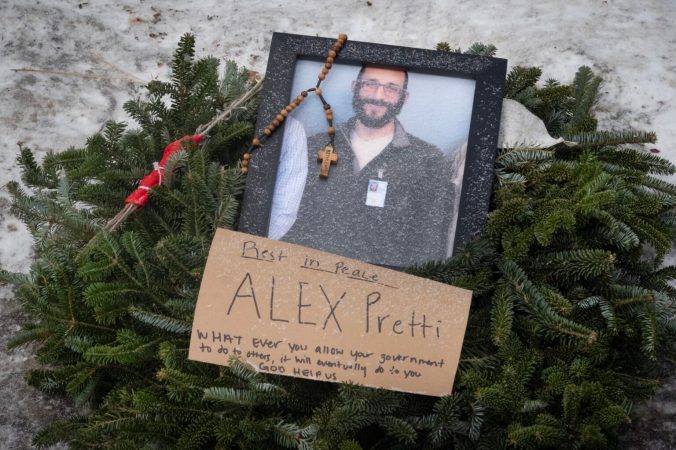
I’m not sure that’s possible in this situation.
FIRE is in Ethics Zugzwang.
The Foundation for Individual Rights and Expression bravely and admirably expanded its mission when it became clear that the ACLU no longer cared about protecting the rights of all Americans, just those whose political views it supported. Now the expanded FIRE is trying its mightiest to maintain a politically neutral stance while involving itself in the current rebellion against the rule of law and immigration enforcement in the “sanctuary” states and cities.
Stipulated: This is unquestionably the right position for a civil rights watchdog to take. I also believe it is a position that cannot be effective or even coherent.
The latest statement by FIRE is an essay on its website called “The Alex Pretti shooting and the growing strain on the First Amendment.” Everything in the essay is fair and accurate. Unfortunately, FIRE’s position is likely to get people killed, as fair as it seems. Or in the immortal words of my father’s favorite epitaph,
He was right, dead right
As he sped along
But he’s just as dead
As if he were wrong.
The points FIRE makes about Pretti are arguably legitimate:
Whatever comes of the investigation, this moment demands a reaffirmation of basic First Amendment principles that the administration increasingly undermines by collapsing protected expression into criminal conduct.
First, Americans have a right to protest peacefully. That right doesn’t depend on the cause or politics involved. Whether you are protesting immigration enforcement, the president, abortion, or COVID-19 restrictions, you have a right to go outside and make your voice heard. But the administration has shown a pattern of hostility toward this nation’s long tradition of peaceful protest and dissent, including threatening demonstrators with “very heavy force” and targeting universities and foreign students over protest activity. In September, the administration released National Security Presidential Memorandum 7, which links disfavored viewpoints to domestic terrorism, notably “extremism on migration,” a term left undefined.
Second, Americans have a right to observe and record law enforcement officers performing their duties in public. Government officials sometimes abuse their power or make mistakes, and public observation and recording are essential tools for documenting misconduct and holding officials accountable. Nobody has a right to physically interfere with law enforcement. But officials have claimed — incorrectly — that it’s illegal to follow and videorecord federal agents or to share photos and videos of them online. Just last Friday in Maine, video revealed a masked ICE agent telling a woman recording him that he was taking pictures of her car because “we have a nice little database and now you’re considered a domestic terrorist.”
The administration’s invented or distorted definitions of “impeding,” “obstructing,” or “doxxing” have no basis in the law and are inconsistent with the First Amendment.
Third, Americans don’t forfeit First Amendment rights when exercising their Second Amendment rights. That was true when demonstrators opposing pandemic restrictions openly carried guns at the Michigan statehouse. And it’s true for those protesting immigration enforcement today. In some contexts, displaying the firearm itself is part of the expressive message. Threatening others with a firearm is plainly illegal, but legal carry cannot justify suppressing protected expression or using deadly force.
All true, and also, “Yes, BUT…”
 Ethics Alarms
FIRE does what FIRE is supposed to be doing, and that is zealously defending the First Amendment rights to peacefully protest, and also capture the actions of law enforcement on video. Being allowed to record actions on videotape is essential for two purposes a) being able to hold law enforcement officers accountable for their actions b) as a bulwark against authoritarian government agencies.
As things are developing now in Minneapolis, Homan has been sent in by Trump and Bovino is being called back, and ICE enforcement in Minneapolis is being scaled down. I see that as being related to a press conference Bovino gave where he was to eager to offer explanations and cast blame for the Pretti shooting without deflecting the questions pending investigation. Bovino’s interview is causing a lot of bad PR for the Trump administration right now, and we see tomorrow how things develop in MN, and how it will affect negotiations in Congress in order to avert another shutdown. All the video recordings that are out there of both the Pretti and the Good shooting will be very important in the coming criminal trials.
Reading the tea leaves (following Fox News) FIRE may be politically on the winning side of the issue. That is a good place to be in. FIRE also has the courage to take defend the rights of those with unpopular opinions, as back in the day ACLU with their defense of the right of Nazi’s to march through Skokie. The crux of the matter is that the rights of those whose viewpoints are repugnant are everybody’s rights. In the past laws were passed that affects the rights of others, with the Patriot Act as a great example. Conservatives were in favor of this, and if you were against the Patriot Act you were suspected of sympathy of terrorism. But after the persecution of J6 protesters conservatives the perspective of the Patriot Act has been altered, and the dangers of laws that give authorities too much leeway has become clear.
I think we need to be careful with invoking the “Shouting fire in a crowded theater” analogy, or at least put in context. Justice Oliver Wendel Holmes made this analogy in his opinion in the Schenk v. USA case before SCOTUS in order make the case that Schenk’s speech opposing the draft during World War I was not protected under the First Amendment. This authoritarian approach to the First Amendment has later been overruled by many other 1A cases that have come before SCOTUS.
Having said all this, a government agency should also be able to exercise their legitimate authority. What happens in Minneapolis is exceeds the boundaries of legitimate protest; it endangers ICE officers, and makes ICE enforcement impossible. It is rule by the mob with paramilitary means. That is also a danger to our freedoms.
I have no affiliation with law enforcement and am a huge supporter of civil liberties especially speech and firearm ownership.
The statement made by Jack may need a bit of clarification in my opinion.
“But the administration has shown a pattern of hostility toward this nation’s long tradition of peaceful protest and dissent, including threatening demonstrators with “very heavy force” and targeting universities and foreign students over protest activity.”
While we may have a long tradition of peaceful protest and dissent we have seen a steady rise in violent mob activity at any time activists can exploit a situation. From the beginning of the first Trump inauguration we have seen a significant escalation of violence in these so-called peaceful protests. Who can forget the image of the CNN reporter saying the protests were peaceful with a burning city block in the backdrop. Lest we not forget the hundreds of police officers injured from thrown frozen water bottles and other objects during the three day siege of the Whitehouse.
The threat of heavy force came about when he remarked that protesters trying to disrupt a parade used to honor veterans and the military would be met with heavy force but he also stated he knew of no planned protests. In that same NBC article Holman cited a protester who threw a Molotov cocktail at ICE agents in LA. Speech is one thing spitting on officers is assault and the spitter should be arrested.
The targeting of the Universities resulted from pro Palestine groups were not totally peaceful protests denying Jewish students access to college facilities, commandeering buildings with no consequences from the University administration, and undermining the general academic environment for learning. It has been stated many times that schools have the right to limit speech that impact the learning environment. It seemed to many that it was rules for some and not others which is a violation of the 14th amendment if the school takes federal dollars. I cannot comment on the rules of student visa requirements or limitations but guests should behave in a manner that is not disruptive.
Let’s not conflate open carry rights and concealed carry permit holders. There is a major difference. Pretti I understand was a concealed carry permit holder. This puts special obligations on him when interacting with law enforcement. While Minnesota like some others does not require the permit holder to disclose his weapon, it does require him to present his permit and show the weapon upon request. In this case, he failed to inform anyone. In the context of the environment a reasonable person would question the motives of not just carrying a firearm but two additional magazines. As Pretti was an educated person I must ask why he kept his activist activities confined to live streaming protests rather than seeking to work legislatively to correct what he saw as “injustices” perpetrated against minorities and illegal aliens.
“Even if you live in, or are traveling through, a state with no law on this topic, many concealed carriers choose to notify a law enforcement officer as a matter of courtesy and safety. While you are not legally obligated to volunteer that you are carrying, being upfront can help establish trust and prevent misunderstandings during a traffic stop or similar encounter. Voluntary disclosure often sets a calm, cooperative tone. Officers appreciate knowing what to expect, especially since they routinely face uncertainty during stops.
I would say that when aggressive protesters are fighting with you you may not think to ask if he has a firearm so that he can present his credential. Moreover, if the weapon was concealed at first then it cannot be construed as speech.
Politely informing them that you are legally armed, and explaining where your firearm is located, can show that you are responsible, respectful, and committed to keeping everyone safe. Many officers openly acknowledge that they appreciate the gesture, even when it is not legally required.” http://www.concealednation.org
ICE officers are criticized by activists, politicians, and the media for being masked and wearing military style gear. I ask how different is that from the dress, gear and tactics of Minneapolis’ SWAT teams or that of virtually any other major city police department. They dress that way because they are seeking to arrest known violent people who do whatever it takes to avoid detainment. The masks are used to provide anonymity to prevent reprisals on them and their families. The desire to unmask them is to promote intimidation and reprisals. Federal agents picking up detained arrestees from local law enforcement agencies are not dressed in tactical gear.
There would be no need for 3000 ICE officers in Minneapolis if the city and the state participated in the 287G program. This program allows ICE to pick up dangerous felons or those arrested by local law enforcement in a controlled safe environment and would not scoop up illegal aliens not otherwise involve with law enforcement. The Maryland legislature just introduced a bill to make it illegal for any police department to participate in the 287G program. The goal is to resist Trump; nothing more. This is not ideologically motivated it is politically motivated. I should point out that Trump’s pick for Homeland Security Tom Holman was given a medal by Obama for his work in preventing illegal immigration and facilitating deportations.
U.S. Immigration and Customs Enforcement (ICE) Executive Associate Director (EAD) of ICE Enforcement and Removal Operations (ERO) Thomas D. Homan was one of three Department of Homeland Security (DHS) career executives who received a 2015 Presidential Rank Award for Distinguished Service, which is bestowed to leaders who’ve achieved sustained extraordinary results. http://www.ice.gov
Jack stated “There would be no need for Administration voices erring on the side of expressing hostility against over-zealous protests or warning citizens that such conduct can place them in harm’s way, if local officials properly instructed citizens to protest from the sidelines.” True enough but if local and state officials were concerned about the rule of law and that no one is above the law then they should not be facilitating ICE detainers. That is the behavior that is causing the politicians to abuse their power for political benefits while putting the average citizen at risk.
The public’s right to seek redress for grievances through protests using signs, banners, pamphlets or a bullhorn is not contestable. Throwing stuff is not speech . A legitimate protest is protected speech when it seeks to change that which currently law to something with which they agree. What is transpiring in these protests that result in clashes with law enforcement is at best civil disobedience which can carry penalties. Free speech does not give one the right to vitiate existing law through mob activity.
“Everything in the essay is fair and accurate. Unfortunately, FIRE’s position is likely to get people killed.” People don’t forfeit their rights, BUT.
Gotta love the use of all caps for that “BUT”.
Lemme think; where have I seen that typography used before?
Never mind. I understand. The people can exercise their rights; they’ll be right, BUT dead right. Well, why would that be? Government is instituted to secure those rights, right?
Yes, BUT!
BUT, what?
BUT, if there’s a perception by government that rights are in the way, that they interfere with government law enforcement, then rights must fall to the wayside. Free speech? Right to carry? Due process? Those are rights, nearly sacred, BUT, they must yield when government is on the move.
The Tree of liberty, refreshed with the blood of patriots? BUT, that’s ridiculous. Give up some liberty for perceived security? Yes, that’s the ticket. We’ll then have both security and liberty. Works for some.
BUT, ‘when government is destructive of those rights’ — well, let’s hope the current administration still can pull back from that.
HJ. Did you understand the complete message Jack was communicating. He acknowledged that Pretti had a legal right to carry. Just as I have a legal right to keep a gallon of gasoline in my furnace room it was a dumb move on his part if he had planned to do more than just observe, record and protest.
Mistakes get made and the reason that Pretti is dead today is because the Minnesota and Minneapolis governments failed their citizens by ignoring the supremacy clause in the Constitution that gives the responsibility to enforce immigration law. I would bet that you cheered when the Federal Court in Arizona told Sheriff Arpaio that he had no right to enforce immigration law and it was the sole province of the Federal government. That set the stage for the cascading of events that have followed.
No one I know wants to see protesters killed either accidentally or with reason. Ask yourself why are illegal alien felons being captured in states that participate in the 287g program not seeing the violence and protests or even large numbers of ICE agents in their streets. They answer is simple. Walz and Frey are using its citizens as canon fodder by egging them on. I don’t see either of them standing in the breach.
I understand exactly what that BUT means – set aside your rights when in the presence of government brutality. You did see the video of the woman being pushed to the ground, right? At that point, Petti should have turned away and left the scene. He compounded his error by helping the woman back to her feet; what a stupid thing to do considering the threatening presence of ICE.
Yes, mistakes get made. The mistake by ICE in that situation was using too few ‘officers’ to subdue a civilian; the six or eight (or whatever it was) clearly weren’t enough. A dozen or maybe fifteen should have been used. There were enough standing around in the area. Never mind that Petti was face down on the ground surrounded by ICE; he still had not been subdued and still was a deadly threat (so we’ve been informed).
The woman (it doesn’t matter what her sex is) was pushed to the ground because she got in law enforcement’s way. That’s interfering. What’s better, getting arrested, or being pushed aside? Protests and demonstrations are speech, not conduct. When they cross the line into obstruction, especially obstruction while carrying a weapon, it leaves the First Amendment on the curb, where it belongs.
It’s possible those two were the only choices, but I doubt it. DHS said the two women were pushed to get them out of the road. Perhaps standing in front of a parked car, observing, blowing whistles, videoing, all or at least one constitutes interfering which cannot be seen in the videos.
Here is an article on the event.
https://reason.com/2026/01/27/border-patrol-agents-started-the-scuffle-that-led-to-alex-prettis-death/
First of all, nothing indicated Pretti had a lawful reason to direct traffic. He was described as an ICU nurse, not an EMT or firefighter or even a construction worker who could have plausibly looked like someone who could direct traffic.
From this description, Pretti appeared to insert himself into the scene. Law enforcement did not initiate the confrontation with him (though his unlawful directing of traffic would have justified such a confrontation)
He was not someone who was simply protesting while standing on the sidewalk, let alone minding his own businesses. He inserted himself into a conflict between law enforcement and others.
Even if the shooting was unlawful, he was someone who was “dead right”.
Excellent comments, Chris.
jvb
Has anyone thought that maybe Alex Pretti would be alive if the officers had been allowed to pepper spray him? The District court banned the use of ALL less than lethal means against the protesters. All they were allowed to use was lethal force.
https://www.newser.com/story/382114/judge-feds-cant-detain-tear-gas-peaceful-protesters.html
You might think “Well, that says you can’t use it against ‘peaceful protesters'”, but both Pretti and the woman who drove her car at officers were described as ‘peaceful protesters’. The agents’ hands were tied by the judge. Lethal force it is.
That absurd ruling was yet another incompetent, partisan obstruction by an unethical judge, which is why it was stayed by the appeals court. Either local law enforcement has to protect federal agents, or they have to be able to defend themselves.
They did use pepper spray.
There seems to be evidence that he was already subdued when he was shot. At worst, this was manslaughter.
What it was definitely not was an execution for the exercise of First Amendment rights.
If the guy was interfering with a ICE, that’s a crime. Being armed while committing a felony is itself a crime. He had a gun, it was removed, not every agent saw the gun removed, he took out his stupid cell phone and in the confusion agents thought it was a gun, and had no time to do a close examination. I feel sorry for him, like I feel sorry for anyone who deliberately puts himself in harm’s way where he shouldn’t be and gets hurt, but he created the situation. If he had been peacefully demonstrating and protesting, he’d be alive today.
Holly Harding gives us a different perspective.
https://www.quora.com/Why-would-a-person-take-a-gun-to-a-dangerous-protest/answer/Cal-Peters?comment_id=500810969&comment_type=2
Was he being ordered to stand back? What was his interaction with ICE before the woman was pushed? Was he more peaceful that time then in the earlier video when he kicked in the car’s tail light? Is the claim now that he was just passively protesting and only interacted with ICE when the woman clashed with them?
I see no justification or excuse for Pretti OR the woman to be that close to the agents at all, and his being armed made his intent ambiguous.
Why does where he was standing matter?
Because if he was standing close enough to be interfering with the operations, he was crossing into interference and a threat. Police and firefighters need clearance to do their jobs safely and without distraction. This kind of “protest” isn’t speech, Michael, it’s illegal conduct. ICE should not be put in the position of having to deal with people like Pretti, or worry about them. I think a bystander who crosses these lines should have strict liability.