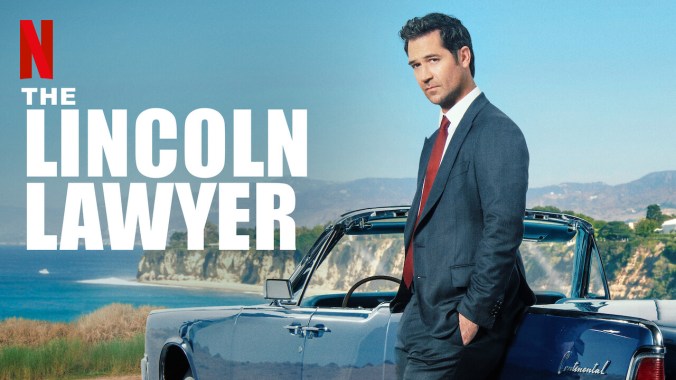
Netflix’s “The Lincoln Lawyer” series has dropped its fourth season. This gave me an excuse to revisit the first three seasons of the legal show, based on the Matthew McConaughey film, itself based on Michael Connelly novels, about sketchy a Los Angeles criminal defense attorney whose office usthe backseat of a chauffeur-driven Lincoln town car. The series—it’s Netflix after all—has DEI’ed the movie, with Micky Haller, the central character, being transformed into a Mexican-American who speaks Spanish frequently (though not as often as Bad Bunny) and is played by Manuel Garcia-Rulfo, a Mexican actor who only plays Hispanic roles when he appears in U.S. movies and TV shows. He was, for example, the gratuitous Hispanic father in the ostentatiously “diverse” “Jurassic World” franchise addition last year (the worst of them all, in my opinion). That is not to say he isn’t an appealing, intelligent, entertaining leading man in “The Lincoln Lawyer.”
The show makes a point of highlighting legal ethics dilemmas, as Mickey habitually tightropes along ethical lines to zealously represent his clients. A fellow legal ethicist thinks the show is unusually good in this realm. I’m not quite so enthusiastic. I will examine some of the legal ethics dilemmas that surfaced in the first two seasons over the next couple days.
Today’s featured problem:
 Ethics Alarms
Did the actual murderer contract that Lawyer’s firm in bad faith to ethically trap the lawyer? Would such a scenario change the ethical duties involved?
Yeah he did, but had a colorable need for representation. His motive wouldn’t let the LL off the hook.
If only the lawyer can form client attorney relationship then if the admitted murderer got his timing wrong with engaging the lawyer, the lawyer could present that testimony and subpoena the man?
A local bank is the single biggest client of the law firm where I work, but bankruptcies are the most frequent type of case we handle for individuals, so the office manager and I are always checking the Documents folders on our computers to see if a defendant the bank wants us to proceed against was a bankruptcy client of ours. (Likewise, if we’re already representing the bank in a collection or foreclosure against a would-be client, the attorneys will tell them that we can’t represent the would-be client, whether as defense counsel in the collection or foreclosure, or as their bankruptcy attorney.) I’ve also overheard our attorneys telling clients in other types of cases that no, they can NOT represent both sides, no matter how well the first side to contact us gets along with the other side. Basic legal ethics and common sense!
If both sides get along that well, then why the lawsuit? Or maybe they just need arbitration…
Did they even address the conflict in that episode?
I don’t remember that episode but that is a surprisingly bad story (overall, I like the Lincoln Lawyer and can disregard the unrealistic legal elements). You could not get halfway through reading the standard rule on conflicts of interest without concluding this is not permitted. It’s not even plausible. Yet plausibility or “close calls” are what make for more interesting drama because it can reveal the character’s character. Here, he just looks like a bad lawyer who either did not know the rule, or simply decided to ignore it.
-Jut
They did. Mickey’s ethics guru, as you know,is old Elliot Gould. He told Mickey in no uncertain terms that he had to withdraw from his innocent client. Mickey said, “Well, maybe there’s something else I can try.” I thought he was going to try to claim the real murderer wasn’t a client because of the botched retainer, but no, when the guy admitted the murder, he believed he was a client because of the staff’s incompetence, so his confession was confidential.
I haven’t watched the series, so I don’t know how much Haller’s background diverges from the books. Bosch and Mickey have the same father, but different mothers. In the books, Mickey’s mother was Mexican, but I think he was brought up in California. It has been a while since I read them, so I may be a bit rusty on the details.
I wasn’t basing my comment about Mickey’s change of ethnicity on the books, but the movie, which is how most viewers know the character. In the book he’s from California, but in the series he says he grew up in Mexico, where his mother was an actress.
I remember criticizing Haller’s solution to that problem.
Here’s the setup as I remember it: Haller was working with another client and/or witness who could identify the murderer.
To get the murderer to reveal his guilt, Haller deliberately left information about the witness where the murderer would find it. Haller gave the witness an oblique warning and had the police watch her apartment, which could have gone very wrong and almost did. The witness only survived because the murderer stopped to gloat before the police burst in.
I don’t think the problem was providing the murderer with information that would motivate him to commit more crimes. I would be surprised if lawyers were forbidden from mentioning true information that could prompt their clients to commit a crime. That might prevent them from discussing the witnesses at all, since there’s theoretically a motive to silence those witnesses.
However, putting another client/witness in danger by revealing her file to an outside party without her express permission was unethical and an enormous risk.
No, the problem is setting a trap for your own client. Can’t do that: there’s a rule against it in many jurisdictions. If Mickey dropped his other client, which he had a duty to, then his unethical conduct in giving his remaining client information he knows he will use to incriminate himself becomes clear. It’s a breach of loyalty.
If a lawyer suspects that a client will commit a crime against the lawyer’s advice, what lengths is the lawyer expected to go to to prevent the client from committing the crime? And isn’t a lawyer obligated to report a crime they know will be committed in the future? How does those rules interact?
A lawyer doesn’t have to do anything about a client’s planned crime, unless the client is using the lawyer’s services in order to commit it. In only two states does a lawyer have to report when he KNOWS a client is going to kill somebody.
A lawyer is not obligated to try to stop a clients future crime or report it if the information is confidential.
Gotta love the office in the back seat of a Lincoln Town Car. My good friend and last tax partner was brilliant but pretty seriously OCD. He would provide tax advice over the phone in his office while playing poker on his computer. He loved to drive. He would drive non-stop for fourteen hours from Phoenix to Cabo San Lucas just to deliver vehicles for a client. He’d schedule lunches with clients an hour’s drive each way, just so he could drive. We decided what he really needed was to set up his office in an RV. His paralegal could ride along, and he could talk with other clients while driving. He’d always be on the move, and he could drive to and pick up clients, and they could ride along during their appointments while he DROVE.
All kidding aside, OCD is a brutal disease.