Professional athletes are paid millions of dollars because they do their jobs uniquely well and have such value to their teams, which then charge exorbitant ticket prices to ordinary, working slobs to watch them ply their trades. When sports stars show up on the field out of shape and their performances suffer, they get called out on it, as they should. Performers performing when they are not in excellent shape is like, oh, say, a legislator showing up drunk for a public meeting, just to pick a wild hypothetical out of the air.
I chose Elvis for the graphic here because he is perhaps the most famous example of a singer who “let himself go.” The King was a great performer and a spectacular vocalist and stylist, but much of his entertainment value in concerts was his physical performance and his presence. In Presley’s latter years, when he often resembled a rhinestone sausage, he was relying on his audience’s fond memories and good will, and fortunately, as a generational talent, he had a lot of that stored up. Nevertheless he looked ridiculous, and his irresponsible diet hurt his performances and his fans’ enjoyment of them.
Performers deserve to be criticized when they are out of shape. A couple generations ago, Elizabeth Taylor was frequently body-shamed for being fat. Slim and at her best (as in “Cat on a Hot Tin Roof”) Taylor was every bit the sex siren she was famous for being. When she starred in “Cleopatra,” however, which ended up being one of the biggest high budget bombs in Hollywood history, critics savaged taylor for playing the iconic beauty with rolls of fat protruding over parts of her elaborate costumes.
I’m sure the “body-shaming” hurt. Good. She let everyone down: the studio, her fellow performers, her fans, film-goers, and Cleopatra. Liz was paid an unprecedented $1,000,000 in guaranteed salary up front for the1963 film, making her the first actress to break that salary barrier. Her total earnings ultimately reached approximately $7 million, roughly $60-$70 million in today’s money. Don’t tell me that poor Liz was cruelly ly treated for failing her obligations to the project and, as my father liked to say, “crying all the way to the bank.”
Female pop singers’ appearances are always a big part of their shows, their images and their popularity. When they all start performing in HAZMAT suits, then I won’t roll my eyes when they say, “talk about the music.” Tell me another: Linda Ronstadt and Judy Garland had such splendid pipes that they could get away with some extra weight as their careers went on. Britney Spears? Madonna? They sold sex with their music, such as it was. Ann Wilson of the “Heart” sister act could really belt it out, but “Heart’s” fame was also built on having two gorgeous women delivering pounding rock anthems like “Barracuda.” Ann’s weight kept climbing to the point where the best way to enjoy Heart’s concerts was to keep your eyes closed.
These celebrities are paid too much and promise too much to complain when they fail to live up to fans expectations. Last year, singing star Nelly Furtado announced she would take a hiatus from live performing because the mean body-shamers were too much to bear. But Furtado’s before and after shots…
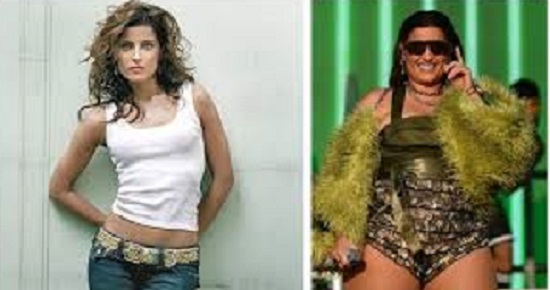
made her seem like an aspiring female Elvis. If she doesn’t want to work to keep in shape, swell: then she should make recordings and stay off the stage.
Oh: and if social media upsets you, then stay off social media. Complaining about that is like deliberately jumping in a pool of piranha and being indignant that you were bitten.
 Ethics Alarms
I’ve never heard of Alana, nor saw a performance. What you said about Elvis and other stars does it apply to Alana? Did she once have good looks and let herself go?
Take a look at her Instagram, and compare that to the photo in the article.
Based on their names, I don’t think that’s the same person. Stage names are a thing, though, so I could be mistaken. They appear to have different Instagrams, though.
The link that you showed really doesn’t show that she has let herself go.
No, it doesn’t really apply to Alaina. She gained a bit of weight after her child was born, but still looked lovely. If she had just complained that fans were expecting too much of HER, I wouldn’t have used her in the post. But he wrote about “body-shaming” performers in general, and in general, fans who watch performers have a right to expect the ones welling their appearance to maintain that appearance.
You can get great or horrible food at a hole-in-the-wall restaurant, and great or horrible food at an opulent one. If you’re after good food, the food is what you hopefully focus on. If you’re after good singing, Fats Domino, Aretha Franklin, and Luciano Pavarotti, perhaps, but don’t put them all in on the same bandstand at the same time. And if you can’t simply avoid the performances that feature an overweight person, for some reason, and you feel the need to publicly shame them, although you don’t have my support, you can shame with the knowledge that a few good people have your back…
To make sure I understand you correctly, Jack:
Does that all sound right?
Even if we assume that performers should look appealing as an ethical duty to their fans, as opposed to a pragmatic means of continuing to fill auditoriums, is there no ethical obligation of fans to express their disappointment in a respectful manner, or to consider the human limitations of the celebrity they’re talking about before criticizing them?
That’s all just in general. In this specific case…
I think that Alaina’s detractors must have very narrow standards for attractive body shapes, because she looks well within the parameters of conventionally attractive humans as far as I can discern. I agree with her that it is a bad habit for humans to be imposing unrealistic standards for appearance on each other. Shallow and selfish people inflict much unnecessary grief. If you take care of your health and your hygiene, and develop empathy-related skills like fashion and presence, you’ll do fine. If you want to physically alter your body, it should be because of what you want, not because of what other people want you to be.
Meanwhile, you can certainly have opinions about other people’s appearances, but even when you’re paying them money because of those appearances and feel justified in voicing criticism, it’s important to be respectful and know that for them to implement your feedback can come with costs you’re not privy to. If you don’t like it, you can vote with your dollars and find someone else to ogle, because there’s always more out there.
Alas, beauty is among the many things that do not last indefinitely in this world. You get to decide if you still enjoy the music.
This is a dishonest arguing technique, EC. No, that doesn’t sound right.
You got my position 100% wrong, and I could not have been clearer. If a performance artist builds their brand and appeal based on their appearance as well as their talent, then they have as much of an obligation to maintain one as the other. Beauty and sex appeal becomes part of the package, because it’s part of the appeal and entertainment value. Britney Spears is selling her sexy appearance and dance moves along with her music: if she gains 50 pounds, she has reduced what her concert fans are getting for their money, and they have every right to complain. Did you not get the Elvis analogy? Elvis was famous because of his gyrations and physicality as well as his singing. Fat Elvis was simply not as entertaining as fit Elvis.
Nobody body-shamed singers Rosemary Clooney or Barbara Cook when they got fat, because their appearance was was tangential to their appeal.
The politeness issue is a straw man. Alaina condemned criticism of her weight, not the manner of its expression.
And yes, I would call her a minor offender, unfairly maligned. She was a tiny bit out of shape after having her baby: she still looked great. But the performer defines her brand and if a certain level of beauty is what she leads fans to expect, that’s her choice and her responsibility to maintain.
Thank you for clarifying. The original post focuses a lot on scorn and less on nuance, so I honestly wasn’t sure where the limits of your condemnation were. However, I didn’t want to assume the extreme impression I got was accurate, which is why I asked. Paraphrase-and-confirm is a good habit. In this case, it revealed that not only was I wrong, but that we agree on some major points.
My only followup question would be what criteria we would look at to tell whether a performer uses their appearance as part of their brand (the promise they make to their fans).
My default position is that as long as fans get what is advertised, they’re not being misled, and they can decide if it still appeals to them. Fans don’t owe performers any loyalty (and I’m undecided as to whether fan loyalty is healthy or not; maybe it depends). Performers should take that into account when they identify what their fans want and decide how much effort to put into delivering it.
Taking care of our bodies is an ethical imperative. Growing up Catholic, we were told our bodies were not to be defiled as they were “the Temple of the Lord.” That’s good doctrine. Would that tattoos were still only worn by a few military and naval veterans and mechanics.