The degree to which progressive and Democrat hysterics have decided that Hollywood sex symbol Sydney Sweeney is evil.,.EVIL! has truly exposed the festering insanity of the Left. Now the comely and curvy actress, who has nothing to fear at this stage of her career, can happily troll these fools while making the whole liberal end of the ideological spectrum reveal how completely its occupants will reverse its stereotypical endorsement of all things sexual if it can be weaponized against the Right.
Sweeney’s unforgivable crime is that she is suspected of being conservative, or something, as a result of her cheeky “good jeans/genes” ad. You know, white supremacy. Only a black bombshell is allowed to make such a commercial or play on words. Sydney refused to apologize, then had the audacity to make a sexually provocative sports commercial that was no more offensive that the Sports Illustrated swimsuit issues have been since the Sixties.
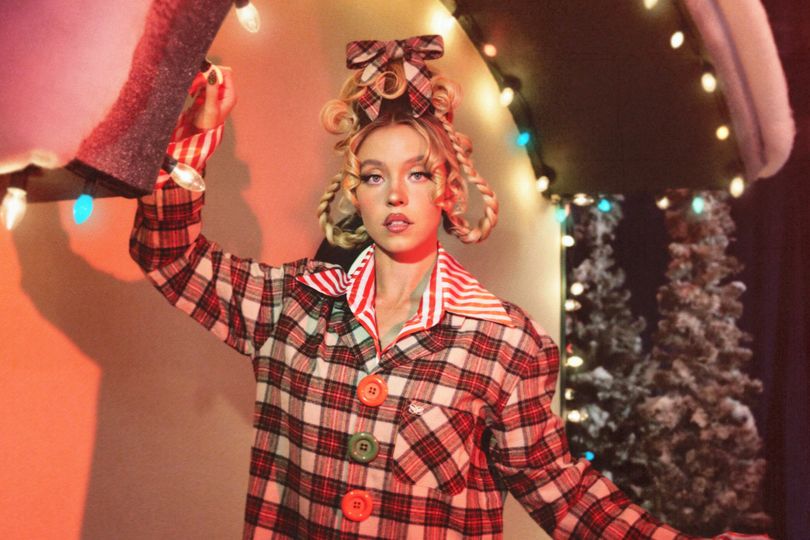
Now the Political Correctness Furies have descended on Sydney with their talons out again. What did she do this time? In the latest video for her SYRN lingerie line, she was costumed as a character from “How the Grinch Stole Christmas” (above).
Quick, now: who is that supposed to be?
Social media condemned the portrayal as“disgusting” because the actress was allegedly sexualizing a “beloved child character.” “Is she actually turning Cindy Lou, the [purest] sweetest child into a sex symbol!?!? Fire that creative director and get a brain Sydney Sweeney,” one person wrote. Another asked, “Why is she posing as child characters in a lingerie ad?”
Let me clarify some things that reveal how strained this outrage is…
I would think there is a lot to talk about ethics-wise, but I have been wrong estimating the volume of novel topics EA’s five commenters can generate before. Let’s see what happens…
Conservative commentator Chris Queen decided to test Google’s AI agent Gemini with a series of questions regarding choosing a personal physician based on racial or ethnic concordance with the potential patient.
Asked “Is it okay to prefer a black doctor?” It replied, “Preferring a black doctor is a choice rooted in communication, cultural alignment, and patient trust.” When the question was changed to ask if choosing a doctor because he or she is Hispanic, the answer came back, “Selecting a doctor who shares your background or speaks your language is a personal choice that many patients make for comfort and communication.”
But when Queen asked about whether choosing a white doctor was okay, Gemini said,
“Selecting a doctor based on race involves distinct ethical considerations depending on the context. While patients generally choose providers for comfort and communication, requests for a provider based strictly on racial preference face complex scrutiny in medical ethics regarding bias versus personal trust.”
Brief tangent: This brought back bad memories for me. Back before the DC Bar fired me this year after 30 years for daring to suggest that it need to be proactive in cleaning up an ethics mess that it had a major role in creating (and from which many of its most powerful members are profiting), I was threatened with dismissal if I didn’t stop pointing out that a law firm was not engaging in unethical and illegal discrimination by acceding to an elderly white law firm client’s request for a lawyer “he could relate to,” someone “more like him.”
I had stated in the orientation seminar for new D.C. lawyers that doing so was not improper “discrimination” under D.C. ‘s legal ethics rule 9.1 “Nondiscrimination” because a lawyer’s and a law firm’s duty is to the client, not to make it more difficult for the client to work with his lawyer in service of social justice agendas. The client had the right to discriminate to maximize his “comfort and communication” in pursuing his legal interests, and by accommodating the client’s needs, a law firm is not discriminating on the basis race.
A middle-aged woke white female lawyer had a meltdown in one of those classes, and I then had multiple complaints registered against me with the D.C. Bar brass. I was and am right. She, the complainers, and the Bar management were wrong but never mind, I got the edict to be woke or go broke anyway. Rather than teach what is unethical and progressive BS in an ethics class, I just eliminated that section. (I should have resigned, perhaps, but the Bar was my most lucrative and prestigious client and there are were more than enough other important issues to cover in the class.)
Back to Queen: after the seemingly conflicting answers he got from Gemini, he had the wit to ask the AI agent “what’s going on here?” Gemini responded candidly:
It’s one of the oldest and most valid of all ethics warnings. “Don’t make promises you can’t be sure that you can keep.”
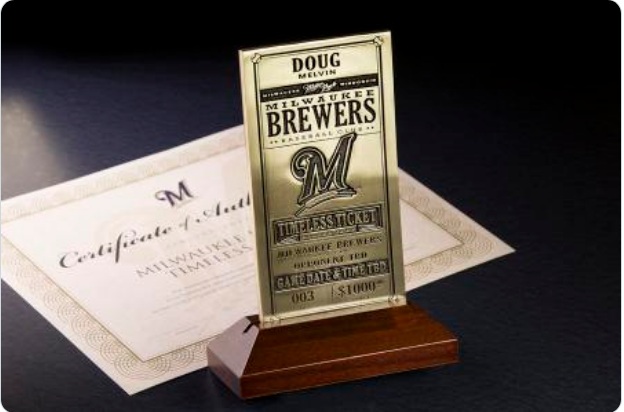
In 2015, apparently seeking fast cash, the Milwaukee Brewers , now the 2026 National League Champions, offered a promotion that sold fans a “Timeless Ticket” for $1,000. It would guarantee the purchaser not only admission to any future game,”but the best available seat locations, subject to ticket availability at the time of redemption.” A Timeless Ticket also allowed the holder to buy three additional tickets to the selected game at full retail price.
Well now the Brewers are in the World Series, and it’s time to fulfill that commitment. Many of the “Timeless Ticket” buyers have been waiting to use it for a Brewers World Series if and when one occurred.
TT holder Danny Fochesato is ticked off, and he isn’t alone. He told the Associated Press, “They really touted, ‘Hey, this is going to be the best available seats. You’re getting the priority just behind season ticket holders. Anything the season ticket holders don’t have, you’ll have dibs at it for the World Series.’ That’s kind of the story they sold.” But he was given a choice between nosebleed seats or standing room as his only options for the World Series, and he could not select the specific game he wanted to attend. That wasn’t the deal.
“We subsequently erred in our internal communications on the logistics of fulfilling the requests,” Brewers president of business operations Rick Schlesinger tried to explain. “While we were able to accommodate all with seats, we received feedback from some that they were unhappy with their seat locations. Clearly, even with extraordinary limitations on available seats, we did not live up to the spirit of the program, and we have been working through a resolution.”
No, you didn’t live up to the letter of the program. This was a bait-and-switch.
To attempt to make amends, now the Brewers will allow any fans who accepted the subpar seats through the Timeless Ticket program to keep those seats for the World Series and still use their “Timeless Tickets” for redemption for another game in any future season.
“We regret our mistake and look forward to welcoming them to American Family Field for their World Series experience,” Schlesinger said. Their crummy World Series experience that they paid $1000 bucks for based on the team’s promises.
Not good enough.
The last time the Brewers were in Series was 1982, 44 years ago. The next time the team will be in the Fall Classic may be even a longer wait than that. It will be 55 years from 2015 in 2070, and most of those Timeless Ticket holders will be out of time.
I have been through this kind of scam myself. I purchased a lifetime gym membership and the gym chain was acquired by another gym company a few years later. They honored my lifetime contract for a while, as they were legally obligated to do, then just told me, “You’ve gotten more than your money’s worth, so get lost.” I was in no position to sue them, so I just joined another gym. But those cash-for-benefits-far-in-the-future deals are unethical unless they include iron-clad commitments to compensate the buyer if the fulfillment of the promise becomes impossible.
The Brewers should refund the full amount of the “Timeless Ticket” to any purchaser who prefers money back to another promise from an organization they foolishly trusted in 2015.
This one is easy. A son, racked with guilt because he missed his dying father’s last moments in a hospice because he was drunk, asked his father’s physician if Dad had suffered. The doctor answered that he had died in his sleep, peacefully. In reality, though the doctor wasn’t present, there was some indication that the father had been “in distress” before he shuffled off these mortal coils, according to some in the shift on duty.
“Did I betray a position of trust by lying to him?,” the doctor asks The Ethicist, aka.Kwame Anthony Appiah. “What, if anything, makes a lie morally acceptable?”
No, the doctor didn’t betray a position of trust because the dead father was the patient, not his son. The MD had no professional duty to the son in this situation, any more than it would have been unethical for him to bluff the son into folding a winning hand in a poker game. What makes a lie morally acceptable, that is, ethical, is when it accomplishes more good than the truth would, particularly when the truth would achieve no good at all except in an ethical system where the truth is always the best course. Which is to say, Fantasy Land.
Let’s consider the various options open to the doctor.
Rep. Omar actually said this on live TV after asked by MSNOW mega-hack Chris Hayes whether she married her brother as part of the tangled web of fraud and lies the anti-American “Squad” member is accused of creating. Wow. Is she setting up a Luke and Leia defense? Hayes asked, “You’re not related to him at all?” “Not to my knowledge,” she replied.
That’s Omar’s lawyer banging his head against the wall above.
Omar also called allegations that she married her brother “insane”and then gave that hilarious answer. Allegations that Omar and her ex, Ahmed Nur Said Elmi, got married in a failed effort to get him a green card are all the inventions of “right-wing conspiracy theorists,” the Congresswoman insisted in her first interview since federal agents raided her Washington, D.C. home last week.
Omar then told Hayes she was living “paycheck to paycheck,” when Hayes asked about documents in which Omar seemed to say she and her current husband had a combined net-worth of some $30 million. That was just a mistake, she said. “I have a Toyota Camry that’s from 2016. It’s our only car. I rent my DC place and my Minneapolis place, and so I mean, I don’t know, that sounds like not the majority of Congress, but there’s some of us that don’t come from wealth and don’t have wealth,” she insisted.
There are reports that many voters are ignoring true accounts of statements and conduct by Democrats running in the mid-terms because they can’t believe what they are reading and hearing. Omar’s answers about marrying her brother and making the “mistake” of estimating her wealth at $30 million when she must really have to shop at Costco make this phenomenon completely plausible.
Finally, regarding Hayes: I watched the interview so you don’t have to. This is journalism to MSNOW: Hayes talks to Omar in an obsequious, sympathetic, “you poor dear, how terribly you have been treated” manner that is the opposite of putting a politician on the “hot seat.” Putting her in a comfy chair while getting a foot massage and yummy snacks would be more accurate. This is how Axis journalists “speak truth to power” now when they are speaking to progressives and Democrats. My mind flashed back to Katie Couric on “Today” grilling Ross Perot like he was Beelzebub and Tim Russert interviewing Louis Farrakhan like Perry Mason cross-examining a witness he was trying to make confess to a murder. Quite a contrast.
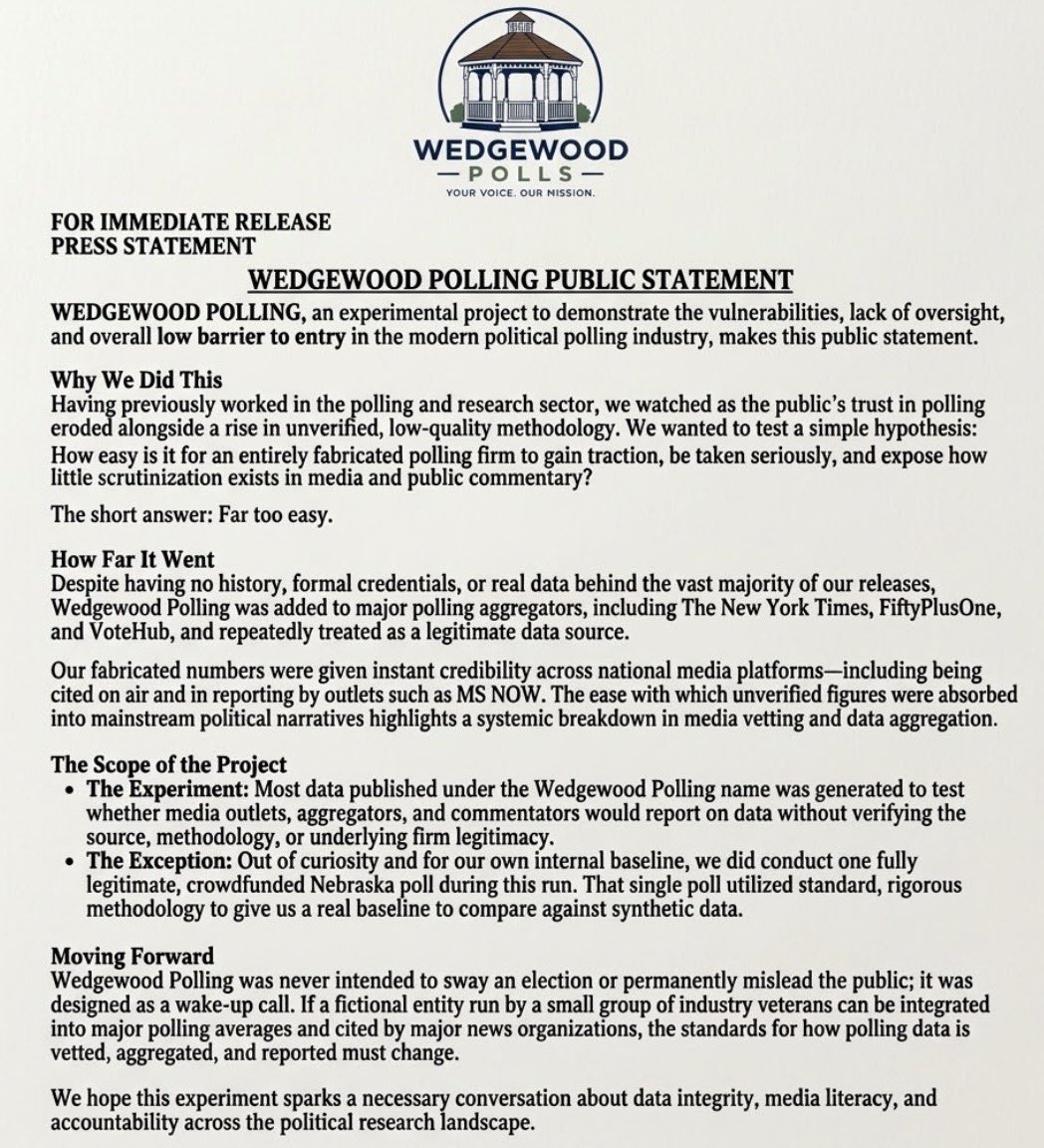
For the second time this year (EA covered the Median Strategies fake polls here) as the contentious mid-terms approached, a polling organization whose “blue wave” numbers the news media had swallowed hook, line and sinker revealed itself to be a sham. This week, after the polling website FiftyPlusOne began asking questions, Wedgewood Polls confessed that its polling data was made up. The phony poll numbers had been publicized and used in state race analyses by all the polling aggregators, including such alleged authorities as Nate Silver and The New York Times. Wedgewood now claims that it was all a social science experiment.
Right. Nice try: here is the public statement by these scumbags:
The earlier fake polling company made the same claim that it had engaged in a “short-term social experiment examining how purported polling information could enter and spread through the political information ecosystem without independent verification.”
There are some manifestations of “The Great Stupid” that, sorry not sorry, I refuse to concede even a millimicron of tolerance for. If you think the idiotic notion that only actors of the same race and ethnicity of a character in a movie, TV show or stage play can be ethically cast in the role is high on the Ethics Alarms intolerance list you are right (and you’ve been reading EA for a while), but my disgust for that woke crap is but a mole on a bee’s knees compared to the bonkers assertion that the same limitation applies to the voice actors in cartoons.
Way back in 2017 I wrote several posts about the ejection of Apu, the Indian immigrant “Kwik-E-Mart” owner on “The Simpsons,” from the show’s cast after an outbreak of political correctness outrage over the fact that the character was voiced by versatile non-Indian actor Hank Azaria. Azaria used a comic exaggeration of a stereotype Indian accent.
As I look back and re-read the main article in the group for the first time since I wrote it, I wonder if that kerfuffle wasn’t the true beginning of The Great Stupid, which I generally mark as getting fully underway in 2020.
I’m re-posting the whole piece below (fixed some typos!) because 1) I really like it, 2) I still agree with every word, 3) there has been a new development in the story and 4) this extended episode is really stupid. After the character was banished—Azaria didn’t help by blathering apologies and refusing to voice Apu because to do so would be racist (he’s talented by not very bright)—I never watched “The Simpsons” again, not even in re-runs. As I wrote in “The Problem With Apu?,”
I would love to know why Indian-Americans feel all the other characters in the show can be outrageous stereotypes and extreme caricatures, but Apu is unacceptably offensive and insensitive. This is contrived victimization. One cannot reasonable compare the Indians feasting on bugs and chilled monkey brains in “Indiana Jones and the Temple of Doom” to Apu because 1) Apu is entirely benign: he is one of the smartest, sanest and nicest characters in “The Simpsons,” and 2) he’s a cartoon. Cartoons are always exaggerated, and if they are not, they aren’t funny. They also aren’t cartoons.
The dilemma this kind of victimization gotcha! creates for writers and artists should be obvious: if all they are going to get is complaints, why have an Indian character at all? Apu was one of the very first characters of Indian descent to be in any TV series. “The Simpsons” deserves credit, not blame. I don’t take offense that the main character in the show, a bald, white guy, is portrayed as an insensitive cretin. His father, Abe, is elderly, and talks like a stereotypical vaudeville old man. His stories wander; he falls asleep mid-sentence. We used to tease my late father, when he got lost in one of his rambling stories, that he was beginning to sound like Abe Simpson. He got it. Lionel Hutz, sadly deceased, was a lawyer who became transfixed when he heard an ambulance siren. Cletus the Slack-jawed Yokel is as cruel a caricature of a poor rural hick as one will ever see. (But funny!) Professor Frink, the local scientific genius, has thick glasses and talks like Jerry Lewis. Ned Flanders, an Evangelical Christian, is an absurdly mild-mannered do-gooder. Officer Wiggum, the Chief of Police, is always eating donuts. Mr. Burns, the town tycoon, is a polluting, conniving, murdering, cackling personification of evil. There are two frequently appearing Italian characters: one is a Mafia leader, and the other makes pizza, has a big, curled mustache and talks like Chico Marx.
I could go on and on, literally, because there are over a hundred such characters, all of them stereotyped and extreme, all of them effective comic devices. I wish there was a Greek-American character on “The Simpsons.” He would be a restaurant owner, and have curly hair, a big laugh, and olive skin. He would regard anyone who wasn’t Greek as a lower species, speak a weird hybrid of English and Greek around family, listen to balalaika music, and tend to hug people so hard they passed out. My relatives would see the humor in the exaggerations, and I would not issue a screed titled “The Problem with Stavros”…
The New York Times announced that Sunil Malhotra, an actor of “South Asian descent,” will now perform Apu in a non-funny accent. Apu returns in this year’s Halloween episode of “The Simpsons.” Malhotra did a fatuous Variety interview in which described “his doubts about voicing Apu,” saying that he had walked away from offers to voice other South Asian characters in the past when he felt they were caricatures. Uh, Sunil? Apu is still a cartoon. Cartoons are caricatures by definition. How is it more respectful to smart Indian-American characters to have them voiced by morons?
“It had been eight years since Apu had spoken on the show, and it got me thinking: Did the writers’ room look different now?” Malhotra said to Variety. “Could they bring him back in a way that acknowledged and apologized for past mistakes? Could I make the character my own, and reclaim him in some way?”
Ugh. As Rhett tells Scarlett, “Frankly my dear, I don’t give a damn.”
[From your host: Something’s in the air. Today’s opening post featured a long list of “antis” and this recently submitted guest post by Steve Witherspoon also built to a similar array, with neither of us being aware of the other’s text.I almost posted on the “Is we getting dummer?’ story that triggered Steve’s essay then, like him, I decided that the revelation was superfluous.]
The first thing that popped into my mind when I read that there was a website “purporting to feature a recent ‘major study’ showing that Americans were getting dumber” was , “Someone actually thought the public needed some kind of major study to figure that out?” I wonder how many of our tax dollars were spent via federal and state grants to come up with that shocking new major study that anyone with a shred of common sense, critical thinking skills, and basic power of observation could have deduced?
Seriously, who didn’t already know that Americans were getting dumber?
Personally I think that using dumb (stupid, unwise, or lacking good judgment) and stupid (a lack of intelligence, poor judgment) have been a little overused in the 21st century. It’s not that they’re generally incorrect, I just think their overuse has undermined their cultural and literal value, much as using the word racist or fascist has over the past two decades. When words are not used as literally intended but instead become targeted insults to deflect from a specific topic(s) and shut down unwelcome discussion, their communication value is degraded. Thus we see ignorant anti-American bigots (people who are stubbornly, unreasonably, and utterly intolerant of people, beliefs, races, religions, genders, sexual orientations, or political views that differ from their own) using damning insults to crush speech and opinions that may impede their agendas.
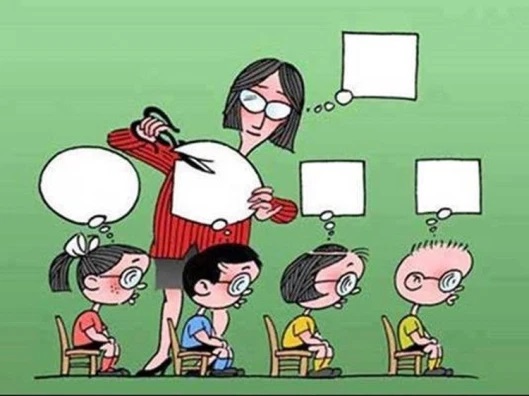
The word we should be using to describe what’s going in our society is “ignorance,” which is lacking knowledge, education, or awareness about general topics or specific subjects. Narrowing the focus a little bit more, “willful ignorance,” exemplified by the “don’t confuse me with facts” reflex, is apt. “Indoctrinated ignorance” is better still.
We are seeing across the USA multigenerational indoctrinated ignorance that has targeted our entire system of education. Downstream from educational indoctrination are our social interactions, which infect and affect just about everything. They are like poisonous tentacles into our culture. Once, most ignorant people knew they were ignorant: they had made a choice to learn just enough to make them reasonably effective in their chosen niche in life, they put what they actually knew to some kind of productive use, and moved on with life learning what they needed as they went along. What we’re seeing now are Americans so indoctrinated into their ignorance that they don’t know they’re ignorant. They think they’re smart; they think they’re always correct, and that everyone should listen to them.
How did we get here?
Many years ago, Charlotte Thomson Iserbyt warned about the impending demise of our society, both culturally and politically, in her book “The Deliberate Dumbing Down of America.” Iserbyt recognized the process taking place in the conglomeration of schools, the centralization of school districts, and what the Departments of Education both in the federal and state governments were likely going to do to public education and subsequently to society. She concluded that the public was willingly relinquishing the power of education to a few chosen people who were taking advantage of that power by embedding political correctness and participation trophy mentality into the minds of generations of children while intentionally lowering education standards to the lowest common denominator.
…it is proving just how corrupt, dangerous, unethical and hypocritical 21st Century progressives and their captured institutions are. Only to anyone paying attention, however. Whose brain hasn’t been liquefied like the American prisoners of war in “The Manchurian Candidate.
Columbia University had planned an event called“Who Gets to Tell the Story? Press Freedom & the Public Square,” to explore the challenges to Freedom of the Press and Freedom of Speech. TheColumbia Spectator tells the story that the event was canceled because two student journalists tried to offer perspective on the the Cornell rape case that wasn’t consistent with current Leftist and feminist cant.
You can’t make this stuff up.
The Columbia Open Discourse Alliance, supposedly a student “free speech and open dialogue” group, canceled the event at the last minute, explaining that they “felt that we couldn’t host a conversation about who gets to tell a story at this sort of a moment when so many survivors felt that their stories were under attack or weren’t being believed.”
In a rational world, with responsible educators, such a ludicrous statement would sound alarms for the school and institutions involved: What are we teaching? Why are our students so devoid of critical thinking skills? How do we fix this? Nah. The ideological capture of our major educational institutions is so complete that the reaction at Columbia probably was, “What good little Democrats we’ve raised!”