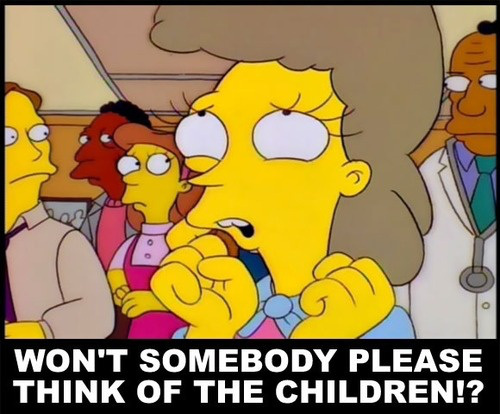
The “Unacceptable Word” Fiasco: OK, Now I Really Want To Know How Many Progressives Seriously Endorse Stuff Like This?

I just received an email from the Democratic National Committee urging me to protest Betsy DeVos’s (completely valid and overdue) withdrawal of the “Dear Colleague Letter” by which the Obama Department of Education pressured universities into dispensing with due process when a male student is accused of sexual assault. “Tell Trump and DeVos not to undo President Obama’s policies to combat sexual assault on campus!” it bleats. The e-mail blast (if I ever find out who put me on this list, there will be blood), quotes DeVos, as if this advances their case, as saying, “If everything is harassment, then nothing is harassment.”

The Education Secretary was exactly right, and a story today from Reason shows why.

Joshua Zale, a student at Moraine Valley Community College, was asked by his drama instructor to play a pimp asking for money from another student, playing the role of a prostitute in an improvisation exercise. Improvisation means that the actors work without a script. In the process of the improv, Zale used an “unacceptable word” according to the instructor, who was apparently improvising the role of a fool. The teacher immediately reprimanded Zale, who later insisted on a private meeting to learn why he had been attackedfor using a word he felt was consistent with  the role he had been assigned.  Assistant Dean Lisa Kelsay subsequently accused  Zale of violating Title IX—the weapon of choice in the “Dear Colleague Letter”—and school conduct policies by sexually harassing his acting partner “as a woman.”

No one has yet divulged what this “unacceptable” word was. I have taught improvisation. I am a pretty creative guy, with a fairly extensive vocabulary. I cannot imagine any word, from Pneumonoultramicroscopicsilicovolcanoconiosis to supercalifragilisticexpialidocious to Bill Maher’s favorite, cunt, to “penis breath,” uttered by a child in the opening minutes of “E.T.”, that would be “inappropriate” in an improv, especially in a scene involving a sex worker and a pimp.

As you know, ethics stories often remind me of TV shows and movies. This one (see the video clip above)  reminds me of a famous “MASH” episode, “The General Flipped At Dawn,” in which Harry Morgan, later to play lovable, crusty old Col. Potter, played an insane general. Reviewing the MASH squad, he asks Radar, “Where are you from, son?” Radar answers, “Iowa, sir..” only to have the General scream, “NO TALKING IN RANKS!!!!”

Maybe the improv instructor, Craig Rosen, flipped too. That would be an excuse, at least. But how do you explain the Assistant Dean? Continue reading →

Morning Ethics Warm-Up, 9/8/17: Hybrid Topics! CNN, Hillary, DACA And More…

Good morning, all.

1 The Public Interest Legal Foundation, a conservative non-profit public interest group that focuses particularly on voting issues, claims to have data suggesting that Hillary Clinton’s narrow win in New Hampshire in the 2016 election—about 2,700 votes gave her the state—may have been achieved by fraud. A study showed that more than 6,000 voters in New Hampshire had used the state’s same-day voter registration procedures to register and vote.  The current New Hampshire speaker of the House, Shawn Jasper, sought and obtained data about what happened to these 6,000 “new” New Hampshire voters who showed up on Election Day. Most of them are no longer in the Granite State. Only 1,014 have ever obtained New Hampshire driver’s licenses. Of the 5,526 voters who have not, just 3% have registered a vehicle in New Hampshire.  70% of the same-day registrants used out-of-state photo ID to vote in the 2016 presidential election in New Hampshire and to utilize same-day registration.

All of which suggests that it would be prudent if a group other than a right-wing advocacy organization did an unbiased and objective study.  Since Democrats won several top races last year along thin margins, notably Maggie Hassan defeating Kelly Ayotte in the U.S. Senate race by 1,017 votes, some Republicans are claiming that out-of-state voters illegitimately tilted the election. Of course, for all anyone knows, the same-day voters may have voted Republican. The episode does compel three conclusions:

  • Same day registration is a recipe for chicanery. I am suspicious of any elected official or activist who supports it.
  • The Democratic/ mainstream media cant that there is no voter fraud is incredible on its face, and manifestly dishonest.
  • The nation’s lack of eager, objective investigators without partisan agendas is crippling. I don’t believe what conservative sources and pundits conclude about the New Hampshire vote, and I find the lack of interest the liberal national mainstream news media seems to have in the story— on Google, I see New Hampshire sources and conservative sources like Breitbart, BizPac, Fox and the Washington Times—gives the story more credibility, not less.

2. For those who are still having trouble accepting that the DACA was an illegal measure as executed by President Obama, I highly recommend the article by Constitutional law expert Jonathan Turley, who explains why he regarded it as “a flagrantly legislative act by President Barack Obama.”  So did I, but he’s a legal scholar and I’m just a lawyer. From an ethics perspective, my area of expertise, I’m still disturbed at the attitude of the supporters of this Obama’s end-around the Constitution (and others). which can be summarized as, “Let’s see if we can get away with it, because we like the results.” It translates into “the ends justifies the means,” and epitomizes the drift of the Left toward totalitarian methods and philosophy. Continue reading →

From The Ethics Alarms “Law vs Ethics” Files: The Deadly Hexes Of Sally Quinn

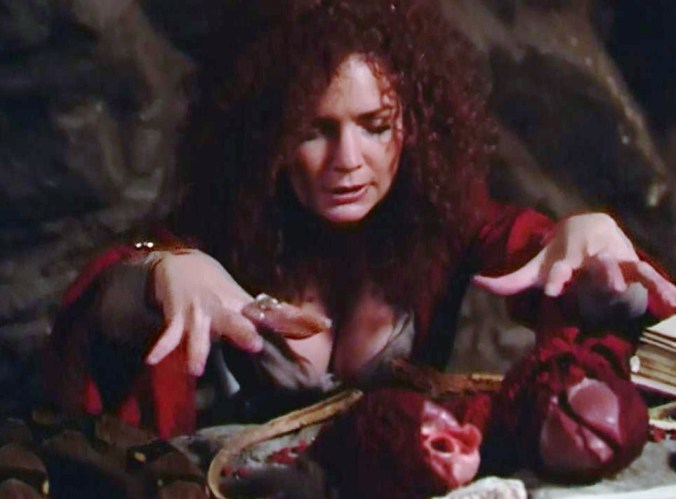
In a newly published memoir, Sally Quinn, the famous journalist who married iconic Washington Post editor Ben Bradlee and became a D.C. society matron, then a religion columnist, reveals a lief-long obsession with mysticism and the occult. Ouija boards, pentagrams, witchcraft, charms, spells, seances, messages from the dead (like Ben), voodoo, the whole thing: Quinn writes that she has had an  “epiphany” revealing that “believing in magic is as legitimate as any religion or faith.”

I’ll buy that. I wouldn’t say that the next step is an application to Hogwarts, however.

So these are the people who presume to tell Americans what to think, eh? Good to know.

But I digress. In a recent Washingtonian Magazine profile contrived to puff the release of  “Finding Magic,” Bradlee’s widow says that she not only believes in hexes, she’s used them. And they work!

She reveals that, in her less mellow days, she put hexes on three people who promptly wound up having their lives ruined, or ended.

The first, cast in 1969, was spurred by old-fashioned jealousy. Some exotic beauty at a Halloween party inspired lust in Quinn’s beau at the time—and then killed herself just days after Sally cast her spell.

Her second victim was Clay Felker, the longtime editor of New York magazine who oversaw a brutal profile of Quinn in 1973, just before her catastrophic debut on the CBS Morning News. Quinn hexed Felker not long after flaming out at CBS and returning to Washington. “Some time afterward, Rupert Murdoch bought New York magazine in a hostile takeover, and Felker was out,” she writes. “Clay never recovered professionally. Worse, he got cancer, which ultimately caused his death.”

Target number three: a shady psychic who, the autumn after Quinn Bradlee was born, ran afoul of Sally’s maternal instincts. The woman dropped dead before year’s end.

This raises a classic ethics question that I nearly posed today as an Ethics Quiz. I didn’t, because I know the answer and have no doubts about it. (If it’s an ethics quiz, I at least have doubts.) The question would have been:

Ethically rather than legally, is there any difference between Sally Quinn and a murderer?

The answer is no.

I’d say that the first two victims make her the ethical equivalent of someone who is guilty of manslaughter, and the last one, after her first two hexes led to her targets’ deaths, was, again ethically rather than legally, premeditated murder.

Sally says that after the psychic dropped dead, she swore off her Death Hex. That’s admirable. The fact remains, however, the while believing an instrumentality would lead to harm when employed against specific individuals, she employed it, got her desired results, and believed that she was the cause of their subsequent deaths. She also doesn’t express any remorse or regret. Continue reading →

Comment Of The Day: “Deferred Action for Childhood Arrivals (DACA) Ethics”

I am very grateful for veteran commenter Extradimensional Cephalopod clarifying explanation regarding how and why adversaries on the “dreamer” issue so often talk past and around each other, with never the twain meeting. The first I heard of the “Honor vs. Compassion schism” was in this 2009 essay in The New Criterion by James Bowman. I should have referenced it before. He wrote in part,

Compassion is a virtue, but it is a private, a face-to-face virtue which almost invariably ceases to be one when it takes on a public dimension. An act of compassion by a government, in the full glare of publicity, is not a virtue but a bid to be given credit for moral superiority.

Bingo.

Here is Extradimensional Cephalopod‘s Comment of the Day on the post,Deferred Action for Childhood Arrivals (DACA) Ethics:

It’s a classic honor versus compassion schism. Honor represents orderly good, enforcing consistency and stability so that society may benefit from people knowing where they stand. Compassion represents chaotic good, making exceptions and doing things that cannot be expected or required so that society can benefit from such kindness. Both are necessary, but they must be balanced against each other.

Because your position is based on honor, and makes sense in that context, it’s impossible for people to rebut it in those terms. Instead, they assert that the harm allowed by not extending compassion outweighs the benefits provided by honor, or they reject the concept of honor entirely. They don’t really understand honor or the harm done by dismantling it. Maybe they never noticed the benefits of honor, and only saw its negative effects, or they were oppressed by an ill-conceived brand of honor. Continue reading →

Unethical Quote Of The Month: Simon Radecki

“You probably haven’t seen the news. Can you confirm whether or not your daughter Bridget has been kidnapped?”

–Pennsylvanian Simon Radecki of Northampton County, asking Senator Pat Toomey a question at a public town hall relating to the President’s decision to suspend the DACA.

It’s seldom one sees a deliberate breach of question and answer ethics from a member of the public (journalists breach these all the time, but they also are held to higher standards).Radecki’s question to the Senator qualifies, and is about as odious as the breed gets.

To begin with, the question was framed as a lie, suggesting that there was any report to confirm. It was also vicious, an intentional infliction of emotional distress (a tort), a plausible threat, and a direct Golden Rule breach. Nobody would want to have someone falsely report that his daughter was the victim of a crime or in mortal danger, yet this is exactly what Radecki did to Toomey. To add to the question’s unethical pedigree, Radecki dragged Toomey’s innocent 16-year-old daughter ( Ivanka Trump-hate  notwithstanding, being the child of a Republican is not yet a crime)  into a political controversy, exploiting her and employing her as a tool of partisan attack.

Nice. Continue reading →

Morning Ethics Warm-Up, 9/7/2017: Compromise, Competence, Verrit, A Congressional Jerk, And Democratic Crooks Don’t Matter…

Good Morning!

1 President Trump stunned the political world and particularly the left’s “I hate him” news media by crossing party lines and cutting a debt deal with Democratic leaders in defiance of his own hyper-partisan party. One reason they were stunned is because this is what competent Presidents do and are supposed to do in order to govern, and we have just finished eight years with a previous President who was unwilling and incapable of doing it.

This single episode doesn’t make Trump a competent President, but it does show that he is competent in at least one aspect of democratic leadership (Obama was competent at exactly two: appearing Presidential and speaking coherently), and has some guts. The demonstrated ability to negotiate and the willingness to act in the teeth of furious opposition were two characteristics that the advocates of his candidacy cited as justification for electing him.

It is also dawning on some that the structure of the DACA executive order may well be to fashion the measure as a bargaining chip to be cashed in later. This is also the kind of thing competent leaders do.

2. There is a new website called Verrit, which appears to be an openly, proudly, left-biased news source which purports to “verify” news stories, obviously based on its own progressive world view. Verrit founder and CEO Peter Daou told the news media,

“We’re in a time now where you just no longer trust anything that you’re reading,” Daou said. “Facts are now in question. Reality is now in question. So we want to do something where we rigorously vet these facts and we actually stand by our research and put an authentication code on every fact that we put up.”

And what qualifies Verrit as a fair and objective “authenticator”? Apparently it is the virtue of being hard-progressive and anti-conservative to the bone. Here is a recent Verrit collection of its “cards”:

Continue reading →

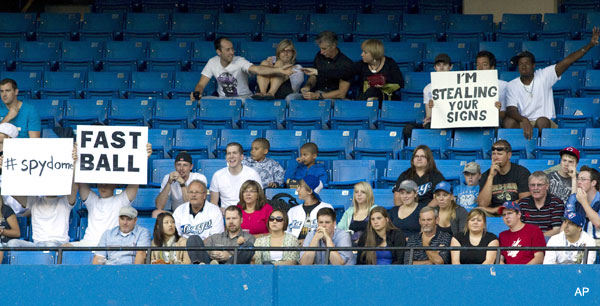
Ethics Alarms Baseball Ethics Special Report: The Boston Red Sox, Sign Stealing, Technology, And Cheating [UPDATED]

[I got the news about Major League Baseball’s announcement that the Boston Red Sox had admitted that some of the team’s employers and players had engaged in illegal sign-stealing about an hour before the Sox-Blue Jays game was scheduled. My intent was to write the post about it last night after the game. The game, however, went 19 innings and lasted 6 hours. (The Sox won, and absent this scandal, it would have been a big news story itself, one of the most important victories of the year and one that set several team records.) So the post didn’t get written, and believe it or not, I have occasional priorities and commitments that take precedent over my profit and income free ethics blog. Thus I consider the multiple e-mails and Facebook messages I have received accusing me of ducking the issue less than amusing, an unwarranted attack on my integrity. To all of those individuals, most of whom barely read the news reports, I say, “Bite me.”]

Yesterday afternoon the New York Times broke the following story, which reads in part:

Investigators for Major League Baseball have determined that the Red Sox, who are in first place in the American League East and very likely headed to the playoffs, executed a scheme to illicitly steal hand signals from opponents’ catchers in games against the second-place Yankees and other teams, according to several people briefed on the matter.

The baseball inquiry began about two weeks ago, after the Yankees’ general manager, Brian Cashman, filed a detailed complaint with the commissioner’s office that included video the Yankees shot of the Red Sox dugout during a three-game series between the two teams in Boston last month.

The Yankees, who had long been suspicious of the Red Sox’ stealing catchers’ signs in Fenway Park, contended the video showed a member of the Red Sox training staff looking at his Apple Watch in the dugout. The trainer then relayed a message to other players in the dugout, who, in turn, would signal teammates on the field about the type of pitch that was about to be thrown, according to the people familiar with the case.

Baseball investigators corroborated the Yankees’ claims based on video the commissioner’s office uses for instant replay and broadcasts, the people said. The commissioner’s office then confronted the Red Sox, who admitted that their trainers had received signals from video replay personnel and then relayed that information to Red Sox players — an operation that had been in place for at least several weeks.

As reported by ESPN, Baseball Commissioner Rob Manfred said in a statement,

“We actually do not have a rule against sign-stealing. It has been a part of the game for a very, very long time. To the extent that there was a violation of the rule here, it was a violation by one or the other [team] that involved the use of electronic equipment. It’s the electronic equipment that creates the violation. I think the rule against electronic equipment has a number of policy reasons behind it, but one of them is we don’t want to escalate attempts to figure out what a pitcher is going to throw by introducing electronics into that mix.To the extent there was a violation on either side, we are 100 percent comfortable that it’s not an ongoing issue, that if it happened, it is no longer. I think that’s important from an integrity perspective going forward.”

This is a complicated story, and part of not one complicated ethics category, but several: technology ethics, baseball ethics, cheating, and general ethics. In the interests of clarity, I’m going to cover the story in a series of short observations, each with a heading. At the end of this post, I have posted a long published essay I authored about baseball ethics within the culture of the game. Those who are not familiar with these issues, which are fascinating, might want to read that first. it is helpful background information.

Points and Observations:

  • Traditional sign-stealing in baseball is not regarded as cheating. This seems counter intuitive because of the word “stealing.” Sign-stealing refers to teams decoding the signals given by the catcher to the pitcher (regarding what kind of pitches to throw and where ), and the coach or the dugout to a batter or baserunner (in bunt and hit-and run plays). Theoretically, knowing the other team’s signals provides an advantage, as to a batter who knows that the next pitch will be a curve rather than a fastball. Usually, signs from the catcher to the pitcher are in jeopardy when there is a runner on second base. He can see the catcher’s signs as well as the pitcher can. Catchers use finger-signs in various combinations to ask for various pitches, and position their gloves to indicate where they want the balls thrown. If the runner at second can signal to the batter what the catcher has told the pitcher to throw, the batter may have an advantage.

This is why catchers often go to the pitching mound when a runner is on second base. They change the signs. The second baseman will often join them, because it is his job to know what pitch is being thrown so he can signal (usually behind his back, using his hand) to his team’s outfielders. An outside fastball makes it unlikely that the batter will pull the ball, for example.

Sign-stealing on the field, using just eyesight and hands, is what players call “the game within the game.” Joe Girardi, the Yankee manager, said in an interview yesterday that he just assumes every team is trying to steal signs, whether they are or not. Continue reading →

Morning Ethics Warm-Up, 9/6/17: Comey’s Premature Draft, Obama’s Golden Rule Breach, Newspapers “Protecting Us,”And Thank-You, Boston Red Sox


1 I want to sincerely thank the Boston Red Sox for giving me, the sole baseball ethicist on the web who also devotes a disturbing amount of his time, energy and passion to following the team, the challenge and opportunity to address a major cheating scandal involving the organization and institution I love. Seriously, guys, thank you. This is exactly what I needed to face after staying up past 1 AM watching the Sox pull out a 19 inning, 6 hour game on Hanley Ramirez’s bloop single to center.

I’ll cover the issue in the next post. Ugh.

2. Ironically, just as the anti-Trump news media was hyperventilating over the fact that the Special Counsel was examining a draft letter by the President regarding his reasons for firing James Comey (draft letters have minimal probative value if any, but you know: Trump), it came to light that in May of 2016, Comey had drafted a statement declining to charge Hillary Clinton or her staff in the State Department e-mail scandal, months before key witnesses (like Clinton herself) had been interviewed or much of the evidence had been reviewed. President Trump, of course, tweeted that this proved there was a “rigged process,” but Comey’s draft is no more incriminating that Trump’s draft. (Now, Loretta Lynch’s meeting with Bill Clinton might suggest a rigged process, but that’s another story.)

Supreme Court Justices have drafted opinions before oral argument; that doesn’t mean they can’t change their minds. It is certainly odd that Comey would have drafted a statement that Clinton would not be indicted so long before the investigation was completed. It is odder still that Hillary’s interview was not under oath, that it wasn’t videotaped, that there was no transcript, and that she was allowed to have representing her as an attorney at the session a top aide who was also a potential witness.

Professor Turley, in a column at The Hill, agrees that the early draft doesn’t implicate the integrity of the investigation, but raises a related issue:

While I am inclined to accept assurances from Comey that he did not finally decide on charges until after reviewing all of the evidence, the details from the Clinton investigation hardly support a view of a robust and dogged effort in comparison to the type of investigation of people like Paul Manafort.

In pursuing Manafort, special counsel Robert Mueller has now enlisted an army of investigators, reached a cooperative relationship with staunch Trump critic New York Attorney General Eric Schneiderman, and actively pursued tax and financial dealings far afield of the original Russian collusion allegations. He also ordered a heavy-handed (and unnecessary) “no knock” search in the middle of the night on Manafort’s home.

The Clinton investigation looks like Club Fed in comparison. Clinton and her staff refused to cooperate with State Department investigators seeking confirm any damage to national security. Key laptops were withheld and only turned over after Comey’s staff agreed to destroy the computers after their review, despite the relevance of the evidence to congressional investigations. Comey then cut five immunity deals with key Clinton staff members, including former State Department staffer, Bryan Pagliano, who set up a server in Clinton’s home in Chappaqua, N.Y., and worked for her at the State Department.

Pagliano refused to cooperate after invoking his Fifth Amendment right against self-incrimination and destroyed evidence after being given a preservation order. Those deals raised the concern over a type of prosecutorial planned obsolescence, making a viable case less likely.

The amusing part is that all of this circles back to Comey’s firing, which was justified by his handling of the Clinton investigation regardless of any other factors.

3. The New York Times today reviews a festival play called “___hole.” That’s not really the title, however, although “___hole” was printed twice as the play title before the Times made this clear. A comment by the reviewer noted that the real title couldn’t “get past the editors.” Continue reading →

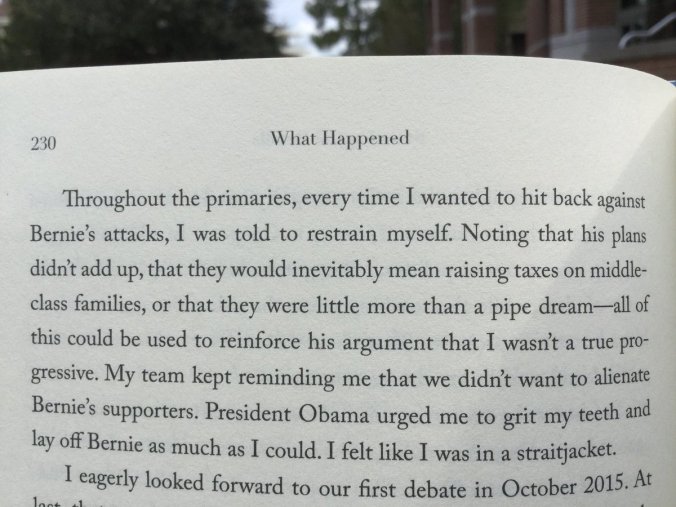
Ethics Quote Of The Month: Hillary Clinton In Her Upcoming Book, “What Happened”

You see the quote above. This is a section of one of the excerpts being doled out to the media and public to build interest in Clinton’s latest book. In the excerpt she blames Bernie Sanders, among others, for her defeat, saying that his attacks against her during the primary caused “lasting damage” and laid the foundation for “(Donald) Trump’s ‘Crooked Hillary’ campaign.”

Observations:

1 As with her earlier excerpt about how she wishes she had acted more assertively when Donald Trump was “stalking her” during a debate, Clinton displays the opposite of leadership instincts here. Although she was the one offering herself as the leader of the free world, she whines that she was rendered powerless by the advice of others and the recommendation of President Obama. Saying that she felt that she was “in a straitjacket” is simply admitting that she was indecisive and accepted the judgment of others over her own. However, that decision was hers; she was not in a straitjacket, and she is accountable for the ultimate decision to “lay off Bernie.” She can’t credibly blame anyone else.

2. Bernie Sanders was as inoffensive and respectful as opponent as Hillary could have possible drawn for the Democratic Party nomination. His obvious reason for running was to get a national platform for his far-left, Socialist positions. He was too old, he was eccentric, and he wasn’t even a Democrat. Like Barack Obama, who also ran against Hillary believing that he had no chance, Hillary’s lack of charisma, chilly public persona and inherent untrustworthiness suddenly made Sanders’ underdog candidacy viable. Nonetheless, as Ethics Alarms discussed during the campaign, Sanders never behaved as if he was committed to winning. Most remarkably (and unforgivably for his supporters), he gave a pass to Clinton on her e-mail server scandal, saying more than once that he didn’t care about her “stupid e-mails.” Since Clinton was lying about, double-talking around, spinning and ducking the issue almost daily, this was a gift that no other serious candidate would have given her. Yet she’s blaming Bernie now for not being even less competitive.

Incredible! Continue reading →

Foundation For Individual Rights In Education (The FIRE) Report: America’s Top Universities Deny Students Fair Hearings

(If you don’t know what this photo has to do with the FIRE report, you haven’t been paying attention…)

The FIRE, the heroic non-partisan non-profit that is dedicated to fighting restrictions on student speech, expression and other civil rights, has issued an important report showing how badly respect for Constitutionally guaranteed rights eroded during the Obama Administration’s embrace of the “war on women” narrative and radical feminist propaganda regarding the “rape culture” at American universities. From the press release:

“Spotlight on Due Process 2017” surveyed 53 of America’s top universities and found that a shocking 85 percent of schools receive a D or F grade for not ensuring due process rights. The schools were judged based on whether they guarantee those accused of campus misconduct 10 core elements of fair procedure, including adequate written notice of the allegations, the presumption of innocence, and the right to cross-examine all witnesses and accusers. FIRE awarded each institutional policy a grade based on how many of those elements it guaranteed.

“Most people will probably be surprised to learn that students are routinely expelled from college without so much as a hearing,” said Samantha Harris, FIRE’s vice president of policy research. “This report should be a huge red flag to students, parents, legislators, and the general public that an accused student’s academic and professional future often hinges on little more than the whim of college administrators.”

FIRE’s report found that 74 percent of top universities do not even guarantee accused students the right to be presumed innocent until proven guilty. Making matters still more unjust, fewer than half of schools reviewed (47 percent) require that fact-finders — the institution’s version of judge and/or jury — be impartial.

Additionally, 68 percent of institutions fail to consistently provide students a meaningful opportunity to cross-examine their accusers or the witnesses against them — despite the fact that the Supreme Court has called cross-examination the “greatest legal engine ever invented for the discovery of truth.”

Most universities try students under one set of procedures for sexual misconduct, and an entirely different set of procedures for all other offenses. Of the 49 institutions in the report that maintain separate policies for sexual and non-sexual misconduct, 57 percent grant students fewer procedural protections in sexual misconduct cases — even when those cases allege criminal behavior. Troublingly, 79 percent of top universities receive a D or F for failing to protect the due process rights of students accused of sexual misconduct….

The report later says that not one institution covered by the study received the top grade. Continue reading →