Fun With Rationalizations: Considering Salon’s Attack On The New York Post

post_cover-620x412

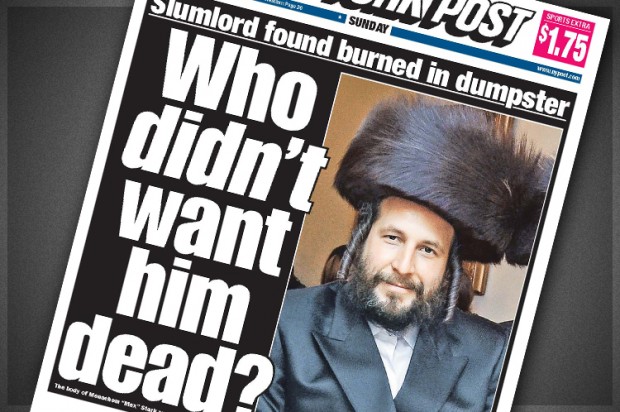
Let me dispense with the outrage over The New York Post’s brilliant (from their perspective, which is selling newspapers) and tasteless front page covering the death of Menachem Stark, a Hasidic real estate developer ( a.k.a. “slumlord”) who was found murdered and burned in a dumpster last Friday in Long Island.

The operative principle is not, as the reader who flagged the issue suggested, the Golden Rule. The Golden Rule does not often apply to the press, which is supposed to be truthful, not kind and diplomatic. There are provisions of most journalistic codes about avoiding unnecessary harm to third parties, which is pretty much a universal ethics rule in every field, from law to the military. When, however, you operate a tabloid, and not just any tabloid but a tabloid whose brand is defined by intentionally shocking, outrageous, assaultive and controversial headlines and photos, “Unnecessary harm to third parties” is almost an impossible principle to apply.

The headline is a perfect example of the Julie Principle, which I explained back in May. The Julie Principle comes into play when an undesirable or annoying  characteristic or behavior pattern in a person or organization appears to be hard-wired and part of their essence.  In judging such a person or entity, it is useful to keep the lyrics of Julie’s song from “Show Boat” (lyrics by Oscar Hammerstein Jr., music by Jerome Kern) firmly in mind, when she sings…

Fish gotta swim, birds gotta fly…

I’ve gotta love that man til I die

Can’t help lovin’ that man of mine!  Continue reading

The White House Scores A 2013 Jumbo Jumbo

There's no elephant. Do you see an elephant?

There’s no elephant. Do you see an elephant?

Just in time to make the 2013 cut-off, the White House achieved the Jumbo of the year, and simultaneously made me wonder if I am going to have to jettison all respect for my loyal Obama-supporting friends.

The Jumbo is an Ethics Alarms category lunched in 2013, designed to recognize individuals who engage in spectacular examples of unethical conduct I have always detested with a special passion: trying to wiggle out of a tight spot by stubbornly insisting that what is obviously the case isn’t really, a brazen exercise resting on the presumption that everyone else is either a dimwit or as corrupt as the speaker. The name derives from an iconic moment in Billy Rose’s 1936 Broadway musical extravaganza “Jumbo,” named after P.T. Barnum’s famous giant elephant, that starred Jimmy Durante. Caught red-handed as he tried to sneak his dying bankrupt circus’s major asset off the premises and away from creditors, the “Old Shnozzola” was confronted with a sheriff who belligerently inquired, “Just where do you think you’re going with that elephant?” Jimmy’s response, acting for all the world as if the massive pachyderm at the end of the rope he was holding didn’t exist: “Elephant? What elephant?” Another apocryphal equivalent is the old burlesque joke about the philandering husband caught by his wife as he frolics in their bed with a naked and luscious bimbo. The rake still denies anything untoward is going on, pleading, “Who are you going to believe, me, or your own eyes?” . In real life, the gold standard might be actress Lindsay Lohan’s insistence to police, when she was arrested for reckless driving and cocaine was found in her pocket, that she was wearing someone else’s pants.

The White House’s entry into the Jumbo Hall of Fame is pretty impressive, though. As figures showed that a million Americans had registered for Obamacare in December, bringing the total number to 2.1 million, well short of the 3 million goal, White House White House health care adviser Phil Schiliro told MSNBC yesterday that the frequently stated Administration goal of  7 million enrolled by the end of March, when the individual mandate (penalty, according to Democrats; tax, according to the U.S. Supreme Court) kicks in, was not really the goal after all. Continue reading

Maybe I’m Losing My Mind, But I Think Geico’s “Maxwell The Pig” Ads Are Racist

Well, not racist, exactly, since there is no such human race (yet) as “Pig Men.” If there were such a race, however, there is no question that Geico’s humorous ads would be regarded as racist and offensive. And in Geico Universe, where Maxwell the Talking Pig resides, there is such a race. Therefore the ads are racist. Right? No?

Hear me out.

This has been bothering me for a while, and I don’t think I am imagining it. If we had, living among us, anthropomorphic swine like Maxwell (first discovered being driven home by a friend’s mother and yelling “Wee wee wee!” all the way), would making not so subtle, demeaning pig references (“when pigs fly” in one commercial, “pig in a blanket” in another) be considered acceptable or civil? Clearly not. Obviously Maxwell is a minority, and obviously sensitive about being a pig. Using “when pigs fly” around him is like intentionally inviting an obese friend to “chew the fat,” or accusing a Native American of being an “Indian giver.” Maxwell gets the intent of the insult in both ads, too: “I can’t believe she said that,” he says after one swine-slur, and “I walked right into that one,” after another.

Geico laid the foundation for Maxwell to be a “harmless” stand-in for harassed minorities that the commercials couldn’t mock without serious consequences in an earlier ad, where his car is stopped by a policeman. The cop asks, “Do you know why I stopped you?” Maxwell suggests profiling. “Because I’m a pig driving a convertible?” Yes, it’s strange. The more I think about it, the stranger and more subversive it seems…

This is ridiculous, I know, but also, I think, sinister. Continue reading

The Obligation To Know Something About What You Are Writing About

Believe it or not, this isn't the most ridiculous feature of the Slate essay it comes from.

Believe it or not, this isn’t the most ridiculous feature of the Slate essay it comes from.

I am constantly being reminded of an old Bob and Ray skit (no, I can’t find it online) they did on late night TV where Bob played an interviewer of a longshoreman (Ray) who had just published a thousand page history of the U.S. that was riddled with errors. “Here, for example,” the increasingly perplexed interviewer sputtered, “you say that Abraham Lincoln was born in 1943 in Bailey’s Mistake, Maine!” Because the internet permits anyone to publish authoritative-sounding nonsense and lies without penalty, that skit seems less and less absurd with each passing day.

Even the content of supposedly legitimate, respected on-line sources cannot be relied upon , because 1) the job of “editor” appears to be obsolete, and 2) if there is an editor, he may be an ignoramus too. For example, a day after after the World Health Organization released a stunning report announcing that citizens of Greece were intentionally giving themselves AIDS so they could get health benefits, it retracted the statement, saying, through  a spokesman, “There is no evidence of people in Greece or anywhere else in Europe deliberately infecting themselves.” What happened? It was an editing error. Oh, well then… wait, what? And nobody other than the editor read the ridiculous release before falsely accusing an entire country of breeding idiots?

This brings us to this “correction” that appeared yesterday on Slate….you know, that sophisticated, erudite, eclectic online cultural  commentary magazine:

“Correction, Dec. 10, 2013: This article originally misidentified penguins as mammals. They are birds.” Continue reading

J.J. And The Chickens: When Compassion Should Trump Principle

J.J. and friend.

J.J. and friend.

This strange and infuriating news story about the autistic child who is about to lose his “therapy chickens” is yet another example of how even the best ethics practices not only have exceptions, but obvious ones. Obvious, that is, except for the muddled thinkers on the DeBary (Florida) City Council, who have decided to harm a young and vulnerable child while turning his family’s life inside out because the needs of one citizen shouldn’t be enough to justify an otherwise unwise public policy. That governing principle is undeniably true…except in this case. And since it is so screamingly obvious that the otherwise sound principle is cruel to apply in this case, it is the perfect, obvious, compassionate instance when making an exception to a rule that works 99.9999% of the time is not only reasonable, but the right thing to do. The city council in question doesn’t comprehend this. Dead-eyed petty bureaucrats seldom do. Continue reading

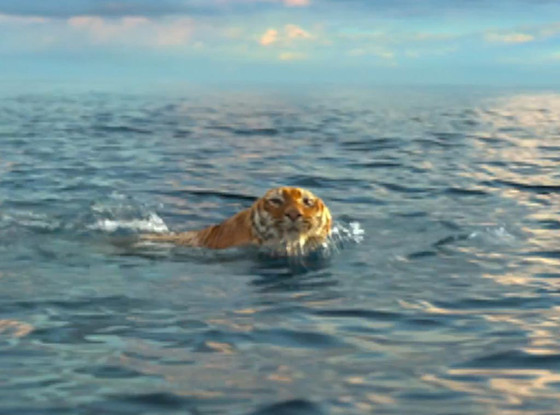
If You Are Surprised To Learn That “No Animals Were Harmed During The Making Of This Film” Doesn’t Mean That No Animals Were Harmed During The Making Of The Film, Then You Havn’t Been Paying Attention To The Ethical Culture In Hollywood

"OK, the tiger almost drowned. No harm, no foul, right?"

“OK, the tiger almost drowned. No harm, no foul, right?”

Hollywood abuses its child actors routinely, and you really believed it was kind to animals?

Today the Hollywood Insider carries a thorough exposé revealing that the American Humane Association, which supposedly monitors films for their treatment of  animals and grants the familiar“No Animals Were Harmed” trademark accreditation seen at the end of film and TV credits, participates in the covering-up of animal deaths and cruelty as much as it prevents them. The report suggests that the AHA  has been thoroughly co-opted by the industry, so that it is not an objective advocate for the creatures it supposedly represents, but a willing participant in audience deception.

The smoking gun quote may be this one, from Dr. S. Kwane Stewart, the veterinarian who took over as the national director of the AHA’s “No Animals Were Harmed” program in April:

“This whole idea that we’re cozy with the industry — it’s simply not the case. We first and foremost want to keep the animals safe…[but] we need to keep in mind that [the producers and directors of productions the AHA monitors] want to arrive at their vision as well.”

This means, of course, that the AHA representatives are not acting as an advocate for the animals, but as a participant in the film-making process that balances the lives and welfare of the animals against the concerns, needs and profit motives of the speaking, spending, threatening and otherwise powerful human beings with which they share a species and common values. Gee–I wonder who has the most weight in reaching that balance… Continue reading

Ethics Hero (Animal Lover Division): Janet Sinclair

janet+and+sedona

Janet Sinclair used United Airlines’ “PetSafe” service to fly her beloved greyhound Sedona cross-country from San Diego. The service assures flyers that their pets will make the journey safe and sound, with responsible care and personal handling. Sinclair, however, became alarmed when she saw a United employee kick Sedona’s crate six times to shove it under the shade of the plane’s wing instead of carefully moving it. She then began documenting United’s pet care. Her video  shows her dog being left outside in 94 degree heat at a mid-journey stop (in Houston), and not placed in a temperature-controlled vehicle as she had been promised. When Sinclair landed at Logan Airport in Boston, her dog was barking at death’s door.

“Sedona’s entire crate was filled with blood, feces, urine,” Sinclair told reporters. “Sedona was in full heat stroke. All of the blankets were filled with blood. She was urinating and defecating blood. She was dying, literally, right in front of me.” The veterinarian who saved Sedona diagnosed her with heat stroke, urinary tract infection and liver dysfunction, all arising from the over-heating the dog experienced during the United Airlines flight. The airline, for its part, claimed that the dog’s distress was due to pre-existing conditions, though Sinclair’s vet had declared Sedona healthy following a pre-trip exam. Continue reading

Joke Ethics, Jay Leno, And The Rats In The Pantyhose

Ugh. Come on.

Fortunately, Jay's successor is ready to go...

Fortunately, Jay’s successor is ready to go…

Jay’s ethics alarm was sure malfunctioning during THAT taping. The Golden Rule is made for situations like this. Surely Jay knew about it? Once?

Louann Giambattista, a former American Airlines flight attendant, had sued the airline in June, claiming that American had discriminated against her as a result of her co-workers’ false allegations that she carried pet rats on board planes in her pantyhose and underwear. I get it: it’s an inherently funny story.  But Jay charged over every line of fairness, respect, compassion and common sense when he showed Giambattista’s photo to his national TV audience, and then, in a repeating segment called  “Woulda, Coulda, Shoulda,” challenged three guest comics to make their best jokes about the material. They were rolling, too—some examples..

  • “If I were one of those rats, I would’ve been very upset. I prefer not to sit in cooch.”
  • “I don’t understand this woman at all. If she wanted something that creepy in her underwear, she should have hooked up with me.”
  • Giambattista “coulda used what the rest of us ladies use … a Rabbit” (a popular vibrator).

Classy as ever, I see, Jay! Continue reading

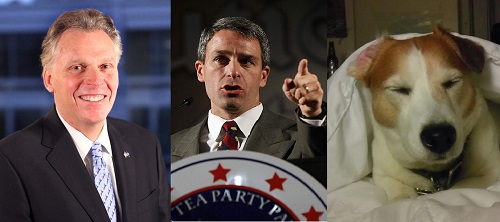
Vote Rugby Marshall For Governor Of Virginia: It’s The Right Thing To Do!

That's Rugby on the right...

That’s Rugby on the right…

Periodically,  the same contentious argument breaks out on Ethics Alarms after I assert my position that voters should support the candidate who is the most honest and trustworthy–the one with the most ethical character—regardless of his or her policy positions. My argument is bolstered when someone like Anthony Weiner—and fortunately there aren’t many candidates like him—  runs for office on the extreme opposite concept, that even demonstrably horrible character and dubious trustworthiness are irrelevant as long as a candidate holds the right policy views. He was just clobbered in his quest for NY mayor, getting just 5% of the vote, every one of them cast by a lunatic, porn star, mental defective or ethics dunce.  I doubt that his wife voted for him. Client #9. Eliot Spitzer, also lost in his race for Controller…and he is like Weiner.

My position is shaken when faced with a fiasco like Virginia governor’s race, where a proven huckster, Terry McAuliffe, is carrying the Democratic banner and Ken Cuccinelli is the Republican choice. (I live in Virginia.) That McAuliffe is corrupt to the core, like his pals, the Clintons, there is no doubt. He is pure Machiavelli, and worse, he is gleeful about it, like his pal Bill, but without the charisma. I learned all I needed to about McAuliffe’s character when I learned that he tried to bribe Ralph Nader to drop out of the 2000 Presidential race, but that was hardly the only evidence. Virginia Democrats disgraced themselves by nominating him. I wrote about his public dissembling here and here; I didn’t even go into his dubious financial dealings andthe strange way —well, if you think cronyism is strange— he got rich investing in Global Crossing—as I said, the sliminess of his character has never been in doubt.

Cuccinelli, however, is worse: he’s just unethical in different ways. Continue reading

Logo Ethics: How Insane Is Campus Political Correctness? A Quiz

Here are four logos from U.S. institutions of learning.  Each was or  is under attack by groups of students or administrators as being “offensive,” and in each case, the school’s administration either spent or is spending time and money to comply with the concerns. You have to guess the reason for the offense in each case.

Ready? Here’s number #1, from Brooklyn College:

Logo1

Give up? Well, back in 2009, we have recently learned, Karen L. Gould, who had just taken over as the first woman president of Brooklyn College, raised $107,000 to replace the old logo (the silhouette of the school’s landmark La Guardia Hall clock tower), because she thought it looked like a giant penis. [An earlier version of the post surmised that she therefore believed the logo was sexist. There is no evidence of that; it was my surmise and my error.]

She would not be happy living in Washington, D.C., clearly.

Ready for the next one? Here’s #2, from the University of Connecticut: Continue reading