Slow Loris Ethics: Great, Now Even The Smithsonian is Hyping!

Slow Loris

If we can’t even trust the Smithsonian not to lie to us, what hope is there?

The February issue of the Smithsonian magazine arrived, full of articles about origins and evolution. I immediately gravitated to the essay about komodo dragons, whose bite, as those of you who have been bitten by one know, is poisonous. In a colorful sidebar to the main article was a smaller note about the wide range of other animals that poison their victims, titled “Pick Your Poison.”

“The komodo dragon may be the newest addition to the elite corps of predators that kill with chemistry, but the venomous world is already more diverse than people realize,” it began. The note was illustrated by photos of a duck-billed platypus (owner of a leg spur with a poison gland that gives the thing quite a kick); the tiny Pacific cone snail, which can kill a human; the black mamba, the snake that had a co-starring role as an assassin in “Kill Bill, Part 2,” and…a slow loris???

The little, big-eyed, furry, cute Asian primate is venomous? That was a surprise. The article included no details, just noting that the slow loris was the only “venomous primate.” I managed to pass along this information as fact to my wife and two friends before bedtime (it takes so little to excite me these days!), and this morning dived into the web to learn the details of the slow loris’s poison. What I discovered was even more shocking than the original note. The Smithsonian magazine was hyping, and badly at that.

To begin with, there is a difference between venomous animals and poisonous ones. “Venomous” means that the creature injects toxin into its prey, through a sting, a bite, or other means. “Poisonous” means that the animal carries some kind of toxin that the prey ingests, absorbs or inhales, occasionally fatally. The Smithsonian article ignores this distinction for sensational purposes, as the title “Pick Your Poison” suggests. But the slow loris, which is definitely not venomous,. and  it isn’t really poisonous either. Continue reading

Soccer, Sports, Corruption, and Cultural Rot

Bitter rot After a moment’s reflection, I realized that it was inevitable that international soccer would be rocked by a match-fixing scandal. If I should have seen it coming, and I care as much about soccer as George S. Kaufman cared about Eddie Fisher’s social life*, then the officials of the sport should have seen it coming too.

From the New York Times:

“…A European police intelligence agency said Monday that its 19-month investigation, code-named Operation Veto, revealed widespread occurrences of match-fixing in recent years, with 680 games globally deemed suspicious. The extent was staggering: some 150 international matches, mostly in Africa, Asia and Latin America; roughly 380 games in Europe, covering World Cup and European championship qualifiers as well as two Champions League games; and games that run the gamut from lower-division semiprofessional matches to contests in top domestic leagues.”

Thus soccer, the most played, most followed, most passionately cheered of all major team sports has been rigged. It doesn’t matter that all the games weren’t rigged; what matters is that now nobody can be sure that a game isn’t rigged. How can a fan care, deeply care, about the outcome of an athletic contest when there is always a lurking, justified suspicion that victory is undeserved and that defeat is unfair? In the span of just a few weeks, we have heard the golden boy of American and international cycling admit that he was at the center of a cheating conspiracy, and that he used lies, influence and financial power to make his sport a contest of which competitor could break the rules most effectively. New revelations from Miami, meanwhile, indicate that Major League Baseball’s so-called steroid era, which supposedly had been vanquished forever, may never have gone away at all: several current stars, like the Yankees’ Alex Rodriguez and 2011 National League MVP Ryan Braun, have been linked to treatments at a clinic known for human growth hormone therapy. Big sports mean big money, and where there is big money, there will always be clever, dishonest people willing to crush laws, ethics, sportsmanship and public trust in order to get more of it. Continue reading

Yes, Putting Underpants on Michaelangelo’s “David” Is Unethical.

japan-David

So is putting a bikini on the Venus de Milo, in case you’re wondering.

The issue has been raised because a huge replica of the nude male statue was unexpectedly donated to a Japanese town, where it is unsettling some people and frightening others. Clothing “David” in a big Speedo or something has been suggested as a way to make the artwork more viewer-friendly.

Uh, no. Not all art will be welcome in every culture, and it may be that a mega-“David” in a Japanese park was a mistake. It is a work of visual art, however, and it is wrong for anyone other than the artist to alter or censor that artist’s creative work, especially when such a change renders the work of art risible. Putting underwear on “David” is as unfair and disrespectful as putting Groucho glasses on the “Mona Lisa.”

The town of Okuizumo has precisely two ethical choices, and no more: remove the statue and give it to someone else who will take care of it and appreciate it, or leave it alone.

Fruit of the Loom is not an option.

________________________________

Pointer: Lianne Best

Facts and Graphic: News.com.au


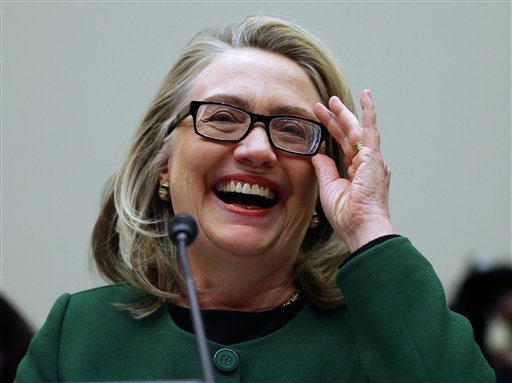
Ethics Catch-Up: The Revolting Hillary Clinton Testimony

No wonder she's laughing.

No wonder she’s laughing.

I know I neglected my duty to highlight a truly nauseating example of American political shams at their worst with last week’s dual appearances by outgoing Sec. of State Hillary Clinton on the Hill, where she was ostensibly going to inform Americans what really happened in Benghazi, and why. I apologize. I was preoccupied with the earth-shattering matter of  Beyonce’s lip-syncing, and also, I admit, was having a hard time enduring both Lance Armstrong’s act and a Clinton performance in such close proximity. I’m only human, after all. Still, I need to go back a week and examine, if briefly, the ethics stinker that was Hillary on the Hill:

1. Members of this administration keep using the word “responsibility,” but to paraphrase Inigo Montoya, I don’t think the word means what they think it does. Clinton had stated unequivocally that she “accepted full responsibility” for the Benghazi tragedy in October, reiterated that statement last week, and then repeatedly shifted the blame to others or otherwise denied responsibility. She wasn’t responsible for the decisions regarding security, she said. It wasn’t her fault that she didn’t know about cables from Ambassador Stevens’ a month earlier requesting more protection, because “1.43 million cables come to my office. They’re all addressed to me.” Well, who’s “responsible” for a system in which urgent, perhaps life and death messages not addressed to the Secretary of State never reach her desk? She blamed a lack of funding ( a claim that appears to be untrue) was also responsible for the tragedy, and naturally, she can’t be held responsible for that. Clinton’s definition of “responsibility” reveals itself during her testimony as meaning responsible for fixing the problems and systemic failures that led to the deaths of the four Americans, but not really accepting responsibility for what happened–responsibility, in other words, without accountability. Continue reading

Ethics Hero: Bindi the Jungle Girl

Bindi Irwin,posing with an American politician

Bindi Irwin,posing with an American politician

It shouldn’t surprise us that 14-year-old Bindi Irwin, a.k.a. “Bindi the Jungle Girl”, has the stuff of ethics heroism. After all, she is the daughter of Steve Irwin, the late lamented “Crocodile Hunter,” and his intrepid wife, Terri Irwin. She has also been hosting her own Australian TV show since she was 7, in which Bindi regularly faces-off with the same nasty critters that amused her father so.

But Bindi’s heroism doesn’t involve crocodiles on this occasion, but rather the treachery and deceit of American politics. She was asked to write an article about protecting the environment for Secretary of State Hillary Clinton’s e-journal. (I’m not sure why this is a topic for discussion by the Secretary of State, but never mind.) After spending many hours of school time writing the piece for the “Go Wild – Coming Together for Conservation” edition of the newsletter last month, Bindi received the edited version of her 1000 word essay from State and found that it was drastically changed to the point of being rewritten completely.  ( You can read the original essay—which isn’t bad at all—here, and the re-written one, on a substantially different topic, here. She refused to let it be published with her name as author, withdrew it, and called foul to the Australian press.

This is called integrity. It is a rare and exotic breed in today’s Washington, D.C. Continue reading

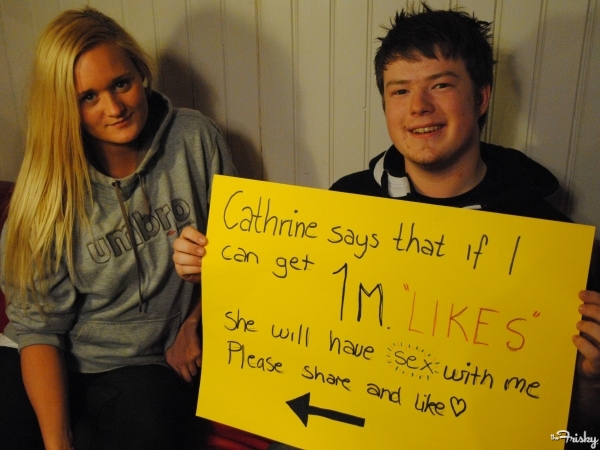
Ethics Quiz: Petter’s Sex For Facebook Likes Deal

Sex for Likes

First Stan Musial dies, and now this.

 Petter Kverneng is an awkward  Norwegian teen. He wants to have sex with Cathrine, the love of his young life, and she 1) doesn’t or 2) wants to make him earn the privilege by showing how much he wants her or 3) wants to humiliate him first and then if she has to have sex, well, whatever. The story goes that she told him she would have sex with him if he could score 1,000,000  “likes” on Facebook. A large internet message board decided to either help out Petter or stick it to Cathrine, and now the pimply-faced youth has  1.2 million “likes” on his Facebook page.

Get ready, Cat.

Let us take an ethics inventory, shall we? What is interesting about this stupid story, if indeed it is true, is that many of its turns could be seen as both ethical and unethical. Continue reading

The Fourth Annual Ethics Alarms Awards: The Worst of Ethics 2012 (Part 1)

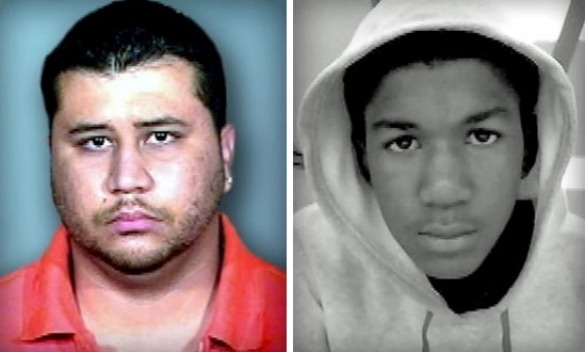
Trayvon

Welcome to the Fourth  Annual Ethics Alarms Awards

Recognizing the Best and Worst of Ethics in 2012!

This is the first installment of the Worst. (Part 2 is here, the Best is here.)

2012 inspired over 1000 posts, and Ethics Alarms still missed a lot. And the last week of 2012 was sufficiently ethics packed that the Awards are late this year. My apologies.

In a depressingly unethical year, these were the low points:

Ethics Train Wreck of the Year

Was there ever any doubt? The Trayvon Martin- George Zimmerman fiasco, naturally, which is far from over. This year’s winner may be the worst ethics train wreck since Monica and Bill were dominating the news.  So far it has involved dubious, unprofessional or clearly unethical conduct by, among others, Martin’s parents, their lawyer, Zimmerman, his wife, the police, Zimmerman’s first set of lawyers, the prosecutor, the Congressional Black Caucus, NBC (which repeatedly broadcast an “accidentally” truncated tape of Zimmerman’s 911 call that made him sound racist), the rest of the broadcast media, conservative talk radio and bloggers (who decided their contribution would be to try to show that Martin deserved to be shot), Spike Lee, Rosie O’Donnell, the New Black Panthers, and President Obama, who ratcheted up the hate being focused on Zimmerman by implying that the killing as racially motivated, and by connecting himself to the victim. Runner-up: The 2012 Presidential campaign.

“Incompetent Elected Officials of the Year” Division Continue reading

Evil Empire Ethics: Stand Up For The Crooks By Sacrificing The Children

Putin's pawns

Putin’s pawns

Stalin would be proud.

Today Russian President Vladimir Putin signed into law a bill barring  Americans from adopting Russian children. The objective of the bill had absolutely nothing to do with American adoptions, both Russian and American analysts agree. The law is retaliation for various American measures that punished or embarrassed Russia for various human rights violations.  One of these was the Sergei Magnitsky Rule of Law Accountability Act, which mandated  financial and visa sanctions on corrupt Russian officials linked to the arrest and imprisonment of Magnitsky, a lawyer who discovered a $230 million tax fraud and was then arrested by the same police officers he had accused of the fraud. He was sentenced to prison and died there in 2009.

The adoption ban is itself a human rights violation. Continue reading

Ethics Bob Asks: “Did Torture Lead Us To Bin Laden”? My Answer: “So What If It Did? It Was Still Wrong.”

It's all for the best.

It’s all for the best.

The last time my friend “Ethics Bob” Stone blogged about ethics, it was way back in August, and he was writing about some guy named “Romney.” Now he’s back on the job, thank goodness, with a comeback post titled “Zero Dark Thirty: Did torture lead us to Osama bin Laden?”. And he’s ticking me off.

“Zero Dark Thirty” is Hollywood’s treatment of the search, apprehension and execution of Osama Bin Laden. The film suggest that methods of torture were employed by the CIA to uncover crucial intelligence that led to the terrorist mastermind’s demise. Torture opponents, including some U.S. Senators, are alarmed by this, and disputing the film’s account. (Imagine that: a movie that misrepresents history!) Meanwhile, conservatives, neocons, Bush administration bitter-enders, talk radio hosts and admirers of Dr. Fu Manchu and James Bond villains are citing the film as confirmation that they were right all along: torture is a wonderful thing.

I am puzzled that Bob got in the middle of this debate as an ethicist. “It worked!” and “It came out all right in the end!” are not valid ethical arguments or justifications. The first is an embrace of a pure “the ends justify the means” rationale, a favorite tool of Auric Goldfinger and Dr. No. The other is consequentialism. When ethicists and principled opponents of torture allow the issue to be adjudicated on this basis, they are surrendering their principles at the outset. “Torture doesn’t work” is a pragmatic argument, not an ethical one. If the societal consensus regarding torture is going to be determined by how much we can benefit by returning to the rack and wheel, then ethical considerations have already been jettisoned. Continue reading

Why Can’t We Trust Our Government? Here’s One Big Reason…

A complete lack of accountability.

Now THERE'S something you won't see in Washington: heads rolling.

Now THERE’S something you won’t see in Washington: heads rolling.

Here is part of the Associated Press report on the internal review of the Benghazi Ethics Train Wreck. The bolding is mine: :

“An unclassified version released late Tuesday said serious bureaucratic mismanagement was responsible for the inadequate security at the mission in Benghazi where the U.S. ambassador and three other Americans were killed. Systematic failures and leadership and management deficiencies at senior levels within two bureaus of the State Department resulted in a Special Mission security posture that was inadequate for Benghazi and grossly inadequate to deal with the attack that took place, the panel said.

“Despite those deficiencies, the board determined that no individual officials ignored or violated their duties and recommended no disciplinary action. But it also said poor performance by senior managers should be grounds for disciplinary recommendations in the future.” Continue reading