Should the World “Stand By”UNRWA? Of Course Not…

The U.N. agency for Palestinian refugees, UNRWA, is losing support and funding for a very good reason. Israel’s intelligence alleges that at least six UNRWA employees infiltrated Israel on October 7, including two who may have helped kidnap Israeli civilians to be taken as hostage. Israel Prime Minister Benjamin Netanyahu told Britain’s TalkTV, “UNRWA is perforated with Hamas.”

Last week, U.N. Secretary General António Guterres said 12 UNRWA employees were implicated in the Hamas attacks. Of those, “nine were immediately identified and terminated,” one is “confirmed dead,” and “the identity of the two others is being clarified.” In response at least 15 countries, including the United States, have announced a halt to payments to UNRWA, pending further investigations. Officials have expressed fears that UNRWA could run out of money, endangering its humanitarian efforts in Gaza.

Too bad. That consequence should have been considered before allowing terrorism supporting U.N. employees to work for the organization.

The New York Times published an opinion piece by the foreign minister of Norway, one of the nations holding fast to its funding commitments. Espen Barth Eide argues that “we should not collectively punish millions of people for the alleged deeds of a few.”

I may have to fashion that time-honored excuse into a rationalization for the list. We read and hear versions of that entreaty constantly: it is a call to avoid just consequences for unethically run, untrustworthy organizations, agencies, societies, cultures and businesses. The only rational response to that argument is “Sorry. The organization is at fault, not those who make a reasonable and rational decision in response to it.”

No one should give funds to any organization that has proved itself untrustworthy, and UNRWA has. Apologists for the agency keep talking about “alleged misconduct,” but the U.N. acted quickly in firing twelve of the accused Hamas agents in the organization, almost certainly because the allegations were true. UNRWA obviously didn’t properly oversee its activities or properly vet its employees. The agency has has the same leadership responsible for this inexcusable botch; there is no way at this point for nation donors to have confidence that their money won’t be re-channeled into fighting Israel or other illicit projects.

Continue reading

The President’s Deceitful Executive Order

If I were maintaining a “lie database” on Joe Biden (like the Washington Post does, among others, on Donald Trump) this would go right on it. And yes, I have not read a single analysis on any source that explains the deceitful quality of the President’s latest executive order. Unlike several of the others, this one is constitutional. It is just completely misleading, and deliberately so.

Yesterday, Biden ordered financial and travel sanctions on Israeli settlers accused of violent attacks on Palestinians in the West Bank. That explanation at the top of the New York Times story cleared up initial confusion on my part. “Biden issues executive order targeting Israeli settlers who attack Palestinians” was the headline at Axios, and similar headlines abound. Huh? Does Biden think that he, like Leonardo DiCaprio, is King of the World? What power does the President of the United States have over citizens of foreign nations who aren’t in the United States? The answer, for those of you praying that J Biden and the Democrats can save democracy from the previous President who abuses presidential power, is none. None. The executive order is grandstanding of the most cynical sort. Biden literally could issue similar fanciful orders “sanctioning” Parisians who annoy visiting Americans by being rude to them with as much effect.

Continue reading

UPenn’s Anti-Semitic Lecturer

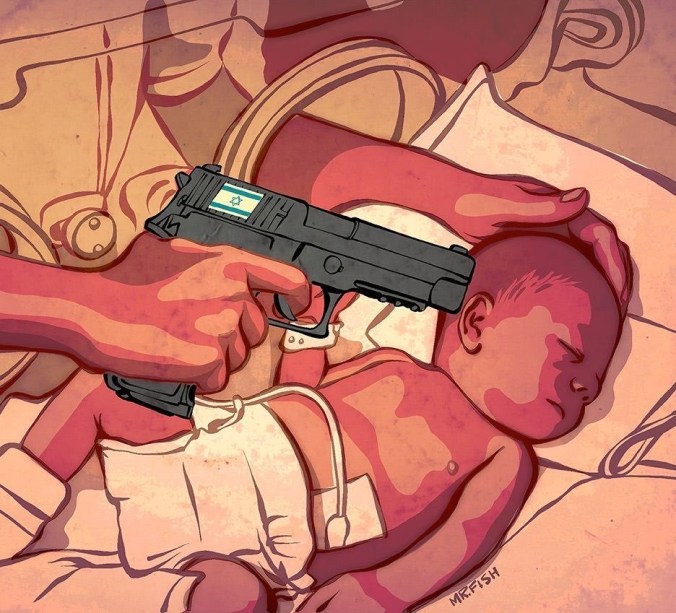
That cartoon above, showing apparent Zionists (as in “Jews”) sipping Gazan blood like wine, is probably the most outrageous of political cartoonist Dwayne Booth’s works…I don’t know, maybe this one is..

All a matter of taste, I guess. The ethics question is, now what, if anything?

Booth is a lecturer at the University of Pennsylvania’s Annenberg School of Communication having joined the school as an adjunct faculty member in 2015. Political cartooning is certainly a valid courss of study. He currently teaches two classes, but since Hamas’s October 7 terror attack, his off-campus cartooning has become especially controversial.

Booth publishes political cartoons under the pen name “Mr. Fish.” One of his classes teaches students the political cartooning art by exploring “the purpose and significance of image-based communication as an unparalleled propagator of both noble and nefarious ideas,” according to Penn’s website. “Work presented will be chosen for its unique ability to demonstrate the inflammatory effect of weaponized visual jokes, uncensored commentary, and critical thinking on a society so often perplexed by artistic free expression and radicalized creative candor.”

You can see more of Booth’s anti-Israel cartoons here. As far as I can determine, there is not sufficient basis for disciplining him or ending his association with the school. Political cartooning, though I personally view it as a crude, over-rated and deceitful form of editorial, is by nature extreme in device and approach. Booth’s own political opinions and obvious anger at Israel that he expresses as “Mr. Fish” or on social media are not relevant to his value teaching the political cartooning craft, and would seem to be squarely within the margins of both academic freedom and the first Amendment, provided that his commentary in class and on campus are not directed at Jewish students.

However, if a school, like the University of Pennsylvania, decided that, at a time when there are unusual tensions around the Gaza-Israel conflict its lecturer should cool his public fervor or consider another teaching position elsewhere, that would be a fully ethically defensible position. He’s right at the line now.

He might even have crossed it.

The Russian Figure Skating Olympics Scandal Finally Is Resolved After Everyone Stopped Paying Attention.

I’m thinking about establishing an organizational version of The Julie Principle. When an entity, company, organization or government has shown that its culture is sufficiently corrupt and unlikely to change for the better, maybe it’s a waste of time and ethical analysis to keep complaining about the inevitable misconduct. “Fish gotta swim, birds gotta fly.” Either just give up on trusting that entity, company, organization or government, or resolve to live with its flaws. Like Hollywood. The National Football League. Or, as in this ridiculous episode, the Olympics and Russia.

Kamila Valieva, the teenage Russian figure skating star, was banned from competition for four years yesterday by a three-member arbitration panel at the Swiss-based Court of Arbitration for Sport. The reason was her positive doping test that messed up the 2022 Beijing Winter Olympics beyond all reason, confusing everyone and keeping more than a dozen other athletes from receiving their medals.

Continue reading

How Do You Solve A Problem Like Rep. Omar?

I was actually going to begin this post with a parody of the cheery song from Rodgers and Hammerstein’s “The Sound of Music,” “How Do You Solve a Problem Like Maria?,” but decided against it for two reasons. First, no English words rhyme with “Omar,” so you’re stuck with fake sort-of rhymes like “home are” and “sonar,” and second, this is too serious a problem to cover in a song parody.

Among Donald Trump’s myriad offensive, stupid and gratuitously inflammatory comments while President was when he said in 2019 that the members of “the Squad” should “go back to where they came from.” This was particularly inept since most of that group of radical, socialist, anti-Semitic and or dumb-as-bricks Democrats are “from” the good ol’ USA, but in the case of Rep. Ilhan Omar (D-Minn.) at least, Trump may have had a valid point that he, as usual, chose the worst possible way to express.

In 2019, Omar declared as part of the anti-Semitic theme much of the Squad vocally embraces, “I want to talk about the political influence in this country that says that it is OK for people to push for allegiance to a foreign country.” Her message was that a lot of U.S. officials—you know, Jews— allowed a conflicting fealty to Israel to blunt their duty to pursue what is in the best interest of the United States. But yesterday, a video surfaced on Twitter/X showing Omar rousing a Somali-American crowd in her district by saying in part,

Continue reading

Unethical Quotes of the Month: The University of North Carolina’s Faculty Council

This is not an encouraging situation.

Last week, the University of North Carolina’s Faculty Council met to consider, among other matters, a resolution condemning anti-Semitism on school’s campus. An on-campus event in November included a speaker who said, referring to the barbaric terrorist attack on Israeli civilians, that “October 7 was for many of us from the region a beautiful day.” No one at the event did or said anything to reject that sentiment. The proposed resolution stated, “We strongly condemn the antisemitic statements made during a Unity roundtable event No Peace Without Justice held on November 28, 2023.”

That wouldn’t seem too difficult to agree with or too controversial, would it? Yet the resolution failed to pass. The Faculty Council voted 32-29, with six abstentions, to table the resolution for the foreseeable future. Here are some of the most striking comments made by those who objected to the resolution:

Continue reading

“Ick or Ethics” Ethics Quiz: The Robot Collaborator

As Jackie Gleason, aka. “The Great One,” used to say to begin his popular variety show on CBS (“Jackie Gleason? Who’s he?”), “And awaaaaay we GO!”

Rie Kudan, accepting the prestigious Akutagawa Prize for promising new Japanese writers, told the audience that her novel, “The Tokyo Tower of Sympathy,” was co-authored by ChatGPT and other AI programs. She revealed that her novel, which is about artificial intelligence, had approximately 5% of its dialogue composed by the popular bots and added by her “verbatim” to the text. “The Tokyo Tower of Sympathy” has met with unanimous raves by critics: “The work is flawless and it’s difficult to find any faults,” said Shuichi Yoshida, a member of the prize judging committee. “It is highly entertaining and interesting work that prompts debate about how to consider it.”

It seems clear that the author’s public admission (“I made active use of generative AI like ChatGPT in writing this book. I would say about five per cent of the book quoted verbatim the sentences generated by AI.”) was designed to fuel that debate.

I think we can all agree that this was shrewd on the author’s part. But is what she admitted to ethical?

Your Ethics Alarms Ethics Quiz of the Day is…

Is having an AI program write all or part of your book or novel ethical, or merely something that feels wrong right now that we’ll eventually accept?

Continue reading

Update: We Can’t “Trust the Science” Because We Can’t Trust the Scientists

…or the politicians and untrustworthy elected officials who use both for unethical ends.

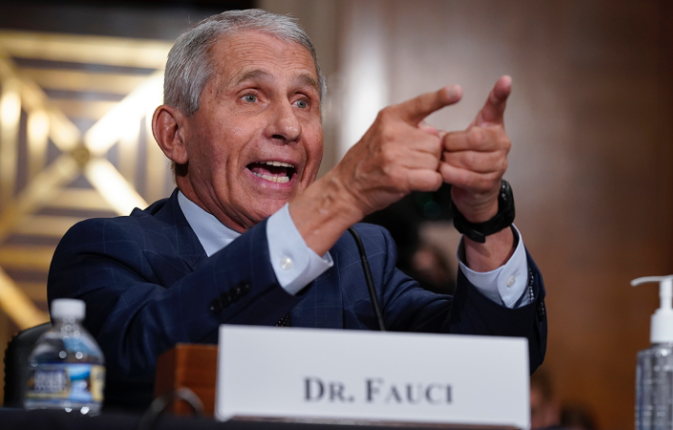
Further reinforcing his Ethics Alarms status as an Ethics Villain, the now retired Dr. Anthony Fauci blithely told lawmakers on the House Select Subcommittee on the Coronavirus Pandemic this week that “social distancing guidelines”—warning the public to keep six feet apart from anyone else supposedly to limit the spread of the Wuhan virus — “sort of just appeared” without scientific input, and was “likely not based on scientific data.”

Oh! That’s nice! Schools remained closed well into 2021 substantially as a result of the social distancing guidelines that he stood by and allowed to be issued without scientific data. I was screamed at in several public places because I knew the social distancing edicts were garbage from the beginning, just like the “don’t touch your face!” nonsense and 95% of all masks. My sister has been a phobic about physical contact ever since March of 2020: she has yet to allow me into her house, and will only speak to me at my home ten feet away on the front yard. Research studies and other health officials pooh-poohed the social distancing mandates early on while media scaremongers—-after all, it was vital to wreck the Trump economy if he was going to be brought down—were quoting some “experts” saying that we should all wear masks and socially distance forever. Fortunately my pop culture addiction served me well: I recognized all of the CDC recommendations from the 2011 pandemic movie “Contagion.” They were exactly the same, proving to me that “social distancing” and the rest were just boiler plate “Do something!” measures off the CDC shelf. (They didn’t work in the film, either.)

Continue reading

From the “The Trouble With Protesters” Files…

The trouble with protesters, to cut to the chase, is that a large percentage of them in virtually every protest and demonstration don’t know what they are chanting about and are just happy mob participants. I remember when my college was shut down by a student strike my freshman year, several of my friends were happily raising their fists and carrying signs despite the fact that they weren’t interested or informed on the matter being protested. They all reassured me that they were involved to meet girls. Later, in my first job after law school, the PR director I worked with in D.C. seemed to be attending a protest or rally every weekend. When I remarked that she was unusually politically active for someone who never discussed politics at all, she assured me that she just enjoyed the energy of crowds…and found it a good way to meet guys.

Since yesterday was “Capitol Insurrection Day,” which I predict will be made a national holiday as soon as Democrats get control of Congress, it seems a propitious opportunity to ponder an equally stupid protest in Clifton, Bristol (Great Britain). A resident reported that his Tesla’s tires were deflated, and on the windshield was this message:

Other automobiles on his street were also victims of tire-deflating. The group behind the mass flattening calls itself “the Tyre Extinguishers.” ( The play on words would work better if the Brits spelled “fire” as “fyre.”)

The annoyed Tesla owner told reporters, “It’s ironic, because I was trying to do the right thing by buying an electric car. It’s ridiculous and inconvenient. I get why [climate activism] is happening, but I’m not seeing the point of this.”

The point he ought to derive from the incident is that most climate change protesters know almost nothing about climate science and related matters, like the full environmental effects of electric vehicles. They are passionately protesting what they don’t understand sufficiently to have an informed opinion about, and therefore shouldn’t influence anyone beyond persuading observers that they are passionate, unethical dolts and blights on society.

One more point: deflating the tires of Teslas is a brilliant climate change protest compared to gluing oneself to a famous painting.

___________

Pointer: Curmie

Curmie’s Conjectures: The Belfry Theatre’s Crisis of Nerve

by Curmie

[ JM here: I want to let Curmie’s Conjectures stand on their own, so I apologize at the outset by intruding with a brief introduction. Lest anyone be dissuaded from reading the whole post because the author’s scholarly tone and apparent focus at the start suggests that this will be a narrow discourse on topics rather more relished by Curmie and me than by the majority of EA readers—theater and the performing arts—fear not. The tags on the article will be “Canada, censorship, the Hamas-Israel War Ethics Train Wreck, and political theater.” The post also involves some of the same considerations as one of mine two days ago. ]

There is a theory, one to which I subscribe, which suggests that the Dionysian Festival of classical Athens began not really as a religious observance in honor of a demi-god but rather as a means of consolidating the political power of the tyrant Peisistratus.  Whether or not this is true, there is no doubt that by 458 BCE Aeschylus’ Oresteia, widely acclaimed as “the world’s first dramatic masterpiece,” offers commentary on the reforms of the Areopagus enacted by the strategos Ephialtes some three years earlier.

There is no question that since that time the theatre has often—not always, but often—been political.  The 20th century offered more than a few examples of playwrights and production companies who, often at personal risk, critiqued the power structures around them: Jean-Paul Sartre took on the Nazis; Lorraine Hansberry, racism in the US; Athol Fugard, apartheid; Václav Havel, communism in Eastern Europe.

Not all such efforts were for causes most of us would endorse, of course.  Socialist Realism was a Stalinist policy under which all art had to support The Revolution: not just avoid criticism of the regime, but actively and explicitly endorse it.  More recently, the Freedom Theatre of Jenin (on the occupied West Bank) has been in the news.  A few weeks ago, one of the student organizations at my university posted an encomium to the company, which they described as “an example of creating liberating theatre and serving communities through theatrical pedagogy and profound performance.”  I remembered having written about that theatre a dozen or so years ago.  If I might quote myself for a moment: “Turns out that the Freedom Theatre was pretty damned proud of having turned out alumni who engaged in armed insurrection, and at least one of whom, a suicide bomber, richly merited description as a terrorist.” 

So no, propagandistic theatre isn’t always a good thing… but engaging with the world is.  Even subtle messages matter.  Under normal circumstances, Aunt Eller’s wish that “the farmer and the cowman can be friends” doesn’t amount to much.  But Oklahoma! hit Broadway after the declaration of war against the Axis powers and before D-Day.  “Territory folks” need to put aside their petty grievances when there’s a guy with a funny mustache who’s far worse than any of your neighbors will ever be.

Continue reading