Comment Of The Day: Public Confidence And Trust (2): Observations On Gallup’s Confidence In Institutions Poll

After Charles Green‘s recent  Comment of the Day on the post, Public Confidence And Trust (1): Observations On Gallup’s Trust In Occupations Poll, I was pretty sure that there would be an encore when I posted Part 2, an overview of the Gallup poll on public trust and confidence in American institutions. Charlie didn’t disappoint, so here is his Comment of the Day on the post, Public Confidence And Trust (2): Observations On Gallup’s Confidence In Institutions Poll:

…I agree with you that this stuff is as mission-critical as anything.

As you know, my life’s work is studying trust, and while I focus on interpersonal trust, you can’t ignore the systemic institutional issues either. In fact, they are connected.

In fact, I agree with your fundamental point that the cure for what ails our institutions must lie in personal behaviors, personal relationships, personal ethics.

Without taking anything away from that fundamental and massive agreement, let me suggest two tweaks to the issue as you have presented it.

The first is that this is NOT simply a US phenomenon. I recommend even more sobering reading from the Edelman Trust Barometer, a study that has been ongoing for over a decade. See the 2017 version here: https://www.edelman.com/global-results/

That survey covers about 18 western countries: fully half of them report the level of distrust in institutions – business, communications, NGOs, CEOs, etc. – not materially different from what we see in the US. Continue reading →

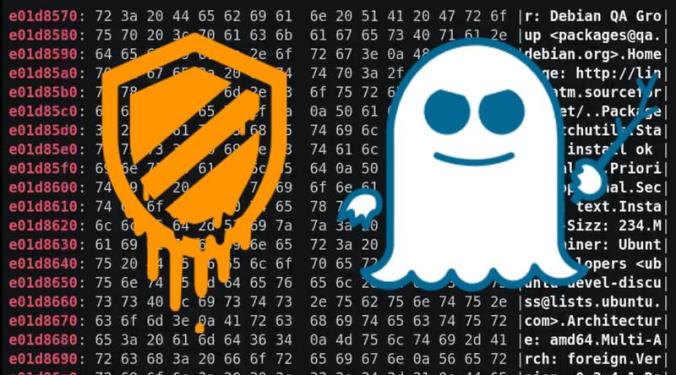
Wait, WHAT? NOW They Tell There Are “Two Big Flaws” in Every Computer?

(That’s Meltdown on the left, Spectre on the right.)

From the New York Times:

Computer security experts have discovered two major security flaws in the microprocessors inside nearly all of the world’s computers. The two problems, called Meltdown and Spectre, could allow hackers to steal the entire memory contents of computers, including mobile devices, personal computers and servers running in so-called cloud computer networks.

There is no easy fix for Spectre, which could require redesigning the processors, according to researchers. As for Meltdown, the software patch needed to fix the issue could slow down computers by as much as 30 percent — an ugly situation for people used to fast downloads from their favorite online services. “What actually happens with these flaws is different and what you do about them is different,” said Paul Kocher, a researcher who was an integral member of a team of researchers at big tech companies like Google and Rambus and in academia that discovered the flaws.

Meltdown is a particular problem for the cloud computing services run by the likes of Amazon, Google and Microsoft. By Wednesday evening, Google and Microsoft said they had updated their systems to deal with the flaw.

Here’s the best part:

“Amazon told customers of its Amazon Web Services cloud service that the vulnerability “has existed for more than 20 years in modern processor architectures.”

We trust the tech giants and computer manufacturers to give us secure devices. We then entrust our businesses and lives to these devices.

That there were such massive “flaws” in every computer, and that it took 20 years for those whom we trusted to discover them, is an unprecedented breach of competence, trust and and responsibility. Imagine auto manufacturers announcing that every car in the world had a “flaw” that might cause a fatal crash. I see no difference ethically.

And why is this story buried in the Times’ Business Section, and not on the front page, not just of the Times, but of every newspaper?


Morning Ethics Warm-Up, 1/4/2018: A Frivolous Lawsuit, An Unscripted Actress, A Lesson In Assuming, And Fake News

Good Morning!

1 On feminist integrity. The reader poll on the post about the interesting silence of US women’s rights organizations and their component feminists as their Iranian sisters protest oppression in Iran has already had more participation that the last four Ethics Alarms polls combined. Why is that? In more news related to that post, some determined spinners here claimed that the feminists have been burning up the blogs and websites with supportive essays and blog posts, so the radio silence is a myth. No, THAT was a myth: there is nothing on those sites, or if there is, it didn’t surface when I checked Ms., Jezebel, NOW and four prominent blogs. (Update: Reader Humble Talent has checked two more. Also nothing.)

Please don’t make up stuff or assume facts you haven’t checked when you don’t want to accept reality, friends. It’s not fair, and it’s not ethical debating practice. Because I trust and respect the commenter in question, I just assumed she was right, because I assumed she had checked. No, it appears she had assumed, and was not right.  And you know what Felix Unger proved happens when you assume..

2. This is why they give actors scripts. I enjoy actress Meryl Streep as an artist, but for me she is fast entering Alec Baldwin territory, a performer whose personal character deficits are becoming so overpowering that even her undeniable talent can’t make watching the performer on screen endurable. Streep is in a deep hole she keeps digging. Being a Harvey Weinstein acolyte and beneficiary for years (and a Roman Polanski apologist), she is denying culpability as an enabler of his serial sexual predation because, she says, she didn’t know. Almost nobody finds her denial credible. Yesterday the Times published a joint interview with Streep and her “The Post” co-star, Tom Hanks. Told by the interviewer that in light of the doubts about what she knew, the public wants to hear more from her, she responded,

“I don’t want to hear about the silence of me. I want to hear about the silence of Melania Trump. I want to hear from her. She has so much that’s valuable to say. And so does Ivanka. I want her to speak now.”

Streep locks up the 2018 Whataboutism of the Year title with that one, along with adding a ridiculous sentence into my personal collection of statements that deserve note because they had never been said before in the history of the English language. I started my collection decades ago at a family Thanksgiving dinner, when my sister said, “You know, the fish looks so good, I think I’ll wear my bra on my head.” And a collection was born.

“I don’t want to hear about the silence of me” has an elegant simplicity about it. In addition to being a strange sentiment, Streep also misses the whole concept of an interview—surprising, since she has done so many of them. See, Meryl, these questions are about what the public wants to hear about, not what you want to hear about. Was that really unclear to you until now? This was not an open invitation to announce all the things you’d like to hear about that have absolutely nothing to do with Harvey Weinstein. This is “Look! Squirrel!” carried to a demented extreme. Streep revealed herself as seriously Trump Deranged, as she thinks that the way out of every personal crisis is to declare, “But what about TRUMP????”

Looks like I won’t be watching “The River Wild” again. Pity. (I won’t watch “The Dear Hunter” again either, but then you never could have made me watch that thing a second time, not under torture or extortion.)

3. Now THIS is a frivolous law suit.  From CNN:
Continue reading →

Why Aren’t Feminists In The U.S. Supporting The Cause Of Iranian Women In The Current Protests?

Excellent question, don’t you think?

Writes Sarah Rumpf, at the conservative blog Red State,

“Liberal feminist groups in America have been busy this year, knitting pink hats with cat ears, organizing marches, dressing up like characters from The Handmaid’s Tale, and tweeting their #Resistance panic that the Trump administration will soon chain all of us ladies in the kitchen, barefoot and pregnant, where we’ll be forced to make sandwiches and watch Archie Bunker…you’d think that a story about women who are actually facing systemic gender-based oppression would be an obvious rallying cry.

Nah.

Conservative author Christina Sommers tweeted,

“Women in Iran are valiantly protesting genuine oppression. So far the silence of major feminist groups in USA is deafening. Where are you @NationalNOW, @AAUW @nwlc @MomsRising?

Where indeed. Nor have Hollywood celebrity feminists like Madonna, Meryl Streep, Ashley Judd, Lena Dunham, Alyssa Milano, et al. mentioned the Iranian protests. The Democratic party feminists among their elected officials have similarly been silent. Why? From an ethics perspective, it seems like a serious breach of integrity.

I see the following possible explanations:

  • Cognitive dissonance. The feminists are more dedicated to opposing President Trump than they are supporting women’s rights abroad. Trump has been vocal in support of the Iranian protests.

That means the protests are bad.

  •  Pro Obama denial. President Obama let the 2009 protest, and by extension any chance of liberty for Iranian women, come and go without his support or endorsement in a cold display of real politick at its worst.

Obama’s ex-staff and supporters are twisting themselves into pretzels to insist that this wasn’t the mistake—and betrayal of principle–that it was.

  • Apathy. They don’t care about Iranian women.

They care about abortion.

  • Selective multiculturalism: Muslims can do no wrong is the progressive party line, and U.S. feminists don’t have the courage of integrity to break from it.

Did I miss one?


Ethics Dunce: Logan Paul

I was blissfully unaware of the existence of Logan Paul until this morning. He’s a unique creation of the cyber-age, a 22-year-old college drop-out whose occupation is “social media entertainer.” He makes daily videos–“vlogs”—that he posts on his YouTube channel. It has 15 million followers, along with his hundreds of thousands of others across social media, and is regarded as major cultural force, for what, I have no clue. He is, of course, rich.

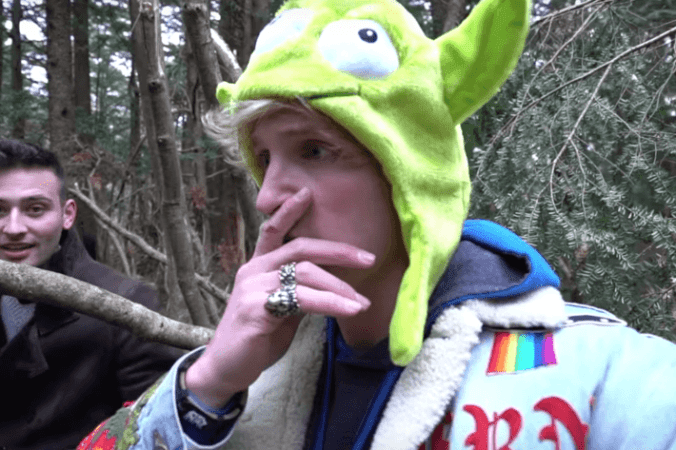
In pursuit of more followers and cash, he posted a video, since  removed from YouTube available elsewhere online, that features a dead young man, lying in a Japanese forest known as the “Suicide Forest,” which lies at the base of Mount Fuji. Paul began by telling his YouTube fans,

“This definitely marks a moment in YouTube history Because I’m pretty sure that this has never hopefully happened to anyone on YouTube ever. Now with that said, buckle up!”

With that titillating intro, Paul described the reputation of the Aokigahara Forest at the base of Mount Fuji. It is a popular site for distraught Japanese to end their lives, and is thus known as “the Suicide Forest.”  Locals also say the forest is haunted, another exiting feature that Paul and his companions hyped as they walked along. Then they come across the dead body. The video blurred his face. “Yo, are you alive?” Paul shouted at the dead man. As a camera zoomed in, Paul described the body’s condition, and speculated that the death was recent.

After making the obligatory observation that depression and mental illness are not a joke, Paul’s group left the scene and he began joking, with the mugging and giggling his fans are accustomed to seeing on his vlogs. At the end of the video he encountered a young fan and told him, smirking and pointing the way, “I have one piece of advice. Don’t go over there!”

And yes, he was wearing that hat (above) the whole time.

 The video was posted over the weekend, and did not receive the desired response. Many expressed horror that a young man’s body would be used a a prop, and that Paul would be cavalier about mental illness, depression and suicide. Now the Cyber Furies are after him, and threatening to turn him from web star into a web pariah. Continue reading →

Comment Of The Day (5!): “An Ethics Alarms Holiday Challenge! Identify The Rationalizations, Logical Fallacies, Falsehoods And Outright Errors In This Essay…”

The  Comment Of The Day Weekend continues into the long weekend with yet another one on the Holiday Challenge, wherein readers were asked to metaphorically defenestrate Noah Berlatsky’s essay calling for a hsarp edit to the First amendment.

This sharp comment is by long-time Ethics Alarms regular Glenn Logan. Here is his Comment of the Day on the post, An Ethics Alarms Holiday Challenge! Identify The Rationalizations, Logical Fallacies, Falsehoods And Outright Errors In This Essay Advocating Limits On Speech…

I read this a few days ago, at least as much as I could stomach. It’s pretty irrational. I thought this was funny:

Delgado and Stefanic, though, argue the price for freedom in this case may be higher than we think. For example, a John Hopkins study published in 2013 concluded that being exposed to racism can lead to high blood pressure and stress among African Americans.

Being exposed to racism isn’t funny, but the idea that the stress of racism is different from other stresses is medically and logically bankrupt. Being called a racist can just as easily be shown to produce the same negative physiological effects, but the author is so incredibly purblind that this would never occur to him.

So are we to place progressives who allege racism at the drop of a hat into the “You can’t say that, it’s hate speech!” column along with the n-word? I’m betting no.

More hilarity:

Currently the federal government is prosecuting 200 people for being present at the protests during Donald Trump’s inauguration, including journalists and street medics.

Heh. I guess he’s unaware that those so-called protesters were rioting, a felony in every state in the union. Protests are peaceful demonstrations, but destroying property and participating in a riot is not free speech. Also, just because a person is a “street medic” or “journalist” does not make them automatically exempt from consequences if they participate in a riot.

Police officer to journalist: “Did you just break that window?”
Journalist: “Yes, but I’m a journalist.”
Officer: “Oh, I guess it’s okay, then.”

In what universe? Berlatsky’s, I suppose. Continue reading →

Morning Ethics Warm-Up, 12/31/2017: The Too Many Year Ending Ethics Issues To Handle In One Day Edition

Happy New Year!

1 Arrgh! In an op-ed called “Higher Ed’s Low Moment, Farnk Bruni bemoans the fact that colleges “found themselves on the defensive.” Citing the Pew Center’s findings that I discussed here, he writes of declining opinions about the value of college,

“That’s not so surprising, given Americans’ intensifying resentment of anything that smacks of elitism and given Republicans’ attacks on science and intellectuals. As Ron Daniels, the president of Johns Hopkins University, recently told me, “Even if we were completely unblemished in the way in which we pursued our mission, it would be hard to imagine that in Trump’s America, we wouldn’t be targets for scorn.”

Incredible. (Or, as my late, schizophrenic cousin Trefon would say, “Umba!“, as in “Umbelieveable!” I always found that funny, and I would love to see his slang word enter the popular lexicon. Trefon was a great kid who had a short, empty life, and ended it by jumping off an overpass into an oncoming truck. It would be nice if he left some enduring contribution to the culture, even if it was a silly one.) No, the reason so many Americans no longer think college is a wonderful thing is that they can see and hear. Students aren’t being educated. Graduates have minimal knowledge of history, literature, government and culture. They can’t write, and they can’t argue. Their professors get on social media and issue things that would destroy trust in any institution that employed them.

The campuses are increasingly hostile to free speech, free thought, democracy, capitalism and the United States of America. None of these factors penetrate Bruni’s biases and conventional wisdom. He keeps repeating the mantra that caused me to resign from an education board many years ago: ” a college degree is one of the surest harbingers of higher earnings and better economic security.” That’s how college has been regarded as a reflex for a century now, and the policies that followed that starting point–a degree,  means jobs and money—have created the sick system in which students who are not qualified to attend college are accepted anyway, and tuition has soared to obscene level., all while the actual content of the curriculum and teaching have become an afterthought. It’s the diploma that matters!

No, it’s the education. Bruni says, ” [T]he continued competitiveness of the American economy depends on the skills of our work force, the intellectual nimbleness of our citizens, the boldness of our scientific research and the genius of our inventions. Our colleges and universities are central to that.”  If getting as many people diplomas as possible is the mission, however, seeking “intellectual nimbleness” is obviously an afterthought.

This emperor has no clothes, and hasn’t had for a long time. The disturbing development isn’t that so many conservatives have finally realized that the golden ideal of an American college education no longer comports with reality. It is that so many opinion makers and policy makers hold on to that ideal when it is so evidently false. If college degrees don’t prove that  graduates have core knowledge, writing and critical thinking skills, then they are  just high-priced tickets to be incompetent.

And they don’t. Continue reading →

Morning Ethics Warm-Up, 12/30/2017: Is Robert Mueller Biased? Are The Patriots Cheating Again? Is Larry Tribe Deranged? Is President Trump A Robot?

Good Morning!

(Nothing better than waking up to a light dusting of snow!)

1 When you can keep your head when all about you are losing theirs…Alan Dershowitz, a Democrat and legal expert who has prominently avoided the ravages of anti-Trump mania that have crippled so many of his distinguished colleagues, tried to clarify several issues in the Mueller investigation on Fox News.

On Special Prosecutor Mueller personally and professionally: “I don’t think he’s partisan, I don’t think he cares whether the Democrats or the Republicans benefit from this.I think he’s a zealous prosecutor and if he were going after Hillary Clinton, he’d be going after her with as much zeal.”

On his investigative team: “Now that’s not true for some of the people on his staff. He should never have allowed these people to serve on this investigative staff, if they had the points of view that they’ve had towards Hillary Clinton and towards Donald Trump. That was a mistake…when you’re going after a president or a presidential candidate, you have to be ‘Caesar’s wife,’ you have to be above reproach, and he didn’t do a good enough job in vetting the people that he brought on to the prosecution and the investigative team, and that hurts his credibility.”

Correct, and obviously correct. So why is the White House and Fox News being criticized daily for questioning the legitimacy, fairness, objectivity, and independence of the investigation? It doesn’t matter if Mueller is personally fair and objective if he appoints biased and conflicted lawyers to do the work. That still means the investigation is compromised and untrustworthy. It also means that Mueller undermined the investigation exactly the way he could not afford to if he wanted its results to be accepted.

There is nothing inappropriate about those being investigated pointing out bias, incompetence and conflicts of interest by the investigators. Criticism of a legitimate complaint, backed up by facts, indicates that those critics  don’t care about bias, incompetence and conflicts of interest, if they lead to the result they crave.

2. Suspicion! Why would the NFL’s New England Patriots sign a washed-up, 39-year-old Pittsburgh Steelers veteran, James Harrison, with only one game left in the regular season, at a cost of about $60,000 for that game and for any play-off games the Patriots participate in? Harrison has barely played all season, is no longer a top performer, and was a discordant and disruptive presence in the locker room. Many sportswriters and fans believe that he is being paid by New England to be a turncoat, and to reveal  Steelers’ secrets that might provide an edge if the Patriots, as many expect, have to defeat Pittsburgh on the way to another Super Bowl. The Patriots have been caught cheating more than once. Would this be cheating?

I assume not, unless Harrison had an enforceable non disclosure clause that prohibited him from revealing Steelers plays and strategies even after he was no longer on the team. Indeed, it would be unethical for Harrison not to help his new team in any way possible. When New England signed him, they signed his body, mind and accumulated experience. Continue reading →

Ethics Observations On Pew’s “17 Striking Findings From 2017”

#1Partisan divides dwarf demographic differences on key political values. The average gap between the views of Republicans and Republican-leaning independents and Democrats and Democratic-leaning independents across 10 political values has increased from 15 percentage points in 1994 to 36 points today. Two decades ago, the average partisan differences on these items were only slightly wider than differences by religious attendance or educational attainment, and about as wide as differences across racial lines. Today, the partisan gaps far exceed differences across other key demographics.

I attribute this ominous development to both parties crossing previously observed lines of appropriate political tactics and rhetoric, picking at the seams that hold our society and democracy together. The GOP-advanced Whitewater investigation of the Clintons’ financial shenanigans began the criminalization of politics. President Clinton’s arrogance and recklessness as a sexual predator placed Democrats in the position of defending unethical conduct especially repugnant to conservatives, and the furious (and dishonest) efforts of both Clinton and Democrats to deny the legitimacy of his impeachment drove the parties further apart.

The essentially tied election of 2000 came at the worst possible time, but Democrats made its wounds to public comity worse that they had to be by using the false claim that the election was “stolen” to energize its base for years. The rise of hyper-partisan leaders in the House and Senate—Gingrich, Pelosi, McConnell, and worst of all, Harry Reid—continued to poison discourse.  The Iraq War fiasco, a Republican mistake, and the false Democratic mantra “Bush lied…” in response to it exacerbated the divide. Then the bi-partisan botches that led to the 2008 crash were widely attributed only to Republicans. Spurred by the prospect of a black President, the news media, always heavily tilted leftward, abandoned large portions of its ethical values to be an unapologetic cheerleader for the Democratic candidate, because having a black President elected would be so darn wonderful for everybody. Thus did the media fully embrace “the ends justifies the means” as an operating principle/

The inevitable racist response of a minority—but a vocal one—in conservative and Republican circles to the prospect of a black President caused further division, and Obama’s alliance with an openly racist Reverend Wright caused more racial polarization. Once elected, President Obama could have healed much of the damage since 1994 (as he promised to do) , but instead he chose to leverage divisions among races, genders, ages, classes, gays and straights, and legal and illegal immigrants for political advantage. His supporters, meanwhile, including those in the news media, began using accusations of racism to smother and inhibit legitimate criticism. Obama broke with Presidential tradition by repeatedly blaming his predecessor for problems he proved unable to solve, keeping partisan resentment hot.

Even with all of this, Obama could have healed much of the accumulated partisan antipathy if he had been an effective leader. He wasn’t. In contrast to his predecessor he was an effective (though over-praised) communicator,and in marked contrast to the current POTUS, he played the part beautifully, and that’s not inconsequential. The rest, however, was an ugly combination of misplaced priorities, incompetence, laziness, racial bias and posturing, with awful results. This hastened the divide, because Obama’s core base, the African American community, was inclined to view him uncritically no matter what he did. As other groups called out the President on his failings, that group’s loyalty and bias drove it, and allied groups, into defensive, knee-jerk ideological opposition, as the growing power of social media exacerbated hostility between the ideological polls.

Obama’s divisive administration, rhetoric and poor governing habits begat Donald Trump.

And here we are. Continue reading →

Reluctant And Uncertain Ethics Observations On The U.S., Israel, And United Nations Squabble

International relations is an ethical morass, and the Israel/Palestinian mess is an ethical morass inside an ethical morass. In international relations, gaffes turn out to be masterstrokes, and vice-versa, and my usual rejection of consequentialism doesn’t always fit. It is politics on steroids, and a never ending Ethics Train Wreck. Thus I approach the topic of the events that roiled the U.N. right before Christmas with trepidation. There were obviously ethical principles in play here, but beyond that, my certainty recedes like my hairline in 1976.

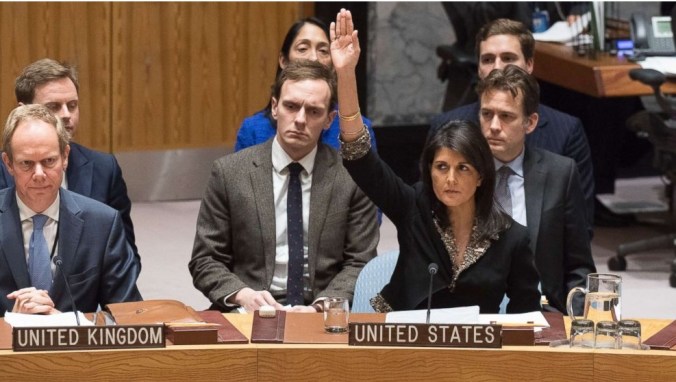
The background: On December 18, UN ambassador Nikki Haley vetoed an Arab-proposed Security Council resolution that rebuked President Trump’s decision to recognize Jerusalem as Israel’s capital and start the process of moving the US embassy there. All other 14 Security Council members supported the anti-American resolution, including U.S. allies Great Britain, France, and Japan. Then the UN General Assembly went on to pass a non-binding resolution disapproving of the Trump administration’s decision. Several more U.S. allies failed to vote with the U.S., including Canada and Australia, which abstained.  Before the general assembly vote, Haley announced the US was “taking names” of those voting against the US. and afterward, the U.S. held a party where the only countries invited were Guatemala, Honduras, Israel, the Marshall Islands, Micronesia, Nauru, Palau, and Togo, all of which voted with the U.S.

Finally, Haley announced that the U.S. had negotiated quarter billion dollar cut to the UN’s annual budget, saying  “We will no longer let the generosity of the American people be taken advantage of or remain unchecked.”

1 Was it responsible for the U.S. to condemn the actions of the nations, including its allies, that voted for the resolution in the Security Council and the the General Assembly?

The U.S. should be strong rather than weak, and must stand up for core principles. It is beyond argument that much of the hostility to the U.S. decision to move its embassy to Jerusalem was based on anti-Israel bigotry, which flourishes in many of the nations that voted against Israel and the U.s., notably France. The Obama policy was to generally allow the U.N. to direct the U.S., with Obama “leading from behind,” an oxymoron that was a euphemism for “not leading at all.” Many of the nations opposing the U.S. are Arab nations, Muslim nations, and nations who are worried about unrest in their large Muslim populations.

The assertion of a false moral equivalency between Israel and the Palestinians among a majority of the world (and a lot of Democrats) should not be enabled. The Palestinians still officially refuse to acknowledge Israel’s right to exist. British UN Ambassador Matthew Rycroft, for example, said that “The status of Jerusalem should be determined through a negotiated settlement between the Israelis and the Palestinians} and that that Jerusalem must “ultimately be the shared capital” of Palestine and Israel. Yes, that will work well, with the Palestinians still refusing to acknowledge Israel’s right to exist.

The status of Jerusalem, like the status of Palestine, is what is technically known as “all messed up.” In 1949, Israel’s first Prime Minister, David Ben-Gurion, proclaimed Jerusalem as Israel’s “eternal” and “sacred” capital, saying that only hostilities against Israel  had “compelled” its  leadership to establish the seat of Government in Tel Aviv.  “For the State of Israel, he said, “there has always been and always will be one capital only – Jerusalem the Eternal. In 1950 all branches of the Israeli government—legislative, judicial, and executive—were moved to Jerusalem, except that the Ministry of Defense, stayed in Tel Aviv. At the time of Ben Gurion’s proclamations Jerusalem was divided between Israel and Jordan and thus only West Jerusalem was proclaimed Israel’s capital. Then, in 1980, Israel passed the  Jerusalem Law, which declared Jerusalem the “complete and united” capital of Israel. In response, the United Nations Security Council passed Resolution 478 that same year, declaring  the law  “a violation of international law.”  “null and void” and that it “must be rescinded forthwith.” Member states were told to withdraw their diplomatic representation from Jerusalem, and 22 of the 24 countries that previously had their embassy there moved back to Tel Aviv.  In 1995, under President Clinton, the United States Congress passed the Jerusalem Embassy Act, which required, subject to conditions, that its embassy be moved from Tel Aviv to Jerusalem.

Whether the U.S. tactics will work out well or not is a matter of conjecture, and impossible to know. Are they ethical? Sure they are, compared to the alternative.

2. Was Haley’s Trumpian, tit-for-tat, we take this personally and you’ll regret it rhetoric responsible and ethical? Continue reading →