Comment Of The Day (2): “Observations On Britain’s Charlie Gard Ethics Fiasco”

This is the second outstanding comment on the Charlie Gard post, and it boldly ventures into the ethics jungle of euthanasia. The discussion must go there, for if society has limited resources, and we have more limited resources than Paul Krugman and Bernie Sanders admit, then when people use up their allotted portion, they either have to die or someone else has to pick up the bill. The recent surge in popularity for single-payer health care is due in part to the old saw about how soldiers think when going into battle. It’s everyone else who’s at risk, not you. Or as my dad liked to put it, “Gee, I’m going to miss those other guys!”

Increasingly, as I get older and think about how different my family’s life would be if both Mom and Dad hadn’t contrived to pop off quickly after relatively short illnesses and minimal hospitalization, I see the same consideration in planning for my loved ones. I don’t want to waste my son’s inheritance to pay for the last and worst years of my life; indeed, I think it would be unconscionable to do so. However, that needs to be my choice, not the Death Panel’s.

Here is Mrs Q’s Comment Of The Day on the post,  “Observations On Britain’s Charlie Gard Ethics Fiasco”:

When medical care is socialized, nihilism & scientism combine to control those who can be useful to the state & those who need to be eliminated from it.

Dutch lawmakers are looking at a Completed Life Bill that would allow those 75+ in age to choose medical euthanasia. The lawmaker pushing the bill, Alexander Pechtold, said it would allow the Netherlands to…

“take the next step for our civilization.”

And what step is that exactly?

The Gard case highlights the dark workings of Marxism for what it is by defining life in terms of how much of a burden it supposedly is to others. That the “greater good” is better served when certain people s lives are considered “complete.”

Baby Gard, as Jack noted, cannot continue to be a financial burden in the context of socialized medicine because in such a paradigm, there are not enough resources to support all of those represented by it. Remember socialism ALWAYS promises more than it can ever deliver and always spends more than it has.

I love it when people tell me how great the health care in France is, while many there complain the immigrants are a drain on the system because they have not put their money into it for years. Or Canada, where our friends cannot afford private insurance and go without certain medications & treatments because they’re not covered by state. Or Europe, where rates of Downs Syndrome are jarringly low because doctors have advocated so severely for abortion of these unborn, that in some countries it has literally been years since such a child has been born. Continue reading

Morning Ethics Warm-Up: 7/2/17 [UPDATED]

1. I wonder when and if the LGTBQ community will ever grow up. I had an annoying exchange yesterday when a Facebook friend began whining that President Trump hadn’t done or said anything to honor Gay Pride Day, proving again that he was the spawn of Satan. A friend of that friend then added, to the usual flood of “likes”—all you hve to do is insult the President to get likes— that for him to honor Gay Pride Day would be like Hitler observing ceremonies for Holocaust victims. Of course, nobody had the integrity or the decency to point out what an idiotic comment that was, so I did. When will people stop making me defend Donald Trump? He is the first and only President to enter office fully accepting same sex marriage (unlike Obama and Clinton) and the unending slur that he is hostile to gays is the product of two factors: fearmongering (He was going to put gays in camps!) and bigotry (If he’s a Republican, he must hate gays.) One response to my rejoinder was someone posting this NBC story as a “rebuttal.” The sum total of the anti-gay actions of the Trump administration, according to this alleged indictment? Here’s the description:

“For many LGBTQ Americans, the early days of Trump’s Republican administration have been fear-inducing. A series of Cabinet appointments have been roundly criticized by LGBTQ advocacy groups. An early draft of a reported executive order legalizing broad discrimination against LGBTQ people threw the community into a panic. The dismantling of Obama-era protections through executive orders came with the simple stroke of a pen.”

This is modern day fake-news journalism at its most obvious. All  the paragraph says is… Continue reading

Observations On Britain’s Charlie Gard Ethics Fiasco

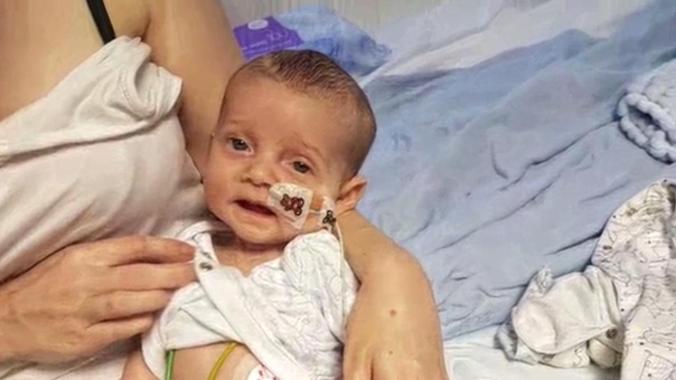
A recipient of Great Britain’s national health care, infant Charlie Gard was born with  a rare genetic condition resulting in what is probably irreversable brain damage.  He cannot move his arms or legs, eat or even breathe without a ventilator.

After 10 months of being kept alive, Charlie’s caretakers, the Great Ormond Street Hospital for Children in London, announced that it was time for Charlie to die. Chris Gard and Connie Yates, Charlie’s parents, wanted to take him to the United States to try an experimental treatment available here. The doctors at the hospital refused to allow them to take the child, and vetoed their decision, even though the parents had received sufficient funds from donations to pay for the effort.  In  the resulting lawsuit, British courts sided with the hospital. The parents then brought the case  to the European Court of Human Rights, which declined to hear the case last week. The previous court rulings that it was in Charlie’s best interest to withdraw life support and that the state, not the parents, got to make this life and death decision stood.

The  parents, Chris Gard and Connie Yates, appeared on a video this week,, sobbing and saying their son would be removed from life support at the hospital. “He’d fight to the very end, but we’re not allowed to fight for him anymore,” Gard said in the video statement. “We can’t even take our own son home to die.”

Initially, the hospital would not delay the fatal  disconnection of the child from life support so family members could gather and say goodbye. It has since relented.

Observations: Continue reading

( PSSST! The Supreme Court Just Unanimously Pointed Out That The Courts Blocking The Trump Temporary Travel Ban Were Playing Partisan Politics, Not Objectively And Ethically Doing Their Jobs)

As many predicted (including me), the Supreme Court unanimously slappped down the lower court injunctions based on claims that the Trump temporary travel restrictions on six Muslim countries were unconstitutional, writing,

But the injunctions reach much further than that: They also bar enforcement of §2(c) against foreign nationals abroad who have no connection to the United States at all. The equities relied on by the lower courts do not balance the same way in that context. Denying entry to such a foreign national does not burden any American party by reason of that party’s relationship with the foreign national. And the courts below did not conclude that exclusion in such circumstances would impose any legally relevant hardship on the foreign national himself. See id., at 762 (“[A]n unadmitted and nonresident alien . . . ha[s] no constitutional right of entry to this country”). So whatever burdens may result from enforcement of §2(c) against a foreign national who lacks any connection to this country,they are, at a minimum, a good deal less concrete than the hardships identified by the courts below.
At the same time, the Government’s interest in enforcing §2(c), and the Executive’s authority to do so, are undoubtedly at their peak when there is no tie between the foreign national and the United States. Indeed, EO–2 itself distinguishes between foreign nationals who have some connection to this country, and foreign nationals who do not, by establishing a case-by-case waiver system primarily for the benefit of individuals in the former category. See, e.g., §§3(c)(i)–(vi). The interest in preserving national security is “an urgent objective of the highest order.” Holder v. Humanitarian Law Project, 561 U. S. 1, 28 (2010). To prevent the Government from pursuing that objective by enforcing §2(c) against foreign nationals unconnected to the United States would appreciably injure its interests, without alleviating obvious hardship to anyone else.

…The Government’s application to stay the injunction with respect to §§6(a) and (b) is accordingly granted in part. Section 6(a) may not be enforced against an individual seeking admission as a refugee who can credibly claim a bona fide relationship with a person or entity in the United States. Nor may §6(b); that is, such a person may not be excluded pursuant to §6(b), even if the 50,000 person cap has been reached or exceeded. As applied to all other individuals, the provisions may take effect.

Got that?

“To prevent the Government from pursuing that objective by enforcing §2(c) against foreign nationals unconnected to the United States would appreciably injure its interests, without alleviating obvious hardship to anyone else.” Continue reading

Morning Ethics Warm-Up: 6/20/17

1. It isn’t just the President’s boorish role modelling and the misbehavior and incivility of his opposition that makes me fear for the ethics alarms of our rising generation. The long-term results of people being able to isolate themselves from social contact—and the social skills and sensitivities that direct, face to face contact nurture—by constant attention to electronic devices is a matter for concern. Yesterday, I became aware of another danger.

I heard, on the new Sirius-XM Beatles channel, a recording of Paul McCartney singing my favorite song from “Guys and Dolls,” a sweet ballad sung in the musical by an elderly father to his grown daughter during her romantic crisis.

McCartney has a foot in two cultures and always has. As much as a rock and pop innovator as he was, Paul was also steeped in the traditional love songs of his parent’s generation, including Broadway. Today both of McCartney’s feet are planted where nobody under the age of 30 is likely to tread, and that is natural. Yet it seems that popular music is increasingly devoid of tenderness, empathy and compassion. Hip-Hop, particularly, seems immune from being able to express a sentiment like that in Frank Loesser’s nearly  70-year-old song that Paul McCartney obviously understands. I wonder, and worry. how many of today’s young Americans understand it, or will grow up with the capacity to do so.

Here’s Bing crooning the same song…

You know I love ya, Bing, but the Moptop wins this round.

2. There was some discussion on a thread here yesterday about the ethics of interests outside the state putting so much money into Georgia’s 6th congressional district’s special election. The House was designed to give communities a say in the national government, so to the extent that a local election is warped by interests outside the community—the Democrat, Jon Ossoff, is a carpetbagger who doesn’t live in the district—it’s a violation of the spirit of the Constitution and the ideal of American democracy. Some have even made an analogy to foreign governments interfering in U.S. elections. On the other hand, all this outside “interference” consists of are words, ads, and marketing. The district’s residents still are the ones who vote. If they are so easily swayed by slick ads and robocalls, that’s their responsibility. (There may even be a backlash.) Continue reading

Let Us Not Allow Pity And Compassion To Obscure The Ethics Lesson Of The Otto Wambier Tragedy

Young Otto Warmbier  is back from North Korea, where he had been a prisoner since 2015. The a 22-year-old University of Virginia student was finally returned from the Communist dictatorship in a coma, suffering from “extensive loss of brain tissue in all regions of his brain.” Doctors believe he had sustained his catastrophic brain injury sometime before April 2016.

His heartbroken parents are condemning North Korea and praising the Trump administration, which finally obtained his release. Someone, however, needs to make the crucial point that Otto’s fate was directly due to his own recklessness and bad judgment in engaging in conduct that frequently results in disaster, as well as international tensions and needless cost to U.S. taxpayers.

Otto signed up for a five-day tour of North Korea with  Young Pioneer Tours,  a Chinese company that advertises “budget travel to destinations your mother would rather you stayed away from.” There is a good reason your mother—and your father, and the U.S. State Department—would rather you stayed away from North Korea. The place is a hell-hole run by a power-mad lunatic, and it is not safe. Nobody put a gun to Otto Warmbier’s head and kidnapped him: he decided on his own to defy his government’s warnings, recent history and the sense god gave puppies to deliberately place himself in harm’s way, knowing that many, many similarly misguided citizens have become prisoners, propaganda tools,  pawns or worse because they willfully placed themselves in similar peril as the people who decide to climb into tiger or lion enclosures at zoos.

Warmbier left on his “tour” in December , 2015. He would have had a chance to see “Bridge of Spies” by then: I wonder if he did. You will recall that the history-based plot involved am American student named Fred Pryor, who is one now a renowned comparative economists. Then, however, he was a graduate student in West Berlin who decided it would be a dandy idea to pass through the half-completed Berlin Wall in August, 1961 to attend a lecture and give a copy of his dissertation  to an East Berlin economics professor.  We know he’s a smart guy, but one would think that the fact that the East German government was in the process of sealing in its citizens as prisoners might have alerted him that this was not the time to go visiting.

Sure enough, Pryor was arrested, thrown in jail, and became a bargaining chip in the U-2/Gary Powers/Rudolph Abel negotiations. Had Otto Warmbier seen the film (which Pryor says misrepresents his part of the story), I would think he would  have been a bit more resistant to a sales pitch that said, “This is a great time to visit beautiful North Korea!” Indeed, being 22, presumably literate and of sound mind,  he should have had the knowledge and sense of self-preservation to resist that sales pitch even  if he had never seen any movie in his whole life. Continue reading

Morning Ethics Warm-Up: 6/9/17

1. News Item: “More than 130 imams and Muslim religious leaders in the United Kingdom have said they will refuse to perform funeral prayers for the Manchester and London terrorists as a rebuke to the “dastardly cowardice” of the “vile murderers.” Notes Ethics Alarms issue scout Fred, “This time it’s religious institutions refusing [to provide a service based on religious/political beliefs and conduct], and it’s based on the actions of the people they’re refusing to pray for or bury. On the other hand, anyone born in Scotland is entitled to the government’s services even if he’s No True Scotsman. By analogy, is it right for them to deny funerals to Muslims, even the most egregiously sinful?

I’d have to do more research on Islam than I have time for right now to address that question, but it’s an interesting one.

2.  As a follow-up to New Orleans’ lamentable decision to remove statues honoring Confederate figures (discussed on Ethics Alarms here), The Atlantic published an exhaustive brief against the “myth” that Robert E. Lee was worthy of his reputation as a noble human being who fought for Virginia out of loyalty to his “country,” but who deplored slavery. I have criticized the hero-worship of Lee as well, but much of what is in Adam Serwer’s article was completely unknown to me. If accurate, it is horrifying. Just one example:

“Lee’s cruelty as a slavemaster was not confined to physical punishment. In Reading the Man, the historian Elizabeth Brown Pryor’s portrait of Lee through his writings, Pryor writes that “Lee ruptured the Washington and Custis tradition of respecting slave families,” by hiring them off to other plantations, and that “by 1860 he had broken up every family but one on the estate, some of whom had been together since Mount Vernon days.” The separation of slave families was one of the most unfathomably devastating aspects of slavery, and Pryor wrote that Lee’s slaves regarded him as “the worst man I ever see.”

3. I’ll discuss the Comey testimony in detail later, but I came close to writing about the unseemly and self-indicting display of gleeful anticipation by much of the news media (and “the resistance,” of course) over what they were just certain would be the smoking gun to get President Trump impeached. CNN had a countdown, second by second, on-screen the whole previous day, like Christmas was coming. Ann Althouse nicely summed up how foolish and ugly this was: Continue reading

Comment Of The Day: “Facebook User Ethics : Don’t Spread Panic, And Don’t Make Your Friends As Ignorant As You Are”

The post on Facebook hysteria over the U.S.’s decision to withdraw from the largely symbolic Paris climate change accords has drawn perplexing commentary. The post did not assert a position on climate change, nor did it defend the reasons given for the withdrawal.  The post simply stated that it was irresponsible and dishonest to claim dire consequences of the decision when the accord itself is almost entirely symbolic, requires nothing, in the sense that there are no enforcement mechanisms, and can’t possibly carry the existential weight that social media, politicians, pundits and activists are claiming. It is all appeal to emotion and ignorance.

And it is. Especially since most of the social media hysterics haven’t read the accord and are illiterate regarding climate science.

And they are.

I guess I knew that both climate change flacks and those suspicious of them would shift gears into the messy issue itself and its controversial research and models. The dreaded (and misleading) “97% of all scientists” stat even made its appearance, although, again, it was irrelevant to the post.

Finally, Zoltar Speaks!, Popeye-like, declared that “I ain’t gonna take it, ’cause I can’t take no more!” after a side debate over whether the infamous hacked e-mails among climate-change researchers “proved” that there was a conspiracy to distort the science on climate change (no,  they prove that the scholarly research community members are not as objective and independent as they are professionally obligated to be, and that this makes their conclusions inherently untrustworthy). He produced an epic essay in response, so long and detailed that he posted it on a satellite blog. With his permission, I am posting it in it’s entirety here.

Here is the Zoltar Speaks! Comment of the Day on the post, “Facebook User Ethics : Don’t Spread Panic, And Don’t Make Your Friends As Ignorant As You Are” … Continue reading

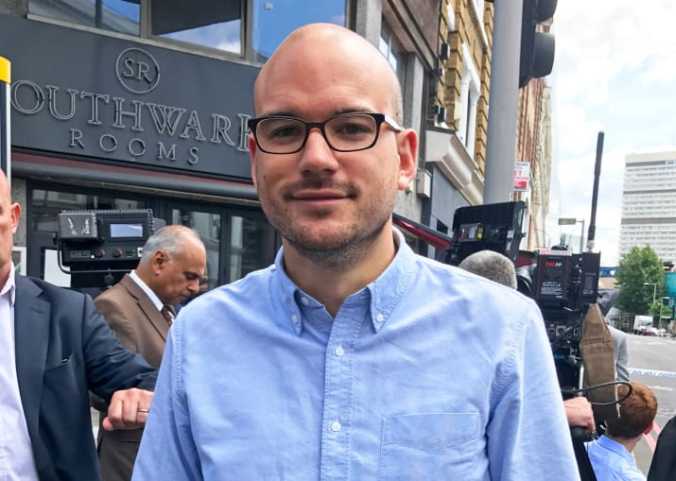
Ethics Hero: London Terror Attack Witness Richard Angell

Richard Angell, the director of a British Labour Party think tank called Progress,  was dining with friends at the Arabica Bar and Kitchen at London’s  Borough Market when he witnessed Saturday’s terrorist attack on London Bridge, like everyone else, he was focused on the unfolding scene, which he described in detail to Buzzfeed.

Unlike everyone else, Angell returned to the establishment, now closed indefinitely,  on Sunday morning so he could pay his tab and tip the staff.

“I’ve got to pay my bill. Also, we haven’t given the staff a tip and they looked out for us when they should have been helping themselves. It was lovely food and I want the rest of my main course,” he said.

He was displaying exemplary ethics. Yes, perhaps he was grandstanding a bit too: I’m not sure how this came to be publicized. I’m hoping that the restaurant owners reported what was meant to be an example of someone quietly doing the right thing when nobody was insisting on it. In fact, that’s what I’m going to believe what happened. Whatever his motives, Angell did the right thing. He deserves the benefit of the doubt, and I need an Ethics Hero.

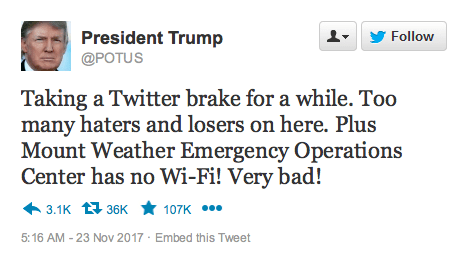
The President’s London Terror Tweets

I’ve GOT it! Make Trump move to the Mount Weather Emergency Operations Center! Problem Solved!

Flat learning curve. That’s really the most alarming thing about President Trump’s tweet barrage over the weekend, as he responded stupidly, irresponsibly and offensively to the terror attack in London. It proved that he hasn’t learned a thing, despite repeated Twitter-assisted catastrophes that in the past have turned potential victories into embarrassments, mere mistakes into disasters, and whimsy into large clubs for his enemies to beat him bloody with. How could he not be wary when he considers a tweet? What happened to “Once burned, twice shy?” How about 6,348 times burned? How analytical do you have to be to think, after hitting yourself in the head squarely with a 2 X 4 and realizing that it is permanently dented (the head, not the board), “Wow! That hurt! I sure don’t want to do that again!”?

And yet here we are.

I can’t say I’m surprised, and that itself is depressing. But I’ve dealt with enough alcoholics in my life who I have asked, following particularly devastating relapses that placed everything they cared about (or should have cared about) in jeopardy, “Why would you do that, after all you have been through?”…and watched them shrug, shake their heads, and say, in various words, “I can’t explain it, and you’ll never understand.”

After the two attacks on Saturday, the President’s tweets weren’t all terrible. The second one read, “Whatever the United States can do to help out in London and the U. K., we will be there – WE ARE WITH YOU. GOD BLESS!” Then, like a binge drinker out of rehab who takes a small sip of chablis at a reception, POTUS was on a Twitter bender—a Twender. He began exploiting the tragedy to lobby for his stalled travel ban. He blamed the attacks on political correctness. He mocked the Mayor of London. He somehow saw the episode as revealing the hypocrisy of gun control advocates. Metaphorically, the President of the United States was reeling and staggering all over the street, singing “Barnacle Bill,” stopping traffic and vomiting on pedestrians. Continue reading