Goodbye, Connie…

Connie Francis just died. I guess I just feel that attention should be paid.

She had a tragic life off the stage and out of the recording studio. Her Old Country father ended her romance with the man she believed was the love of her life; she was raped; she had serious emotional traumas. But I felt she was the greatest of all female pop singers, country singers, rock singers—hell, the woman could just sing. And that sob in her voice! I confess, every time I hear “Where the Boys Are” or its sequel, “Follow the Boys,” I get a pang.

I would have loved to hear Connie and Linda Ronstadt in their primes have a sing-off.

Neil Sedaka is quoted today in the Times as observing, “What struck me was the purity of the voice, the emotion, the perfect pitch and intonation, It was clear, concise, beautiful. When she sang ballads, they just soared.”

They just soared. Connie Francis never found love: her two marriages were to manipulative jerks, and both ended in less than a year. Like so many great artists, her own life was often miserable but her art made life a little better for millions, including me.

Connie Francis could sing in many languages, but none suited her style better than Italian: her real name was Concetta Franconero, and she grew up in Newark’s Italian section. I first heard that version of “Where the Boys Are” this year, on Pat Boone’s Fifties radio show. Wow.

Goodbye Connie, and thanks.

You were loved!

[And as a curtain call, “Follow the Boys…”]

President Trump: The Kennedy Center, NPR, PBS…Now Fix The Smithsonian, Please

I knew there was a reason I hadn’t been to the Smithsonian Institution for so long. Like so many other crucial institutions the apathy of sane and patriotic American allowed to become leftist propaganda weapons over the last 50 years or so, the Smithsonian, along with most of the major museums across the country, “stress on narratives over artifacts.” That’s a quote from Jonathan Turley in his annoying understated mode.

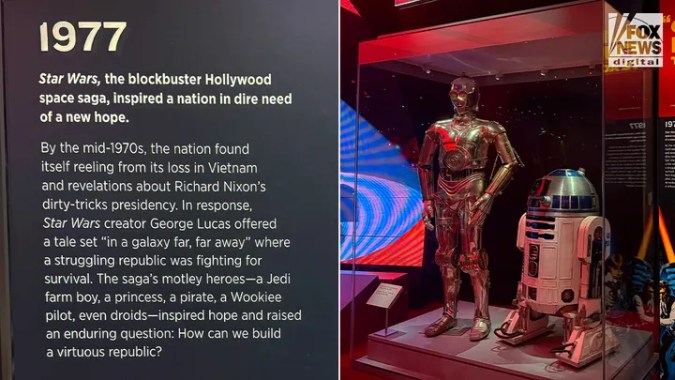
White House official Lindsey Halligan condemned the new National Museum of American History’s Entertainment Nation exhibit, writing, “American taxpayers should not be funding institutions that undermine our country or promote one-sided, divisive political narratives. The Smithsonian Institution should present history in a way that is accurate, balanced, and consistent with the values that make the United States of America exceptional.”

Gee, ya think?

That Star Wars exhibit above would have prompted me to walk out of the building. Turley comments, “I was one of those who went to the movie when it came out, and I cannot recall anyone thinking, let alone connecting, the film to Nixon or Vietnam.” Nor can I, because nobody thought that, even the most politics-obsessed. Even film reviewers, always mostly left-leaning and desperate to find hidden messages in the most apolitical films, didn’t think Jabba the Hut was meant to suggest Spiro Agnew, or something.

We’ve known this about the Smithsonian for a long time, of course, but just shrugged it off because so many other example of insidious political corruption are worse. The Institution tried to slap a war crimes narrative on the Enola Gay. It left Clarence Thomas out of the National Museum of African-American History because being conservative means that he doesn’t count.

Among the flagrant propagandizing noted by Turley:

  • The commentary tied to a 1923 circus poster, reads:Under the big top, circuses expressed the colonial impulse to claim dominion over the world.” Ah. So those clowns were supposed to be scary…
  • The Smithsonian declaresOne of the earliest defining traits of entertainment in the United States was extraordinary violence.” You know, because United States BAD. One of the earliest traits of HUMAN entertainment for thousands of years was “extraordinary violence”! That one would have also had me running for the exits. Gladiators? Bull-baiting? Public executions? Grimm’s Fairy Tales???
  • The Lone Ranger display states:The White title character’s relationship with Tonto resembled how the U.S. government imagined itself the world’s Lone Ranger.”

Oh for God’s sake…

Fix this, Mr. President. Fire the administrators and curators, all of them. Start from scratch.

Comment of the Day 2, “All That Jazz” Edition: “Does Jazz Really Need DEI?”

I never know when a relatively obscure topic will strike a chord and produced a bumper crop of terrific comments. “Does Jazz Really Need DEI?”turned out to be such a post. Here is the second standout response, a Comment of the Day by johnburger 2013 on the post, Does Jazz Really Need DEI?

***

Here I thought Berklee College of Music was a serious institution. Silly me. Any institution with the following mission statement should be dismissed:

“The mission of the Berklee Institute of Jazz and Gender Justice is to support and sustain a cultural transformation in jazz, with the commitment to recruit, teach, mentor, and advocate for musicians seeking to study or perform jazz, with gender justice and racial justice as guiding principles.” (emphases added).

Just out of curiosity, what the hell does “gender justice” mean and what does it have to do with vamping in E flatMinor? Do we only study songs written by women? Do women prefer major modalities over augmented fifths? Do women avoid playing the F#maj13add4addflat7 chord?

Music is the one medium where gender and race are monumentally irrelevant. Is Within Temptation fantastic because the lead singer is a woman? No. The combo is great because their music is complex and full of surprises. The Warning (my most recent favorite band) isn’t great because it consists of three Mexican sisters. No. They are great because their music is intricate and heavy. The fact that they started out very young and have gained world-wide recognition as a family band is interesting but they are phenomenal musicians and songwriters. Kiki Wongo isn’t great because she is a woman, but because she has talent and tone, and can melt your heart or tear your face off with her guitar playing (Smashing Pumpkins realized her greatness when they selected her out of 10s of thousands of applicants for their lead guitarist on their latest tours). Linda Ronstadt wasn’t great because she is a woman; she was great because her voice compelled attention and takes you on all kinds of sonic adventures. [Editor’s note: Linda cannot sing any more because of Parkinson’s, but she was indeed great, and is still a great interview.)

As for “racial justice,” does that mean that only minorities are allowed to play jazz? Dizzie Gillespie, Miles Davis and John Coltrane are not considered jazz geniuses because they were African American. No, they were great because they wrote and played the vocabulary for modern jazz. What about Buddy Rich? Was rich great because he was white? Hardly: he is great because he could play drums like nobody’s business and had a sublime sense of rhythm.

Comment of the Day 1, “All That Jazz” Edition: “Does Jazz Really Need DEI?”

The recent essay about the efforts of an apparently bonkers music school to apply DEI policies to the jazz world was really a “Bias Makes You Stupid” post, and perhaps I should have framed it that way. After all, nobody, no institution, no profession, no workplace “needs” DEI discrimination. As my father would say, the nation and society need DEI “like a hole in the head.” In fact, DEI is a metaphorical hole in the head of the nation allowing core American principles to leak out.

I found Sarah B’s Comment of the Day, prompted by Chris Marschner’s comment regarding the correlation between jazz improvisation ans mathematics ability, both fascinating and, as usual with Sarah’s comments, illuminating. (I also found the context of her use of the phrase “toot my own horn” brilliant. )Here it is, in response to the post, Does Jazz Really Need DEI?:

As a woman musician and mathematician (my husband would claim engineers aren’t mathematicians, but the lay person sees no difference), I think there is one aspect of Jazz that you are forgetting. I tried Jazz and not only do I hate the sounds of Jazz (I like Chopin, Beethoven, and Holst as my personal preference), but I also found the emphasis on improvisation impossible. I cannot improvise music, or anything really. I have no skill at making up music, though if you give me sheet music not horrendously above my level, I’ll play it for you, at least with adequate practice. I can sing nearly anything (in my range) that you can throw at me in at least seven different languages, and with a little time, I can do them from memory. I have a repertoire of several hundred songs that I can pick up and perform adequately on a given day without much more than a little warmup. I read soprano and bass clefs before I read English (my only language). I dabble in 7 instruments, with 2 of those mastered “enough”.

All of this is not to toot my own horn. I have much I could do to improve my music, but I have other priorities and I am happy at “good enough”. However, with all this musical study, I have found that while I can do a lot, I CANNOT improvise, nor can I make up my own lyrics. This means that Jazz musicianship is beyond my reach. It takes a different type of mind than mine to be a good Jazz musician, and not just someone who knows the math and the theory. There is another element besides musical and mathematical thinking, that of a certain type of creativity.

Continue reading

Does Jazz Really Need DEI?

I would say that DEI has more rapidly than most reached the final evolutionary stage noted by philosopher Eric Hoffer, who famously observed that every great cause begins as a movement, becomes a business, and eventually degenerates into a racket. The problem with that is that DEI was never a great cause to begin with. However, it has definitely entered its racket stage, and maybe its certifiably insane stage. Behold…

Institute of Jazz and Gender Justice—no, I’m not making that up— at Boston’s Berklee College of Music has issued the results of a study that claims to show that because “male-identified jazz educators” outnumber “female-identified counterparts” six to one, it is proof that jazz “remains predominantly male due to a biased system.” The Institute’s website asks,“What would jazz sound like in a culture without patriarchy?” One wag’s answer: “Probably like nothing at all.”

Indeed most jazz musicians and composer are male. If the only tool you have is a hammer, everything looks like a nail, and if any variation from demographic equality proves bias, oppression and discrimination in your DEI worldview, then this phenomenon is sinister. Researcher Lara Pellegrinelli PhD is an “ethnomusicologist” who contributed to the study. She blathers, “To identify each jazz faculty member by gender, we examined the pronouns we encountered in these sources—and found only “he” and “she” in reference to the educators in our study. This is why we use the terminology “female-identified” and “male-identified” for our data, as opposed to sex assigned at birth or the descriptors “female-identifying” and “male-identifying,” which suggests a more active process of participant self-identification.”

Oh.

Continue reading

Unethical Rendition of the National Anthem Ethics: Regarding Broadway Diva Kristin Chenoweth

Kristin Chenoweth, the long-time Broadway soprano who has won accolades for, among other triumphs, her performance as Glinda in “Wicked, has been getting flamed on social media and elsewhere for her performance of “The Star Spangled Banner” before the NBA’s Championship Finals.

Another performing soprano I know and trust was horrified at Kristin’s rendition, writing me, “She needs to be put out to pasture for this. There’s not a single redeeming quality about it. I can’t believe how amateur her technique and choices are. Shameful and disappointing.  I used to think she was talented. Now I just think she’s made a career out of being a hack.”

Continue reading

Announcing a New Ethics Alarms Principal: The Jumanji Axe

As regular and long-time readers here know, Ethics Alarms is fond of useful analogies and metaphors from popular culture that illustrate regularly occurring ethics breaches, self-defeating irresponsible conduct, or the proper remedies or reactions to them, in society at large or various segments of it. Hence we have the Barn Door Fallacy, the Julie Principle, the Popeye, the Nelson (“Ha-ha!”), the Ripley, the Costanza, and quite a few others.

I was, just this morning, in a discussion with a bar ethics counsel regarding a serious problem in the legal world. It is a corrupt system that neither the legal profession nor the incompetent news media has let the public know about, one that amounts to a multi-level scandal that hurts everyone except the unscrupulous, greedy lawyers who participate in it. At one point she said to me, “You know, we have had the means available to address this all along, and it never occurred to us even when the solution was not only obvious, but right in our hands.”

And I thought of that moment above from “Jumanji.” At least the kid in the movie had an excuse, since he had been turned into a monkey….

Do you have some current candidates for an Ethics Alarms “Jumanji Axe”? Let me know about them in the comments.

Comment of the Day: “Jaws Ethics”

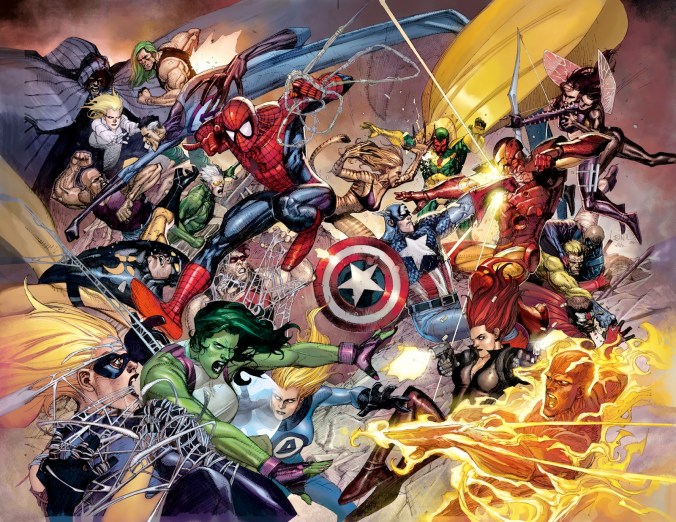
The “Jaws” post, predictably, set off a lively debate about cultural icons, though, significantly, nobody yet has tried to maintain that “Jaws” isn’t one. Along comes halethomp with this Comment of the Day exploring the matter of whether Disney’s Marvel movies, now in decline, qualify as “iconic.” Personally, I don’t think so. There are iconic super heroes to be sure, but perhaps because they were late to the party, no Marvel character qualifies to stand next to Superman and Batman. No single film qualifies either in that genre by my standards: I think TCM host Ben Mankiewicz nailed it when he compared the Marvel film franchise to MGM musicals. Both genres have intense, loyal devotees, but neither has produced a societal- and culture-wide icon. Maybe “Singing in the Rain,” qualifies, but its a close call. Icons create lasting images, quotes, values and lessons that cross generations, ideally gaining vigor over time and becoming powerful cultural influences. Personally, having been familiar with the principle that great power confers great responsibility from other sources, I have been surprised that Spiderman’s Uncle Ben has been getting credit for it. No, I don’t think resuscitating a classic maxim that younger generations missed because of galloping illiteracy should qualify one for icon status, but that’s just me.

Here is halethomp’s Comment of the Day on the post, “Jaws Ethics.”

***

Two quotes within the original post and the comments stood out to me as examples of the cultural arrogance that Jack often laments, both applying to the Marvel franchise (I include the various streaming series in this). “A competent, curious, responsible member of society wants to see “Jaws” because 1) it is famous 2) it is a cultural touch-point 3) one should understand why people remember and care about it and 4) when the public embraces anything so completely,” and “Marvel movies like their predecessor print comics are just good versus evil with different characters.”

First, regarding cultural impact, there are few as great as the line “With great power comes great responsibility” which Uncle Ben tells Peter Parker just before dying. I believe a great cultural reference is one that most people know regardless of whether they know its origin. It is not necessary to have ever read a comic book or seen a superhero movie or cartoon to know that quote: in fact, it has been applied and misapplied by many people for generations. In Jack’s own words, Marvel must be recognized as a cultural touch-point.

With regard to this blog, Marvel movies and television shows should be required viewing for their ethics implications. I have not watched all of the Marvel programs. I have no interest in Ant Man, Doctor Strange, Ms. Marvel, etc. However, the best ones represent not just conflicts between heroes and villains but within individuals and society at large, and provide a visual, cultural reference to real conflicts that have existed in our society in parallel with those of the comics and screens.

Continue reading

“Jaws” Ethics

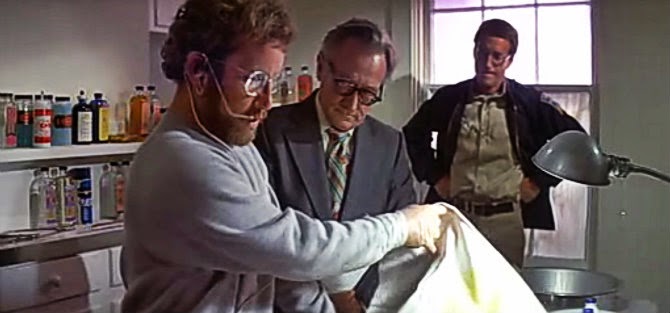
I have another classic ethics movie post in the pipeline, but this is the 50th anniversary of the Summer of “Jaws,” and attention should be paid. An obnoxious comment this morning from retired law professor blogress Ann Althouse drew my attention to the topic. She wrote,

“As for “Jaws,” I’ve never seen it. I’ve always imagined that it would bore me. I still feel that way. Waiting around for a shark to attack someone? I don’t see the point. I don’t have a tag for sharks. I have to give this post my “fish” tag. Have I ever seen a movie about fish? I don’t think so.”

Her quote isn’t exactly unethical, but it betrays an arrogance and a wilful ignorance of popular culture that does not show Ann in a good light. Althouse has some shocking gaps in her film and television literacy, and, as in this case, she often seems proud of her ignorance. As with all iconic movies and TV shows, being unfamiliar with “Jaws” means that you don’t comprehend references that have become part of modern communication: “You’re going to need a bigger boat!” and “This was no boating accident” come immediately to mind.

Someone saying, “I imagine that what so many people enjoy and remember would bore me” is a way of asserting unearned superiority; it reminds me of the snobs in Harvard bedroom community Arlington, Mass. who would say, “Oh, we never watch anything but PBS (you crass, low-brow peasants).” And they missed “Perry Mason,””The Defenders,” “The Honeymooners,” “The Hollywood Palace,” “The Avengers,” “Maverick,” “The Carol Burnett Show,” “The Smothers Comedy Brothers Hour,” “The Ed Sullivan Show,” “The Twilight Zone” and dozens more, all in the secure but ignorant belief that they were too sophisticated for such tripe.

Ann saying that she’s too sophisticated to watch “a movie about a fish” is like someone saying that they’ve never seen “Casablanca” because “who wants to see a movie about Morocco?,’ or “Singing in the Rain” because singing in the rain is a silly thing to do. A competent, curious, responsible member of society wants to see “Jaws” because 1) it is famous 2) it is a cultural touch-point 3) one should understand why people remember and care about it and 4) when the public embraces anything so completely, whether it is “Hamilton” or baseball or “The Mikado,” or Elvis or “Sergent Pepper’s Lonely Hearts Club Band,” or “Star Wars,” or “The Godfather” or Frank Sinatra or the Mona Lisa or “Oklahoma!” or John Wayne or Chuck Berry or Madonna or Taylor Swift or Bugs Bunny or Beethoven’s Fifth—the list is very long—the public’s opinion deserves respect. This why Rachel Zegler’s dissing of the original “Snow White” was so foolish and destructive. Nobody has to like or admire anything, but when a particular work of art or cultural phenomenon reaches icon status, there is always a reason. Not knowing the reason means one is just that much more incompetent as a participant in society.

“Jaws” is an important and even after 50 years, entertaining and powerful movie. Among its virtues:

Continue reading

Message to Simone Biles: “Shut Up and Vault!”

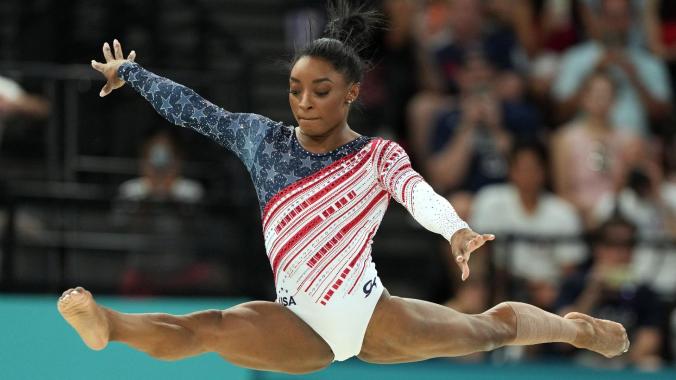
It shouldn’t matter than cute little Simone Biles isn’t very bright. She’s a talented gymnast, and has parlayed that skill into a fortune, a brand, and enough fame to last her a while. There was that choking episode at the 2020 Olympics, but never mind: she’s won enough championships and medals to qualify as one of the all-time greats.

Unfortunately, Biles, like so many other jocks and celebrities,, has let her popularity and acclaim in a very narrow field go to her head. She thinks she has something to contribute to national debates that have nothing to do with floor exercises and the balance beam, and she doesn’t. I’d love to know what books, if any, Biles has read while being essentially a full time gymnast since she was knee-high to a praying mantis. The fact that she never attended high school (she was home-schooled) and eventually got a college degree from a non-profit, online college doesn’t mean Simone necessarily is lacking in critical thinking skills, but her engaging in a name-calling battle with Riley Gaines—the former competitive swimmer who has become a critic of trans men who still have to shave every morning throttling girls and women in women’s sports because they can— does.

To begin with, Gaines is smart, articulate and knows her topic. Biles’ contribution to the debate has consisted of social media posts the equivalent of “Oh yeah?” and “Well, I’m better at my sport than you were at yours, so there!” Here’s one…

Continue reading