I didn’t expect a white Christmas in Northern Virginia this morning, and there wasn’t one. It’s a good thing too: a snow-covered vista would have probably made me cry, and that’s been happening too often this holiday season. (My mother, who made up Christmas traditions and legends as an avocation, once told my sister and me that it was bad luck for the whole year to come if you cried on Christmas.) The song “White Christmas” is supposed to make you cry, however, or at least get a bit misty.
I co-wrote two Christmas revues for my late, lamented (by me, anyway) professional theater company in Arlington, Virginia, The American Century Theater. The most popular of the two was called “If Only In My Dreams,” taken from the lyrics of another wistful Christmas song, “I’ll Be Home For Christmas,” by lyricist Kim Gannon and composer Walter Kent and introduced by Bing Crosby in 1943. The show was constructed around the letters written by GIs overseas during World War II to their families or girlfriends as Christmas loomed, alternating those stories with narration and the popular Christmas songs of the period.
The most famous and important of these songs was, of course, “White Christmas.” Bing Crosby’s version was the best selling single record of all time for half a century. When Irving Berlin handed the song over to the musician who transcribed his melodies (Irv could not read music and composed by ear, just like another brilliant and prolific tune-smith, Paul McCartney), he famously announced that he had written, not just the best song he had ever written, but the best song that anyone had ever written. Continue reading →
When I look back on what I wrote to introduce the greatest of all Christmas movies last year, I almost have to laugh, if I could laugh.
“What makes ‘Miracle on 34th Street” the most appropriate classic Christmas film for 2023 is its theme: the importance of conquering cynicism and pessimism, and always keeping one’s mind and heart open to hope…. I know my year has been especially miserable on multiple fronts. Nonetheless, I remain, at heart, about 12 years old. The same things make me laugh; my level of optimism remains high; I believe in this nation’s miraculous ability to somehow get out of the fixes it gets itself into; I’m still a romantic, and, yes, I think with a little luck and one more starting pitcher, the Boston Red Sox can make it to the World Series next year. I am being constantly confronted with old friends, some much younger than me, who have suddenly decided to be old: they think old, they act old, and they seem to have given up the future as irrelevant. The Santa Claus myth represents faith in the possible, or rather the impossible. Yes, its easier when you are a child, but it is worth the fight to never lose the part of you that still believes in magic and miracles.”
What a joke on me. My wife died unexpectedly in February. Hidden financial horrors were uncovered that she had been hiding from me. My son decided he was trans; a lot of those friends who were acting old ended up acting dead, and rather convincingly. I lost my last connection to my mother’s family when Aunt Bea died at 96; my mentor and Most Unforgettable Person, Tom Donohue of the U.S. Chamber of Commerce, died as well; one of my closest lawyer clients died too. Another loss that I felt: Luis Taint, the Boston Red Sox pitcher who was at the center of some of my most cherished baseball memories, died this year. A big theatrical project I had been working on for six months was abruptly cancelled (the theater was condemned as structurally unsound). Worst of all, the Red Sox had a star-crossed, frustrating season: if there’s anything worse than watching baseball alone, it’s watching your team lose alone.
Indeed, I do, as Auntie Mame sang, “need a little Christmas,” but it is very little indeed this year. Luckily for me, there’s a song for that: “Have Yourself a Merry Little Christmas,” from “Meet Me in St. Louis.”
So the Christmas movies are about it for me this holiday season. I’ve seen “It’s a Wonderful Life,” “White Christmas,” my favorite version of “A Christmas Carol,” “The Santa Clause,” and even “Holiday Inn.” (No, “Die Hard” and “Die Hard 2” are not “Christmas Movies.) “Elf” doesn’t make the cut; I suppose that I’ll see “A Christmas Story” eventually, though I am sick of it, and Grace’s complaints about Melinda Dillon’s hair haunt me. I will revisit “Home Alone” and “Home Alone 2.” I’m saving “Miracle on 34th Street” for tonight, Christmas Eve.
I confess, I believed n Santa Claus until I was 12. I didn’t want to give the fantasy up: I loved magic, and my parents always tried to make the season magical. (More of that later.) Grace and I tried to do the same with Grant, now “Samantha,” but he was a non-believer by the third grade. Is there anything more joyful to see than the look on a child’s face as he or she sees what Santa has delivered? Will anything feel that wonderful again?
“Miracle on 34th Street” is an ethics movie in part because its artists committed to telling a magical story and charming audiences by working as an ensemble selflessly and efficiently. The director, George Seaton also wrote the screenplay, and it won him an Oscar. He cast his movie brilliantly, and making the correct but bold decision to stick with a matter-of-fact, realistic, unadorned style that keeps the story grounded in reality while it spins off into fantasy.
“Miracle on 34th Street” is about the importance of believing in good things, hopeful things, even impossible things. The movie reminds us that wonderful things can happen even when they seem impossible, and that life is better when we believe that every day of our lives. I’m trying.
One thing this film does well is to concentrate on the secular holiday without any allusions to the religious holy day, but not being obnoxious about it. “It’s a Wonderful Life” straddles the line very cleverly: it begins in heaven, after all. All the “A Christmas Carol” films include Bob Cratchit telling his wife that Tiny Tim mused about how his disability reminded people of Jesus’s miracles at Christmastime, and that’s Dickens’ only reference to Jesus in his story. On the offensive side is the Rankin-Bass animated “Rudolph the Red-Nosed Reindeer”—I can’t believe they still show that thing—when the “stormy Christmas Eve” causes Santa to decide to “cancel Christmas.” I’d say that’s above Santa’s pay grade, wouldn’t you agree? It also suggests that Christmas is only about gifts and children. (Do parents today explain that the singing snowman who narrates the story is based on (and looks like) the real person who also sings the most memorable songs? They should. Burl Ives had a fascinating life and a varied career, and those kids will probably be hearing him sing “Have a Holly Jolly Christmas” for the rest of theirs.
Last year I discussed the many remakes and the fact that they all fail to equal the original. I wonder why this, of all the Christmas classics, has inspired so many remakes. Nobody would dare remake “It’s a Wonderful Life.” I think it’s because the story connects with children as well as adults, and there is a sense that a black and white movie very obviously set in the 1940s seems too distant.
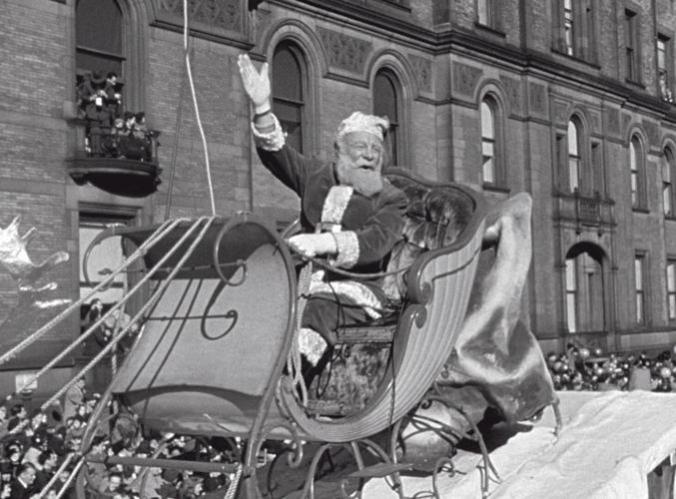
Interestingly, all of the perennial Christmas movies have been made into stage musicals of varying success—“White Christmas,” “It’s a Wonderful Life,” “A Christmas Story,” “Elf”—- but “Miracle on 34th Street” flopped so badly when Meredith Willson [“The Music Man”] adapted it as “Here’s Love” on Broadway that nobody has tried again. The show included the song, “It’s Beginning to Look a Lot Like Christmas,” which Willson wrote long before the show was assembled, and it was still the best song in the weak score. At one point John Payne took over the part of Fred Gailey, reprising his role in the film. But as with all the movie remakes, the show missed Edmund Gwynn, the best Kris Kringle of them all. Continue reading →
“Christmas is built upon a beautiful and intentional paradox; that the birth of the homeless should be celebrated in every home.”
—G.K. Chesterton.
“It’s Christmas Eve. It’s the one night of the year when we all act a little nicer, we smile a little easier, we cheer a little more. For a couple of hours out of the whole year we are the people that we always hoped we would be.”
—Frank Cross (Bill Murray) in “Scrooged”
CHARLIE BROWN: I guess you were right, Linus. I shouldn’t have picked this little tree. Everything I do turns into a disaster. I guess I really don’t know what Christmas is all about. Isn’t there anyone who knows what Christmas is all about?
LINUS: Sure, Charlie Brown. I can tell you what Christmas is all about. Lights, please?
“And there were in the same country shepherds abiding in the field, keeping watch over their flocks by night. And lo, the angel of the Lord came upon them, and the glory of the Lord shone round about them. And they were sore afraid. And the angel said unto them, ‘Fear not, for behold, I bring you tidings of great joy which shall be to all people. For unto you is born this day in the City of David a savior, which is Christ the Lord.’ And suddenly there was with the angel a multitude of the heavenly host, saying, ‘Glory to God in the highest, and on Earth peace, goodwill toward men.’”
That’s what Christmas is all about, Charlie Brown.
—Charles M. Schulz
“Our hearts grow tender with childhood memories and love of kindred, and we are better throughout the year for having, in spirit, become a child again at Christmas-time.”
—Laura Ingalls Wilder
“Then the Grinch thought of something he hadn’t before!
What if Christmas, he thought, doesn’t come from a store.
What if Christmas…perhaps…means a little bit more!”
—Dr. Seuss, “How the Grinch Stole Christmas”
“Want to keep Christ in Christmas? Feed the hungry, clothe the naked, forgive the guilty, welcome the unwanted, care for the ill, love your enemies, and do unto others as you would have done unto you.”
— Steve Maraboli, in “Unapologetically You: Reflections on Life and the Human Experience”
“My idea of Christmas, whether old-fashioned or modern, is very simple: loving others. Come to think of it, why do we have to wait for Christmas to do that?”
— Bob Hope
“I heard the bells on Christmas Day Their old, familiar carols play, And wild and sweet The words repeat Of peace on earth, good-will to men!”
—Henry Wadsworth Longfellow
“There are many things from which I might have derived good, by which I have not profited, I dare say,’ returned the nephew. ‘Christmas among the rest. But I am sure I have always thought of Christmas time, when it has come round—apart from the veneration due to its sacred name and origin, if anything belonging to it can be apart from that—as a good time; a kind, forgiving, charitable, pleasant time; the only time I know of, in the long calendar of the year, when men and women seem by one consent to open their shut-up hearts freely, and to think of people below them as if they really were fellow-passengers to the grave, and not another race of creatures bound on other journeys. And therefore, uncle, though it has never put a scrap of gold or silver in my pocket, I believe that it has done me good, and will do me good; and I say, God bless it!”
—Fred, Scrooge’s Nephew, in Charles Dickens’ “A Christmas Carol”Continue reading →
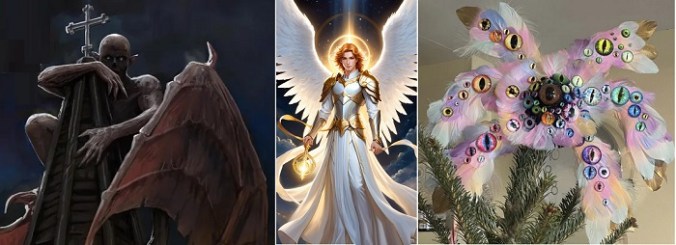
Above you will see three interpretations of what angels—you know, those benign, heavenly creatures we hear on high and observe, “Hark! They sing!,” the celestial guardians like the funny little old man who shows Jimmy Stewart that he’s really led a wonderful life, the kind of immortal being that appeared to Mary to tell her she was going to bear the Son of God, you know, those things?—really look like. The version on the left is from the Mike Flanagan horror series “Midnight Mass.” It’s a scary angel, but not as scary as the ones that show up in Robert and Michelle King’s scary TV series “Evil,” which look like this…
Yikes.
The version of Gabriel in the center is pretty much how I had been taught and told and shown how angels look for most of my life, and I assumed that was how they are represented in the Bible. Now, this is at least partially my own fault for not knowing the Bible better than I do, but when artists, churches, Sunday school teachers, movies, tree ornaments, Christmas cards and children’s books all show angels as friendly-looking Scandinavians with big, white, fluffy wings, I think I can be excused for assuming that there is at least as much authority for those representations as there is for anything else in the Bible—-an assertion to which Carnac the Magnificent (oh, look it up, ye of pop culture deficit!) would say to me, “You are wrong, Ethics Breath!”
I finished a seven hour deposition late yesterday (the lawyer grilling me was a Red Sox fan, so it was okay), and from here until after New Year’s Day, I have nothing on my calendar…no, not even Christmas. I am giving gifts to the two families on my cul de sac, my long-time neighbors the Wests who have been so supportive this year, and the absurdly perfect young couple next door with their three adorable children, who warm my cold heart every time I see them riding bikes together, creating adventures, and generally making me feel like I was a crummy father. Unfortunately, the season is reminding me both of wonderful times long gone and last year’s grim, painful holidays, so everything is causing me crippling cognitive dissonance. I can’t wait for it all to be over on January 2.
Nevertheless, I am going to read “A Christmas Carol” to Spuds out loud, and of course watch at least two of the dramatic versions, the 1984 George C. Scott version, and, of course, “Mr. Magoo’s Christmas Carol.” I like all the “Christmas Carols” except the horrible musical starring Albert Finney and Patrick Stewart’s weak entry. No, I don’t count Bill Murray’s “Scooged,” but I do enjoy it if I’m in the right mood. I favor George’s version, first, because he was one of my favorite actors and I miss him, second, because the rest of the cast contains many of my other favorites like Edward Woodward and David Warner, and the creepiest Marley by far. I also admire the adaptation.
The entire text of “A Christmas Carol” is and has been for a long time listed under Inspirations on the Ethics Alarms homepage. I often wonder if anyone uses the Ethics Alarms links, which now reminds me that its time to cull, revise, and update the collection. I use them.
Last year I noted that the last time I directed a professional theatrical production that wasn’t my own, it was a staged reading of “A Christmas Carol.” I miss directing greatly, but if was my last hurrah, I can live with that. “A Christmas Carol” is, after all, the greatest ethics story of them all.
I worry that this Christmas the neighborhood is looking at me as Scrooge: mine is one of the few homes in the neighborhood with no lights, and no decorations, and I have been walking Spuds wearing a black Santa hat that reads “Bah Humbug.” It’s a joke, but maybe people think it’s my real attitude. Nothing could be further from the truth. I love Christmas; I always have and always will. This year, I hope for the last time, it doesn’t love me.
[This is Jack:Yikes! I didn’t realize that EA had been Curmie-less for a full four months!The second Ethics Alarms featured columnist has been both busy and seeking respite from politics, which unfortunately has been disproportionately rampant here during the Presidential campaign drama and related horrors. I’m hoping Curmie can leads us out of the dark into the light. Welcome back, Curmie!]
I’m not sure if this is sufficiently ethics-related for this blog, but since Jack posted it, so be it.
I retired from full-time teaching in August of 2021. It was August instead of May because I was hoping—to no avail, as it turns out—to do one more iteration of a Study Abroad program in Ireland; the trip had already been postponed from the previous summer. I did teach one course per semester in the 2021-22 academic year, but then not at all for two years.
I assumed that I’d never be in a classroom again except for an occasional guest appearance to be, apparently, the local authority on absurdism. But then a colleague got a one-semester sabbatical to work on her book. It would be extremely unlikely to find someone who had both the ability to teach all the courses in question and the willingness to move to small-town East Texas for a one-semester gig at crappy pay. The powers-that-be then decided to try to staff those courses locally. I suspect I was the only available qualified person in a 75-mile radius, so I was asked if I’d teach Theatre History I and II this semester. I agreed.
There were a lot of changes for me, completely apart from the two-year hiatus. I’d taught both courses numerous times, but never in the same semester, and always on a Monday/Wednesday/Friday schedule; this time it was Tuesday/Thursday. Back in the days when I was the only person teaching these courses I could insist that one of the research papers be on a certain type of topic; that’s no longer a requirement. And I ditched the expensive anthology I’d used for years, switching to things that were available online. This also allowed me to choose the plays I wanted to teach instead of necessarily the ones in the anthology: critics may agree that the The Cherry Orchard is Anton Chekhov’s best play, for example, but there is absolutely no question that The Seagull is far more important to theatre history, so I used that.
Last night I was totally blotto and depressed, took myself to a favorite restaurant to dine alone (I was looking for “a place where everybody knows my name” because the owner and some of the staff knew me and Grace because we started going there the week it opened, but none of them were around. Or were avoiding me…). I even had a stiff drink, my third this year.
I didn’t help. When I returned home, I decided to watch a semi-Christmas movie, the 1942 Irving Berlin movie musical “Holiday Inn” with Bing Crosby and Fred Astaire that I realized I hadn’t watched in decades, and never critically. The movie spawned several Irving Berlin classics, “White Christmas” and “Easter Parade” among them, as well as the movie “White Christmas,” which shares several ingredients with its predecessor—it’s a musical, it takes place at a resort inn in the country, Bing’s the star and sings his iconic Christmas song, he has an old friend and partner who dances, and there are two women who perform with them—but the movies have completely different plots.
And “White Christmas” has no blackface number….
One of the few moments I remembered from the film was Astaire’s number above, which is spectacular. In the movie he improvises it on the spot when his dancing partner doesn’t show up, which is of course impossible, even for Fred. In fact, the entire movie is so ridiculous and contrived that suspension of disbelief is out of the question: It makes “White Christmas” look like a documentary by comparison. Another realization: As well as Bing Crosby sang in the Fifties, his freak voice in the Forties was much better. Wow.
And yes, the movie was the inspiration for the founders of the motel chain to call it Holiday Inn. Apparently they didn’t pay Irving Berlin a penny, the cheap bastards.
“Holiday Inn” is definitely not about ethics, as it is completely mindless.
But you’re going to make your contributions to day about ethics, right?
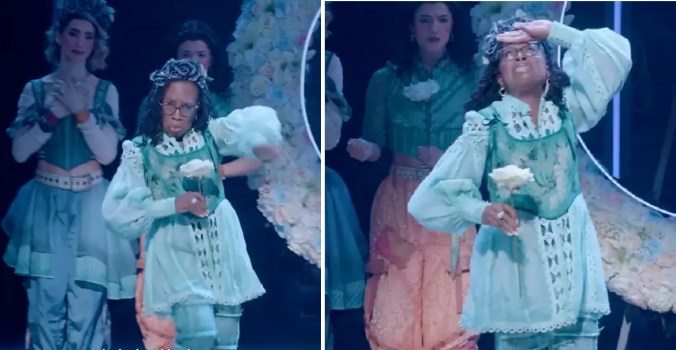
Above are some examples of SCOTUS Justice Ketanji Brown Jackson making a spectacle of herself in her Broadway turn last weekend in the musical “& Juliet,” a LGBTQ adaptation of William Shakespeare’s “Romeo & Juliet.” Jackson portrayed Queen Mab, described as a “she/her” character on a production poster, in two scenes written especially for her. “I just also think it’s very important to remind people that justices are human beings, that we have dreams, and that we are public servants,” Jackson told“CBS Mornings” prior to the performance. One of her dreams was apparently to be an actress, long ago. (She made the right choice going into law.)
Except that judges, and especially Supreme Court justices, don’t have the option of doing whatever they feel like or dream about, as least if they are conservative justices. All of the criticism of the Roberts Court in the past few years has been over alleged ethical violations by the Justices making up the 6-3 conservative majority. The Justices appointed by Democrats Obama and Biden are, of course, as pure as Ivory Soap. And yet…
Netflix has a Christmas movie (well, if “Die Hard is a Christmas movie, this is) about a TSA agent caught up in a diabolical scheme to kill all the passengers on a commercial airplane for some reason or another—that part doesn’t really matter. In “Carry On,” our hero stumbles into the plot and is made the unwilling pawn of the villains, who are ubiquitous, brilliant and high-tech. Through an earpiece, the agent learns that the love of his life who is also pregnant is being watched by the bad guys and will be murdered at any second if he doesn’t use his position to get a piece of luggage containing a device that will release nerve gas through security screening. Suspense, thrills and unexpected twists ensue.
I’m probably not celebrating Christmas anywhere but on Ethics Alarms this year. Last Christmas was truly awful in every way, with my wife Grace in pain and suffering from some creeping malady that killed her in February and that I was too blind to detect (and so were her doctors). We were also in our worst financial crunch in 25 years of running our ethics business, my son was having personal problems, and all was definitely not happy and bright.
I am certainly conflicted about the holiday this year. I am a passionate Christmas booster, as long-time readers here know, because I regard the secular holiday as a vital social balm as well as an ethics catalyst. It is a unique holiday that calls on us to be kind, generous and forgiving, and, if possible (I’m trying!) to just be happy for life and its wonders. I am not religious, but I do believe that this is a profoundly ethical time of year. We all need Christmas, frankly. I need it, even though I dread every minute of it this year.
One of the special features of Christmas is that it is soaked with nostalgia and traditions along with bittersweet memories of people and events long past. Charles Dickens got this aspect of the holiday exactly right; it is why I love “A Christmas Carol” so much and have so often participated in public presentations of the story. My last professional directing gig was a staged reading of it, and that was the fourth time I have overseen one; I also have organized and directed three mass “radio” readings, using conference call technology and the sound effects wizardry of Keith Bell. (Where is Keith these days? See, there’s another memory knocking!).
With The American Century Theater, I co-wrote and presented two Christmas musical revues: “If Only In My Dreams,” which centered on the letters GIs wrote home at Christmastime during World War II, and “An American Century Christmas,” a salute to the old-fashioned TV Christmas specials and perennial Christmas movies like the three that have Ethics Alarms “guides’ here: “It’s A Wonderful Life,” which I posted at Thanksgiving, “White Christmas,” which will be updated and posted soon, and on Christmas Eve this year, “Miracle on 34th Street.” The first revue was more popular, but the second was my favorite, because it was generated entirely by my own warm memories of what Christmas was like for me and my sister growing up in Arlington, Massachusetts.
Both of our parents were Depression kids in poor families and their Christmases were spare at best, so both were determined to make the holiday magical for their children. And it was. We would decorate the tree carefully and lovingly a week before the 25th—I remember my mother insisting that each strand of genuine tin tinsel saved for years be placed individually on the branches—and go to bed after hanging our (huge) stockings with visions of sugarplums dancing in our heads. When we got up on Christmas morning, my parents had meticulous constructed a “Christmas panorama,” with the giant stockings stuffed with gadgets, oranges, walnuts and small packages lying by the fireplace, and the whole living room covered with presents, mine on the left of the living room, my sister’s on the right. The gifts were mostly unwrapped, and the vista was ever spectacular.
My father, a photography fanatic who was terrible at his hobby, had the old home movie projector spotlights blazing. He would record Edith and I coming down the stairs to see the amazing treasure left by Santa as mom looked on beaming and eager to see our reactions. My parents insisted on going through this ritual even after we were in college! My mother wouldn’t let the tradition go.
In 1963, the week before Christmas, Bing Crosby hosted “The Hollywood Palace,” a live variety show that was always headed by some entertainment legend, though Bing had the honor more than anyone else. That week he introduced a new Christmas song, the last popular Christmas song to have an unambiguous religious context. That was “Do You Hear What I Hear?,” and the video above was what I saw live. Something in the song immediately resonated with me; I was always a Bing Crosby fan, following the guidance of my father, but I loved everything about the new song despite its childlike simplicity. I said so immediately following Bing’s rendition. Sure enough, the song was playing on our old Magnavox stereo when my sister and I came down the stairs in our pajamas on Christmas morning.
“Do You Hear What I Hear?,” Bing’s version of course though there have been hundreds of covers, is the first Christmas song I play every year as soon as whiffs of holly, evergreens and mistletoe are in the air. It throws my mind back to those magical Christmases that Grace and I tried to recreate for our son every year while he was growing up. That magic was significantly dimmed when my father died, in his sleep, on my birthday in 2009, leading to the saddest Marshall Christmas. The spirit fell away a bit more the next year, when my mother, who never got over losing the love of her life after 58 years of marriage, was in the hospital fighting a voracious hospital infestion that killed her two months later. Christmas was never the same after Mom died: it was her joy and obsession. Still Christmas reminds me of her, and Dad, and that lost magic…and Bing.
I was pondering when and whether to put up a post about “Do You Here What I Hear?” this year when I checked out Ann Althouse’s blog and discovered that she had posted the video as a joke after her post about Jill Biden getting a laugh at her Christmas comments wishing the assembled “joy.” Apparently some took her choice of words as a sly swipe at Kamala Harris’s ill-fated “joy” theme.
In the comments to the post, some wags made jokes about how the shepherd boy tells the king to bring the “child shivering in the cold” silver and gold when what the baby needed was a blanket or a space heater. Yeah, good one: they made those jokes in 1963. Some jackass wrote, “If you listen to the lyrics, “Do You Hear What I Hear” ranks right up there with “Santa Claus is Coming to Town” for supposedly secular seasonal songs with aggressively creepy quasi-Christian imagery applied to Progressive pieties.”
Oh, bite me. The song was never intended to be “secular” and how it can be heard as “anti-Christian” is beyond me. And Bing: he was a devout Catholic, and one of the reasons Crosby became the voice of Christmas is that he sang Christmas music with such reverence and conviction. (The other reason was that he had that amazing, rich, expressive voice.).
It is especially perverse to impugn the lyrics of a Christmas song written by a man with the first name “Noël.” “Do You Hear What I Hear” was written in October of 1962 during the Cuban Missile Crisis, by a married songwriting team that wondered at the time if it would be the last thing they ever did. Regney, the lyricist, was born in France and had studied music at the Strasbourg Conservatory and at the Conservatoire National de Paris. When France was overwhelmed by Hitler’s troops in 1940, he was conscripted into the German army. As a Nazi soldier, Noël secretly joined the French underground and served as a spy, passing information along to the resistance. Once he led German soldiers into a trap where they were massacred by French fighters who cut them down in a crossfire. Regney was shot too, but survived. He then deserted and worked with the French underground until the end of the war. Continue reading →

 Ethics Alarms