“A Nation Of Assholes” Epilogue, Baseball Edition

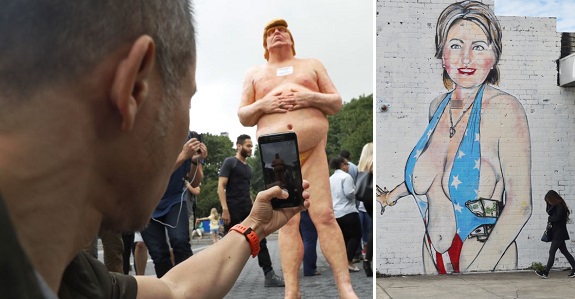
To be fair, Donald Trump supporters and Trump himself are not the only ones who would transform the United States into a rude, boorish snakepit of jerks and narcissists.

There is Bryce Harper, for example, shown above in his minor league days blowing a kiss to a pitcher after a home run.  In a much discussed interview with ESPN, Harper decried the “unwritten rules” of Major League Baseball, which, among other things, disapprove of showboating, trash-talking, styling, and showing up  opposing players. Naturally, many sportswriters, whose IQ and ethical standards hover perilously close to those of the juvenile, none-too-swift Harper, are flocking to his side.

“It’s a tired sport because you can’t express yourself. You can’t do what people in other sports do,” Harper said in the interview. “I’m not saying baseball is . . . boring . . . but it’s the excitement of the young guys who are coming into the game now who have flair. If that’s Matt Harvey or Jacob deGrom or Manny Machado or Joc Pederson or Andrew McCutchen or Yasiel Puig — there’s so many guys now who are so much fun.”

Nobody’s against fun, of course, and there have been many players past and present whose unique flair was justly celebrated. Harper, not being a rhetoric master, probably mixed up the harmless with the toxic in his list unintentionally, but there’s no excuse for Pulitzer Prize-winning sportswriter Tom Boswell, other than the fact that intellectual dishonesty is his career calling card.

“From Willie Mays basket catches to Pete Rose sprinting to first on a walk to Dennis Eckersley fanning his finger-pistol at hitters he had struck out, baseball needs all the authentic extroverted individuality it can get, ” writes Boswell in his piece about Harper in the Washington Post. Ah yes, the device of the deceptive metaphor. Willie Mays used the basket catch because that’s the way he caught baseballs. Pete Rose ran to first on walks because he hustled.

The pistol routine Eckersley used (occasionally)? He was being a jerk. Continue reading

More Casting Ethics: In Search Of Acting Afghans

whiskeytangofoxtrot

The problem is that our educational system belches out new graduates who have been indoctrinated into rigid and often absurd ideas about right and wrong, They quickly fill the culture with those ideas and their freedom-stultifying emanations. The ideas act like viruses: if you don’t diagnose them and wipe them out, our very minds are at risk.

Here is an example, by mere coincidence, concerning casting ethics, the same topic as the recent post about how some African-Americans seem to want to discriminate on the basis of skin shade, at least when it comes to casting movies. (Who knew?) I was reading Entertainment Weekly on an airplane, as I only read Entertainment Weekly on airplanes, and this whole issue (The “Batman v. Superman” issue) struck me as being written by 22 year-olds. In a review of Tina Fey’s latest bomb (“Whiskey Tango Foxtrot”—“WTF,” or What the Fuck, get it?), reviewer Leah Greenblatt wrote this…

“And its more than a little disappointing that the two major Afghan supporting roles are filled by obviously non-Afghan actors….”

Leah doesn’t bother to explain why it’s a little disappointing; she just assumes it’s obvious, as in, “What? They didn’t hire real Afghans to play Afghans? I’m outraged!” Meanwhile, a young impressionable reader who assumed that a film reviewer has some expertise in such things, would absorb this heretofore unknown standard of decency and take it as cant. Contagion! This is how the political correctness virus eats our brains. Continue reading

The Zoe Saldana-Nina Simone Controversy

I have been following this story for some time with a mixture of amusement and horror; satisfaction too, I suppose, as it is nice to see that black grievance-mongers are equally irrational when the imagined offender is black rather than white. There is integrity in this, after the irrationality of it all.

Nina Simone’s tribute website calls her a “classically trained pianist who evolved into a chart-topping chanteuse and committed civil rights activist.” As a white kid growing up in the Sixties, I missed Simone almost entirely: she wasn’t a regular guest on TV variety shows.  In college, I encountered aficionados who referred to her as brilliant, and I tried to appreciate her song stylings. She was one of those singers that  I could understand why she was famous and exceptional without wanting to listen to her for pleasure. At the time I regarded Simone as a cult singer, but that was unfair; she was obviously more important than that. I was also unaware of her considerable significance in the civil rights

Three years ago, Zoe Saldana was cast as Nina Simone in “Nina”, a major Hollywood film about the singer’s life, replacing singer Mary J. Blige, who was originally cast but dropped out. Immediately, the choice of Saldana, a rising black actress of Dominican and Puerto Rican parents best known for her work as Uhura on the “Star Trek” reboots, “Avatar,” and “Guardians of the Galaxy”, was attacked. She wasn’t a singer, isn’t a “true” African-American and doesn’t resemble Simone sufficiently, the critics said.

All of these accusations are ridiculous on their face. Most biopics about famous singers, though not all, star actors rather than vocalists: all singing is dubbed in after the film anyway. When, in the history of drama, has there been a rule that the performer’s ethnicity had to match the role he or she was playing? I wrote about the foolishness of this issue most recently here. What matters isn’t that Yul Brenner wasn’t really a Thai, what matters is that he was fantastic at playing the King of Siam. Continue reading

Post-Debate Ethics Part 3 (of 4): Of Drumpf And Other Cheapshots

donald-drumpf-john-oliver

When there is so, so much of substance to justify criticizing Donald Trump, it is absurd for any critics to engage in manufactured scandals and cheap shots. It is also annoying, because it forces me to defend the guy, when I’d so much prefer to be, say, stuffing grubs up my nose.

Gawker, not surprisingly, may have set the low bar (or just put the bar on the floor) for anti-Trump tactics when it published anonymous excerpts from Trump’s answering machine to show that he was chummy with liberal media figures. This obviously made Mediaite’s Joe Concha’s head explode, as he wrote in part, in a post called “Even for a Toxic Waste Dump like Gawker, this Trump Voicemail Story is Truly Craptastic”:

Here’s a little background for anyone with an ounce of lucidity: Donald Trump once worked for NBC as host of The Apprentice….Newsflash: Politicians and media members, particularly those on the editorial side, are actually friendly with each other. Bill O’Reilly, for example, has gone to Knicks and Yankees games with Trump in years past. He doesn’t hide from it nor should he. Because before running, Trump was an A-List celebrity in New York… has been for 30 years. A-listers tend to hang out, you know, with each other from time to time…Am I missing something? Seriously. Because the next dot this comically bad story attempts to make mocks Trump for not securing his voicemail, and then has the audacity to call him hypocritical for criticizing Hillary Clinton for her use of a private server out of her home while she was Secretary of State… as if these situations are remotely on the same planet….You know what, I can’t even comment on this anymore. The genius authors, Ashley Feinberg and Andy Cush… who really have a big future ahead of them, don’t deserve any more free promotion. I’m not even going to link it here.

This Gawker scoop was so bad virtually nobody would touch it. This is not the case with HBO’s John Oliver riff on Donald Trump’s grandfather’s name, however. In an epic and generally funny take-down of Trump at the end of February, Oliver devoted part of his deconstruction to the fact that Trump’s original family name was Drumpf until it was changed by his grandfather. Continue reading

It’s Corporation For Public Broadcasting Fundraising Time, Which Means Deception At NPR And PBS

The "Car Talk" brothers today, or so we are told.

The “Car Talk” brothers today, or so we are told.

It is fundraising time for the Corporation of Public Broadcasting, and once again, perhaps more than ever, NPR and PBS are lying to you. If you watch the PBS broadcast of “Downton Abbey” this weekend, for example, you will find the show introduced by a series of promotions for such companies as Viking Cruise Lines. These spots look, feel, sound and smell like commercials, but because PBS describes them with the euphemism “promotional considerations,” it thinks it can magically make them non-commercial, and thus, within seconds of running these ads, and while making its audience wait fifteen minutes to actually see the programming, describes PBS as “commercial-free television.”

If you can sell commercials, guys, don’t tell me that the survival of Western civilization depends on my tax-payer dollars going into your pockets.

Over at National Public Radio, it’s also deception and hypocrisy, but worse. I just turned on WMAU, a local NPR affiliate, and heard the familiar strains of Boston townie accents talking about automotive issues on “Car Talk,” where  the Tappet Brothers made the banter between Cliff and Norm sound pedestrian by comparison. After the last segment, in which “Click and Clack” answered a query from an LA area student about whether he should buy a car (Their answer, after much foolery: “No.”) Tom Tappet came on and explained that if this were commercial radio and they were sponsored by an auto manufacturer, the bothers might have felt pressured to give a different answer, or perhaps been fired for giving the honest one they did. And this is what is so important about NPR being listener-funded, he explained. It is independent radio. NPR is only interested in the objective truth, and isn’t swayed by conflict of interest.

Right, Tom! Ask Juan Williams about how independent NPR is. Continue reading

Oscar Ethics Post Mortem: The Academy Just Guaranteed That Whatever Artists Win Oscars Next Year, They Will Have No Credibility Whatsoever

Good job, everybody!

Good news, Sipke! The fix is in: if you make a movie this year, no matter how crappy it is, you'll get a nomination. Happy now?

Good news, Sipke! The fix is in: if you make a movie this year, no matter how crappy it is, you’ll get a nomination. Happy now?

Thanks to an extended public self-flagellation by the Academy of Motion Picture Arts And Scientists last night, any future Oscar nominations or awards to black performers, designers, writers and directors will be regarded by the public and the Hollywood community itself with justifiable suspicion, doubts and cynicism. Last night’s ceremony, from Chris Rock’s all-race monologue to the choice of the music over the credits, was a tacit commitment by the Academy to henceforth and forever name sufficient minority nominees and winners regardless of the merits of their work or the comparative merits of their work to any white artists. Diversity is officially more important than merit. By hook or by crook, there will now be prominent honors to Hollywood blacks….even if some of the honored work is crap.

Not surprisingly, given its traditional and intellectually wan reflex liberalism, Hollywood painted itself into an affirmative action and quotas mandate. After last night, the voters won’t dare fail to nominate a whole bunch of blacks, so Spike Lee will come to the ceremony.  This does put pressure on black artists to actually turn in some outstanding, or at least plausibly decent, work to avoid making all those guaranteed nominations and awards look as phony and rigged as they will be. If the 2017 Oscars include nominations for Samuel L. Jackson playing Samuel L. Jackson, a lifetime achievement award for Sydney Poitier and a gift nod to James Earl Jones for a charming cameo as a crusty old hermit in “The Sandlot, Part 3,” it’s going to be even more obvious what’s going on. Continue reading

More Photography Ethics: A Federal Court Rules That There Is No Right To Photograph Police

photographing_police

U.S. District Judge Mark Kearney has ruled that citizens don’t have a First Amendment right to take cellphone videos and photos of police unless they are challenging or criticizing the police conduct.

This opinion makes no sense, and is dead wrong.

Richard Fields, a Temple University student, took a cellphone photo of about 20 police officers standing outside a house party because, he testified, he thought it would be an interesting picture. Amanda Geraci, who says she is “a trained legal observer,” whatever that is, tried to video an arrest during a an anti-fracking  protest.

Fields had his cellphone seized and was cuffed, as an officer searched his cellphone before returning it and cited him for obstructing the highway and public passages while taking the photo.  Geraci said an officer physically restrained her to prevent her from recording the arrest. The two both sued for alleged First and Fourth Amendment violations, and their cases were consolidated before the court, as the same Constitutional issues were involved.

Judge Kearney argued that Fields and Geraci would have to show their behavior was “expressive conduct” to support a First Amendment claim. Neither plaintiff met that burden, because neither told the police why they wanted to capture the images, Kearney wrote. “The conduct must be direct and expressive; we cannot be left guessing as to the ‘expression’ intended by the conduct.”

“Applying this standard, we conclude Fields and Geraci cannot meet the burden of demonstrating their taking, or attempting to take, pictures with no further comments or conduct is ‘sufficiently imbued with elements of communication’ to be deemed expressive conduct. Neither Fields nor Geraci direct us to facts showing at the time they took or wanted to take pictures, they asserted anything to anyone. There is also no evidence any of the officers understood them as communicating any idea or message.”

What astounding nonsense! Would Kearney argue that an oil painting was similarly ambiguous as “expressive” without the painter saying, “I am painting the picture so that I have a painting that I can show others”? Continue reading

#FreeKesha Ethics: Ignorance, Indignation And Feminist Bias Vs. The Law

Kesha

Perhaps, if you don’t follow pop music, you managed to miss the long, long ongoing drama of singer Kesha’s (formerly “Ke$ha”—I know, I know… ) legal efforts to get out of her recording contract with  Sony and producer Dr. Luke, (Lukasz Gottwald) who has produced hits by other artists like Katy Perry, Rihanna, Pitbull and Miley Cyrus. It isn’t over, but the unethical caterwauling by Kesha and her supporters both in and out of the industry is deafening.

Also off-key.

Kesha Rose Sebert was 18  and an unknown singer from Nashville  when she signed a five or six (I have read both)  album contract with one of Dr. Luke’s recording companies in 2005. It took five years, but the producer’s faith in her paid off when Tik Tok became the No. 1 song in the country. Kesha released two albums in the next two years, but none since 2012.

In October 2014, Kesha’s legal team sued Dr. Luke for alleged sexual assault and battery, sexual harassment, gender violence, emotional abuse, and violation of California business practices since the beginning of their business relationship. The lawsuit claimed that Dr. Luke had  drugged her, raped her while she was drugged,  and also tormented her to the point where Kesha developed an  eating disorder that eventually required medical attention. Kesha asked that the court let her out of her exclusive recording contract because, as she put it in a sworn affidavit, “I cannot work with this monster.”

Dr. Luke, not appreciating being branded a rapist, filed a countersuit against Kesha and her attorneys for defamation, and accused her, her mother, and her management of fabricating the abuse claims to break her contract with him and his partner, Sony. Last November, Dr. Luke asked the judge to dismiss Kesha’s allegations of sexually abusing her. Continue reading

Ethics Dunce: Samuel French, Inc.

collage

A ridiculous and offensive example of misuse of legal process and interference with free speech was just flagged by self-exiled Ethics Alarms star, Barry “Ampersand” Deutsch on his blog.

In her one woman play Thatswhatshesaid, playwright Courtney Meaker cherry-picked lines from the female characters in the eleven most-produced plays of past theater season, according to one list, anyway. She mashed them up for effect, the effect being to show how “society forces women to conform to certain harmful and paradoxical gender stereotypes, and America’s most popular plays reflect those stereotypes. Playwrights perpetuate the patriarchy by creating roles for women that reduce them to one version or another of male fantasy or fear, and playhouses make sure those plays have a home.”

Okaaay, I think I’ll be passing on that one! Nevertheless, re-arranging bits and pieces of other copyrighted works to create a different work and message from any of the components is such a well-traveled and obvious tool of the modern arts that to say this play’s content is fair use, legal and ethical should be completely unnecessary. Collages that do this (see above) have been accepted as routine; musical works and videos too. Here’s a favorite of mine…

But law, ethics and art didn’t stop Samuel French, the theatrical publishing company which licenses some of the plays quoted in Thatswhatshesaid. The company  sent a last minute cease-and-desist notice right before a performance, demanding the play not be presented, and also left a threatening message on the voicemail of the show’s sole performer, Erin Pike, promising to “go after” her, “the presenter and the theater and all the folks connected to it.” Despite being warned by the theater not to defy the mighty French, Pike made sure her show went on anyway, like any good and courageous artist should.

What’s going on here? Continue reading

Celebrity Ethics: Sir Paul And Bill

Pual rejcected

Two recent ethics stories involving the famous, accomplished and popular:

1. Bill Murray The aging bad boy of SNL and “Groundhog Day,” found himself in some trouble recently when he was trying to chill at the Vesuvio rooftop lounge in Carmel, California, convenient to the annual Pebble Beach Pro-Am golf tourney in which Bill was playing. A few patrons started flashing cameras at him from close range—without asking, of course–and true to his on-screen character (and off-screen, where he is known as an impulsive jerk), Murray got up and chucked their phones off the 2nd story rooftop. Obviously, whatever the provocation, you can’t do that.

Bill paid for the phones, and the owners didn’t press charges. The problem for me were the typical reactions of commenters on the story, proving once again that the average, even above average member of the public can’t solve a simple ethics problem. Continue reading