No, Taylor Preparatory High School, There Is No “Rap Singing Teacher Principle”

I want to credit esteemed EA commenter JutGory for both the headline and the pointer. He properly identified this ethics tale out of Detroit as an important contrast to the “Naked Teacher Principle” and its many variations. The NTP et al. (like the the “Drag Queen School Principal Principle,” “the Porn Actor University Chancellor Principle,” and many others) holds that if you are a teacher or in some other position that requires the respect and trust of your employers and stakeholders, having photographs of you appearing naked or in other sexually provocative conditions appear on line justifies your separation from your job and leaves you no leave to complain.

Domonique Brown, however, a recent “Teacher of the Month” at Taylor Preparatory High School, did not have any naked photos or anything close on the web. She was fired from her job as a history teacher because the school learned that she had a second career as a rising rap artist named “Drippin’ Honey.” Brown had proven herself to be a skilled and popular teacher for seven years, and is pursuing a master’s degree and a doctorate. But when a parent alerted the school in an anonymous complaint last October that Domonique was also a rap artist, she found her fitness to teach being questioned.

Continue reading

Ethics Quiz: The RBG Awards

This quiz could be fairly paraphrased, if in vulgar fashion, as “Who’s the asshole?

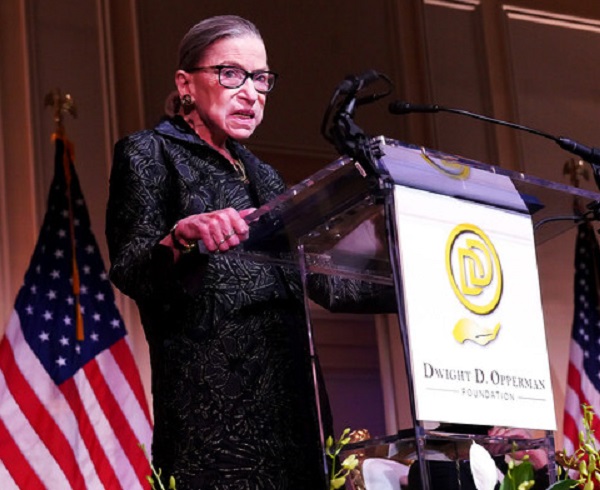
Established in 2019, the RBG Leadership Award is supposed to honor “trailblazing” men and women of distinction, with “distinction” having a rather broad and vaguely defined meaning, as the pronouncements of officials connected with the awards made clear. “Justice Ginsburg became an icon by bravely pursuing her own path and prevailing against the odds,” said Brendan V. Sullivan, Jr., chair of the RBG Award. “The honorees reflect the integrity and achievement that defined Justice Ginsburg’s career and legend.” “Justice Ginsburg was a legal entrepreneur who innovated and took risks in ways that rewarded us all,” said Matthew Umhofer, president of the Dwight D. Opperman Foundation, which administers the awards. “In a world that sought to define and limit her, she found ways to challenge and change the system, armed with nothing more than a brilliant mind and a powerful pen. Her impact transcended the law, and society is better off for it.” “Such is the spirit that defines the honorees of the RBG Award,” adds the award’s website.

This year, it was decided that the awards, which were originally limited to women of distinction (because Ginsburg was an iconic feminist and women’s rights advocate), should be awarded to men as well. “Justice Ginsburg fought not only for women but for everyone,” said Julie Opperman, Chair of the Dwight D. Opperman Foundation. “Going forward, to embrace the fullness of Justice Ginsburg’s legacy, we honor both women and men who have changed the world by doing what they do best.” 

[Can you see what’s coming? Diversity-obsessed progressives were set up to be hoisted on their own petard!]

When this years’ honorees were announced, it is fair to say that the late Justice Ginsburg’s family flipped out. The awards went to…

ELON MUSK – Entrepreneurship
SYLVESTER STALLONE – Cultural Icon
MARTHA STEWART – Industry Leadership 
MICHAEL MILKEN – Philanthropy
RUPERT MURDOCH – Media Mogul

…and the family’s and assorted Ginsburg admirers’ collective heads exploded. Jane C. Ginsburg, a law professor at Columbia University, said the choice of winners this year was “an affront to the memory of our mother.” “The justice’s family wish to make clear that they do not support using their mother’s name to celebrate this year’s slate of awardees, and that the justice’s family has no affiliation with and does not endorse these awards,” she said.

Trevor W. Morrison, a former dean of New York University School of Law and one of the justice’s former law clerks, condemned the choices in a letter addressed to the Dwight D. Opperman Foundation. “Justice Ginsburg had an abiding commitment to careful, rigorous analysis and to fair-minded engagement with people of opposing views,” he said “It is difficult to see how the decision to bestow the R.B.G. Award on this year’s slate reflects any appreciation for — or even awareness of — these dimensions of the justice’s legacy.” Shana Knizhnik, an author of “Notorious RBG: The Life and Times of Ruth Bader Ginsburg, ” spat out, “Honoring Elon Musk, who uses his platform to promote anti-feminist and anti-L.G.B.T.Q. sentiments, and Rupert Murdoch, who has used his immense power to undermine democracy, dishonors what Justice Ginsburg spent her career standing for.”

Your Ethics Alarms Ethics Quiz of the Day is…

Who is being unethical (unfair, disrespectful, incompetent irresponsible and/or breaching trust), the administrators of the awards, the critics of the awards, neither, or both?

Continue reading

If George Costanza Was in a Rock Band…

I’m assuming there is nobody reading this post who believes the following conduct is ethical, or that it isn’t justification for being fired.

The Nashville-based hardcore band Llorona ( named after a ghost in Mexican folklore who is said to roam near bodies of water mourning the children she drowned in a jealous rage) announced that it had fired its lead singer Diego after he admitted putting estrogen in the protein powder used by the band’s bass-player Sixx before his work-outs. This caused him to begin suffering various physical problems such as stomach ulcers, weight loss, muscle weakness and fatigue, as well as “notable mental changes” and other developments that Sixx described as too disgusting to describe. Worst of all, he began annoying his band mates by describing himself as “they.”

Okay, I made up that last part. Actually, the band members already used “they” to describe the bassplayer.

Continue reading

On Incompetent Pundits (Like Bill Maher)

It’s no wonder the “low-information” voter is confused. The media presents prominent individuals as experts, analysts and pundits who often lack the experience, education, erudition, breadth of information and, sadly, active brain cells to fulfill these roles competently. Meanwhile, much of the public lacks the tools and ability to distinguish legitimate authorities whose opinions are at least worthy of being taken seriously from the fake variety, as with the opinionated dolts of “The View,” officially a news program, remember.

I was forced to think about this toxic phenomenon when I read that Bill Maher proclaimed on his HBO political punditry/ comedy show that a President Biden -Nikki Haley ticket would be the perfect solution to the current Democratic Party dilemma as it prepares to face Adolf Hitler…excuse me, Donald Trump…in the upcoming election. Maher said Haley would be a “good fit” because she is a “woman of color.” “I know it’s crazy to think that she could run with Biden, but that’s my dream, a unity ticket. And then he would, I think, definitely win,” Maher said.

Good thinking, Bill: you’re an idiot. Worse than that, you’re a hypocrite.

Continue reading

No Surprises: The Academy Awards Botches Its “In Memoriam” Segment Again

Differently this time, but still. How hard is it to decide on fair, respectful criteria for the annual feature memorializing film artists who have shuffled of this mortal coil without making obvious omissions and displaying clear bias? Apparently it isn’t just hard, but impossible.

Ethics Alarms had covered this annual orgy of incompetence, unfairness and disrespect for so long, it goes back to when I actually watched the whole show and hadn’t concluded that it was entirely politically biased, phony, crap. Even if I hadn’t given up on the show, the presence of ethics villain Jimmy Kimmel as host guaranteed my absence, though I did force myself to watch the “In Memoriam” segment after the fact.

I agree with the conspiracy theorists who argue that the horrible direction of the over-produced segment this year, focusing on the choreography and often defaulting to such a long view that slides of the departed could barely be read was intentional. It seemed to be designed to foil the sharp-eyed critics who have called out Oscar’s snubs of significant performers, usually because they dared to spend more time on TV than on the big screen.

Continue reading

The Ethical Conflict of the Artist’s Self-Rejected Art

I was certain that Ethics Alarms had explored the problem of estates issuing, publishing and otherwise profiting from famous artists’ works when the artists have specifically said that the works involved were to be withheld from the public. It has not, however. I suppose the issue is ripe for an ethics quiz. However, as this is an issue that has always intrigued me, I’m going to use a current controversy to delve into the matter now.

Gabriel García Márquez (of “One Hundred Years of Solitude” fame, among other works) labored on a final novel in his last years. After five versions and constant edits, additions and deletions, he gave up. He ordered his son to destroy all versions of “Until August” upon his death. That occurred in 2014, but the novel was not destroyed as he requested. All the drafts, notes and fragments were deposited at the Harry Ransom Center at the University of Texas at Austin, in its Gabriel García Márquez archives. Now Márquez’s sons are defying their father’s wishes further and having the novel published this month. Because the author is a major international literary figure, the “new” work is considered to be a major publishing event.

But is it ethical to publish the novel at all, if 1) it wasn’t finished 2) its creator decided it wasn’t up to his standards, 3) the work risks diminishing the author’s reputation, and 4) the artist specifically directed that it be destroyed?

There just aren’t any clear rules for this problem. Whose interests take precedence, the creator of work of art, or the public and future generations that might benefit from it?

Continue reading

Do Progressives Realize What They Are Becoming?

It’s a serious question. Several episodes lately have reminded me of the ubiquitous saying about how we all risk becoming the thing we most hated in our youth, or that we inevitably turn into the person we hate most, etc. There are too many versions of the quotation to list.

I started my mind wandering down these dark corridors while researching a post I may never write about Harvard’s gobsmacking alumni magazine this month, as various writers and revered minds tried (and failed) to make sense out of the university’s recent travails without, somehow, saying anything critical about the woman at the center of them, deposed Harvard president Claudine Gay. After all, she is still on the faculty (and black, and a woman, and a DEI warrior), so being overtly negative about her conduct—as in making her accept responsibility—apparently would be too transparent to countenance.

In an essay reprinted from the “Chronicle of Higher Education,” Derek Bok (who became president of Harvard while I was a student there) wrote about the school’s cultural challenges, and, I noticed, never mentioned the term “progressive” once in his article, only the term “liberal.” And I thought, “Wow. Talk about being out of touch.” Does Bok really think today’s militant, intolerant, censoring, bullying, doctrinaire progressives would qualify as liberals in his era? Sure, they embrace many of the same agenda items, being anti-war, pro-drug use, wanting abortion on demand and other Sixties obsessions. But they are anything but liberal in the classic sense.

Continue reading

Thinking About “The Box”

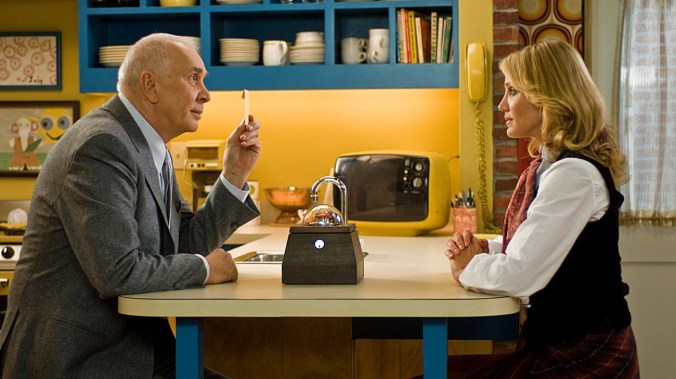
I recently re-watched “The Box,” which my wife and I had first seen more than a decade ago. It is a horror movie based on the 1970 short story “Button, Button” by Richard Matheson, one of the writers of the original “Twilight Zone,” and Matheson’s conceit, a mash-up of science fiction and ethics as his work often was, had been turned into an episode of one of the reboots of Rod Serling’s creation.

If I recall, I didn’t make it to the end of the film the first time, because the set-up was so annoying. A strange, disfigured man shows up at a couple’s door with a strange box in his hands. It consists of a red button under a locked glass dome that must be opened with a key. The man explains to the stunned wife (her husband is at work, getting bad news about his job) that they have been chosen to be the recipients of a gift. All they have to do is push the red button, and the man will return to hand over a brief case filled with a million dollars, which will be tax free. However, when the button is pushed, someone, somewhere in the world, will die. He assures the wife that they won’t know the doomed individual. They have only 24 hours to consider the offer, at the conclusion of which the man will return and take the box away to offer to someone else.

It is, obviously, an ethics hypothetical that has been posed in many different ways through the years. What bothered me originally, and worries me now, is that anyone I would care to have in my community would ever push the button. (As you can guess, one of the couple does—“Why not? It’s just a box…” and a chain reaction is launched that causes havoc.)

Continue reading

OK, I Know “Mary Poppins” Well Enough That When I Heard That the BBC Had Ruled That It Contained “Offensive Language,” I Immediately Knew Why

Why, that is, other than the fact that the UK has been lobotomized by The Great Stupid even more than the U.S. has.

Do you know what was “offensive” in one of my all-time favorite movies without cheating? Think, now…

Time’s up!

It’s this: Admiral Boom, a senile neighbor of the Banks family whose sole purpose in the plot is to set up a running gag showing how the Banks’ and their servants routinely deal with his shooting off a cannon (the house shakes, furniture slides around, things fall off shelves, hilarity reigns), twice refers to “Hottentots.”

The British Board of Film Classification announced that the film was resubmitted for a rating this month in preparation for a theatrical re-release. The Borad reclassified if from “G” to “PG” for discriminatory language, a spokesperson explained. “Mary Poppins (1964) includes two uses of the discriminatory term ‘Hottentots’…While “Mary Poppins” has a historical context, the use of discriminatory language is not condemned, and ultimately exceeds our guidelines for acceptable language. We therefore classified the film PG for discriminatory language.” The term was once used by the British to describe the Khoikhoi and San nomadic tribes in southern Africa—surely you remember them?

Continue reading

Did Oscar Hammerstein Jr. Have an Ethics Problem?

A series of random events have caused my mind to wander over to “Carousel,”the second musical by the legendary team of Richard Rodgers (music) and Oscar Hammerstein II (book and lyrics), following their ground-breaking “Oklahoma!” The 1945 work was adapted from Ferenc Molnár’s 1909 play “Liliom,” and although it is a favorite of most critics (declared by TIME as the best musical of the 20th Century, for example, but what does TIME know?), its plot and characters become more troubling the longer one thinks about them. Rodgers said it was his favorite of his musicals with Oscar, and he was definitely in top form; I think his Overture to “Carousel” may be the best thing he ever wrote.

For the “hero” of the musical, Billy Bigelow, is a thug, a dolt, and a domestic abuser. I found the musical hard to take even as a kid for those reasons. When, in his justly famous song “My Boy Bill” after learning that he is going to be a father, Billy suddenly realizes that he might end up with a daughter instead (this only occurs to the big dummy two-third of the way through), his immediate conclusion is that he’ll rob and steal if that’s what it takes to raise her. Sure enough, that’s what he does: ultimately Billy gets himself mixed up in a dumb robbery scheme that goes sideways, and he is killed. The whole show is about his bad decisions and an ultimate opportunity given to him by God (or someone) to leave Purgatory (where everyone has to polish stars) and go back to Earth for a day to try to clean up the mess he’s made.

Continue reading