The backlash and debate over the ridiculously inept responses by the presidents of MIT, Harvard and the University of Pennsylvania regarding anti-Semitic demonstrations on their campus touches on too many ethics issues for me to organize coherently right now, especially since I have been inundated by emails and phone calls from many people with diverse and perceptive thoughts about the matter. I’m going to devote this post to individual items related to the college leaders’ disgrace.
1. A core ethics conflict is the question of when campus demonstrations and speech cross a line into speech that undermines the educational mission of a school. A college is not required by the Constitution to permit all speech; the Supreme Court has been clear that when speech begins to interfere with the educational functions of a school, it can be disciplined and curtailed. The problem all three school presidents encountered is that their universities’ past record of restricting (or allowing to be restricted) conservative speech and speakers on campus made their stand appear to be that anti-Semitic speech on campus was tolerable even when it creates a hostile living and studying environment for Jewish students. As the prosecutorial Congresswoman pointed out while grilling the three women, racist sloganeering on campus would be swiftly shut down as harassment on their campuses. How can the double standard be justified? Answer: it can’t be.
…consider this coverage of the Jamaal Bowman censure. Some quotes:
“The House voted mostly along party lines to formally reprimand Rep. Jamaal Bowman over triggering a fire alarm last September, the latest episode of the GOP’s censure ire.” That’s the first sentence, essentially “Republicans pounce.” Bowman broke both a DC misdemeanor law by deliberately pulling a fire alarm without any fire, a federal law by disrupting a vote in Congress, and the House ethics rules as well. Politico frames this as a contrived partisan “gotcha!” by Republicans as in“There they go again, making a big deal out of nothing.” This is ethics corrupting behavior by Politico.
“Bowman (D-N.Y.) is the third Democrat that Republicans have voted to censure this year.” Same thing: the sentence implies that the censures were just partisan attacks without basis. Twenty-two Democrats joined Republicans in censuring Rep. Tlaib, whose repeated statements and tweets excusing Hamas while rationalizing the anti-Semitic chant “from the river to the sea” were exactly the kind of conduct condemned by the House ethics code. The hyper-partisan conduct in both cases was by the Democrats, most of whom couldn’t bring themselves to enforce Congress’s ethics standards as they must be enforced to protect the integrity of the institution. The House failed to censure Rep. Adam Schiff for his repeated lies in the media about the evidence of Trump campaign with Russia because Democrats protected him. The significance of the three censure votes involving Democrats is that the party’s ethics have rotted so thoroughly that Republican look relatively chaste by comparison.
“Bowman already pleaded guilty to a misdemeanor charge for pulling the fire alarm in a House office building during a chaotic vote on government funding at the end of September. The lawmaker had also agreed to pay the maximum fine, but some House Republicans who’d been incensed by Bowman’s actions demanded further punishment.” That commentary is moronic, and deliberately misleads readers. Its thrust is “he’s suffered enough,” as if the legal consequences of Bowman’s actions should preclude official sanctions by Congress. They are separate and distinct. Moreover, Bowman’s obvious lies about mistaking the fire alarm for a device that would unlock the door were worthy of House discipline themselves.
“Some on the right have charged that Bowman triggered the alarm to obstruct or delay the House proceedings that day, though he’s maintained he did not intentionally set off the alarm.” “Some on the right?” Bowman was caught on video doing exactly what he repeatedly claimed he did not do—still claims, in fact. In the video, he doesn’t try to get out of the building; he takes down the two signs that would undermine his lie about finding the doors locked and mistakenly pulling the alarm in a state of confusion and panic. The evidence is clear and undeniable: he intended to pull the alarm. Politico’s report sets out to mislead readers who haven’t followed the story so they will believe there is a legitimate controversy over Bowman’s actions and intent. There isn’t. Democrats decided to support an obvious lie.
Politico is considered a major political news source. It is biased and unreliable.
Glenn Loury, is an economist, academic, and author who holds the Merton P. Stoltz Professor of the Social Sciences and Professor of Economics at Brown University. Since he is tenured, Loury doesn’t feel constrained by the lock-step ideological conformity so many of his race (he’s black) hew to in the wake of the George Floyd Freakout. In his latest newsletter on substack, Loury writes in part,
Poetic truth “thri[ves] more by coercion than reason,” accusing all who dispute it of complicity with the ineradicably racist system that governs and has always governed the country.
That Darren Wilson executed Michael Brown is one such poetic truth; that Derek Chauvin murdered George Floyd is, I believe, another. Despite the aptness of Steele’s term, poetic truth is no truth at all, nor is it particularly poetic. It is power masquerading as fact, brute force in the guise of knowledge. The cities that burned across the country following Floyd’s death were expressions of such a truth, as was the incarceration of the police officers convicted of a crime they did not commit. The scramble toimplement race-based policies and quotas, to elevate self-appointed gurus of “antiracism,” and to proclaim, against all evidence, the unreconstructed nature of American society were all tendrils of the same truth, which still threatens to assert itself whenever an incident emerges that fits its preferred pattern.
The cost in life, limb, and property incurred by this particular poetic truth would be bad enough. But I fear that, in the aftermath, when the embers have cooled and Chauvin’s name has been forgotten by everyone save his family, the true danger of the poetic truth of George Floyd will come to fruition.
Later in the piece, Loury quotes John McWhorter, the New York Times pundit: Continue reading →
The title for this two-part edition of Curmie’s Conjectures refers to a song by the Irish punk band the Boomtown Rats, “Don’t Believe What You Read,” which includes not only the title admonition but also lines like “I know most what I read will be a lot of lies / But you learn really fast to read between the lines.”Part I of this exercise attempted to suggest something of the parameters of the problem. As Jack suggested in his introduction to that piece, it’s not an exhaustive list of the various forms of journalistic chicanery, but I hope it served as a representative sample.
Here in Part II, I’ll attempt the daunting task of examining strategies to “read between the lines” and come at least a little closer to the truth of what happened in a given situation. So, what to do? How do we determine if that less-than-objective source we’re reading actually has this one story right, especially if it’s the only source about a particular story? Boy, do I wish there was an easy answer to this one. That said…
The most effective means of ascertaining the truth, of course, is to get different perspectives on the issue. I think I’ve mentioned both here and on my own blog that when I was in England doing my MA (at the time “Don’t Believe What You Read” was released, as it happens), I’d alternate between reading the Telegraph, which leaned right, and the Guardian, which leaned left. If the former said “X but Y,” thereby suggesting that Y was the more important point, the latter would likely say “Y but X.” But whichever paper you read, you’d know that X and Y, though perhaps seemingly in opposition, were both true, and both worth knowing about.
Of course, both the Telegraph and the Guardian were, whatever their political perspectives, both reputable news sources. That’s a statement that would be difficult to make about many of the most prominent news media in this country in the 2020s. Equally importantly, as suggested in Part I, the problem is often that we hear only from one perspective.
There are three possibilities for why this should occur. One, which is (alas!) probably the least likely, is that both X and Y editors make an honest decision that a story is or is not newsworthy. Or X media outlet knowingly runs with a story that is either grossly distorted or fabricated altogether. Or outlet Y, knowing the story casts their team in an unfavorable light, ignores it, hoping it will just go away. At some point it becomes untenable to try to ferret out the true motives; the truth of the story may be a little easier to discern, although there are no guarantees.
[I am particularly grateful for this installment of Curmie’s Conjectures because it assuages my guilt a bit. As longtime readers here know, I occasionally promise posts that never show up, or do, but so long after the promise that it’s embarrassing. Years ago, I promised a post defining and examining all journalistic tricks that I classify as “fake news,” and I use the term broadly to include misleading headlines, burying the lede, omitting key information thatundermines the writer’s agenda, poisoning the well and other techniques. I started the thing, got frustrated and overwhelmed, and never finished it. Here Curmie doesn’t exactly present what I intended, but he touches on much of it, and as an extra bonus, he wrote it more elegantly than I would have (as usual). JM.]
I doubt that this blog has ever before turned to punk rock for ethics advice, but Boomtown Rats composer/frontman (and Live Aid impresario) Bob Geldof had it right in a song that’s probably more relevant today than it was 40+ years ago: “Don’t Believe What You Read.” Well, not uncritically, at least. At our host’s suggestion, I’m about to enter the fraught territory of trying to decide if a story published by an obviously biased media outlet might, this time, just be accurate.
It’s difficult of late to find a news source that only leans in one direction or the other, rather than proselytizing for the cause. The news networks and major newspapers have carved out their market shares based on feeding their viewers and readers what they want to be fed. Whether the advent of Fox News was a trigger or a reaction is up to individual interpretation, but there’s absolutely no doubt that we’re now in an era in which news as reported is determined largely by editorial positioning, rather than the other way around.
It’s inevitable that, to steal a line from another of my favorite musicians, Paul Simon, “a man hears what he wants to hear, and disregards the rest.” Fighting our own biases is not made easier by the knowledge that learning from experience and confirmation bias are opposite sides of the same coin. If a story appears only on Fox News and the Drudge Report, or only on AlterNet and MSNBC, there’s an excellent chance that the indignation is feigned and the actual events are something of a nothing-burger.
But “usually” is not “always.” As a society, we’re well aware of the tale of the boy who cried wolf and the miraculous last-second basket from well past half-court. We nod and smile at the suggestion that stopped clocks are right twice a day.
There are a few variations on the theme of biased journalism. The first, editorializing in a news story, is generally the easiest to spot and the easiest to counteract. If there are words like “communist,” “Nazi,” or “un-American” to describe a US politician, or phrases like “unborn children” or “reproductive freedom,” you’re reading an editorial, whether the article identifies itself as such or not. There’s nothing wrong with editorializing; it’s what I do here and on my own blog, after all. But I also try to not to suggest that what I write is completely objective.
Another variation on the theme, and a personal pet peeve, is what I call a Schrödinger sentence, because it is simultaneously true and not true. For example, I’ve seen a whole lot of conservative commentary on this blog that “progressives want X.” (“X” in this context, of course, has nothing to do with what Elon Musk renamed Twitter.) True, there are enough progressives who advocate for X to make the noun plural, but I’m a progressive, and I’m a big fan of not-X. The implication—or, rather, one possible implication—of the sentence is that in order to be a progressive, one must want X. That is no more true than suggesting that all conservatives believe in Jewish space lasers. And I really resent being told what I believe.
In the latest “Dr. Who” adventure on the BBC (if you don’t know about this long-running cult scifi show, google it), Sir Isaac Newton is played by an actor of Indian heritage:
This raises several issues, most of which Ethics Alarms has delved into before:
1. Does it matter? As Curmie declared in his Comment of the Day regarding my post about another BBC production in which Anne Boleyn was played by a black actress…yes, it does, but it depends on the context and the objective of the casting. The major consideration in any non-traditional casting is whether it works, meaning that the casting isn’t distracting, that it adds something to the work beyond being just a gimmick. (The black Anne Boleyn was a gimmick.) In Curmie’s opinion, almost nobody was likely to see the black actress in the role and think, ““I didn’t know Anne Boleyn was black.” I am less certain of that assumption in the case of a brown Isaac Newton.
I was not a bit surprised to learn that only around 8% of professional magicians are women, as yesterday’s New York Times feature informed me. Magic was one of my main hobbies well into high school, and I even put on a few magic shows. (I still have a trunk full of magic apparatus under my bed.) It was clear early on that while boys were suckers for magic tricks, girls were mostly bored by them. It is one of those pursuits like fast cars, baseball, ventriloquism, juggling, playing soldier, and poker that somehow tend to be hot-wired into male genes while being mostly absent from the females of the species. I don’t know why, and I don’t care why, frankly.
But that’s not the message the Times wants to convey. Focusing on a few female professional magicians (one of whom is performing because her late husband, Harry Blackstone, Jr, did), it tells us that the dearth of female wand-wavers is due to “sexism, wardrobe limitations and the enduring stereotype that women best serve as the audience’s distraction.”
Yes, it’s the disparate impact fallacy again. “I think for many years, no one really thought of the need for women to be the magician,” Gay Blackstone told the Times. “But now, as we’re coming up with different roles and different things we want to be doing, then there’s no reason why women can’t be just as great as men.”
Ethics duncery, abuse of influence, cowardice, bias…oh, lots of things.
The president of the American Bar Association, Mary Smith, leaped onto the careering Hamas-Israel Ethics Train Wreck on behalf of the organization she leads, issuing a statement two days after the October 7 terrorist attack on music festival attendees in Israel that said,
“The American Bar Association unequivocally condemns the attacks of Hamas on Israeli citizens that have killed hundreds. The kidnapping of helpless civilians by Hamas—including women and children abducted at gunpoint—for use in Gaza as hostages and human shields violates international laws. Brutal attacks on civilians are never a solution to disputes or a justifiable way to air grievances. Israel and the Palestinians have had long-running disagreements and differences, but that in no way justifies the actions of Hamas. The state of Israel has the right to exist, and its citizens are entitled to live in safety and peace. The ABA calls on both sides to show restraint to spare the lives of the innocent people caught up in these attacks. The ABA also calls for all hostages to be released and for all parties to stop hostilities and settle their disputes in a peaceful and legal fashion and with the rule of law.”
For a lawyer (and the supposedly most prestigious lawyer organization), that’s an astoundingly self-contradictory statement. Despite giving lip service to the obvious definition of a terror attack on civilians as unjustifiable, the statement goes on to claim that Israel has no right to respond to the attack as an act of war, calling for a “peaceful solution” while implying that any armed response will breach “the rule of law.” Then she struck again on October 17, writing that the ABA,
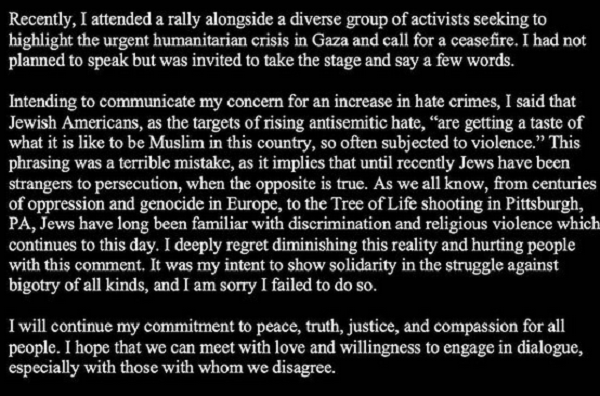
Last month, actress Susan Sarandon became a deserving casualty of the Hamas-Israel Ethics Train Wreck after she spoke at at a pro-Palestinian rally and said that American Jews feeling threatened by the pro-Hamas protesters, demonstrators and rioters (like the Cornell students who had to hide in their dorms)were “getting a taste of what it feels like to be a Muslim in this country, so often subjected to violence.” This epically stupid comment got her dropped by United Talent Agency, whose management is Jewish. As I noted here, “the agency concluded, probably accurately, that Sarandon’s comments diminished her value to them, and perhaps having a pro-terrorism client might deter more rational artists from seeking their aid.”
Apparently Sarandon, who has progressed through her romantic lead stage into and out of her mother role stage and now is getting grandmother parts isn’t quite ready to hang up her acting spurs, and decided that she had made a potential career-ending mistake that needed fixing. So she has now issued this apology:
Your first Ethics Alarms Ethics Quiz of December is…
Is her apology sincere, trustworthy, and sufficient?
I could easily make this an Unethical Quote of the Month post too.
I had fondly hoped that I had written my last sentence about the disgusting blight on the republic that calls himself “George Santos,” but no: I just read the ethics-free, Machiavellian, “the ends justify the mean” protest by The Federalist titled, “George Santos’ Expulsion Is Further Proof The GOP Is A Potemkin Political Party.” One of the supposed media flagships of conservative thought has announced that if the Republican Party really cared about conservative principles, it would happily allow a dishonest, untrustworthy, and stunningly dumb Congressman elected under false pretenses remain in Congress under their banner, because they need him to “tackle” the “aforementioned”crises plaguing the country.”
It is a disgusting, indefensible, unethical position, demonstrating that the Democratic Party’s ethics rot has spread. Consider these excerpts:





 Ethics Alarms