“The Meat Axe”

I had some amusing bloody meat-axe graphics all ready to go for this post, but it is really about flat learning curves: the Democratic Party’s, the Axis news media’s, and maybe, frighteningly, the public’s.

Yes, once again we have a looming test of just how stupid the public really is. Democrats are betting their very existence on the public being as dumb as a box of Joe Bidens, and the biased, anti-Trump news media, having already been completely exposed as the enemies of the people Donald Trump said they are, have predominantly fallen back to the same tactics that served them so well in Trump 1.0. The unethical “advocacy journalists” are gambling that propaganda will prevail, and that the 2024 election was just a blip because the Democrats ran a babbling fool—but a historic one!—for President.

Trump’s tsunami of executive orders along with the relentless DOGE assault has the Axis searching for a magic bullet or two. They settled on two old unethical stand-bys: ad hominem attacks, aka. “kill the messenger,” and “It’s a constitutional crisis!” Trump being elected at all was a constitutional crisis for the Angry Left, and the phony “He’s breaching traditional democratic norms!” trope was core to both impeachments and the “Trump is Hitler” campaign refrain.

Elon Musk is being vilified by using classic Democrat class warfare tactics: he’s been successful and is rich, so obviously he’s only helping Trump cut spending because he greedy and he’ll make money from it somehow. How dumb does someone have to be to buy that logic? If there is anyone in the world who can be trusted not to be serving his country for the money, it’s Musk. I heard some mouth-foaming contributor on CNN screaming this morning that “Trump is a liar and criminal” and “Musk wasn’t even born here!,” an odd argument from a defender of illegal immigrants.

But the EA “Flat Learning Curve” graphic is up there because I heard Chuck Schumer—is he really an idiot or does he just play one on TV?—say that sure, everyone agrees that there is too much waste in government spending, but “this is a meat-axe!” Yup, it sure is, Chuck, and if you don’t know by now that the only way to seriously address systemic corruption, waste, incompetence, dishonesty and obstruction is with a meat-axe (or blow-torch, or metaphorical nuclear bomb), you’ve never successfully managed anything.

Experienced managers know this, and both Musk and Trump are experienced managers as well as successful ones. Good leaders know it too. Heck, I know it.

What Schumer is really saying is, “We don’t want to solve this problem, we want to look like we want to solve this problem, and we are confident that you out there listening are so uneducated, inexperienced, naive and gullible that you’ll fall for it…again.”

When a system is broken, corrupt and incorrigible, and because of its dysfunction causing constant harm, the technique of carefully trying to extract the jewels buried in the shit pile never works. It takes too long. Every inch of the shit will have advocates claiming that it isn’t really shit. Paring down the bureaucracy gets delegated to the bureaucracy, and improvement is minimal if you are lucky. Most of the time, the inefficiency, waste and corruption just gets worse. Nobody can deny that this is the futile path the United States government has been treading.

Continue reading

Guest Post: ‘We’ve Been Trying To Reach You About Your Car’s Extended Warranty…’

by WallPhone

[From your host: This is an epic post about something I know absolutely nothing about, except that I received the calls and marketing materials Wall Phone is writing about—JM]

***

“Well, not that. Actually, I have been trying to reach you about the Telephone Consumer Protection Act, TCPA for short. If you’re reading this, someone connected to your company, someone who cares about your company, and someone who cares about their career and livelihood, has been told that your company is violating at least one provision of this Federal law.

“If you don’t listen to them, it would be prudent of them to begin looking for another job. They shouldn’t want to go down with your ship. If they need to maintain some kind of licensure, they also don’t want to lose their credentials for whatever wrongdoing was going on that got them in contact with the person who gave them this webpage.

Have you ever wondered why those auto warranty calls stopped? It’s because the government has fined the people connected to that advertising campaign more than six and a half million dollars. The fine came with a lifetime ban on any form of telemarketing. What would happen to your company if this kind of fine and ban were to be imposed on you?

“But we don’t make outgoing calls, let alone robocalls!”

And yet you have appeared to have done so. What you thought was a prospective customer told you about this page because they want you to stop harassing them.

“But our company is not harassing them!”

And yet you have appeared to be doing so. And worse, much worse, you appear to have been doing this for years.

“Years?”

Yes.

“But we only recently adopted this marketing partner/strategy!”

And you had better stop. Yesterday. Hopefully your contract has some sort of an enforceable indemnification clause that MIGHT protect you, but it probably won’t. If your marketing agreement does have such a clause, its actual purpose is to pacify any possible reservations at the signing stage of your marketing agreement with them, not the actual true purpose of these contractual things–to avoid the creation of moral hazard.

“Moral hazard” is explained below if you’re not familiar with that term. It’s high time you were.

The reason this indemnification clause on your contract won’t help you is the telemarketing company will be gone when the time comes that you’ll need it. They are betting that by the time it takes for you to figure out that you need to use indemnification, it will be too late. This page is here to help you figure it out sooner, help you recover as much as possible, and make their scam less profitable.

You need to—as soon as possible!—FIRST ask your bank how many of the past payments you made to your marketing partner that you can reverse, THEN ask the marketing partner for refunds. If you think you handling this business with them politely will work, then you have already lost. They will transfer all funds out of their accounts. They will disappear. You’ll lose more than if you IMMEDIATELY reverse as many payments as you can, because they’re not operating in good faith and they’re not intending to refund anything.

You are the victim of a scam. Victim of a crime. It’s literally an organized crime syndicate you are dealing with and they hav done this before, perhaps dozens of times before. They’re counting on you being polite and patient so they have time to disappear, whitewash a new business name on their operations, then start over. They don’t care that they destroyed your agency or business, they have thousands of other prospects they can milk this scam on. They have been doing this for years.

“But why do you want to help my company?”

Continue reading

Death of a Baseball Ethics Hero: Fay Vincent (1938-2025)

Fay Vincent, the last real Commissioner of Baseball, has died and attention should be paid.

The post of Commissioner of Baseball was created in the wake of the 1919 Black Sox scandal, with baseball’s future in doubt after the revelation that key members of the Chicago White Sox had accepted money from gamblers to throw the World Series to the vastly inferior Cincinnati Reds of the National League. The desperate owners turned to an austere judge, the wonderfully named Kenesaw Mountain Landis, who accepted the job provided that he had absolute power to act in “the best interests of the game.”

Landis ruled with an iron hand and baseball’s perpetually corrupt, greedy and none-too-bright owners backed off while he was in power, from 1920 until his death in 1944. Landis, in the harsh light of hindsight, is now vilified for not figuring out that keeping blacks out of the Major Leagues wasn’t in the best interests of baseball (or blacks, or sports, or democracy, or society, or the nation), but he proved a tough act to follow nonetheless.

Most of his successors were mere figureheads or knuckleheads, notable more for their non-decisions and bad ones than their actions in the “best interests of baseball.” Ford Frick, one of the longest serving Commissioners, is best known for his foolish insistence that Roger Maris didn’t really break Babe Ruth’s season homer record, a controversy decisively ended in the American League three years ago by Aaron Judge. Baseball collected weenies and fools in the role because the owners wanted it that way.

There were a couple of exceptions. Peter Ueberroth made the game infinitely more profitable and considerably more popular by modernizing its brandingm merchandising, promotion and marketing. Bart Giamatti , following in the fading footsteps of Judge Landis, courageously refused to issue The King’s Pass to Pete Rose, one of the most popular former players in the game, and banned him for gambling. But when Giamatti died suddenly from a heart attack after less than a year as Commissioner, he was succeeded by Fay Vincent, in a sequence a bit like when the Vice-President takes over when a POTUS dies. He had been deputy commissioner under his good friend Giamatti, and the owners of the major league teams confirmed him without qualms as the next Commissioner . They thought he was one of them: a corporate veteran and lawyer who had served in top executive roles for Columbia Pictures and Coca-Cola before Giamatti recruited Vincent as his right-hand man.

Vincent, however, was not what the owners wanted or expected. He was intelligent, courageous, far-sighted, and worst of all, as a passionate baseball fan, he took his job description seriously and literally. He didn’t work for the owners, though they could fire him. His stakeholders were fans and the game itself. Vincent’s vision for the job was reminiscent of the difficult ethical conflict accountants face: businesses hire them and pay their salaries, but their duty is to the public.

Continue reading

A Nelson For Disney and “Snow White”

“The Nelson,” the Ethics Alarms designation for very special episodes of swell-earned schadenfreude, was introduced in 2023 in a post about…Disney’s live-action reboot of “Snow White and the Seven Dwarfs,” the 1937 animated film that began building the Disney entertainment empire. Thus it is nicely symmetrical for Nelson to give his trademark “Ha ha!” to the trailer of this slow-motion disaster, which has set what is believed to be a YouTube record with, as of yesterday, 40,383 “likes” and 1,012,299 “dislikes.” The film is hitting theaters in March. Ethics Alarms warned Disney about what was bound to happen if and when this botched project ever got out of the cutting room. I wrote in part,

The ethics value defied here is competence, and what we are seeing is the classic sunk costs fallacy in its classic form. The Vietnam War was the most painful example of this breach of life competence and common sense, which holds that devoting a lot of time and/or resources to a failed project argues for devoting more of the same, lest those “sunk costs” go to waste. In reality however, what is being missed is that fact that whether or not one has invested a great deal in a lost cause, its status as a project that has proven itself unworthy of investment is unaltered. Doing what Disney is doing with the “Snow White” project is called “throwing good money after bad.” It is bad business—incompetent, wasteful, and irresponsible.

First, Disney woke fanatics thought it made sense to cast a Snow White-of-Color, which makes no sense since the story makes such a big deal about how “fair” the heroine is. Then, because a single au courant little person actor complained about the dwarfs in the classic fairy tail, Disney eliminated them in favor of these dorks…

Continue reading

Ethics Verdict: Stanford Law Prof. Mark Lemley and Law Firm Lex Lumina Are Unethical

…and their conduct in the Facebook matter is damaging to the profession of the law.

Intellectual property expert Mark Lemley, a professor at Stanford Law School and a partner at law firm Lex Lumina, represented Facebook in the copyright case brought on behalf of creators claiming the platform infringed their intellectual property. Yesterday he “fired” his client, despite believing that Meta’s case was strong. His stated reason was that he is outraged at Mark Zuckerberg and Meta’s “descent into toxic masculinity and Neo-Nazi madness.” His law firm then proceeded to back him up.

Here is Lemley’s Facebook post announcing his decision:

Meanwhile, the managing partner of his woke law firm followed with the statement that “Money can’t buy everyone. We’re proud to be a firm that doesn’t sell out our values. Sadly, it seems this is becoming a rarer and rarer quality in America today.” Another partner said, “When we started Lex Lumina, one of the things we committed to was only taking cases we felt good about, on the law and in terms of who we represented. Proud to be working with my friend and partner, Mark Lemley, who lived out our commitment today.”

This is labeling unethical lawyer conduct as ethical.

Lemley went on to post a reiteration of his decision on LinkedIn. It wasn’t “the right call.” If Lemley and his firm had refused to represent Meta in the case of Kadrey v. Meta Platforms initially, there would be no ethics foul: nothing in the Rules of Professional Conduct mandates that any lawyer accept any client, although the traditional ethos of the profession strongly encourages lawyers to do so. However, dropping a client because of what that client has done or said that has nothing to do with the case of the representation, while not a strict rules violation, is unprofessional and creates a dangerous slippery slope…one that many in the legal profession have been leaping down in recent years.

Noteworthy is the fact that Lemley is no legal ethics expert. His actions demonstrate that vividly, and his post is a flashing sign stating, “I am biased, Trump Deranged, a Democrat, and believe in good censorship.” Got it, Professor.

Naturally, the woke legal hacks at Above the Law love this, and ratioanalizes it with an argument that has been rife since the corrupted legal profession started behaving like the restaurants who won’t serve people wearing MAGA caps. Joe Patrice, the head ideologue at Above the Law writes,

A sanctimonious segment of the legal profession harps on the idea that “everyone is entitled an attorney.” Except no one is entitled to you as an attorney. Frankly, no one is entitled to anything in a civil case and to the extent society needs to extend more protections to indigent clients on the wrong end of life-altering civil actions — landlord-tenant cases for instance — there’s definitely no such entitlement for a multibillion-dollar company in a copyright dispute.

Representing a client is a business decision. Some lawyers thrive as counsel of last resort and model their business around the willingness to represent unpopular clients. Other lawyers build their business on crusading for good causes. A whole lot of lawyers exist somewhere between those poles. In fact, a lot of deep-pocketed clients also don’t want to work with firms associated with unpopular causes — that’s a business decision too.

There’s nothing wrong with any of these approaches. Lawyers should feel free to build their practice however they want.

What is wrong with that argument is that it violates Kant’s Rule of Universality, the “What if everybody did it” test that is part of the philosopher’s categorical imperative. Patrice’s standard, and accepting Lemley’s conduct, would mean that certain citizens and organizations could be left without legal representation entirely because they were regarded by a politicized legal profession (and an ethically addled public) as “bad.” While it is accurate to assert that the Sixth Amendment does not guarantee a citizen legal representation in a civil (as opposed to a criminal) case, the legal professional has long embraced the principle that the same ethical and practical justifications should apply. If we accept Patrice’s ethically ignorant (or deliberately misleading) argument that whether to accept a representation is purely a business decision, that allows lawyers and firms to avoid unpopular clients, leaving them potentially at the mercy of the polls and bias in a rigged legal system.

This is what the actions of Lemley and his firm are pointing to. It is the reason Donald Trump has had difficulty hiring lawyers and getting competent legal assistance. Firms and lawyers get threatened by clients, and in the constant tug-of-war between the profession of law and the business of law, business now prevails. Once, before the progressive bias in laws schools and among lawyers became the status quo, the mission of representing unpopular causes and clients, even when the attorneys for these clients personally disagreed with and even deplored their conduct was seen as part of the legal profession’s mission. Wall Street lawyers represented accused terrorists after the bombings of 9/11 after public figures called for their firms to be boycotted. When Coca-Cola virtually extorted their law firm into dropping its representation of the House Committee defending the Defense of Marriage Act before the Supreme Court, the partner handling the case, Paul Clement, wrote in his letter of resignation in protest of the decision, that “defending unpopular positions is what lawyers do.” Similarly defending unpopular clients is what lawyers must do and be honored for, or we have no longer have an equitable legal system.

The unethical principle Lemley is advocating is worse than opposing taking on an unpopular position: he seeks to justify abandoning a position he feels is valid because his client’s policies no longer please him. I have vowed to promote this section of the Rules of Professional Conduct because it is such a crucial one for maintaining the integrity of the profession and trust in its members:

“A lawyer’s representation of a client, including representation by appointment, does not constitute an endorsement of the client’s political, economic, social or moral views or activities.”

It should be obvious that if it becomes acceptable for lawyers and firms to refuse representations because they fear being regarded as endorsing a clients’ “political, economic, social or moral views or activities,” the legal profession will have nullified that critical standard in practice, and the public will be correct to assume that if a lawyer or firm represents an unpopular cause or individual, those lawyers agree with and endorse them. This is what ideologues like Joe Patrice want, a legal system as polarized as the political system, where one can tell the “good” lawyers from the “bad” lawyers by whom they choose to represent.

Dropping a client one has already accepted, which is what Lemley has done, is worse still. In his letter excoriating his former firm, Clement quoted Griffin Bell, a judge and former U.S. Attorney General, declaring that once a lawyer has accepted a case, it is the lawyer’s duty and ethical obligation to continue the representation. In 2011, when the DOMA controversy erupted, Clement’s position was almost unanimously praised within the profession. Theodore Olson, the late conservative attorney, praised Clement’s “abilities, integrity, and professionalism”.” Olson, who like Clement was a solicitor general during the George W. Bush administration and was a successful Supreme Court advocate, told the media, “I think it’s important for lawyers to be willing to represent unpopular and controversial clients and causes, and that when Paul agreed to do that, he was acting in the best tradition of the legal profession.” Seth Waxman, who served as solicitor general during the Bill Clinton administration, said, “I think it’s important for lawyers on the other side of the political divide from Paul, who’s a very fine lawyer, to reaffirm what Paul wrote. Paul is entirely correct that our adversary system depends on vigorous advocates being willing to take on even very unpopular positions.” In approving Clement’s stand, The Washingtonian observed, “There are countless examples of law firms taking on and standing by controversial clients, even at the risk of their public images.” There are fewer and fewer examples now, however. This is the dystopian legal landscape that Lemley and his firm are promoting, and it is an unethical one.

Continue reading

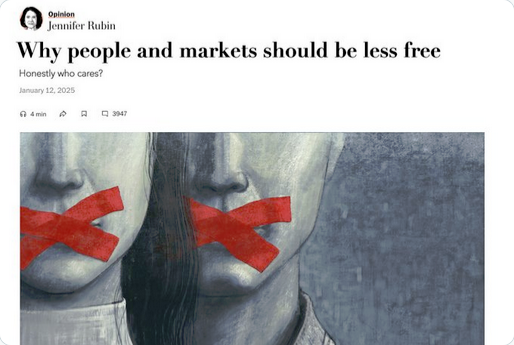
(Psst! Washington Post! Your Previous Motto Was Hypocritical, But Your New One Just Admits That You Lie!)

I’m pondering whether to stop subscribing to the Washington Post digital version. I only do it for Ethics Alarms, and even then I am only moved to check the site every ten days or so. Now the once-essential newspaper is falling apart in chunks, and whether it can be saved—or should be— is very much in doubt.

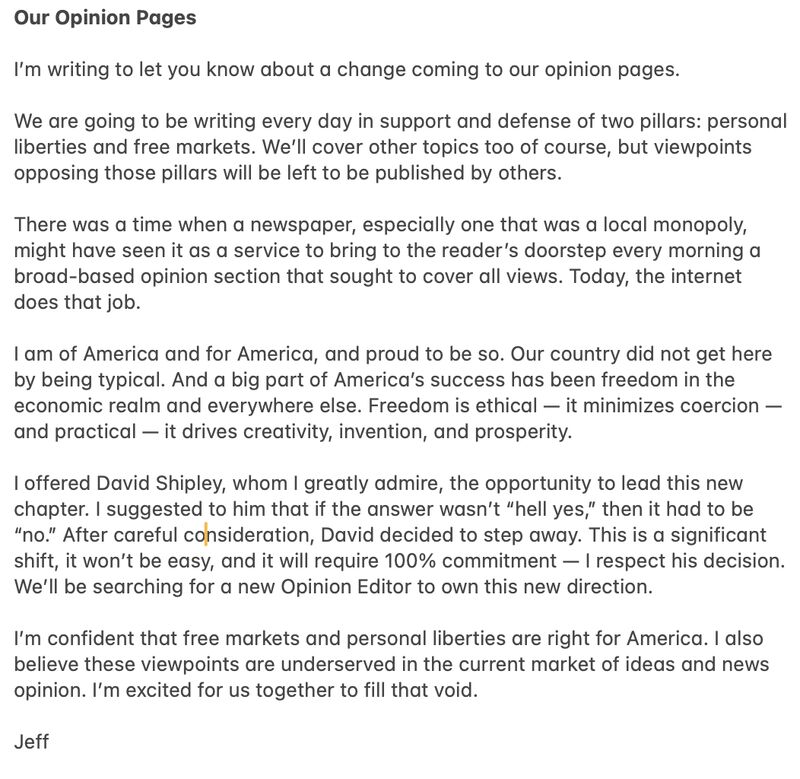
Jeff Bezos is trying to do a Elon Musk imitation, saving the icon by making it less flagrantly biased and such a shameless progressive and Democratic propaganda engine. The problem is that when all of a paper’s subscribers, or most of them, are Trump-Deranged, pro-totalitarian leftists who want their news media to be a tool of a single party and the government if that party has it by the throat, making a sudden commitment to objectivity, fairness and ethical journalism will not be welcome.

Continue reading

And As Long As We Are Talking About Doing The Right Things For (Perhaps) the Wrong Reasons: Zuckerberg and Meta

Mark Zuckerberg, the Facebook founder and its alter-ego Meta’s chief executive, announced that his flagship social media platform, along with Instagram and Threads, will end its longstanding (and biased, and flawed) fact-checking program, moving instead to a “community notes” system like the one employed by Elon Musk’s reinvention of Twitter.

Good. What took so long?

“It’s time to get back to our roots around free expression,” Zuckerberg said. The company’s current fact-checking system had “reached a point where it’s just too many mistakes and too much censorship.” “The reality is that this is a trade-off,” he said. “It means that we’re going to catch less bad stuff, but we’ll also reduce the number of innocent people’s posts and accounts that we accidentally take down.”

In truth, anyone should have been able to figure out that Facebook’s “fact checkers” were progressive, dishonest, partisan hacks. The censors included Snopes (EA dossier here) and PolitiFact (even worse dossier here), which Ethics Alarms, among many others, had marked as biased and untrustworthy years ago, indeed well before Facebook turned to them as censors. The truth is that one person’s “bad stuff” is another’s stimulating opinion or analysis. This shouldn’t be a difficult concept, but in the Age of the Great Stupid, it is. The 21st Century Left likes censorship, indeed has relied on it to hold power, and has embraced the practice on college campuses, social media, and in the news. Sad but true.

Continue reading

From the Res Ipsa Loquitur Files: Ford’s Anti-Israel Tweets

Some questions present themselves, such as,

How much trust should we place in the management of a company that can’t staff and oversee its social media accounts better than this?

Is mere firing sufficient punishment for an employee who would post those? Such an egregious level of betrayal of an employer should carry a lifetime brand, like the scarlet letter.

What could someone guilty of such conduct do to redeem himself?

Ford’s headquarters are in Detroit, an area with a large Arab-American population with strong pro-Palestinian and anti-Israel sentiments. You would think that this incident would be sufficiently predictable that special care would be taken to avoid it. Clearly, that didn’t happen. The incident is also magnified because of the ugly legacy of the company’s anti-Semitic founder, Henry Ford, who among other things promoted the notorious “Protocols of the Elders of Zion.”

Henry’s company’s apology was about as inept as one would expect from one that allowed this to occur: “Our X account was briefly compromised and the previous three posts were not authorized or posted by Ford,” a spokesperson said. “We are investigating the issue, and apologize for any confusion caused.”

Ford apologizes for the “confusion”?

Ethics Dunce: ESPN (Disney)

The College Football Playoff quarterfinal at the Allstate Sugar Bowl between the University of Georgia Bulldogs and Notre Dame, postponed from New Year’s Day to yesterday afternoon because of the deadly terrorist attack on Bourbon Street began with a solemn rendition of the National Anthem, a moment of silence, and a defiant crowd chant of “USA! None of this was deemed worthy of broadcasting by the main platform for the event on cable, ESPN. After all, they had ads to sell.

ESPN cut to a commercial break as the moment of silence began, and deliberately—don’t buy the narrative that it was inadvertent—chose not to let the national audience see the emotional prelude to the game including the “U.S.A!” eruption from the crowd. Disney and ESPN are so blinded by their institutional wokeness that they couldn’t recognize that the pre-game ceremonies had cultural and societal significance.

Continue reading

Ethics Hero: Me, Dammit!

I’m not happy about this, but there it is.

Back in October I wrote this post about how the boobs at Safeway managed to give me over $300 in food for my wife’s memorial event without charging me for it. I ruefully observed that as an ethicist I was obligated to go to the store and pay what I owed them despite the fact that the Safewayers were none the wiser: it was a classic example of “ethics is what you do when nobody’s watching.”

Continue reading