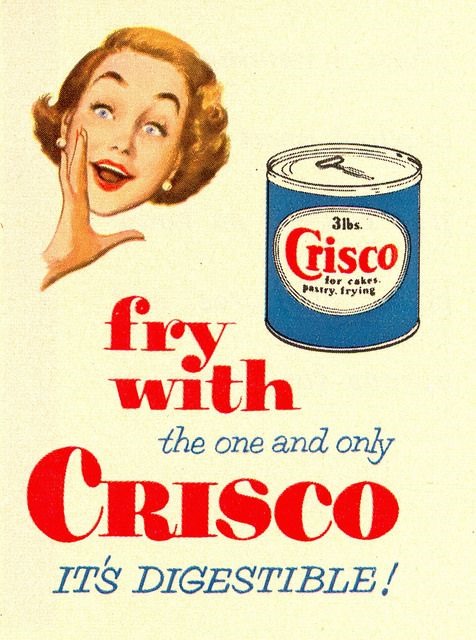
From The “I Did Not Know That!” Files: The History of Crisco

A British personal trainer and fitness coach named Sama Hoole posted this on “X”:

1866: Cotton seeds are agricultural waste. After extracting cotton fiber, farmers are left with millions of tons of seeds containing oil that’s toxic to humans. Gossypol, a natural pesticide in cotton, makes the oil inedible. The seeds are fed to cattle in small amounts or simply discarded.

1900: Procter & Gamble is making candles and soap. They need cheap fats. Animal fats work but they’re expensive. Cotton seed oil is abundant and nearly worthless. If they could somehow make it edible, they’d have unlimited cheap raw material. The process they develop is brutal. Extract the oil using chemical solvents. Heat to extreme temperatures to neutralise gossypol. Hydrogenate with pressurised hydrogen gas to make it solid at room temperature. Deodorise chemically to remove the rancid smell. Bleach to remove the grey color. The result: Crisco. Crystallised cottonseed oil.

Industrial textile waste transformed through chemical processing into something white and solid that looks like lard. They patent it in 1907, launch commercially in 1911. Now they have a problem. Nobody wants to eat industrial waste that’s been chemically treated. Your grandmother cooks with lard and butter like humans have for thousands of years. Crisco needs to convince her that her traditional fats are deadly and this hydrogenated cotton-seed paste is better. The marketing campaign is genius. They distribute free cookbooks with recipes specifically designed for Crisco. They sponsor cooking demonstrations. They target Jewish communities advertising Crisco as kosher: neither meat nor dairy. They run magazine adverts suggesting that modern, scientific families use Crisco while backwards rural people use lard.

But the real coup happens in 1948. The American Heart Association has $1,700 in their budget. They’re a tiny organisation. Procter & Gamble donates $1.7 million. Suddenly the AHA has funding, influence, and a major corporate sponsor who manufactures vegetable oil.

1961: The AHA issues their first dietary guidelines. Avoid saturated fat from animals. Replace it with vegetable oils. Recommended oils: Crisco, Wesson, and other seed oils. The conflict is blatant. The organization issuing health advice is funded by the company that profits when people follow that advice. Nobody seems troubled by this. Newspapers report the guidelines as objective science. Doctors repeat them to patients. Government agencies adopt them into policy. Industrial cotton-seed oil, chemically extracted and hydrogenated, becomes “heart-healthy” while butter becomes “artery-clogging poison.”

1980s: Researchers discover that trans fats, created by hydrogenation, directly cause heart disease. They raise LDL, lower HDL, promote inflammation, and increase heart attack risk more than any other dietary fat. Crisco, as originally formulated, is catastrophically unhealthy. This takes 70 years to officially acknowledge. Procter & Gamble’s response: Quietly reformulate without admission of error. Remove hydrogenation, keep selling seed oils, never acknowledge that their “heart-healthy” product spent seven decades actively causing the disease it claimed to prevent. Modern seed oils remain. Soybean, canola, corn, safflower oils everywhere. Same chemical extraction process. Same high-temperature refining. Same oxidation problems. Just without hydrogenation so trans fats stay below regulatory thresholds. These oils oxidise rapidly when heated. They integrate into cell membranes where they create inflammatory signalling for months or years. They’re rich in omega-6 fatty acids that promote inflammation. They’ve never existed in human diets at current consumption levels. But they’re cheap. Profitable. And the food industry has spent a century convincing everyone they’re healthy. The alternative, admitting that industrial textile waste shouldn’t have been turned into food, would require acknowledging the last 110 years of dietary advice was fundamentally corrupted from the start. Your great-grandmother cooked with lard because that’s what humans used for millennia. Then Procter & Gamble needed to sell soap alternatives and accidentally created the largest dietary change in human history.

We traded animal fats that built civilisations for factory waste that causes disease. The soap company won. Your health lost.

I have no idea if this is all true, partially true, a matter of dispute, or complete fantasy. But I bet RFK Jr. likes it. The story, which certainly has the ring of truth, also raises the issue of trusting science and experts, especially when business interests and money are involved.

My personal favorite use of Crisco was when people would mix it with food coloring and sugar and call it “frosting.”

Ethics Quote of the Week, Self-Delusion Division: Jeff Stein, Washington Post’s Chief Economics Correspondent

“This is a tragic day for American journalism, the city of Washington and the country as a whole. I’m grieving for reporters I love and whose work upheld the truest and most noble callings of the profession.They are being punished for mistakes they did not cause.”

—-Jeff Stein, The Post’s chief economics correspondent, bemoaning the lay-offs today of some 300 Washington Post journalists

Who does Stein think he’s kidding? Or is he completely oblivious to his own paper’s abandonment of fair, honest and objective journalism that is a major, if not the only reason for the Washington Post’s demise?

Stein was quoted in the New York Times’ gloating report of today’s metaphorical massacre. It wrote in part,

“The Washington Post carried out a widespread round of layoffs on Wednesday that decimated the organization’s sports, local news and international coverage.

The company laid off about 30 percent of all its employees, according to two people with knowledge of the decision. That includes people on the business side and more than 300 of the roughly 800 journalists in the newsroom, the people said.

The cuts are a sign that Jeff Bezos, who became one of the world’s richest people by selling things on the internet, has not yet figured out how to build and maintain a profitable publication on the internet. The paper expanded during the first eight years of his ownership, but the company has sputtered more recently.”

The Washington Post figured out too late that the country only needed one all-Democrat-all-the-time biased paper, and that the New York Times was better at its biased reporting and pandering to its bubble than the Post anyway.

The Post could have survived, I believe, by becoming a national paper that strove for even-handedness and objectivity, leaving the Frustrated Right to the Wall Street Journal and the Angry Left to the Times. USA Today had failed miserably at filling that niche (Have you read that rag lately? Weekly Reader used to be more informative!). The opportunity was there once, but many years ago. Instead, the Post continued to inflict flagrant Axis hacks on its dwindling non-woke readers, propaganda agents like E.J. Dionne, Richard Cohen, Dana Milbank, Phillip Bump, Kathleen Parker, Eugene Robinson, Jonathan Capehart and more. Since the local readership was about 95% Democrat, hey, why bother being fair or non-partisan?

Well, people like me and my wife constituted one reason. The Post is my local paper, but we got so sick of its spin and bias, particularly its efforts to sanitize Bill Clinton’s corruption and lies during Monicagate, that we paid three times what the Post cost to have the New York Times delivered every morning. I confess that I was influenced in my decision by the suffering of my professional theater company, which deliberately eschewed the navel-gazing woke dramas that were slobbered over by the Post’s theater critics and was repeatedly slammed and snubbed by the paper’s critics for it.

I remember one of the few times the Post’s chief critic deigned to attend an American Century Theater revival (they were virtually all revivals) of Gore Vidal’s satirical political thriller, “The Best Man.” She actually wrote that Vidal’s script was dated and unbelievable, because a Presidential candidate would never lose an election because of character issues, that only his policies mattered. This was, of course, while the Post was licking Bill Clinton’s metaphorical boots.

I Wonder How Often This Happens and In How Many Places…

Kanye West Issues a Level #1 Apology…Or Maybe Not

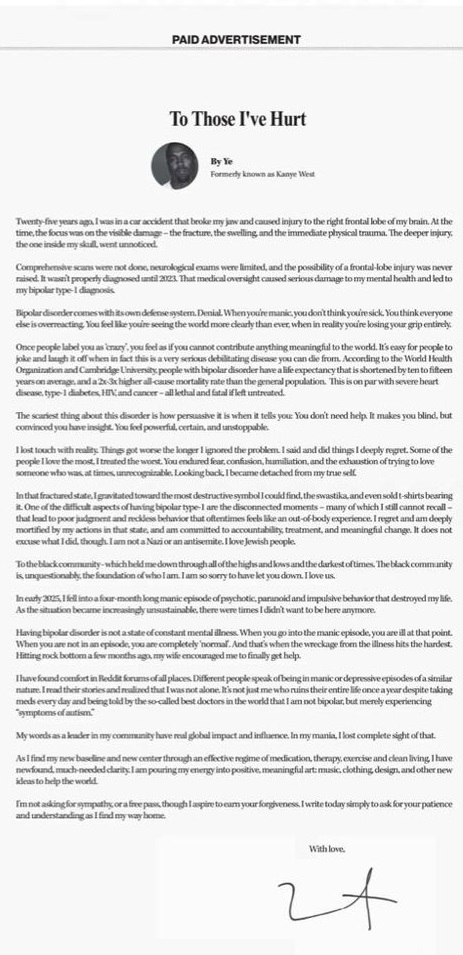
That’s the full page ad that “Ye,” aka. Kanye West, paid to have placed in, of all papers, the Wall Street Journal. I wonder what percentage of WSJ readers even know who the hell he is? Never mind; he did it. Here’s what the ad says (I hesitate to put down “he wrote’):

“Twenty-five years ago, I was in a car accident that broke my jaw and caused injury to the frontal lobe of my brain. At the time, the focus was on the visible damage – the fracture, the swelling, and the immediate physical trauma. The deeper injury, the one inside my skull, went unnoticed….”

It wasn’t properly diagnosed until 2023. That medical oversight caused serious damage to my mental health and led to my bipolar type-1 diagnosis. Bipolar disorder comes with its own defense system. Denial. When you’re manic, you don’t think you’re sick. You think everyone else is overreacting. You feel like you’re seeing the world more clearly than ever, when in reality you’re losing your grip entirely.

Once people label you as crazy, you feel as if you cannot contribute anything meaningful to the world. It’s easy for people to joke and laugh it off when in fact this is a very serious debilitating disease you live from….

The scariest thing about this disorder is how persuasive it is when it tells you: You don’t need help. It makes you blind, but convinced you have insight. You feel powerful, certain, and unstoppable. 

I lost touch with reality. Things got worse the longer I ignored the problem. I said and did things I deeply regret. Some of the people I love the most, I treated the worst. You endured fear, confusion, humiliation, and the exhaustion of trying to love someone who was, at times, unrecognizable. Looking back, I became detached from my true self. 

In that fractured state, I gravitated toward the most destructive symbol I could find: the swastika, and even sold t-shirts bearing it. One of the difficult aspects of having bipolar type 1 are the disconnected moments – many of which I still cannot recall that lead to poor judgment and reckless behavior that oftentimes feels like an out-of-body experience. I regret and am deeply mortified by my actions in that state, and am committed to accountability, treatment, and meaningful change. It does not excuse what I did, though. I am not a Nazi or an antisemite. I love Jewish people. 

To the black community – which held me down through all of the highs and lows and some of my darkest times. The black community is, unquestionably, the foundation of who I am. I am so sorry to have let you down. I love us. 

In early 2025, I fell into a four-month long manic episode of psychotic, paranoid and impulsive behavior that destroyed my life. As the situation became increasingly unsustainable, there were times I didn’t want to be here anymore. 

Having bipolar disorder is not a state of constant mental illness. When you go into the manic episode, you are ill at that point. When you are not in an episode, you are completely “normal.” And that’s when the wreckage from the illness hits the hardest. Hitting rock bottom a few months ago, my wife encouraged me to finally get help. 

I have found comfort in Reddit forums of all places. Different people speak of being in manic or depressive episodes of a similar nature. I read their stories and realized that I was not alone. It’s not just me who run [sic] their entire life once a year despite taking meds every day and being told by the so-called best doctors in the world that I am not bipolar, but merely experiencing “symptoms of autism.” 

My words as a leader in my community have real global impact and influence. In my mania, I lost complete sight of that. 

As I find my new baseline and new center through an effective regime of medication, therapy, exercise and clean living, I have newfound, much-needed clarity. I am pouring my energy into positive, meaningful art: music, clothing, design, and other new ideas to help the world. 

I’m not asking for sympathy, or a free pass, though I aspire to earn your forgiveness. I write today simply to ask for your patience and understanding as I find my way home.”

It’s time to check the old, Ethics Alarms Apology Scale to see where this whatever it is fits.

According to the scale, this is the hierarchy of apologies, their function and their motivation, from most admirable to the least credible:

How Paul Anka Proved Harry Truman Right…

I am not a big fan of Paul Anka or his work, so I considered the new documentary on his career a default choice this morning since ice is on my satellite dish and the channel selection on Direct TV was severely limited. But it’s true: you learn something new and useful almost every day, and often in the least expected places.

I did not know, for example, that Anka wrote “Johnny’s Theme,” the now iconic music that Johnny Carson walked onto the stage to at the start of his version of “The Tonight Show.” But it’s how it ended up as Carson’s entrance music that hammers home an ethics lesson.

When Johnny Carson was preparing to take over from Jack Paar as the host of “The Tonight Show” in October 1962, he ran into Anka, whom he had worked with in a TV special. Carson mentioned to Anka that they needed a new theme, so the pop star composer of “Put Your Head on My Shoulder,” “Puppy Love” and the theme to “The Longest Day” repurposed the instrumental arrangement for “It’s Really Love,” a song recorded by his one-time girlfriend Annette Funicello (not one of Annette’s hits) and sent a demo to Carson.

Johnny phoned Paul and thanked him for the offer (and said he and Ed McMahon loved the tune) but said that “Tonight Show” bandleader Skitch Henderson had “his nose out of joint” (does any one use that phrase any more?) because Carson wanted to use a melody written by a “20-year-old kid.”

So Anka suggested that Johnny Carson write new lyrics to his song and that they call it “Johnny’s theme,” which would then be the composition of the “20-year-old kid” and Henderson’s boss. Brilliant! Henderson had to consent to the song’s use every night, and it was Johnny’s walk on music for 30 years until Carson handed over the show to Jay Leno.

Carson’s name on the song meant that he got half the royalties, which averaged $400,000 per year: Carson’s cut was $200,000 a year for lyrics that were never heard or sung. “Johnny’s Theme” had been played more than 1,400,000 times by the end of the Carson’s show’s run. Anka says that Carson admitted he was embarrassed to make all that money for nothing, but the singer shrugs and smiles about it. Johnny got a great theme, and they both made money.

My favorite Harry Truman quote, perhaps my favorite ethics quote by any President and right up there with Winston Churchill’s immortal, “Success consists of going from failure to failure without loss of enthusiasm,” is:

“It is amazing what you can accomplish if you do not care who gets the credit.”

I don’t know if Paul Anka was familiar with the quote or even if he knows about it yet, but his solution to the “Tonight Show” dilemma is as good an example of Harry’s wisdom in practice as we are likely to see.

[Still waiting for WordPress, or someone, to tell me how to get page breaks in posts under their new %$^&#@ block system…]

From Maryland, A “When Ethics Fails, The Law Steps In” Verdict

I recently re-watched “Runaway Jury,” the ethically and legally repugnant film adaptation of a John Grisham legal thriller. It’s one of the most unethical movies extant, and before the last couple of years I would have said such egregious lawyer conduct as depicted in the film was unlikely to the point of impossible (as in most of Grisham’s books). The novel and movie involved a high-profile civil suit: the widow of a man murdered when a fired employee “goes postal” seeks to hold the manufacturer of the gun used by the killer liable for millions in damages. A pair of anti-gun zealots conspire to both rig the jury verdict and ruin the evil jury consultant (Gene Hackman) who helped defeat their home town in a similar case years before. In the end the “good guys” win (that is, Hollywood’s idea of “good”); I have mentioned the film before in the context irresponsible films and TV shows that actively misinform the public about a lawyer’s ethical responsibilities. Now comes a jury verdict from Maryland where a jury delivered a multi-million dollar verdict against Walmart for allowing an employee to buy a shotgun before he used it to blow his head off.

Continue reading

Air Travel Ethics: “The Bowl of Sadness”

A United Airlines first class passenger posted the photo above of his sumptuous repast on a United flight, saying,

“Hey United, is this a joke? I just flew 5+ hours in First Class and this bowl of sadness is what you serve me for dinner. Between the 3D-printed mystery meat, the cafeteria cheese cubes, and the whole tomato I need a chainsaw to cut, this is genuinely unbelievable.”

No, it’s not unbelievable. I’m old enough that I remember when coach class seating included something approaching real meals on long flights, but those days are long gone. United always was near the bottom of the barrel as far as customer service went, but now that the airlines realize that nothing else matters to flyers as much as the ticket price and the schedule, none of them even try to make flights pleasant any more, because there is nothing in it for them.

Sure, it would be ethical for an airline to decide that it was going to make flying less of a miserable ordeal, but these companies literally don’t care about your comfort. And what’s your alternative? A train? A blimp? Flap your arms real hard?

They don’t have to care, so they don’t. And thus passengers end up with “bowls of sadness.”

Wait: Why Is Uber Hiring Drivers Who Can’t Speak English?

Admit it, now: when you learned that Kiefer Sutherland had been arrested, you thought, as I did, “Ah HA! I always suspected that guy wasn’t acting when he played those evil characters in “Stand By Me,” “A Time to Kill,” “The Lost Boys”and “Eye for an Eye.” He didn’t fool me by playing good guys and heroes since “24”!”

Today the reports are that the actor threatened to kill an Uber driver. He had ordered an Uber Black (What the hell is an “Uber Black”? Is Uber like Johnny Walker now?) after having dinner with a friend, or so law enforcement sources told TMZ. When the late Donald Sutherland’s son asked the driver to pull over and let him out, the driver wouldn’t, and after the third request, Sutherland threatened to kill him if he didn’t do as he asked. The driver phoned 911 for assistance, and requested a translator when the police showed up. The police then requested a Russian or Armenian-speaking translator.

What the hell?

Continue reading

Yup, Mayor Mamdani Is a Deluded Utopian and This Will Not End Well For New York

At all.

Ethics Alarms has repeatedly pointed out that it is unethical to waste time, passion and civic debate on nice, hopeful, idealistic policy objectives that are literally impossible. The anthem for these positions, again as I have noted ad nauseam, is my least favorite John Lennon song, “Imagine.” Yes, I regard anyone who takes that tripe seriously as mentally-challenged and historically, economically and politically illiterate. The official political ideology of these misty-eyed utopians is, of course, Communism.

Utopians, which include at the lower levels of delusion progressives generally, persist in the belief that human nature isn’t an immutable constant and that certain principles of reality can somehow be wished away if we all close our eyes and hope hard enough. Thus we keep hearing that there shouldn’t be wars, violence, hunger—President Franklin Roosevelt, in his cynical, pandering “Four Freedoms” speech, actually said that there should be freedom from “want.” Riiiight, Franklin, like that’s going to happen.

New Yorkers, in their infinite ignorance, elected utopian (and communist) Zohran Mamdani as their mayor. The charismatic demagogue ran on all sorts of claims that various things should be achievable by government without his having any experience whatsoever in making and executing policy. Yesterday, the New York Times reports, Zohran engaged in a signature significance example of irresponsible wishcraft, handing out vouchers for free tickets to a theater festival featuring experimental works. “The shared laughter in a crowded theater, the eager debrief after a musical, the heavy silence that hangs over all of us in a drama — these are moments that every New Yorker deserves,” Mamdani said.

Got it. Everyone deserves live theater, see, so there. It costs too much, though, so “POOF!” let’s make it cheaper.

Continue reading

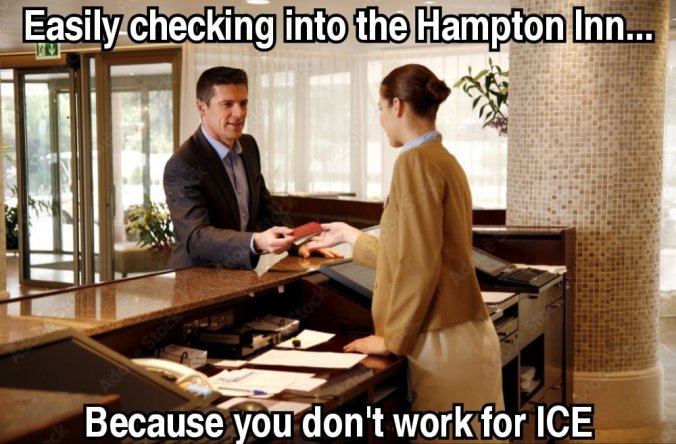
Ethics Observations on the Hampton Inn I.C.E. Freeze-Out In Minnesota

Surely you have heard about this craziness (and ethics breach) by now; it was mentioned in the comments to this EA post yesterday. A post on the official Homeland Security X account revealed that reservations made at the Hampton Inn in Lakeville Minneapolis, a suburb about 25 miles south of Minneapolis, by I.C.E. officers had been cancelled with a message suggesting that they were not welcome at the hotel chain. The DHS post included a copy of the email with the sender and recipient redacted; indeed, it stated the property would not host immigration agents.

In an abundance of caution, I decided to wait to determine “What’s going on here?” What was going on here is that a bunch of rogue woke morons decided to grandstand in anti-Trump, pro-illegal immigrant, pro-Somali immigrant scoundrels Minnesota, where they think up is down, black is white, War is Peace and unethical is ethical.

Continue reading