The Other Branch’s Persistant And Hypocritical Corruption

I subscribe to the Times, but I stopped routinely reading all of the editorials, op-eds and letters to the editor once I realized the stultifying and depressing sameness of it all: narrow viewpoints, deranged columnists, and ugly bias, day after day. This Christmas Eve-day dawned with my wife in a panic, the tree decorations still incomplete, and a recognition that I was going to have to get Ethics Alarms posts done in the midst of other tasks so the 30 or so readers likely to tune in here today wouldn’t be disappointed. I grabbed the wrong section of yesterday’s Times during a tree-breather, and had to consume the editorial section.

For once, the main editorial was not an anti-Trump screed.

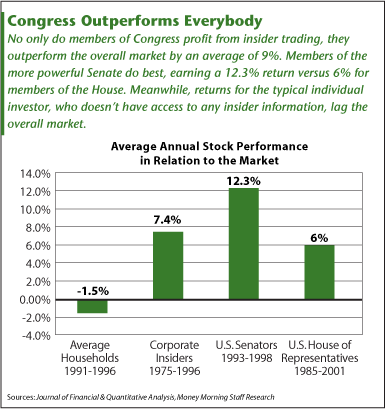
Appropo of the Democratic candidates’ mantra of corruption (though the editors somehow never saw the connection), it was about the persistent insider trading and conflicts of interest that have made Senators and Representatives unethically rich for ages, and that surpass in genuine corruption anything President Trump has been accused of.  (Ethics Alarms covered the issue here, and here.) The Times editors began with the saga of former Rep. Chris Collins, who had to resign his office and also went to jail for breaking the insider trading laws. His crime was tipping off his son about a stock likely to go bad based on his early notice of pending legislation, The Times found it convenient to use Collins, a Republican, as the stand-in for all of Congress, but everything he did before crossing the line of the law is, if not routine, disturbingly common among Democrats and Republicans alike:

[H]e served on various congressional committees that played a role in directing federal health care policy. Mr. Collins was the company’s largest shareholder. He served on the company’s board. He solicited investments in the company, including from other members of Congress. (Tom Price, who served as a Republican representative from Georgia and then as secretary of health and human services in the Trump administration, was among the buyers.) Mr. Collins wrote legislative language to expedite drug trials, potentially benefiting Innate, and he pressed a staff member at the National Institutes of Health to meet with the company about its clinical trial.He also invested in other health care firms, some of which held federal contracts.

Continue reading

Sunday Before Christmas Ethics Ornaments, 12/22/19: Googling Ethics, “Cats,” Goldman Sachs, De Niro, Trump Derangement

Here’s hoping that the the next three days rescue the Spirit of Christmas…

…because the last few weeks have been a downer, man.

1. Googling ethics:  Phillip Galanes, at Social Q’s was consulted by a woman who had bad vibes about her girlfriend’s new love, so she googled him, and found out, as she suspected, that he had some serious red flags in his past. She told her friend, who had discovered the bad news herself, but who was hurt and angry that the inquirer did a background check on her boyfriend. “Was I wrong?” she asked. In his answer, Gallanes implies that she was, although “everybody does it.” I’d like a nice, succinct, substantive explanation of by what ethical theory it can ever be wrong to access publicly available information about anyone. This isn’t an issue of privacy, because the information isn’t private. There was nothing wrong with the inquirer’s motives, because she was concerned about her friend.

I’d call this the Ick Factor at work. It seems unethical because the fact that anyone can check our lives out online is creepy. The research itself, however, is ethically neutral. The ethics comes in with how the information is used.

2. I guess I have to mention “Cats”…since it is getting the most spectacular negative and cruel reviews since “Showgirls,” and maybe before that. “Exorcist II, The Heretic” perhaps. Oddly, the usually hyper-critical New York Times is not one of the worst defilers, but here was what the reviewer really found objectionable :

“It’s too bad that no one seems to have thought through the semiotics of Victoria’s chalky white cat face, given that Hayward is of mixed race and that the heavy is Idris Elba’s predatory Macavity. Elba seems to be having a fine time, but come on!”

Ah! The old “mixed-race actress in whiteface being menaced by a black actor playing a cat” racist imagery!

I can’t wait for them to write down these rules. Continue reading

In The Baseball Dead Of Winter, An Old And Unresolved Ethics Problem Glows Bright

From left to right: MLB, players, and the union.

…as Major League Baseball ignores it, as usual.

Ethics alarms test: Scott Boras, lawyer and player agent, represents two Washington Nationals free agents in their prime. One is Stephen Strasburg, one of the best and most sought after starting pitchers in the game. He was seeking, on the advice of his agent, a long-term contract of more than 30 million dollars a year. Another is Anthony Rendon, third-baseman, and the Nationals’ best player in 2019, their championship year. He also is seeking a salary of at least 30 million per year, over many years. He is a fan favorite in Washington, D.C., and obviously enjoys playing there. Contrary to popular belief, however, Major League baseball teams do not have endless supplies of money, though they have a lot. Mike Rizzo, Washington Nationals general manager, told the sports media and Washington fans that the team could not afford to sign both Strasberg and Rendon at the rates they were demanding and the marketplace dictated.

Is there a problem, and if so, what is it?

You shouldn’t need much time to answer, but then again, thousands of baseball sportswriters and the entire baseball establishment havn’t figured this out over many years, do I’ll give you a “Jeopardy!” period of reflection:

OK, contestants,what’s your answer? Continue reading

Comment Of The Day: “From ‘The Ethicist’: Revealing The Real Bigots Among Us”

A.M. Golden asks, in his Comment of the Day, “When did Americans start thinking that destroying someone and/or that person’s livelihood is acceptable behavior when it comes to a difference in opinion?” It is an issue also raised in the previous COTD, considering the mall Santa fired after someone complained about his Facebook post showing him as the Jolly Old Elf, but wearing a red MAGA cap. A.M. understands that this is not an idle question, but an important one that raises vital concerns about the erosion of core American values, the public’s belief in our founding documents, and the acceptance of the ethical standard of reciprocity.

Here is A.M.’s Comment of the Day on the post, “From The Ethicist: Revealing The Real Bigots Among Us.”

When did Americans start thinking that destroying someone and/or that person’s livelihood is acceptable behavior when it comes to a difference in opinion?

This goes far beyond boycotts to allow blacks to sit at the front of the bus or at lunch counters. This goes well beyond punishing companies for dangerous or illegal practices that have harmed customers. It goes against the heart of what it means to be an American. Too often, we are told that opinions have consequences. Sure, they do. They always have. Doesn’t it seem, though, that the consequences have become far more ominous than they used to be?

I have never understood ideological boycotts. I remember the Disney boycotts of the ’90s when people with too much time on their hands began seeing obscene Easter Eggs in the new animated films. When gays started congregating at Disney parks on certain days, the company was castigated for not warning people ahead of time that it was Gay Day, despite its protests that Disney had no sponsored days for any groups at its parks.

I thought the whole thing was silly then and it’s still silly.

While in college, I worked at a McDonald’s restaurant. One day, sitting in church, a woman pressed a news article into my hands that reported on health benefits being extended to same-sex partners at McDonald’s corporate offices (I didn’t have health benefits myself at the store where I worked).

I gave her a funny look as if to say, “What am I supposed to do with this?”. She whispered, “Well, you WORK there!” Continue reading

Cancel Culture Ethics: Two Gaffes, Two Polls

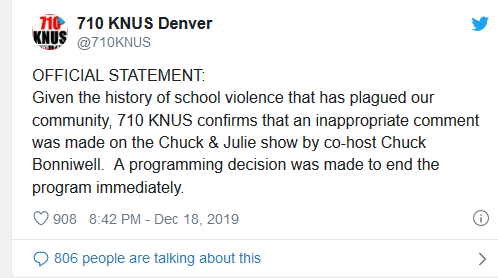
Chuck Bonniwell and Julie Hayden, a husband and wife team, co-hosted the “Chuck and Julie “show  on KNUS AM TalkRadio in Denver. Riffing about the impeachment this week, Bonniwell said,  “All right, here, a little after 1:30, talking about the never-ending impeachment of Donald Trump. Then he added, chuckling, ” You know, you wish for a nice school shooting to interrupt the impeachment news….”  Julie quickly jumped in, saying, “No! No! Don’t even — don’t even say tha!. No, don’t even say that! Don’t call us. Chuck didn’t say that!”Still laughing,  Bonniwell tried a save, finishing his handing sentence with “in which no one would be hurt.”

Jason Salzman of the Colorado Times Recorder, who said that after hearing Hayden’s plea for listeners not to call their complaints about her husband’s joke, he “called anyway.” Sandy Phillips, who lost her daughter in the Aurora theater shooting, posted on Twitter: “This guy should be fired. Total ignorance. Shootings hurt us all … just ask witnesses and first responders. You don’t have to be shot to be wounded.”

Bonniwell isued an apology the next evening after 24 hours of criticism on the “Chuck & Julie” Twitter feed, saying,  “I made an inappropriate comment meant as a joke. I’m sorry it was not received that way.”  Too late. KNUS fired Chuck and Julie later that evening:

Was this a fair decision?

I’m not sure it was. As I have held here on other occasions, those who take extemporaneously for a living, especially when they are expected to be amusing, are constantly walking a high wire. Occasional gaffes, including moments when certain metaphorical landmines are tread-upon or lines are crossed, are inevitable, and the more creative and bold the talent, the more likely such events are. A no-tolerance policy is unreasonable, and it is virtually always the ethical approach to treat the first such error with a warning or punishment short of dismissal. Virtually, because there may always be single gaffes that are so terrible and potentially destructive to the talent’s employer that firing is the only response.

Thus the question here is whether Chuck Bonniwell’s comment falls in the latter category. My view si that it does not: Continue reading

Ethics Round-Up, 12/18/2019: The Day Before An Invasive Procedure Edition [UPDATED]

Yuck.

Even the satisfaction of knowing that the President reads Ethics Alarms, or at least thinks like I do…wait, that came out wrong. Anyway, today I expect to be uncomfortable, hungry and distracted, so who knows what might appear here today?

You were warned.

1. The Ethics Quote of the Day comes from ex-Marine and TV talk show host Montel Williams (who was very nice to me when I was on his show), on the “scandal” of some cadets flashing the dreaded “OK” sign during the Army-Navy Game:


“Both West Point and Annapolis are investigating, and it strikes me as defamatory that some in the media have branded these young people as racists without a shred of evidence. I understand that a handful of racists (perhaps living in their parents’ basements) attempted to co-opt the ‘OK’ sign as a symbol of white power … but that is not evidence that these kids were motivated by racial animus. We owe these young people, who had the courage to sign up to be part of the 1% who defend this democracy, better than this,”

I would say that we owe them better than even investigating such trivia. A ambiguous gestures are ambiguous, and no student, in a military academy or anywhere else  should have to defend or explain them. The students are entitled to the benefit of the doubt.  As with the “It’s OK to be White,” flyers, the rational, responsible approach by administrators is to ignore them, rather than to make a scandal out of nothing.

When will we see the first “It’s OK to make the OK sign” flyers? Heck, I may put some up myself…

2. Nah, there’s no progressive “war on Christmas,’ and there’s no mainstream media bias, either. And CNN’s Brian Stelter isn’t the most incompetent and absurd “media critic” since the term was coined! Imagine: Stelter asked on Twitter,

“Justice Neil Gorsuch is on “Fox & Friends” right now. The Q: How is it appropriate for a Supreme Court justice to try to goose sales of his three-month-old book by chatting on one of the most partisan shows on TV?”

More “Q’s”: Would it be appropriate for Gorsuch to chat on another network, like, say, CNN? Would “wtachdog” Stelter bitch about that? What does the level of partisanship of a show have to do with whether a Supreme Court Justice should appear there? Is there any rule or precedent holding that it is unethical for a sitting Justice to promote a book? (I’ll answer that one: no.)

Stelter’s whining wasn’t close to the most contrived objection to Gorsuch’s visit to the Fox and Friends couch, though. This was: Continue reading

Comment Of The Day: “Ethics Quiz: Santa In A MAGA Cap”

The issue of whether a mall should have fired a long-time Santa who posed for gag photo in a MAGA cap inevitably invited comparisons with the Naked Teacher Principle, which holds “that a secondary school teacher or administrator (or other role model for  children) who allows pictures of himself or herself to be widely publicized, as on the web, showing the teacher naked or engaging in sexually provocative poses, cannot complain when he or she is dismissed by the school as a result.” There are many variations of the NTP, including the recently visited Naked Congresswoman Principle, which cost Rep. Katie Hill her seat.

The question: Is there, or should there be a “President Trump-supporting Santa Claus Principle?

Here is Alizia’s Comment of the Day on the post, “Ethics Quiz: Santa In A MAGA Cap”

“I think this one might fall into The Naked Teacher Principle.”

I think I can understand why you would say that, but I think there are a few problems with that assessment. I will try to explain:

First, a school teacher who engages in sexual misconduct, is transgressing in a limited area. Our social norms — though this is changing of course — does not allow teachers of children to appear to be loose sexually. Long ago, and more especially for women who were teachers — and mostly women were teachers — it was part of cultural norms that a teacher have a ‘chaste appearance’.

But in a sense there is no issue of ‘speech’ involved when and if a teacher posts a naked photo. That is, there is no ‘speech content’ or political opinion expressed. If there is a ‘speech’ issue it is only of a vary limited sort.

The Santa who had his photo taken with a Trump hat should never have had to apologize to anyone. He was completely free to take such a photo of himself. There is no possible argument that could be brought out in a so-called free society that could successfully take the man’s right away. Continue reading

Afternoon Ethics Notes, 12/17/2019: Miller, Hillary and the Duke [CORRECTED]

Hark!

1. Lesson: Don’t underestimate the Duke! It looks like John Wayne is stronger than the cancel culture after all.  Earlier this year the Woke Avengers tracked down an old Playboy interview where the actor made some inflammatory remarks about blacks and Native Americans (I thought then and I think now that the Duke was deliberately trolling his liberal critics, but it was still a bad interview.) Predictions were rife that the most enduring, influential and popular screen icon of all time had reached the end of his run. It doesn’t appear so: at least two cable channels are running John Wayne film marathons on or around Christmas.

2. The ethical response: feel compassion for Hillary. There are people who get run over and squashed by life, their own failings, and bad luck. We don’t have to like all of them, but the Golden Rule argues that we should feel some pity and compassion for them, even though many have brought some of their misery on themselves.

I think about this when I see, for example, Marcia Clark, the losing prosecutor in the O.J. Simpson case, and her desperately tucked and altered face as she transitioned into a B-media personality. The earliest example of this syndrome that I can remember noticing was perennial Republican Presidential candidate Harold Stassen, with his dazed expression and bad toupee, who once thought he was going to be President. Dubbed the “Boy Wonder,” Stassen was only 41 when he seemed to be on his way to winning the Republican nomination for President for the 1948 election in which President Harry Truman was widely regarded as both a lame and dead duck. Stassen lost the convention battle, however, to Thomas Dewey, of subsequent “Dewey Defeats Truman!” fame. After that, Stassen ran for President in 1952, 1964, 1968, 1980, 1984, 1988, and 1992 , gradually becoming a laughing stock. (He also ran unsucessfully for Governor of Minnesota,  the United States Senate twice, Governor of Pennsylvania twice, Mayor of Philadelphia once; and U.S. Representative). I just thought he was a buffoon until my father told me about his many accomplishments before his dreams were crushed. He was one of the founders of the United Nations, for example.

As I made pretty clear in 2016, when I wrote almost as many critical posts about her and her generally awful ethics as I did about our current President when he was a candidate, I am not a fan of Hillary Clinton. I’ve continued to write critical commentary about her, because she continues to operate with wildly malfunctioning ethics alarms. She is stuck now, in Kübler-Ross terms, in the first three stages of grief: denial, pain and guilt, and anger and bargaining because she lost the election she was certain she was going to win. (So is the entire Democratic Party.)

Now look at her:

3. Marvin Miller makes it into the Hall of Fame. Yecchh. Marvin Miller was described in his obituary as “an economist and labor leader who became one of the most important figures in baseball history by building the major league players union into a force that revolutionized the game and ultimately transformed all of professional sports.” I have no quarrel with any of that. Miller was a labor activist who did his job extremely well. I would put him into a labor leader’s Hall of Fame—-I’m sure one would get at least a hundred or so visitors a year—without blinking. He no more belongs in the the Baseball Hall of Fame in Cooperstown, NY than I do, but he was posthumously elected to that Hall of Fame last week.
Continue reading

Movie Flop Ethics, Part II: “Black Christmas” And The Politicization Of Everything

In Part I, I said I was glad that Clint Eastwood’s latest film “Richard Jewell” was bombing, because the film impugns the integrity of a now-deceased reporter simply to spice up its story. After I read some of Clint’s comments yesterday in response to the controversy, I’m even more glad. Clint said that nobody knows how reporter Kathy Scruggs got a crucial leak from the FBI, but that it could have occurred because she traded sex for information. That’s despicable.

Nevertheless, the other dud among the Hollywood releases over the weekend, “Black Christmas,” deserved to flop even more than Eastwood’s epic.

The original “Black Christmas” (1974) was released under the name “Silent Night, Evil Night.” I saw it with my sister a few days after its opening (I was amused at the ad’s catchline, “If this movie doesn’t make your skin crawl, IT’S ON TOO TIGHT!!!”) and it scared the bejesus out of both of us, but especially her: she slept with the light on for weeks, and to this day my uncanny imitations of the maniac’s phone calls upset her (so I keep doing them, of course.)

Arriving before John Carpenter’s “Halloween” and its later, cheesier rip-off “Friday the 13th,” what was soon re-titled “Black Christmas” anticipated many of the themes and techniques of the slasher genre, perhaps too well. Blessed with a much better cast than any subsequent movie of the type (Olivia Hussey, Keir Dullea, Andrea Martin, John Saxon, and Margot Kidder) and clever and gutsy director Bob Clark (“A Christmas Story,” “Porky’s”), the film was declared too disturbing by many critics. I thought it was easily the best horror movie I had ever seen, and recommended it to many friends, some of whom were not grateful after spending the following night jumping at every sound. It was very gratifying to see “Black Christmas” finally emerge as a cult film and the acknowledged inspiration for the slasher film genre (along with “Psycho,” of course.)

I saw the 2006 “sequel,” which was terrible, and had a sense of dread when I learned that Hollywood would try again. It was clear that the new film was already off to an unethical start when I saw the trailer: this was another example of producers hijacking a familiar title while making a movie barely connected to the older film it was evoking. That trick, essentially a bait and switch, always ticks me off. In the trailer for the new film, we could see that the killer wears a black robe and uses a longbow. Clark’s original famously never shows the maniac murderer at all: much of the movie is shot from his perspective (I assume it’s a he), though we see his shadow, one mad eye, and his arm at various times. We also hear him, and a more crazy-sounding killer has never been recorded.

The new “Black Christmas” takes place in a sorority house around Christmas, and there’s someone knocking off the girls. That’s about the extent of the similarity. To be fair, the advent of cell phones ruined the original film’s most iconic scare: it was the first movie in which we heard the chilling words, “The phone calls are coming from inside the house!”

The promotion of more female film directors is a feminist cause right now. There’s even a Christmas commercial where a little girl tells her parents who have just bought Disney princess toys  to put under the tree for her, “I don’t want to be a princess any more. I want to be a film director!” I have always championed female directors for the stage; there is no question that there are multiple biases against them in theater, and I assume the same bias afflicts them in Hollywood. However, I do not want to see more female directors because they bring a special, feminine perspective to their work, and I really don’t want to see more female directors so they can use their plays and films as feminist propaganda vehicles. Just make a good movie, kid: if your work only stands for the proposition that women can’t just make entertaining and effective films, but have to clobber the audience with feminist tropes, you will have created a legitimate reason for the industry to be wary of female directors. Continue reading

Final ‘Week Before Christmas’ Ethics Shopping, 12/16/2019: Joy, Obama, And JPMorgan

Inspiring Christmas lyrics of the week:

Oh, the world is your snowball, see how it grows
That’s how it goes, whenever it snows
The world is your snowball just for a song
Get out and roll it along

1. That this kind of thing could happen at a major bank in 2019 is inexplicable and disgusting. Jimmy Kennedy, a nine-year NFL veteran,  earned $13 million during his nine-year career and had been told that he would be accepted as a “private client” at JPMorgan Chase, an elite designation with perks like travel discounts, exclusive event invitations and better deals on loans. When he went to  his local JPMorgan branch in Arizona to determine why he had not been accepted into the cataegory, he was told by his representative, who is black, “You’re bigger than the average person, period. And you’re also an African-American. We’re in Arizona. I don’t have to tell you about what the demographics are in Arizona. They don’t see people like you a lot.”

Kennedy recorded the conversation, and after pulling most of his money out of JPMorgan,  complained to the bank as well as an industry watchdog agency. The bank sent him a letter saying, “You stated that Mr. Belton informed you that our firm was prejudiced against you and intimidated by you because of your race. We found no evidence to substantiate your allegations.”

He also sent the recording to the New York Times, which wrote about Kennedy’s experience. A few days later, Jamie Dimon, the chairman and chief executive of JPMorgan Chase, sent a memo telling employees that such behavior “does not reflect who we are as a company and how we serve our clients and communities every day.”

That’s the Pazuzu Excuse: “It wasn’t me!” Sorry, chief, but if you have employees treating African Americans like Kennedy was treated, that is who you are as a company, and as CEO, you’re responsible. Continue reading